
What Is Forestry Mulching? A Quick Answer for Property Owners
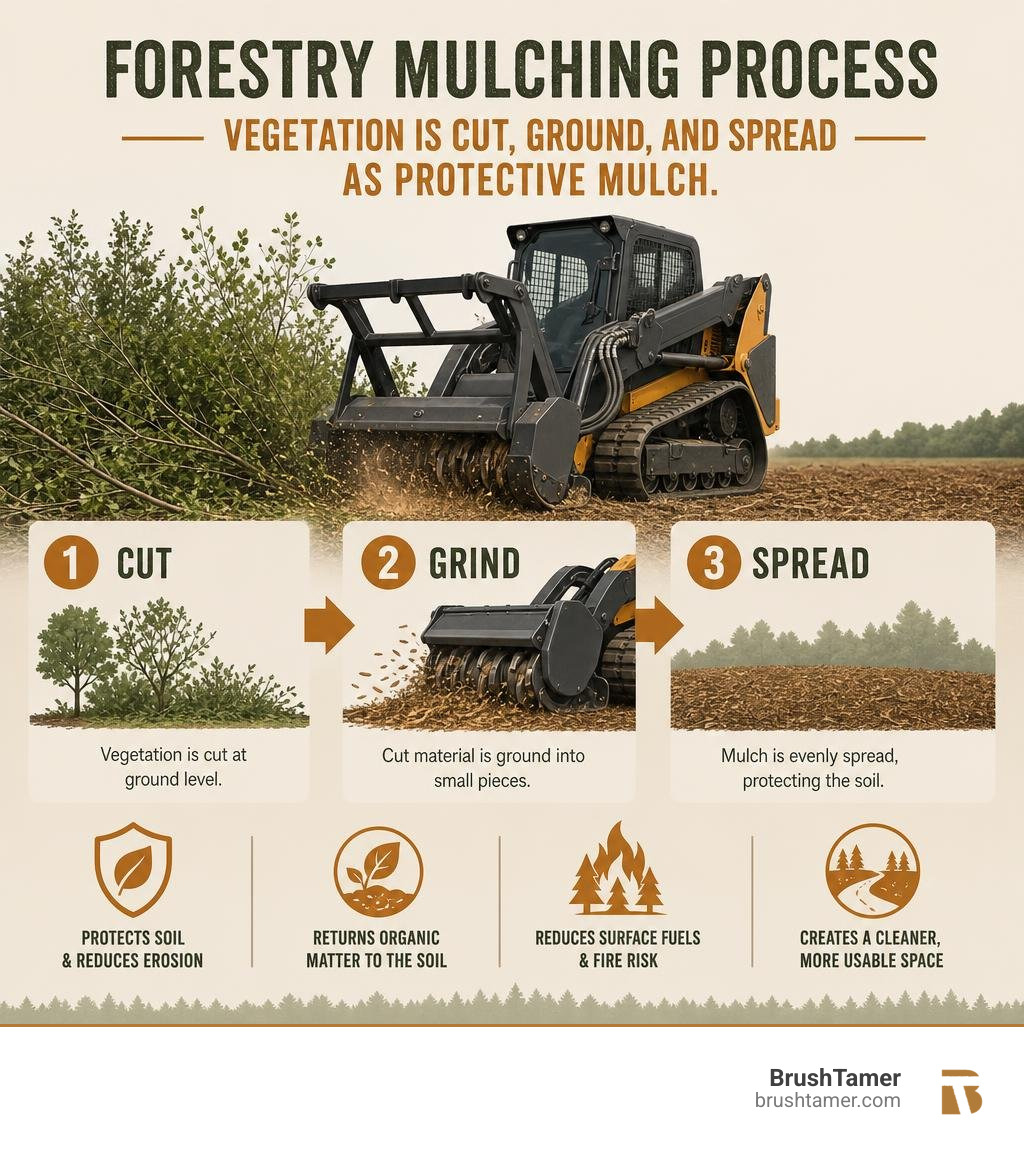
What is forestry mulching? It is a land-clearing method that uses specialized machinery to grind brush, small trees, invasive plants, and woody debris into mulch directly on site. Instead of hauling vegetation away or creating large burn piles, the equipment leaves behind a uniform protective layer of organic mulch that enriches the soil and curbs erosion.
For property owners asking what is forestry mulching best used for, it is a practical way to turn overgrown acreage across Northern Indiana and Lower Michigan into accessible, usable ground. The remaining organic blanket stabilizes topsoil, suppresses weeds, retains moisture, and protects healthy root structures of desirable trees. It provides a direct solution for clearing overgrown parcels, maintaining access corridors, reducing wildfire fuels, and establishing wildlife habitats.
While highly versatile, forestry mulching is optimized for selective land clearing rather than mass site excavation. Properties with large pine stumps, deep rock, or saturated ground may require a different site preparation plan.
I am Leon Miller, founder and operator of BrushTamer. Established in 2021 in Plymouth, Indiana, BrushTamer provides expert land clearing, stump processing, and brush management tailored to regional soil conditions and environmental goals. Through hands-on site evaluation and experienced equipment operation, BrushTamer helps property owners understand what is forestry mulching and whether it fits their land goals.
Related forestry mulching resources:
What Is Forestry Mulching and How Does It Work?
Forestry mulching is an eco-friendly land clearing process using a specialized machine with a high-speed rotary drum to mechanically cut, shred, and grind standing vegetation into a rich mulch layer.
Unlike many traditional clearing approaches that involve separate cutting, hauling, or debris disposal, forestry mulching processes vegetation in place and leaves organic material on the ground. Engineered with rows of forged steel or carbide-tipped teeth, the mulching drum spins at 2,000 to 3,000 RPMs to shred saplings, dense vines, and tangled underbrush right where they stand. Our professional Forestry Mulching Services leave behind an even protective layer that anchors topsoil and preserves desirable root networks without disturbing subsurface earth.
What Is Forestry Mulching Equipment and Head Axis Differences?
Forestry mulching equipment typically combines a tracked carrier, tractor, skid steer, or excavator with a specialized mulching head selected for the terrain and vegetation type.
- Horizontal-Axis Rotary Drum Mulchers: Industry-standard horizontal drums spin parallel to the ground surface, delivering tremendous kinetic energy to process thick hardwood saplings, dense underbrush, and standing timber efficiently.
- Vertical-Axis Mulching Heads: Rotary disc mulchers operate perpendicular to the terrain, utilizing high rotational velocity to slice rapidly through light brush and thin saplings on open, flat sites in South Bend, IN, and Niles, MI.
- Carrier Machinery (Tracked Tractors, Skid Steers, and Excavators): Heavy-duty rubber-tracked carriers provide superior traction with low ground pressure over soft soil in Mishawaka, IN; compact skid steers navigate tight residential boundaries in Elkhart, IN; and excavator-mounted heads process steep ditch banks and hard-to-reach fence lines across St. Joseph, MI.
To explore detailed machinery capabilities and hydraulic specifications, review our complete technical guide on Forest Mulchers 101.
Tree Diameter, Stump Limits, and Vegetation Density Limits
Equipment operational capacity depends directly on hydraulic output (GPM and PSI), tooth design, machine horsepower, and wood density.
Under favorable field conditions, high-horsepower drum mulchers can process larger woody growth, while disc mulchers are generally better suited for lighter brush and smaller saplings. Commercial-grade mulching heads grind surface stumps up to 12 to 14 inches in diameter down flush with the surrounding ground grade. Production is typically fastest on open parcels with lighter vegetation, fewer obstacles, and stable ground conditions.
Primary Applications and Ecological Benefits
Forestry mulching serves as a primary tool for selective land management, right-of-way corridor maintenance, agricultural reclamation, and habitat restoration across Northern Indiana and Southern Michigan.
By mechanically converting unwanted brush and saplings into ground cover on site, property owners reduce debris handling, avoid burn piles, and limit site disruption. The resulting organic blanket protects bare dirt against rain impact, retains critical soil moisture, and suppresses secondary weed outbreaks. Properties in communities such as Granger, IN, and Kalamazoo, MI, experience immediate aesthetic and ecological improvements through this non-invasive mechanical clearing technique.
For additional strategic insights into professional land stewardship, explore our resources on Forestry and Wildlife Management and read about Eco-Friendly Land Clearing.
Invasive Plant Containment and Wildfire Risk Reduction
One of the most vital environmental applications of forestry mulching is controlling persistent invasive plant species while eliminating fire-propagating ladder fuels.
Aggressive invasives such as autumn olive, Japanese honeysuckle, common buckthorn, and multi-flora rose frequently overtake rural woodlots throughout Warsaw, IN, and Grand Rapids, MI. Rotary mower decks can scatter cut material outward, which may spread seeds or plant fragments if invasive vegetation is not managed carefully. Conversely, a heavy-duty horizontal forestry mulcher shreds vegetative matter directly downward inside an enclosed steel housing, pulverizing seeds and burying root collars beneath a heavy mulch blanket.
Furthermore, by grinding low-hanging limbs, thick undergrowth, and fallen woody debris, forestry mulching neutralizes ladder fuels—the vertical vegetation structures that allow localized brush fires to climb into mature tree canopies. To learn more about environmental land clearing practices, consult our detailed resource on Environmentally Friendly Land Clearing.
Utility Right-of-Way Clearing and Wildlife Management
Forestry mulching creates reliable, accessible paths for public utility lines while establishing productive edge habitats for native wildlife populations.
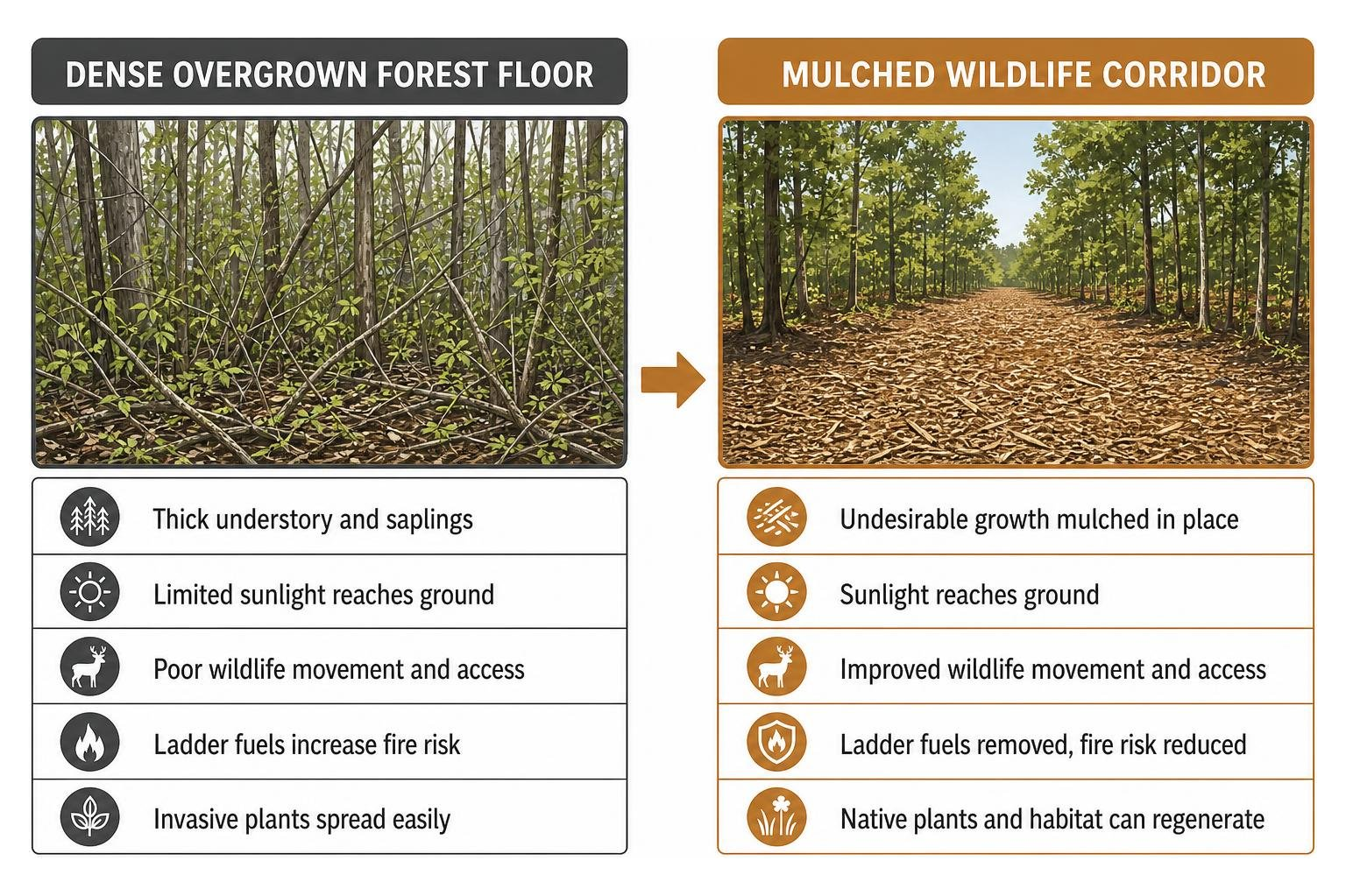
Utility providers and municipal public works crews employ high-production tracked mulchers to maintain clear right-of-way corridors along electric transmission lines, gas pipelines, and municipal roadways surrounding Fort Wayne, IN, and Battle Creek, MI. Selective clearing removes aggressive woody growth while leaving root structures undisturbed to anchor sloped soils and prevent ditch erosion.
For wildlife conservation, strategic mulching opens choked timber stands, allowing ambient sunlight to reach long-dormant seeds of native grasses, clover, and beneficial hardwoods. This mosaic forest structure creates crucial foraging paths, nesting sites, and edge cover for white-tailed deer, wild turkey, ring-necked pheasants, and songbirds. Review our comprehensive Vegetation Management Ultimate Guide to see how custom land programs support ecological health.
Advantages, Disadvantages, and Equipment Comparisons
Forestry mulching prioritizes selective clearing and topsoil conservation, offering a low-impact alternative to heavy land clearing methods across Goshen, IN, and Portage, MI.
Review our dedicated comparative analysis on Land Clearing vs Forestry Mulching for comprehensive project planning recommendations.
What Is Forestry Mulching Compared to Bulldozers and Brush Cutters?
Forestry mulching integrates cutting, shredding, and mulching into a single mechanical pass, whereas bulldozers scrape topsoil to uproot vegetation and agricultural brush mowers only manage lightweight grasses and weeds.
The table below compares forestry mulching, bulldozing, and rotary cutting across common land-clearing factors.
| Feature / Metric | Commercial Forestry Mulcher | Heavy Industrial Bulldozer | Agricultural Rotary Cutter |
|---|---|---|---|
| Primary Operation | Cuts and grinds standing growth in place | Uproots roots and pushes vegetation into piles | Mows light grasses, weeds, and thin sprouts |
| Topsoil Disturbance | Minimal; root networks remain in soil | Extreme; severe displacement and compaction | Minimal surface disturbance |
| Maximum Tree Handling | Up to 30 inches (horizontal drum unit) | Unlimited (can fell and push mature timber) | Typically 1 to 2 inches maximum |
| Debris Management | Converts growth into a 2–4″ mulch blanket | Requires burning, hauling, or off-site debris handling | Leaves scattered, whole stalks on ground |
| Erosion Risk | Minimal; mulch shields exposed soil | High; leaves bare soil vulnerable to washouts | Low to moderate |
| Soil Compaction | Low ground pressure (tracked units \~4.5 PSI) | Extreme ground pressure and deep ruts | Moderate wheel rutting on wet ground |
| Stump Processing | Grinds surface stumps flush to grade level | Pulls entire root ball, creating large holes | Cannot process woody stumps |
For a detailed overview of commercial clearing machinery performance, explore our Heavy Brush Removal Ultimate Guide.
When Forestry Mulching Is the Right Choice (and When It Is Not)
Forestry mulching is the ideal strategy when property owners wish to clear dense underbrush, restore overgrown pastures, create access trails, or selectively thin wooded lots without disturbing topsoil stability.

It is exceptionally effective for residential lot clearing in Valparaiso, IN, or St. Joseph, MI, where low ground-pressure machinery preserves root structures of remaining trees. However, forestry mulching is NOT recommended for:
- Heavy Surface Rock and Ledge Substrates: Dense subsurface rocks, granite boulders, and continuous ledge rapidly shatter carbide teeth, leading to excessive maintenance downtime.
- Commercial Building Footprints: Concrete foundations, roadbed construction, and structural slabs require complete root extraction using heavy excavators and bulldozers.
- Saturated Marshlands and Standing Water: Operating heavy machinery in deep mud or standing water causes machine miring and unacceptable soil rutting.
- Extensive Mature Pine Stump Fields: Fields with many mature pine stumps larger than 18 inches may require dedicated stump grinders or excavators for a more appropriate clearing approach.
Site Planning, Regulations, and Landowner Considerations
Executing a professional forestry mulching project requires evaluating physical property variables, local municipality permits, and legal property boundary lines across Indiana and Michigan.
Because terrain and vegetative growth vary significantly from dense timber stands in Mishawaka, IN, to thick hedge rows in Coldwater, MI, professional land clearing teams evaluate multiple site parameters during pre-job planning.
Before hiring a contractor, review our detailed guide on Questions to Ask Before Hiring Forestry Mulching Companies.
Site Factors That Shape Forestry Mulching Project Planning
Professional forestry mulching projects are planned around acreage, machine capability, vegetation density, terrain conditions, access needs, and project goals.
Landowners should consider these primary project-planning variables before scheduling forestry mulching work:
- Vegetation Density and Wood Hardness: Clearing dense, mature hardwood brush (such as oak, hickory, and hard maple) demands high hydraulic horsepower and lower track travel speeds than mulching softwood species, invasive autumn olive, or field weeds.
- Terrain Slope and Surface Conditions: Level, dry, open acreage allows continuous machine travel. Conversely, steep ravine banks, boggy swales, or tight property boundaries require specialized low-ground-pressure machinery operating at lower speeds.
- Equipment Size and Horsepower Class: High-production dedicated tracked carriers process material significantly faster than standard compact skid-steer attachments, reducing overall job site duration on large acreage.
- Stump and Tree Diameters: Parcels containing numerous trees approaching maximum 12-to-30-inch limits require controlled multi-pass grinding, which increases machine operating hours.
- Equipment Mobilization and Transport: Heavy carrier machinery may require commercial transport planning, access review, and permit coordination before work begins.
For a complete breakdown of commercial site development strategies, read our Land Clearing Services Complete Guide.
Local Regulations, Permits, and Property Setbacks
Prior to commencing mechanical land clearing operations, property owners must confirm compliance with local zoning laws, environmental protections, and municipal boundary codes.
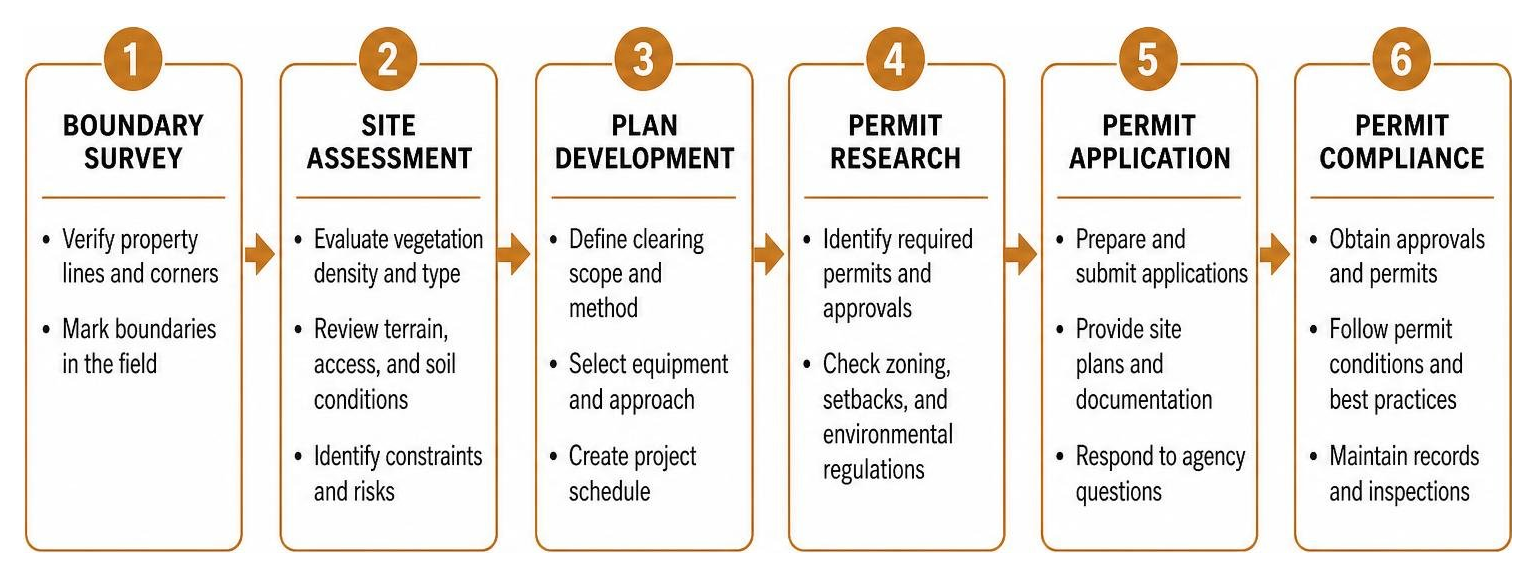
Key boundary and regulatory steps include:
- Property Boundary Verification: Always engage a licensed land surveyor or verify marked corner pins prior to mulching boundary lines in municipalities like Chesterton, IN, or Holland, MI. Clear markers prevent accidental encroachment onto adjacent land.
- FEMA Floodplain and Environmental Buffer Zones: Acreage located near natural rivers, lakes, or county drainage ditches may fall under state environmental guidelines (such as the Indiana Department of Natural Resources or the Michigan Department of Environment, Great Lakes, and Energy). Work inside designated wetland buffers requires specific state authorization.
- Municipal Tree Protection Ordinances: Certain suburban municipalities in areas like Naperville, IL, or South Bend, IN, enforce local tree preservation codes that regulate the removal of mature hardwood trees over specific diameter thresholds without official permits.
- Underground Utility Safety: Although mulching operates primarily above ground level, contacting local utility locators (such as 811) prior to grinding near grade level prevents dangerous contact with shallow underground gas, electrical, or fiber optic lines.
Frequently Asked Questions
Will invasive vegetation regrow after forestry mulching?
Forestry mulching mechanically cuts and grinds top growth down flush with soil level, but stubborn invasive plant species with vigorous, deep root systems (such as buckthorn, autumn olive, or privet) can push new shoots from remaining roots.
Because mulching deliberately leaves subterranean root networks intact to protect topsoil stability, mechanical shredding acts as the initial step in a comprehensive land management program. To ensure permanent elimination of invasives, landowners should coordinate targeted chemical foliage treatments or selective spot-spraying on new shoots during the following growing season. Combining professional initial forestry mulching by BrushTamer with structured post-clearing maintenance delivers long-term control over persistent invasive species.
How deep is the mulch layer and does it cause soil problems?
A properly executed forestry mulching pass leaves a uniform mulch blanket approximately 2 to 4 inches deep distributed evenly across the cleared terrain.
This optimal thickness functions as a protective cover, suppressing weed germination, conserving moisture, and stabilizing topsoil against water erosion on sloped sites. A 2-to-4-inch mulch layer decomposes naturally over 1 to 3 years, returning organic nitrogen, carbon, and trace nutrients to the soil. Problems only occur if an inexperienced operator leaves localized piles deeper than 6 to 8 inches, which can slow decomposition and smother native seed germination. Professional crews ensure mulch is spread evenly across the property.
Can a forestry mulcher remove large tree stumps?
Forestry mulchers are designed to grind standing small trees and surface stumps down flush to ground level, easily processing stumps up to 12 to 14 inches in diameter during clearing passes.
However, forestry mulchers are not intended for deep subterranean stump excavation or removing massive taproot systems buried feet below grade. If a project requires a structural concrete foundation, underground utility installation, or an asphalt driveway, remaining root systems may need to be excavated with dedicated equipment. For standard pasture restoration, access road clearing, or general land beautification, grinding surface stumps flush to grade level with a commercial mulcher is ideal.
Conclusion
Forestry mulching is one of the most efficient and environmentally responsible solutions for transforming dense, overgrown ground into clean, functional property. By grinding standing vegetation into a uniform layer of protective mulch, this single-pass method helps preserve topsoil, suppress erosion, and reduce the need for hauling debris or burning brush piles.
Founded in 2021, BrushTamer delivers professional land clearing, heavy brush management, and forestry mulching services across Northern Indiana and Southern Michigan. Serving property owners in Elkhart, South Bend, Mishawaka, Granger, Plymouth, Fort Wayne, Kalamazoo, and surrounding communities, our experienced team utilizes high-performance machinery to achieve your exact land goals with minimal environmental impact.
Ready to find out whether forestry mulching is the right fit for your land? Contact BrushTamer to schedule a professional site evaluation and get clear guidance from a land-clearing team that helps prepare your property for its next purpose.