
What Is a Forest Mulcher? A Quick Answer Before We Dive In
A forest mulcher is a heavy-duty machine that cuts, grinds, and shreds trees, brush, and undergrowth into organic mulch in a single pass, directly on site. This approach avoids burn piles and hauling, while leaving a stable mulch layer that protects soil and improves site readiness for the next step of your project.
Here’s what you need to know at a glance:
| Feature | Details |
|---|---|
| Also known as | Masticator, forestry mower, brushcutter |
| Primary Function | Shreds vegetation into mulch in place |
| Material Capacity | Brush, undergrowth, trees up to 30″ diameter (heavy-duty models) |
| Carrier Platforms | Tractors, skid steers, excavators, dedicated carriers |
| Primary Applications | Land clearing, firebreaks, ROW maintenance, pasture reclamation |
| Operational Speed | A forest mulcher often clears 1–3 acres/day in dense Midwest growth; higher in light brush. |
In Lower Michigan and Northern Indiana, a forest mulcher is one of the fastest ways to convert overgrown ground into usable space—whether you’re opening a building site near Elkhart, reclaiming pasture outside Three Rivers, or improving access trails around Grand Rapids. Compared with dozing and piling, professional mulching keeps the soil structure more intact and leaves a cleaner finish.
This guide explains how a forest mulcher works, where forestry mulching is most effective in our region, and why hiring BrushTamer is the most dependable way to get predictable results.
I’m Leon Miller, owner of BrushTamer. Since founding BrushTamer in 2021, I’ve managed forest mulcher operations across a wide range of Michigan and Indiana properties. The goal of this article is to give you technically accurate, field-tested answers you can use to plan your project with confidence.
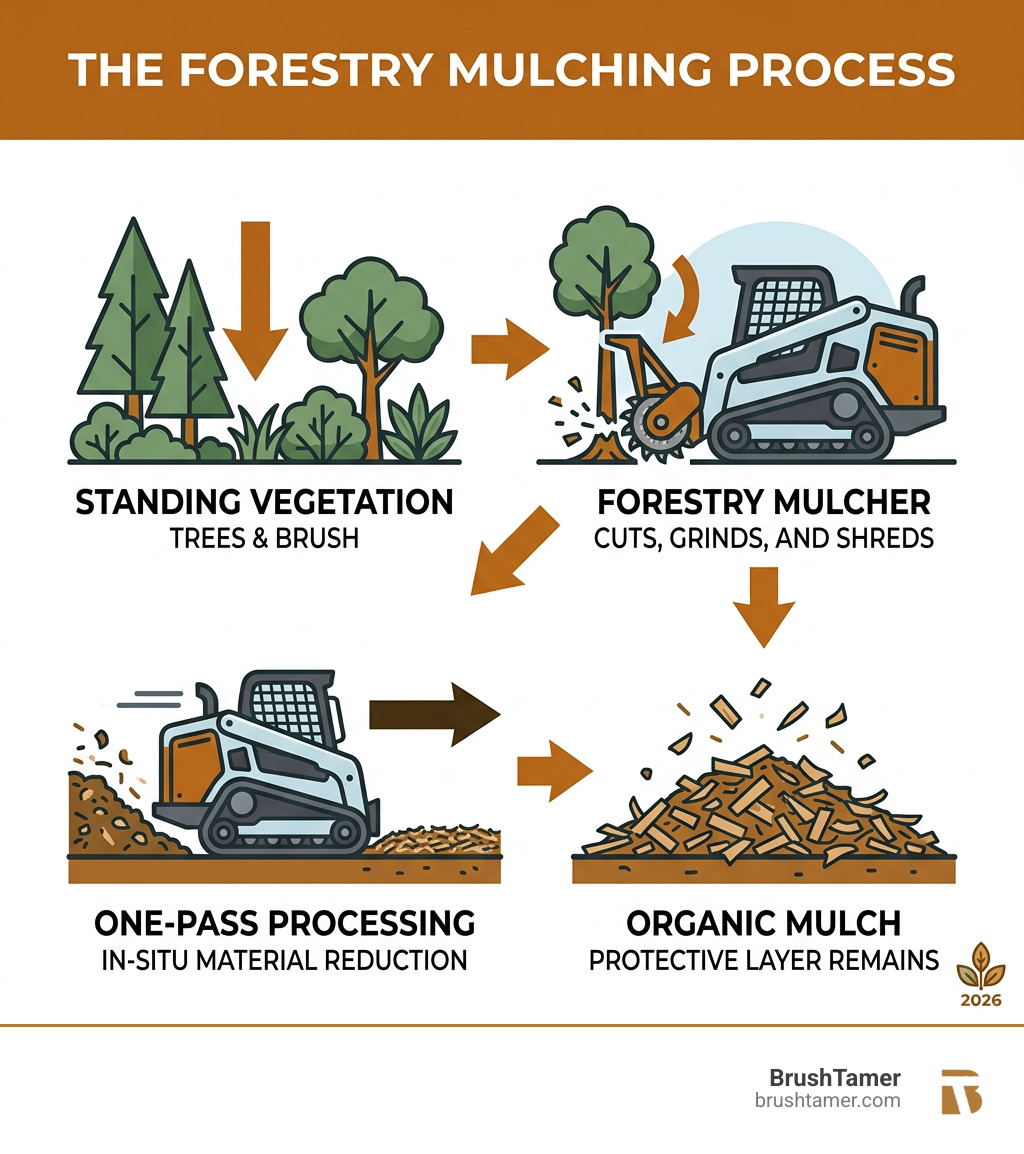
What is a Forest Mulcher and How Does It Work?
A forest mulcher is a specialized piece of heavy equipment that clears land by shredding standing or fallen vegetation into organic mulch directly on-site. It works by utilizing a high-speed rotating drum or disk equipped with steel teeth to grind wood and brush into small fragments. Unlike traditional bulldozing, which rips trees out by the roots and leaves massive piles of debris, a mulcher processes material in its tracks, leaving a protective layer of wood chips that nourishes the soil and prevents erosion.
At BrushTamer, our forest mulcher crews deliver a one-and-done clearing approach for property owners. By processing vegetation in-situ, we eliminate the need for secondary equipment like chippers or haul trucks. This keeps forest mulcher projects streamlined by reducing extra handling and leaving mulch in place for soil protection. For more details on how we apply this to various projects, check out the land clearing services by BrushTamer.
Mechanical Components of the Mulching Head
The “business end” of a forest mulcher is the mulching head. This attachment is a marvel of engineering, designed to withstand the brutal forces of grinding hardwood and dense brush common in the Midwest. The rotor is a heavy steel drum that spins at high speed to pulverize timber and brush. It serves as the heart of the machine, providing the kinetic energy required to pulverize timber. Attached to the rotor are rows of teeth; we typically use carbide-tipped teeth for their extreme durability against rocks and dirt, though some specialized “bite limiter” rotors use sharp knives to produce a finer, more uniform mulch finish.
- Variable Displacement Motor: This hydraulic motor automatically adjusts the combination of speed and torque. If the rotor hits a thick hardwood tree, the motor shifts to high torque to power through; when clearing lighter brush, it shifts to high speed for maximum efficiency.
- Push Bar: Located at the top of the head, this adjustable bar allows the operator to push trees over and guide them into the spinning rotor safely, ensuring controlled felling and processing.
- Hydraulic Door: Many of our units feature a trap door that can be opened or closed from the cab. Closing the door keeps the mulch inside the head longer, resulting in a finer finished product suitable for residential lawns or park areas.
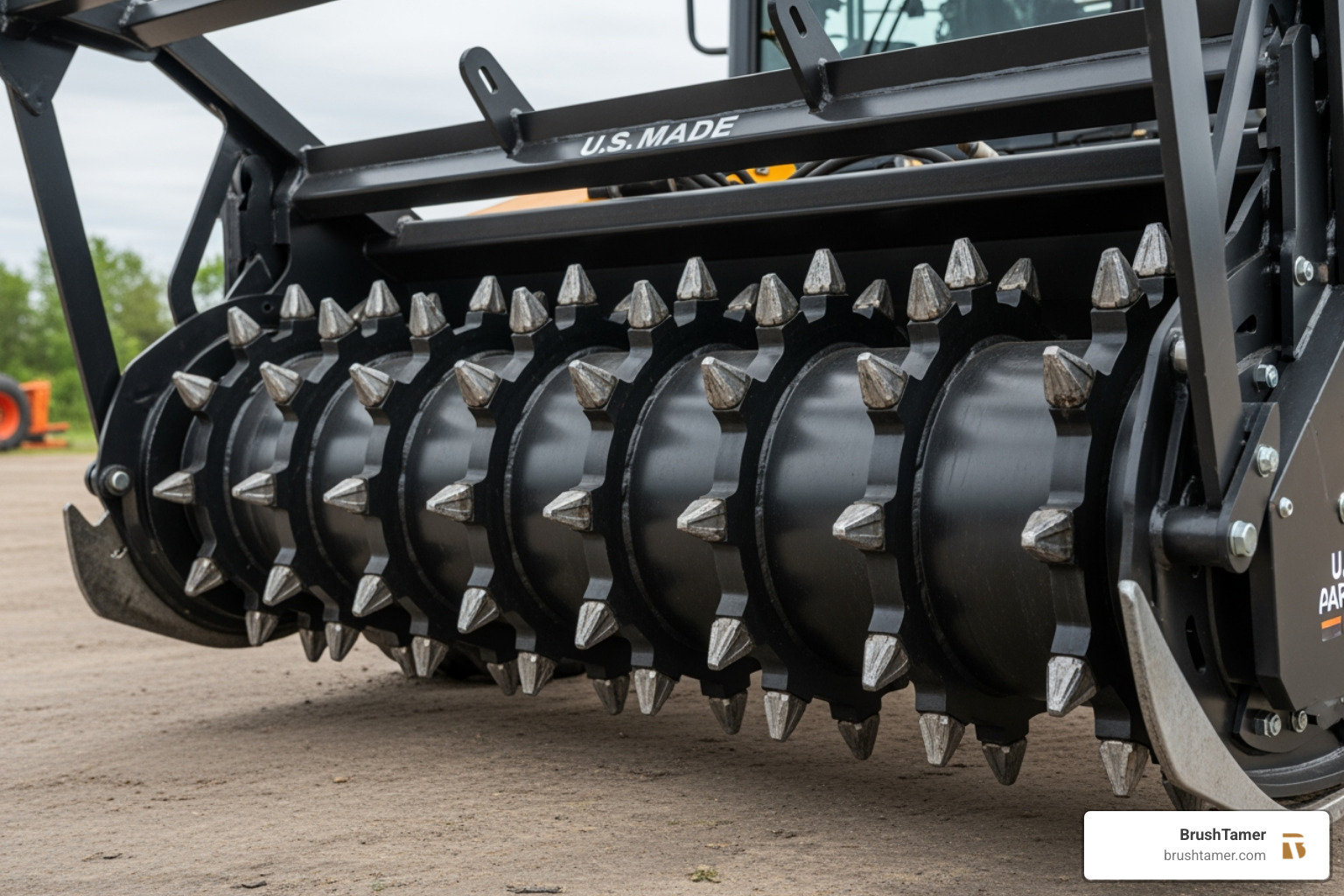
Selecting the Right Forest Mulcher for Specific Terrain
Not every forest mulcher is right for every job. Selecting the right carrier machine—the vehicle that pushes the mulching head—is critical for efficiency and protecting your property. In the Midwest, we deal with everything from flat, sandy plains to muddy riverbanks and steep ravines. We match our equipment to your specific site needs based on cutting capacity, ground pressure, and hydraulic flow. To protect the soil in sensitive areas, we use low-ground-pressure (LGP) tracked machines. For sensitive ground, we can run a forest mulcher on low-ground-pressure tracked machines to reduce rutting and compaction.
| Feature | Skid Steer Mulcher | Excavator-Mounted Mulcher |
|---|---|---|
| Best For | Open areas, pastures, flat terrain | Steep banks, ditches, over-fence clearing |
| Maneuverability | High speed on open ground | Reach over obstacles and down slopes |
| Max Tree Size | Typically up to 8–10 inches | Can handle up to 12+ inches |
| Soil Impact | Minimal with tracks | Extremely low (stays in one spot while reaching) |
Key Applications and Environmental Benefits of Forestry Mulching
A forest mulcher supports forestry mulching by keeping biomass on-site as a protective mulch layer, which helps reduce erosion, moderates soil temperature, and supports healthier ground conditions over time. In practice, this means BrushTamer can clear and condition a property in one mobilization instead of creating debris streams that require separate disposal. This practical, low-waste approach is central to the brush management by BrushTamer service line, and it pairs well with broader planning for eco-friendly land clearing.
In Lower Michigan and Northern Indiana, a forest mulcher is commonly used for forestry mulching to control invasive brush such as Honeysuckle, Buckthorn, and Autumn Olive. These species often dominate wooded edges and can be difficult to remove without disturbing the surrounding ecosystem. Mulching provides a way to shred these invasives into a carpet of organic material that eventually decomposes, returning nutrients to the soil. This method is also ideal for reclaiming overgrown pasture and field margins, opening access and visibility along trails, and stabilizing disturbed ground on slopes and drainage areas where bare soil would otherwise wash out.
Wildfire Mitigation and Fuel Load Reduction
A forest mulcher can support fuel-load reduction by removing ladder fuels and consolidating fine fuels into mulch. While major wildfires are more associated with other regions, fuel reduction is still a real land-management concern in drier seasonal conditions and wind-prone corridors across the Midwest. BrushTamer uses forestry mulching to thin understory growth so fire can’t easily climb from ground fuels into the canopy. We also create and maintain firebreak-style buffers around structures, fence lines, and access roads. When invasive thickets dominate the understory, reducing them also improves long-term biodiversity outcomes. The USDA Forest Service consistently emphasizes the importance of invasive species management and fuels reduction as part of resilient forest stewardship.
Soil Conservation and Erosion Management
A forest mulcher helps conserve soil by keeping root systems in place and leaving a surface mulch layer that reduces raindrop impact and slows runoff. This is especially valuable in the river corridors and rolling ground common across the region. On projects near riverbanks or in hillier parcels, BrushTamer’s approach is designed to limit soil disturbance compared to root-pulling methods. By matching equipment to conditions, we reduce the risk of rutting and leave a stable, drivable surface that can be maintained or built on after clearing. The result is a cleaner site that stays in place after heavy Midwest thunderstorms—without creating disposal problems or bare-earth washouts.
Comparing Mulching to Traditional Land Clearing Methods
Forestry mulching is typically more efficient than traditional land clearing because it combines cutting, processing, and debris management into a single step—without creating burn piles or haul-off logistics. For property owners in Northern Indiana and Lower Michigan, that means fewer moving parts, fewer delays, and a more predictable finished surface.
Traditional clearing often requires:
- Pushing or felling trees.
- Pulling stumps and roots (high disturbance).
- Piling debris.
- Burning or hauling debris off-site.
Mulching consolidates those outcomes into one controlled process, and BrushTamer applies it specifically to produce a usable finish for the next phase—whether that’s fencing, access roads, seeding, or construction planning. For related scenarios where density is the main issue, the heavy brush removal ultimate guide expands on what to expect.
Efficiency and Acreage Capacity
A forest mulcher’s daily output depends on vegetation density, stem diameter, terrain, and the finish standard required. In real Midwest conditions, BrushTamer most commonly sees:
- Light brush and saplings: higher production rates, especially on flatter ground.
- Dense thickets and mixed timber: commonly 1–3 acres per day for a high-quality finish.
Key factors that determine schedule and production pace on sites in places like Warsaw, Plymouth, Portage, and Grand Rapids include:
- Density and stem count: tight, multi-stem brush takes longer than spaced saplings.
- Terrain constraints: wet pockets, slopes, and limited access reduce travel efficiency.
- Finish requirement: a “rough open-up” differs from a park-like, uniform mulch layer.
- Species hardness: dense hardwoods require more time and power per inch of diameter.
Because BrushTamer works across these exact conditions, we scope projects to the ground truth—so the plan matches what you actually have on site. For a broader planning framework, see the complete land clearing guide.
Maintenance and Longevity of a Forest Mulcher
A forest mulcher stays productive only when its cutting system and hydraulics are kept in peak condition. BrushTamer’s maintenance approach is designed to protect performance and deliver consistent results across sandy Michigan soils, clay ground, and mixed terrain.
Operational realities that affect performance include:
- Tooth condition and balance: dull or uneven teeth reduce cut quality and increase fuel use.
- Hydraulic temperature control: mulching loads the system continuously, requiring clean cooling capacity.
- Daily inspections and lubrication: high-speed rotors and bearings demand disciplined upkeep.
This maintenance discipline is one reason professional forestry mulching produces a cleaner, more predictable result than piecemeal approaches—and it’s how BrushTamer protects timelines on projects from Goshen to Battle Creek.
Professional Vegetation Management in Michigan and Indiana
Professional vegetation management is the planned, site-specific removal of unwanted vegetation to improve safety, usability, and long-term land health. In practice, it means selecting the right mulching platform, matching cut depth and finish to the project goal, and executing the work with minimal disturbance. BrushTamer has specialized in forestry mulching since the company was founded in 2021. We focus on Lower Michigan and Northern Indiana conditions—tight residential access, farm edges, mixed hardwoods, seasonal wet ground, and invasive understory that regrows aggressively if not handled correctly.
Our service area includes:
- Indiana: South Bend, Elkhart, Mishawaka, Nappanee, Bristol, Middlebury, Wakarusa, Millersburg, Shipshewana, Ligonier, Syracuse, Warsaw, Plymouth, Laporte, Michigan City, Valparaiso, Chesterton, Portage, Hammond, Gary, Crown Point, Hobart, Merrillville, Rensselaer, Kokomo, Logansport, Lafayette, West Lafayette, Monticello, Peru, Marion, Fort Wayne, Auburn, Angola, Columbia City, Huntington, Bluffton, and Decatur.
- Michigan: Benton Harbor, St. Joseph, Niles, Dowagiac, Cassopolis, Edwardsburg, Three Rivers, Kalamazoo, Portage, Battle Creek, Marshall, Coldwater, Holland, Grand Rapids, South Haven, Watervliet, Paw Paw, Bangor.
- Illinois: Chicago, Evanston, Skokie, Des Plaines, Arlington Heights, Schaumburg, Naperville, Aurora, Joliet, Elgin, Waukegan, Zion, Gurnee, Libertyville, Kankakee, Bourbonnais, Bradley, Champaign.
You can explore our full range of forestry mulching services to see how we scope projects and match equipment to site conditions.
Right-of-Way and Infrastructure Maintenance
Right-of-Way (ROW) maintenance is the targeted clearing of vegetation around utilities, roadsides, and access corridors to maintain safe clearance and inspection visibility. A forest mulcher is well suited to ROW work because it processes vegetation in place and keeps the corridor passable without debris piles. BrushTamer supports ROW-style clearing to improve visibility and access for inspections, reduce hazards from encroaching limbs, and maintain narrow corridors where larger clearing spreads would be disruptive. This is especially relevant in communities with mixed development patterns—where rural corridors meet neighborhoods—such as Kokomo, Logansport, and Valparaiso.
Private Property and Agricultural Land Reclamation
Agricultural and private-property reclamation is the removal of brush and saplings that have reduced access, pasture productivity, or fence-line function. In the Midwest, this regrowth happens fast—particularly along field edges, ditch lines, and neglected corners. BrushTamer is commonly hired for pasture restoration and field-edge reset near Elkhart, Middlebury, and Three Rivers. We also provide orchard and tree-row removal support in the fruit belt near Benton Harbor and St. Joseph, as well as storm damage cleanup when downed and tangled material needs to be processed efficiently. Where stumps or specific grade targets require a separate step, we also provide professional stump grinding and removal to complete the project cleanly.
Frequently Asked Questions about Forest Mulchers
What size trees can a forest mulcher handle?
The capacity of a forest mulcher depends on the machine’s size, hydraulic power, and the wood’s density. Standard skid steer-mounted units are designed to efficiently process trees and brush between 6 and 10 inches in diameter. Our larger, dedicated forestry machines can tackle trees up to 12 or 15 inches in diameter with ease. While it is possible to mulch a 30-inch tree with specialized equipment, it is often more efficient to have BrushTamer fell very large trees traditionally and then mulch the limbs and trunk to reduce handling and keep the workflow moving.
How does mulching improve soil health?
Mulching improves soil health by promoting the natural decomposition of organic matter, which enriches the soil with nutrients and improves its structure. This process mimics the natural forest floor but at an accelerated rate.
- Nitrogen Cycle: As the wood chips decompose, they return nitrogen and other essential nutrients to the soil.
- Moisture Retention: The mulch layer acts as an insulator, preventing the sun from baking the soil dry. This is vital for the health of the remaining mature trees.
- Microbial Activity: A healthy layer of mulch encourages beneficial fungi and bacteria to thrive, which improves the overall “living” quality of your soil.
- No Compaction: Because we use tracked machines with low ground pressure, we don’t “pack down” the soil, allowing air and water to reach the roots of the trees you want to keep.
Is a forest mulcher a practical option for large tracts?
Yes, using a forest mulcher is often a practical approach for large tracts because it reduces extra handling and keeps material on-site as mulch. In fact, the larger the project, the more cost-effective mulching becomes compared to traditional methods.
- Simplified Workflow: One forest mulcher and operator can often complete clearing and processing in the same pass.
- No Off-Site Debris Stream: Material stays on the property as mulch instead of being hauled away.
- No Secondary Steps: You don’t need to hire a separate crew to grind stumps or haul away burn piles.
- Long-Term Outcomes: The mulch layer helps protect soil structure and reduce erosion risk after clearing.
How long does the mulch layer last?
With a forest mulcher, the mulch layer can persist for multiple seasons, depending on species, moisture, and traffic. Hardwoods like Oak and Hickory take longer to decompose than softwoods or brush. Over time, the mulch breaks down into rich organic matter, providing a natural fertilizer for the remaining trees or preparing the ground for future seeding.
Conclusion
Forestry mulching is one of the most efficient, soil-protective ways to clear and manage vegetation in Lower Michigan and Northern Indiana. A forest mulcher processes trees and brush where they stand, leaving a controlled mulch layer rather than debris piles—so your property is cleaner, more stable, and ready for what comes next.
BrushTamer has delivered professional mulching results across the region since the company was founded in 2021, serving property owners from South Bend and Elkhart to Kalamazoo and Grand Rapids. We focus on correct equipment selection, technically sound operation, and a finished surface that matches your goal—whether that’s access, reclaiming usable acreage, or preparing for construction.
Ready to move forward with a clear plan and a professional outcome? Explore all services by BrushTamer and schedule a consultation for forestry mulching in Northern Indiana and Lower Michigan.