
What to Do About an Overgrown Backyard
An overgrown backyard is more than an eyesore — it is an overgrown property issue that can affect safety, access, drainage, and long-term land usability.
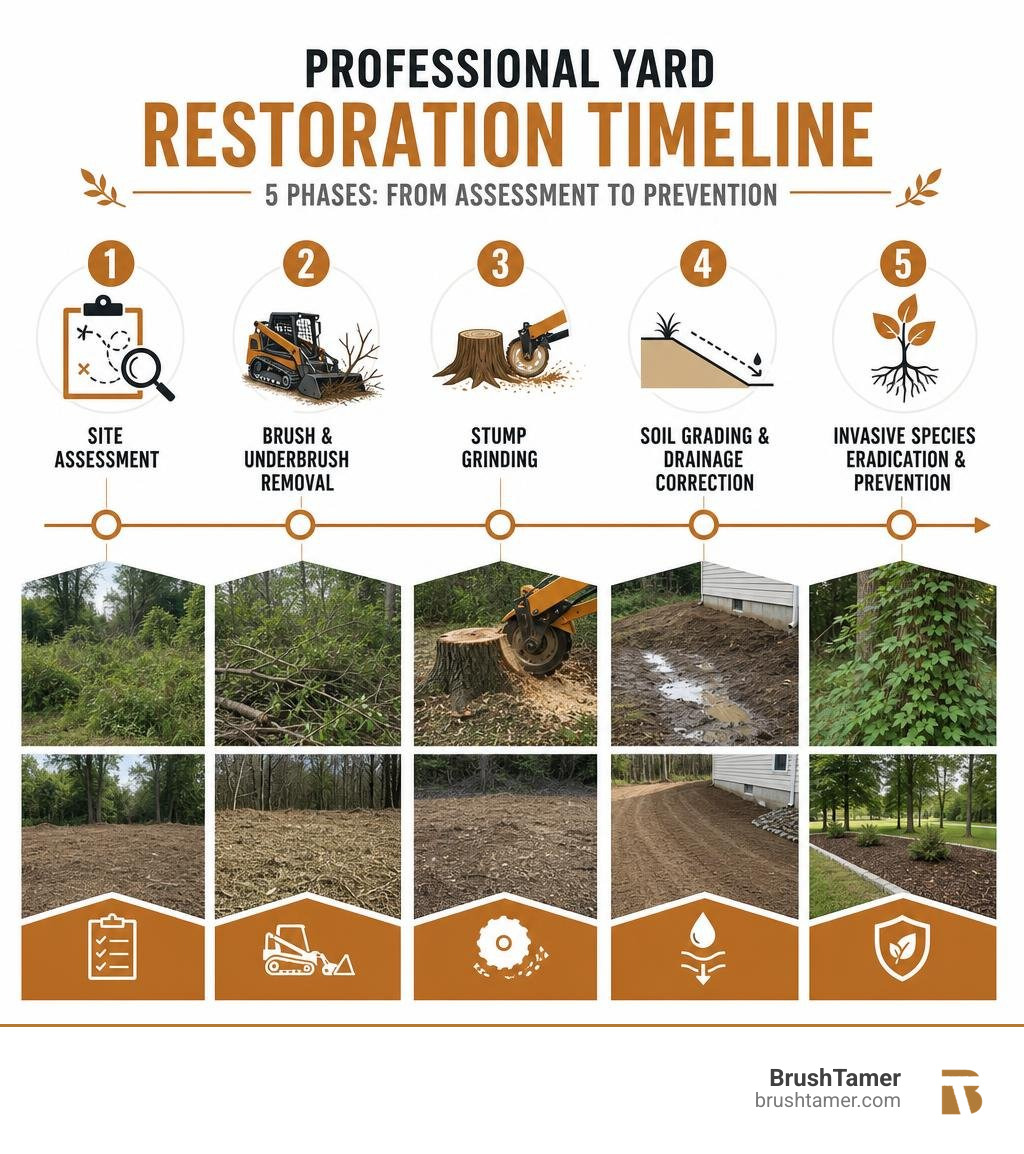
Restoring an overgrown backyard typically involves these professional steps:
- Site assessment — map boundaries, identify hazards, and locate utilities
- Heavy brush and underbrush removal — clear dense vegetation using professional equipment
- Stump grinding — eliminate tripping hazards and pest attractants
- Soil grading and drainage correction — prevent water pooling near your foundation
- Invasive species eradication — remove roots completely to stop regrowth
- Post-clearing rehabilitation — reseed, mulch, and establish a prevention plan
When vines, tangled brush, and dense trees take over an overgrown backyard, the project can feel overwhelming. What started as a few missed mowing sessions can quietly turn into years of unchecked growth. And it is not just a visual problem. An overgrown property can attract pests, limit safe access, trap moisture, and create local code-enforcement concerns. The longer you wait, the more complex the restoration process can become. Addressing overgrowth earlier can reduce vegetation density, limit root spread, and make the restoration process more manageable.
I’m Leon Miller, owner of BrushTamer, a land management and forestry mulching company based in Plymouth, Indiana, and I’ve spent years helping property owners across Lower Michigan and Northern Indiana reclaim overgrown backyard spaces that felt completely beyond saving. In this guide, I’ll walk you through exactly what professional restoration looks like and why timely restoration helps protect access, safety, and long-term land usability.
Related BrushTamer resources for restoring an overgrown backyard:
The Hidden Dangers of an Overgrown Backyard
An overgrown backyard poses immediate threats to your home’s structure, family health, and property value by harboring pests, trapping moisture, and creating wildfire hazards. Left unmanaged, dense brush and tall grasses do more than ruin your curb appeal—they actively damage your investment.
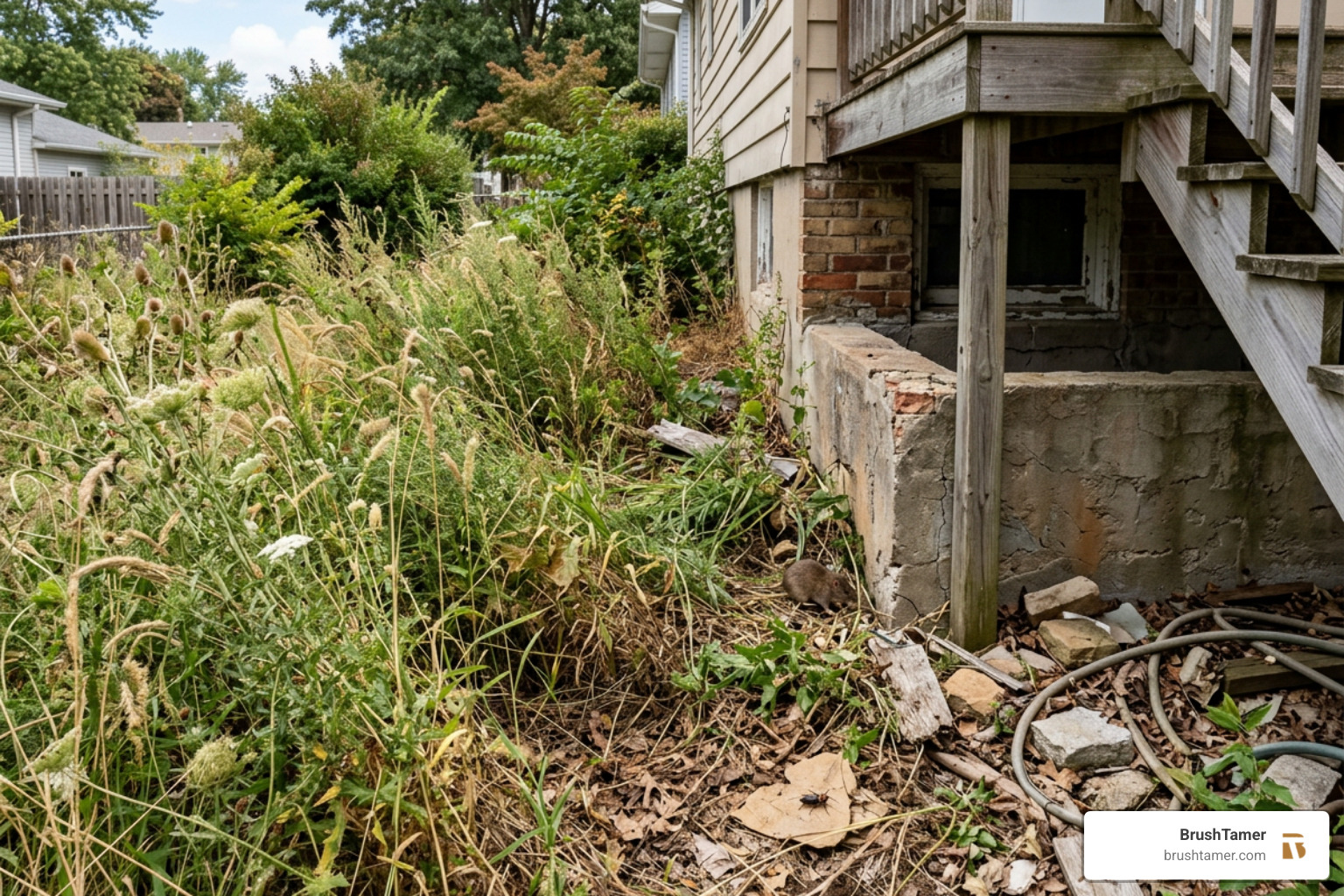
Thick brush, decaying leaves, and tall weeds trap moisture close to the ground, creating an ideal breeding environment for wood-boring insects, ticks, and rodents. Rats and mice frequently nest in dense ground cover, eventually migrating into nearby homes and causing structural and sanitary issues. Furthermore, overgrown grass increases the risk of tick-borne illnesses. You can read more about these risks in our guide on 5 Common Overgrown Grass Dangers You Can’t Afford to Make.
Beyond pests, unchecked growth causes structural damage. Aggressive climbing vines like English ivy can penetrate siding, damage brick mortar, and pull down gutters. Heavy tree limbs hanging over your roof trap moisture on shingles, leading to premature rot and mold. Additionally, during dry Midwestern summers, dead brush and dried weeds act as a fuel source, increasing wildfire risks.
Municipal Code Violations in Northern Indiana and Lower Michigan
Municipalities across Northern Indiana and Lower Michigan often enforce weed and vegetation limits, so homeowners should review local rules before an overgrown backyard becomes a compliance issue.
If you live in Goshen, Mishawaka, South Bend, Elkhart, Granger, or Nappanee, you are subject to clear municipal rules:
- Goshen, Indiana: Property owners must maintain yards to prevent safety hazards. Uncontrolled growth can be reported through the Vegetation Overgrowth – City of Goshen, Indiana portal, leading to warnings and fines.
- Mishawaka, Indiana: The city actively cites properties with excessive weed growth. Learn more via A Clean, Safe, and Proud Mishawaka Starts With You – IN.gov.
- South Bend, Indiana: Code enforcement monitors properties for grass and weeds exceeding legal limits. Violations result in the city hiring a contractor to clear the property at the owner’s expense. Review guidelines on the Grass and Weed Neighborhood Services & Enforcement Violation page.
Failing to address these issues promptly can lead to additional enforcement steps from the local municipality. Partnering with a professional service ensures your property remains fully compliant.
The Professional Process for Restoring Overgrown Land
Restoring overgrown land professionally involves a systematic, multi-phase approach utilizing heavy machinery like forestry mulchers to safely clear debris, grind stumps, and correct soil issues. Rather than hacking away blindly, professional land managers use specialized strategies to transform a tangled jungle into a clean, usable canvas.

At BrushTamer, we approach every restoration project with a structured plan designed to protect your property while maximizing efficiency. Attempting to clear heavily overgrown acreage without commercial-grade machinery often results in incomplete root removal and rapid weed regrowth. To understand the broader scope of land reclamation, check out our resource on Fixing Overgrown Land.
Phase 1: Site Assessment and Hazard Mapping
Phase 1 involves identifying property boundaries, marking utility lines, and mapping overhead hazards to ensure a safe and legally compliant clearing process. Before any machinery is turned on, our team conducts a walkthrough to identify hidden risks.
During this assessment, we map out several key elements:
- Property Boundaries: Ensuring we only clear your land in towns like Plymouth or Granger.
- Underground Utilities: Coordinating with local utility locating services (Indiana 811) to mark gas, water, and electric lines.
- Hidden Obstacles: Mapping old wire fences, concrete footings, and large boulders.
- Overhead Hazards: Identifying dead, diseased, or hanging tree limbs.
This planning helps reduce the risk of utility damage and keeps the clearing process safer. For utility safety, homeowners and contractors should follow Indiana 811 guidance before digging or clearing near buried utilities.
Phase 2: Heavy Brush Removal and Underbrush Clearing
Phase 2 utilizes commercial forestry mulchers and brush cutters to shred thick undergrowth, saplings, and dense brambles directly into a nutrient-rich soil cover. This is where an overgrown backyard starts becoming a safer, more usable overgrown property restoration project.
Instead of traditional bulldoze-and-burn methods that strip topsoil, we utilize low-impact forestry mulching. Our machines grind standing brush, small trees, and thick briars on-site. This leaves behind a clean, uniform layer of mulch that acts as a natural weed barrier, prevents soil erosion, and slowly decomposes to enrich the soil. To learn more, read our Heavy Brush Removal Ultimate Guide and explore our specialized Brush Clean Up Services.
Phase 3: Stump Grinding and Soil Rehabilitation
Phase 3 eliminates below-ground hazards through mechanical stump grinding, followed by professional land grading to ensure proper drainage away from structural foundations.
Leftover tree stumps are tripping hazards, ruin lawnmowers, and attract termites. Many aggressive tree species will quickly sprout new growth from remaining stumps. We use powerful, hydraulic stump grinders to pulverize stumps and major root flares well below the soil surface.
Once stumps are removed, we grade the land to ensure a proper slope—ideally pitching away from your home’s foundation with at least a six-inch drop over the first ten feet. To secure your property’s foundation, read more about our Professional Stump Grinding Services.
Managing Invasive Species and Vegetation Overgrowth
Managing invasive species requires root-level eradication and targeted professional treatments to prevent aggressive weeds from choking out native plants and overtaking the landscape. In the Midwest, neglecting a yard for even a few seasons allows invasive plants to establish a dominant foothold that standard mowing cannot resolve.
Invasive species are biologically adapted to spread rapidly, outcompeting native grasses, shrubs, and trees for sunlight, water, and soil nutrients. When an overgrown property is neglected for multiple seasons, dense vegetation can limit access, spread across structures, and create larger restoration challenges. You can read an incredible real-world example of this level of neglect in this article about a House that was swallowed up by nature for 40 years finally cleared.
Identifying Invasive Species in an Overgrown Backyard
Common invasive species in the Midwest include kudzu, buckthorn, Canada thistle, poison ivy, and creeping charlie, each requiring specific biological identification and removal strategies.
- Kudzu: Grows up to a foot a day, smothering entire trees and structures under heavy, dense foliage.
- Buckthorn (Common and Glossy): This aggressive shrub forms dense, impenetrable thickets. It is crucial to target female buckthorn plants first, as they produce the dark berries that birds spread.
- Canada Thistle: Spreads through an extensive, deep underground rhizome system. Simply pulling or cutting the plant at the surface will not kill it.
- Poison Ivy: Contains urushiol, an oil that causes severe allergic skin reactions. Never burn poison ivy, as the toxic oils can become airborne in the smoke and cause life-threatening respiratory issues.
- Creeping Charlie: A fast-spreading ground ivy that thrives in shaded, moist areas of neglected lawns, forming dense mats that choke out turf grass.
For regional invasive plant context, reference Purdue’s Indiana invasive plant list or the Midwest Invasive Plant Network.
Professional Eradication and Root Removal
Professional eradication uses specialized root-extraction machinery and precise systemic herbicide applications to ensure invasive plants are completely eliminated at the root. Cutting down invasive brush at the surface is merely a temporary fix; without destroying the root system, species like buckthorn, kudzu, and Canada thistle will aggressively resprout.
At BrushTamer, we combine mechanical clearing with targeted, environmentally responsible chemical treatments. For woody plants like buckthorn, we often apply a systemic herbicide directly to the freshly cut stump (known as a cut-stump treatment). This ensures the active ingredients are drawn down into the root system, killing the plant entirely without harming surrounding native vegetation. Reclaiming your property from these aggressive invaders requires a coordinated strategy, which you can learn more about on our Professional Brush Management Services page.
Post-Clearing Land Rehabilitation and Prevention
Post-clearing land rehabilitation establishes a stable, healthy landscape through professional grading, drainage correction, and erosion control. Once heavy brush and invasive species are cleared, the newly exposed soil must be stabilized immediately to prevent erosion and weed seed germination.
Without proper care, a newly cleared yard will quickly return to its wild state. Professional rehabilitation involves preparing the seedbed, correcting drainage patterns, and establishing a healthy ground cover that outcompetes weeds. To ensure your land remains clean and usable, explore our Professional Land Clearing Services.
Long-Term Prevention Strategies for Your Overgrown Backyard
Long-term prevention involves establishing native ground covers, applying thick layers of professional mulch, and scheduling routine land management sweeps to suppress weed seed germination.
We recommend several highly effective prevention methods:
- Planting Native Sedges: Sedges are low-maintenance, grass-like plants that tolerate shade and wet soils, forming a dense root system that naturally crowds out invasive weeds.
- Professional Mulching: Laying down a heavy layer of shredded wood mulch suppresses weed growth and retains soil moisture.
- Establishing a Maintenance Schedule: Scheduling regular professional maintenance sweeps ensures that any emerging saplings or invasive weeds are eradicated before they can spread. To keep your property accessible and clean year-round, read our advice on managing Overgrown Trails.
Frequently Asked Questions About Yard Restoration
What factors affect the restoration plan for an overgrown backyard?
The right restoration plan depends on acreage, vegetation density, invasive species, terrain, access points, and the equipment required.
Several primary factors influence the restoration approach:
- Density and Height of Vegetation: A yard filled with waist-high weeds requires less time and machinery than a property choked with mature buckthorn thickets and heavy saplings.
- Stump and Root Removal: Extensive stump grinding and root-level extraction require specialized high-powered machinery.
- Terrain and Accessibility: Steep slopes, muddy lowlands, and tight residential gates in urban areas like South Bend or Kalamazoo require specialized equipment.
- Disposal Methods: On-site forestry mulching turns cleared vegetation into beneficial ground cover, reducing hauling needs while supporting soil protection. Learn more on our Professional Forestry Mulching Services page.
What is the best time of year to clear overgrown land in the Midwest?
Late autumn and winter are the optimal times to clear overgrown land in the Midwest due to increased visibility, dormant vegetation, frozen ground that protects soil, and reduced pest activity.
During the colder months, deciduous trees and brush drop their leaves, giving operators maximum visibility to identify hidden hazards and terrain changes. Furthermore, because the ground is frozen, heavy equipment can operate with minimal soil compaction and lawn disruption. Clearing during the dormant season also avoids disrupting active bird nesting seasons and minimizes the spread of plant diseases like oak wilt.
Why should I hire a professional instead of attempting DIY clearing?
Hiring a professional ensures safety from hidden hazards, utilizes heavy-duty commercial machinery for permanent root eradication, and provides liability protection.
An overgrown backyard often hides dangerous debris like old barbed wire, rusted metal, broken glass, and deep sinkholes. Operating heavy machinery like commercial brush cutters and chainsaws requires specialized training and safety gear. Furthermore, professionals have the expertise to safely fell large, leaning trees and handle toxic plants like poison ivy without spreading dangerous oils. Partnering with an insured, professional land management company like BrushTamer protects your health, your home’s foundation, and your peace of mind.
Conclusion
Reclaiming an overgrown backyard restores your property’s value, eliminates safety hazards, and gives you back a beautiful, usable outdoor sanctuary. Leaving a property neglected only allows invasive species to spread, structural damage to accumulate, and municipal fines to mount.
At BrushTamer, founded in 2021, we are dedicated to providing the highest quality land clearing, forestry mulching, and vegetation management services across Northern Indiana and Lower Michigan. Whether you are dealing with a dense buckthorn infestation in Elkhart, an overgrown hill in Kalamazoo, or a neglected property in Plymouth, our experienced team has the commercial-grade equipment and expertise to handle the job safely and efficiently.
Ready to reclaim your overgrown backyard? Contact BrushTamer today to schedule a professional site assessment and create a clear, safe, and practical plan for restoring your property.