
What Is Bushy Land and Why Does It Matter?
Bushy land is shrub-dominated ground—typically 2 to 8 meters tall—that functions as a high-value habitat and natural buffer between open fields and mature forest. In Northern Indiana and Lower Michigan, bushy land thickets are not ‘waste areas.’ They are some of the most productive parts of the landscape for wildlife, water quality, and erosion control, especially around fast-growing communities where land use pressure is constant.
Bushy land matters because it delivers practical, measurable benefits to overgrown properties that many properties in Michiana rely on:
- Ecological definition: Land dominated by shrubs, brambles, and low woody vegetation (often classified as shrubland or scrubland).
- Successional role: A predictable transition stage between grassland/old fields and closed-canopy forest.
- Wildlife value: Dense cover, nesting sites, and seasonal food sources for birds, small mammals, and beneficial insects.
- Soil and water protection: Woody root systems stabilize slopes, reduce sediment loss, and filter runoff that would otherwise reach ditches, creeks, and rivers.
- Management requirement: Without professional oversight, bushy land can become invasive-dominated, harder to access, and riskier near structures.
In places like South Bend, Elkhart, Mishawaka, Granger, Niles, and Benton Harbor, bushy land often occupies field edges, creek corridors, lake margins, and neglected lots. Those ‘in-between’ strips are exactly where bushy land conditions often determine whether erosion starts, invasive plants spread, and wildlife movement gets fragmented.
BrushTamer approaches bushy land as an asset that can be improved—not erased. I am Leon Miller, founder of BrushTamer (founded in 2021). We manage bushy land across Northern Indiana and Lower Michigan with professional equipment and a habitat-first mindset: reclaiming overgrown access, restoring functional native structure, and keeping properties usable without stripping away the natural services these thickets provide.
In the sections below, this article explains how bushy land works, how to recognize quality habitat versus problem growth, and what professional management looks like when the goal is long-term stability—not a temporary cosmetic fix.
Defining Bushy Land: Ecology and Characteristics
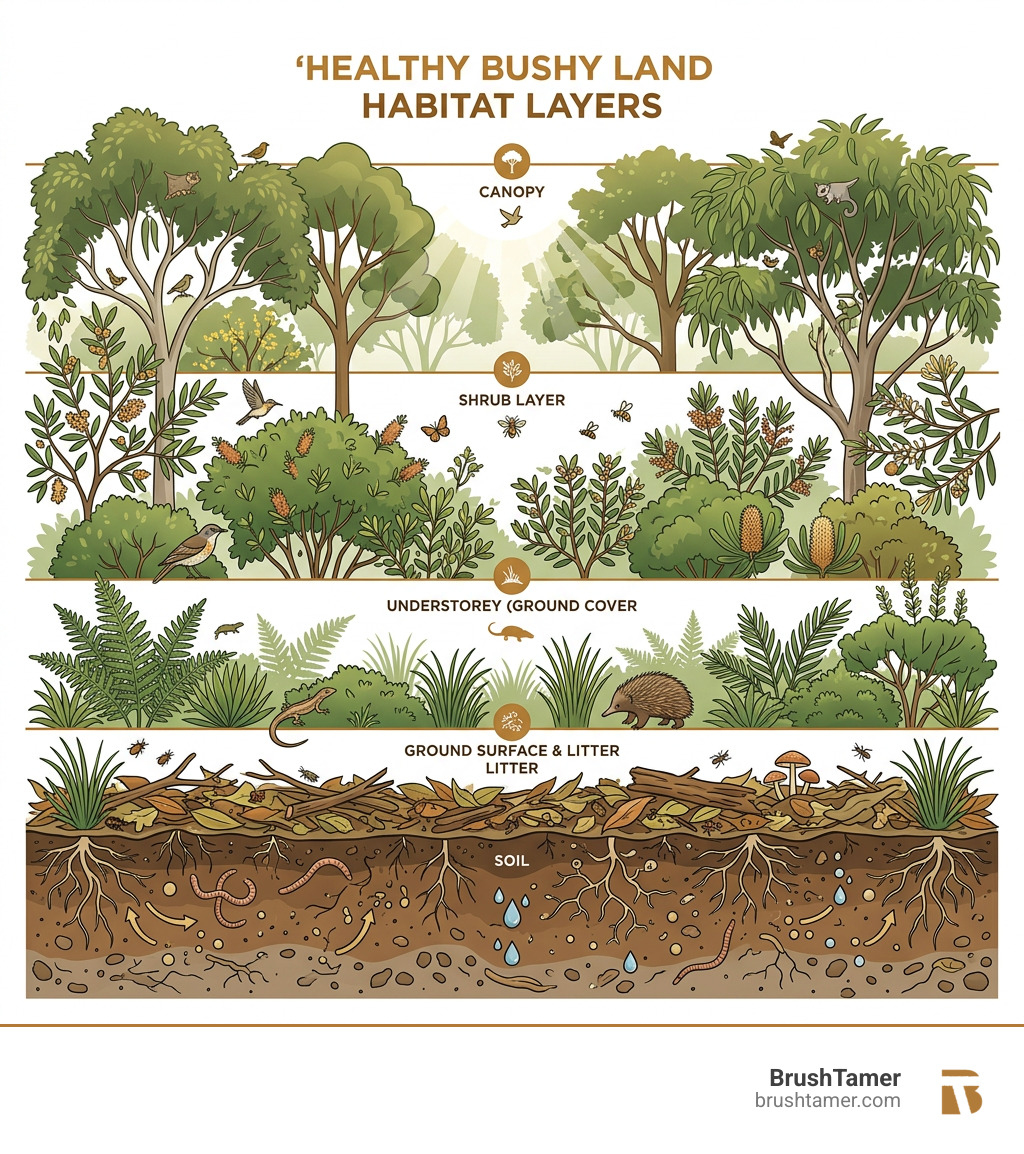
Bushy land is defined by dense, multi-stem woody vegetation under eight meters tall, typically with 30% to 100% foliage cover. Ecologists often classify bushy land as shrubland, vegetation dominated by woody shrubs rather than closed-canopy forest. Across Northern Indiana and Lower Michigan, bushy land frequently appears as mesic shrubland (moderately moist soils), wet shrub-carr near water, and early-successional thickets on former farm ground.
This bushy land stage is not random. Bushy land is a predictable part of succession: when fields in St. Joseph County, Elkhart County, LaPorte County, or Berrien County are left unmanaged, shrubs and saplings colonize first, creating the thick, tangled structure people associate with “brush.” Over time, without intervention, those shrubs often give way to a young forest.
Identifying Healthy Bushy Land Ecosystems
Healthy bushy land on an overgrown property has a layered structure, diverse native species, and active regeneration—not a single invasive plant forming a monoculture. When BrushTamer evaluates bushy land on shrub-dominated properties in places like Valparaiso, LaPorte, New Carlisle, or Stevensville, we look for indicators consistent with the Characteristics of Healthy Bush and then match management intensity to the site’s function (habitat, access, screening, drainage, or future land use).
Key features we look for include:
- Cryptogamic mat: Mosses, lichens, and algae that protect soil and can support nutrient cycling—especially valuable in sandy Lake Michigan-influenced soils.
- Litter layer: Leaves and woody debris that recycle nutrients and create microhabitat for insects and amphibians.
- Native shrub diversity: A resilient mix (for this region often including dogwoods, elderberry, viburnums, willows, and sumacs) that prevents any single species from taking over.
- Regenerative growth: Multiple age classes—young stems, mid-aged shrubs, and mature plants—showing the system can renew itself.
A common local problem is that “dense” is mistaken for “healthy.” Dense cover can be excellent habitat, but if it is dominated by aggressive invasives, it becomes ecologically poorer and harder to maintain over time. Professional assessment separates high-function thickets from high-risk overgrowth.
Botanical Structure and Foliage Density
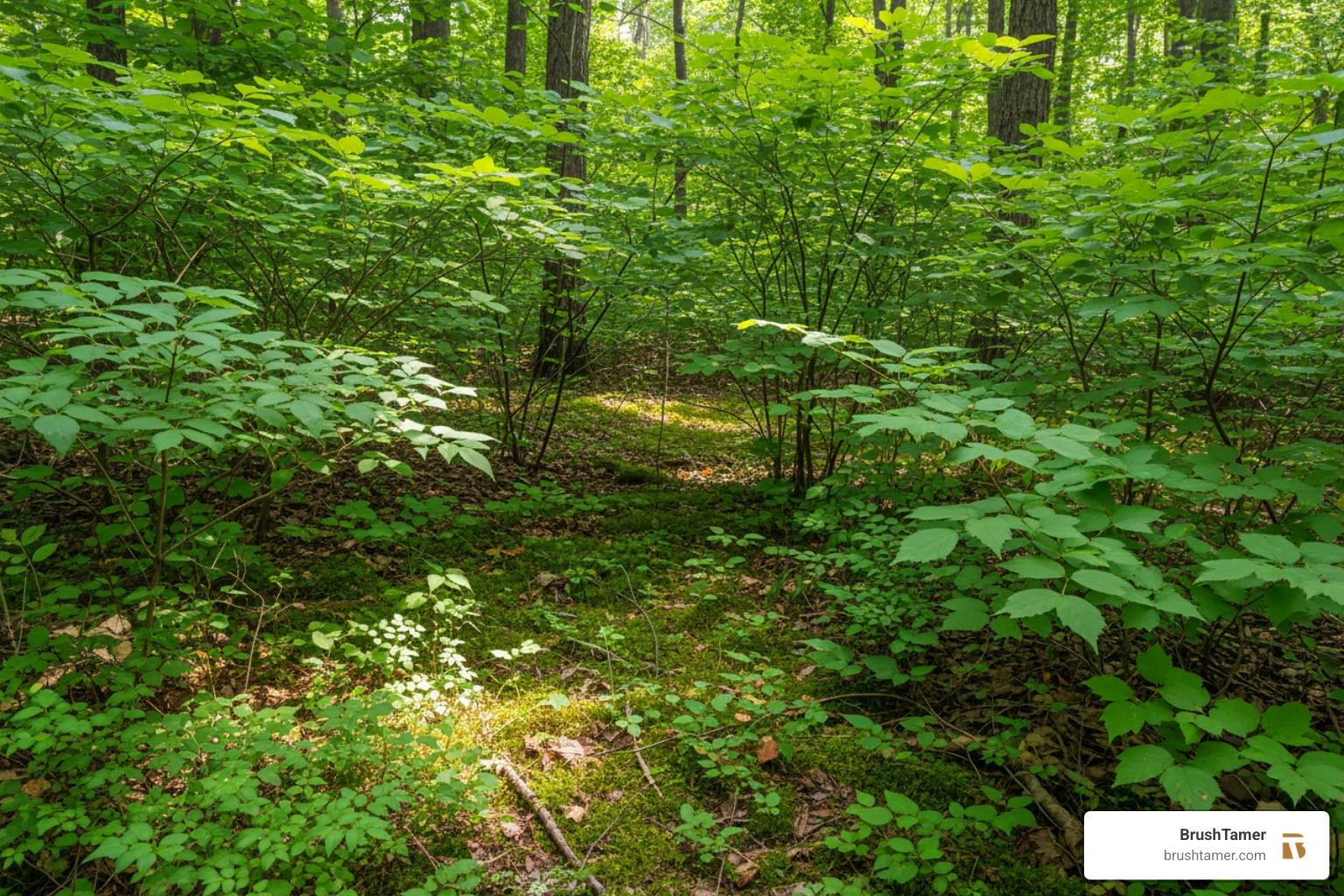
Bushy land classification is based on vegetation height and canopy cover, which determines how much light reaches the ground and what wildlife the site supports. Using common shrubland structure tiers (tall shrubs, small shrubs, subshrubs), we categorize vegetation by height and cover.
- Tall shrubs (2–8 meters): The primary vertical framework; important for nesting and thermal cover.
- Small shrubs (1–2 meters): The dense mid-story provides movement corridors and protection.
- Subshrubs (under 1 meter): Low woody cover that reduces erosion and supports small mammals and ground-nesting birds.
In Northern Indiana and Lower Michigan, BrushTamer most often manages mid-dense (30–70% cover) and dense (70–100% cover) shrublands. Mid-dense areas can support a strong herb layer (wildflowers and grasses), while dense areas provide maximum screening, wind buffering, and winter protection for wildlife. The right target density depends on property goals and local constraints such as drainage patterns, neighbor boundaries, and fire risk near structures.
10 Notable Bushy Land Locations to Explore in the Midwest
Northern Indiana and Lower Michigan include excellent public places to observe bushy land structure, from wet shrub-carr to dune scrub. These public lands provide an excellent opportunity to observe how these habitats function when properly preserved. Below are the top 10 locations within the BrushTamer service area to experience these unique landscapes.
- Bendix Woods County Park (New Carlisle, IN): This park is renowned for its hardwood transitions. The edges where the mature forest meets open meadows are filled with dense shrub thickets. These areas are managed to provide a buffer that protects the interior forest while offering prime viewing for white-tailed deer and wild turkeys.
- Potato Creek State Park (North Liberty, IN): The margins of Worster Lake are home to expansive wetland shrublands. These “shrub-carr” habitats are dominated by willows and dogwoods, providing a critical stopover for migratory warblers and waterfowl. The density of the bush here is a testament to the park’s successful water management strategies.
- Love Creek County Park (Berrien Center, MI): This location showcases the beauty of regenerating fields. Large stands of native dogwood and sumac create a vibrant landscape that supports a massive population of pollinators. It is an ideal spot to see how bushy land provides nectar sources throughout the growing season.
- Warren Dunes State Park (Sawyer, MI): The coastal scrublands here are a marvel of botanical resilience. Hardy shrubs like Sand Cherry and Juniper thrive in the shifting sands, playing a vital role in dune stabilization. These plants survive in extreme microclimates where larger trees would fail.
- St. Patrick’s County Park (South Bend, IN): Focus on the riparian shrublands along the St. Joseph River. The park utilizes these bushy buffers to prevent riverbank erosion and filter runoff before it enters the waterway. It is a prime example of the functional utility of managed brush.
- Grand Mere State Park (Stevensville, MI): This park features rare shrub species tucked into interdunal swales. The bushy land here acts as a protected corridor for wildlife moving along the Lake Michigan shoreline, demonstrating the importance of habitat connectivity.
- Cobus Creek County Park (Elkhart, IN): Known for its sensory gardens and bushy creek banks, this park offers an educational look at native woody plants. The managed thickets along the water are essential for maintaining the cool water temperatures required for local trout populations.
- Rum Village Park (South Bend, IN): This site provides a look at “urban” bushy land. Despite being located within city limits, the dense woodland edges support a surprisingly diverse wildlife population, including foxes and owls, thanks to the cover provided by the thickets.
- Spicer Lake Nature Preserve (St. Joseph County, IN): This preserve features a rare buttonbush swamp. Accessible via boardwalk, this shrub-carr ecosystem allows visitors to see how bushy land thrives in standing water, providing a unique habitat for amphibians and aquatic insects.
- Fernwood Botanical Garden (Niles, MI): Fernwood offers a more curated look at bushy land. Their managed native shrub collections demonstrate how these ecosystems can be aesthetically pleasing and highly organized when maintained by professionals.
Comparing Local Shrubland Destinations
| Location | Primary Shrub Types | Trail Difficulty | Key Ecological Feature |
|---|---|---|---|
| Bendix Woods | Dogwood, Hazelnut | Easy to Moderate | Hardwood Transitions |
| Potato Creek | Willow, Buttonbush | Easy | Wetland Margins |
| Love Creek | Dogwood, Sumac | Moderate | Regenerating Fields |
| Warren Dunes | Juniper, Sand Cherry | Hard (Sand) | Dune Stabilization |
| St. Patrick’s | Elderberry, Willow | Easy | Riparian Buffers |
| Grand Mere | Rare Coastal Scrub | Moderate | Interdunal Swales |
| Cobus Creek | Native Ornamental Shrubs | Easy | Sensory Gardens |
| Rum Village | Brambles, Saplings | Easy to Moderate | Urban Wildlife Edges |
| Spicer Lake | Buttonbush, Alder | Easy (Boardwalk) | Shrub-Carr Swamp |
| Fernwood | Managed Native Species | Easy | Pollinator Thickets |
Why Protecting Bushy Land is Vital for Ecosystem Health
Protecting bushy land is vital because these habitats function as essential wildlife corridors and biodiversity hotspots that prevent local species extinction and manage environmental risks like wildfires. Far from being “wasted space,” shrublands are the connective tissue of the Midwest landscape, acting as safe highways that allow animals to move between larger, isolated forest fragments in counties like St. Joseph and Elkhart.
In regions across the Midwest, conservation initiatives have identified these shrubby “wildlife linkages” as critical for landscape-scale health. These bushy land corridors can support species like American woodcock and other shrubland birds by providing cover and travel routes. Professional management ensures these corridors remain passable and free from the choking influence of invasive species.
Wildlife Corridors and Habitat Connectivity
When BrushTamer is called to manage a property, we often focus on preserving the “linkage” value of the land. A 20-acre patch of dense brush might seem insignificant to a developer, but if it connects two larger forests, it is ecologically invaluable. These corridors allow species like the American Woodcock and various small mammals to travel undercover, protected from predators and human activity. By maintaining these strips of bush, we support the natural migration and dispersal patterns essential for a healthy ecosystem.
Biodiversity and Wildfire Prevention
Healthy bushy land is a powerhouse of biodiversity, providing resources that neither deep forests nor open fields can offer:
- Extended Nectar Availability: Many native shrubs flower at different times than forest trees, ensuring a steady food supply for bees, butterflies, and other pollinators from early spring through late fall.
- Structural Protection: The dense, often thorny nature of species like Hawthorn provides a fortress for nesting birds, keeping them safe from aerial predators like hawks.
- Wildfire Risk Mitigation: While some shrublands are adapted to fire, unmanaged overgrowth can accumulate dangerous levels of “fuel load.” Professional thinning and the removal of dead woody debris by BrushTamer create “defensible space,” protecting homes in Granger and Mishawaka from the threat of fast-moving brush fires.
Professional Management of Overgrown Bushy Land
Professional management of overgrown bushy land means reducing hazard and restoring function with commercial-grade equipment and an ecologically informed plan—without turning the site into bare dirt. In Northern Indiana and Lower Michigan, unmanaged thickets commonly create three common problems for property owners: restricted access, invasive dominance, and rising fuel loads near structures.
BrushTamer manages these sites to achieve predictable outcomes: usable access lanes, stable edges, healthier native regrowth, and a finished look that stays maintainable. The approach is intentionally selective. Clear-cutting bushy land often triggers erosion, accelerates invasive reinfestation, and removes the structure that wildlife depends on.
Restoring Bushy Land for Biodiversity
Restoration succeeds when invasives are removed, overcrowded stems are thinned, and the remaining structure is shaped to support both habitat and property use. BrushTamer provides targeted Vegetation Management Solutions for landowners who need long-term results, including projects focused on Fixing Overgrown Land in communities such as Granger, Mishawaka, Elkhart, Niles, and Benton Harbor.
Our professional process typically includes:
- Invasive species eradication: We remove aggressive non-native plants (commonly Autumn Olive and Multiflora Rose in this region) that outcompete natives and reduce habitat quality.
- Strategic thinning and shaping: We selectively remove dead, diseased, and overcrowded woody growth to improve light penetration and reduce ladder fuels.
- Habitat-first layout: We retain beneficial screening and travel corridors while opening up visibility and access where owners need it most.
- Stabilization outcomes: Mulched material is managed to reduce erosion and protect disturbed soil surfaces—especially on slopes and drainageways.
For property owners who want a clean, managed look without sacrificing ecological performance, our Services – Brush Management are designed to create a “finished edge” that looks intentional and remains functional season after season.
Mechanical Clearing: Forestry Mulching and Brush Hogging
BrushTamer uses brush hogging for maintenance cutting, and forestry mulching for dense bushy land where a controlled finish is required. For larger acreages around Valparaiso, LaPorte, St. Joseph, and across the US-31 corridor, equipment choice is what determines whether the project holds up over time.
- Brush hogging: Implemented through our Brush Hogging service for fields, edges, and lighter woody growth where maintaining openness is the primary goal.
- Forestry mulching: Preferred for heavier, tangled shrubland and sapling-dense zones where long-term manageability, soil protection, and a uniform finish matter most.
When sites require more comprehensive clearing and planning, we follow the framework outlined in our Land Clearing Services Complete Guide. For thick, established brush specifically, the outcomes and constraints are detailed in our Heavy Brush Removal Ultimate Guide.
In practice, forestry mulching is often the most effective professional tool for bushy land in this region because it:
- Processes vegetation on-site into mulch that helps protect soil
- Reduces hauling and staging complexity on tight residential or semi-rural lots
- Produces a stable, “ready-to-use” surface for access, inspection, or next-phase restoration
The result is bushy land that is safer, more accessible, and easier to maintain—while preserving the ecological roles that make shrublands valuable in the first place.
Frequently Asked Questions about Bushy Land
What is the technical difference between brush hogging and forestry mulching? Brush hogging is a form of heavy-duty mowing used for maintaining relatively clear fields and cutting light brush up to a few inches in diameter. Forestry mulching is a more intensive process used for thick, established bushy land and saplings. A forestry mulcher grinds the entire plant into mulch, whereas a brush hog simply cuts it down. For properties in Northern Indiana with significant overgrowth, BrushTamer typically recommends forestry mulching to achieve a clean, finished result.
Why is bushy land often the first to be cleared for development? Because bushy land lacks the “majestic” appearance of large timber, it is often viewed as “junk land” or “waste land.” This leads to it being cleared indiscriminately for subdivisions or commercial lots. However, this often destroys the most important wildlife corridors in the area. Hiring a professional like BrushTamer allows you to manage your land for development while strategically preserving the bushy buffers that maintain local ecological health.
How does professional brush management improve water quality? When bushy land is professionally managed, the root systems of native shrubs are strengthened, allowing them to better hold soil in place. This prevents silt and pollutants from washing into local waterways like the St. Joseph River. Furthermore, by removing invasive species that consume excessive amounts of water, we allow the local water table to recharge more effectively, benefiting the entire Michiana watershed.
How often should bushy land be professionally maintained? To keep bushy land from becoming impenetrable again, schedule periodic professional assessments based on growth rate, invasive pressure, and property goals. Regular maintenance from BrushTamer ensures that invasive species do not regain a foothold and that the land remains accessible and safe for the property owner.
Conclusion
Bushy land is an indispensable component of the Midwest landscape that requires expert oversight to balance its ecological value with the practical needs of property owners. From providing critical wildlife linkages to protecting our local water quality in Northern Indiana and Lower Michigan, these ecosystems perform vital functions that cannot be replaced by any other habitat type.
When left unmanaged, bushy land can quickly transition from a biological asset to a hazardous liability. However, with the professional intervention of BrushTamer, these areas can be transformed into beautiful, functional, and ecologically sound landscapes.
Contact BrushTamer today to schedule a consultation and get a clear plan for managing your bushy land and overgrown property with long-term, habitat-first results.