
Battle Creek Vegetation Clearing: Property Rules, Permits, and Professional Methods
Battle Creek vegetation clearing may be affected by local property-maintenance requirements, zoning conditions, and state environmental regulations, depending on the location and scope of the work. Battle Creek requires exterior property to remain free from weeds or plant growth exceeding nine inches, with limited exceptions identified in the city code. Property owners concerned about fire hazards can also reduce accumulations of dead grass, brush, and other combustible vegetation as part of responsible property maintenance. Low branches, dead limbs, and dense understory growth may need selective trimming when they create safety, access, or property-maintenance concerns. This vertical clearance is essential because it breaks the “ladder fuel” path that allows a small grass fire to transition into a devastating crown fire.
Compliance is not just a suggestion; it is a requirement. Beyond fire safety, the city enforces strict weed abatement rules to prevent the spread of pests and maintain property values. Battle Creek’s property-maintenance code prohibits weeds or plant growth exceeding nine inches, subject to the exceptions stated in the ordinance. These rules apply to every property within city limits, including occupied residential lots, commercial properties, and vacant parcels. The city maintains a rigorous inspection schedule, particularly during the peak growing months of May through September, when Michigan’s rainfall can cause vegetation to grow several inches in a single week.
Compliance Deadlines and Enforcement
When a property falls out of compliance, the City of Battle Creek or Calhoun County officials will issue a formal notice of violation. This notice is typically sent via certified mail or posted directly on the property. Once you receive this notice, you typically have a window of 14 to 21 days to perform the necessary clearing. If the deadline passes without action, the county will dispatch a crew to perform the abatement at your expense. It is important to note that the city does not provide a “grace period” beyond the stated deadline, as overgrown vegetation is considered a public nuisance and a safety hazard.
The financial consequences of forced abatement are significant. If the responsible party does not comply, an authorized city employee or contractor may enter the property and address the nuisance vegetation as allowed by the ordinance. This bill includes labor, equipment transport, and administrative overhead. If you are a repeat offender—meaning you have received a violation within the last 12 months—you may face additional fines ranging from $100 to $500 per day until the issue is resolved. For a deeper look at how these rules fit into a broader property strategy, see our Vegetation Management Ultimate Guide.
Mandatory Clearance for Fire Safety
The primary driver for Battle Creek vegetation clearing is wildfire mitigation. The local climate, influenced by the Great Lakes, creates a “spring fire season” where dead grass and dry brush from the previous year become highly combustible before the new green growth arrives. During this window, low humidity and high winds can turn a small spark into a fast-moving blaze.
To meet safety standards, we focus on removing “ladder fuels”—the small shrubs and low-hanging branches that allow fire to jump from the grass into the treetops. Removing dead material and selectively thinning dense understory vegetation can reduce continuous fuel pathways around structures and access areas. By proactively managing these risks, you aren’t just following the law; you are investing in Vegetation Management Solutions that safeguard your entire neighborhood and reduce the burden on local fire departments.
Advanced Clearing Techniques and Equipment

To achieve professional results in Battle Creek vegetation clearing, we utilize high-performance machinery that goes far beyond what standard lawn equipment can handle. Whether we are preparing a site for a new home in Marshall or reclaiming a pasture in Three Rivers, the method chosen depends on the density of the vegetation and the ultimate goal for the land. Two of the most effective methods we employ are Forestry Mulching and Brush Hogging. Forestry mulching can process brush, saplings, and selected woody vegetation in place, with capacity depending on the equipment, species, terrain, and desired finish.
Specialized Equipment for Battle Creek Vegetation Clearing
Our fleet includes specialized skid steers equipped with high-flow hydraulic mulching heads and tree shears. These machines are designed to exert low ground pressure, which prevents soil compaction and protects the root systems of the trees you wish to keep. For larger projects, we use excavators for piling debris or clearing heavy stumps that are too large for a mulcher to handle. These machines allow us to navigate tight spaces on residential lots in Battle Creek while providing the power needed for multi-acre commercial sites.
When boundaries, protected areas, or designated keep-zones affect the work, the project plan should clearly identify where clearing may and may not occur. This ensures that we stay within property boundaries and adhere to specific site plans, which is especially important for utility right-of-way clearing or preparing land for new construction. By using digital overlays, we can identify protected wetlands or specific trees marked for preservation, ensuring that our clearing is as precise as it is powerful. For a comprehensive look at the tools of the trade, refer to our Land Clearing Services Complete Guide.
Eco-Friendly Mulching and Soil Integration
One of the greatest advantages of modern Battle Creek vegetation clearing is the ability to recycle nutrients back into the soil. Instead of hauling debris to a landfill or creating unsightly burn piles—which can be restricted by local air quality ordinances—forestry mulching grinds trees and brush into a fine mulch on-site. Processing vegetation on-site can reduce the need for separate piling, loading, and debris-hauling steps on appropriate projects.
This mulch layer provides immediate erosion control, which is vital for protecting the Great Lakes watershed. As the mulch decomposes, it improves soil health by adding organic matter and helps prevent the regrowth of invasive weeds by blocking sunlight from reaching the soil surface. A controlled mulch layer may help protect exposed soil, retain moisture, and reduce erosion while the site transitions to its next use. Furthermore, the mulch acts as a natural insulator, keeping the soil temperature stable and retaining moisture during the hot Michigan summers.
Habitat Restoration and Invasive Species Management

Invasive species are a major threat to the ecological balance of Calhoun County. Plants like autumn olive, bush honeysuckle, and multiflora rose grow aggressively, choking out native Michigan flora and ruining the grazing potential of pastures. These plants are particularly problematic because they leaf out earlier in the spring and stay green later in the fall than native species, effectively stealing the sunlight and nutrients required for native oaks and maples to thrive. Battle Creek vegetation clearing is often the first step in a long-term restoration project to reclaim these areas.
If you are dealing with thick, woody overgrowth that has taken over your woodlot, our Heavy Brush Removal Ultimate Guide provides the roadmap for taking your land back from these invaders. Reclaiming land from invasive species requires a strategic approach that often involves a combination of mechanical clearing and targeted follow-up treatments to ensure the root systems do not regenerate.
Ecological Benefits of Strategic Battle Creek Vegetation Clearing
Strategic clearing does more than just remove “bad” plants; it creates room for “good” ones to thrive. By thinning out dense underbrush and opening the tree canopy, we allow sunlight to reach the forest floor. This stimulates the growth of native seedlings and increases biodiversity. A healthy forest floor should be covered in native grasses, wildflowers, and young saplings, rather than a monoculture of invasive shrubs.
A local example of this in action is the Metcalf Lake project. While the harvest of 364 trees was controversial to some, the selective removal was designed to create an “uneven-aged forest.” This forestry management technique promotes younger tree growth and makes the forest more resilient against the heavy ice and wind storms common in Lower Michigan. By removing older, diseased, or overcrowded trees, the remaining timber has more resources to grow strong and healthy. To learn more about the philosophy behind these projects, read All About Land Clearing.
Wildlife Management and Food Plot Preparation
For many landowners in areas like Coldwater or Dowagiac, the goal of Battle Creek vegetation clearing is to improve hunting land. We specialize in preparing sites for whitetail deer food plots, which involves more than just cutting brush. For landowners managing wildlife habitat, selective clearing can create openings for food plots, access trails, and more diverse vegetation.
Our process includes:
- Initial Clearing: Removing invasive shrubs and thinning low-value timber to create an opening.
- Soil Testing: Analyzing the earth to determine what nutrients are missing and what pH adjustments are needed.
- Site Prep: Using specialized equipment to ensure the ground is level and ready for seeding, often incorporating the mulched material back into the topsoil.
- Access Trails: Clearing strategic paths that allow hunters to enter and exit the area without spooking wildlife.
By developing a comprehensive habitat management system, we help you keep wildlife on your property year-round. If you are struggling with a property that has been neglected for decades, our guide on Fixing Overgrown Land can help you visualize the transformation from a tangled mess to a thriving ecosystem.
Investment, Compliance, and Professional Standards
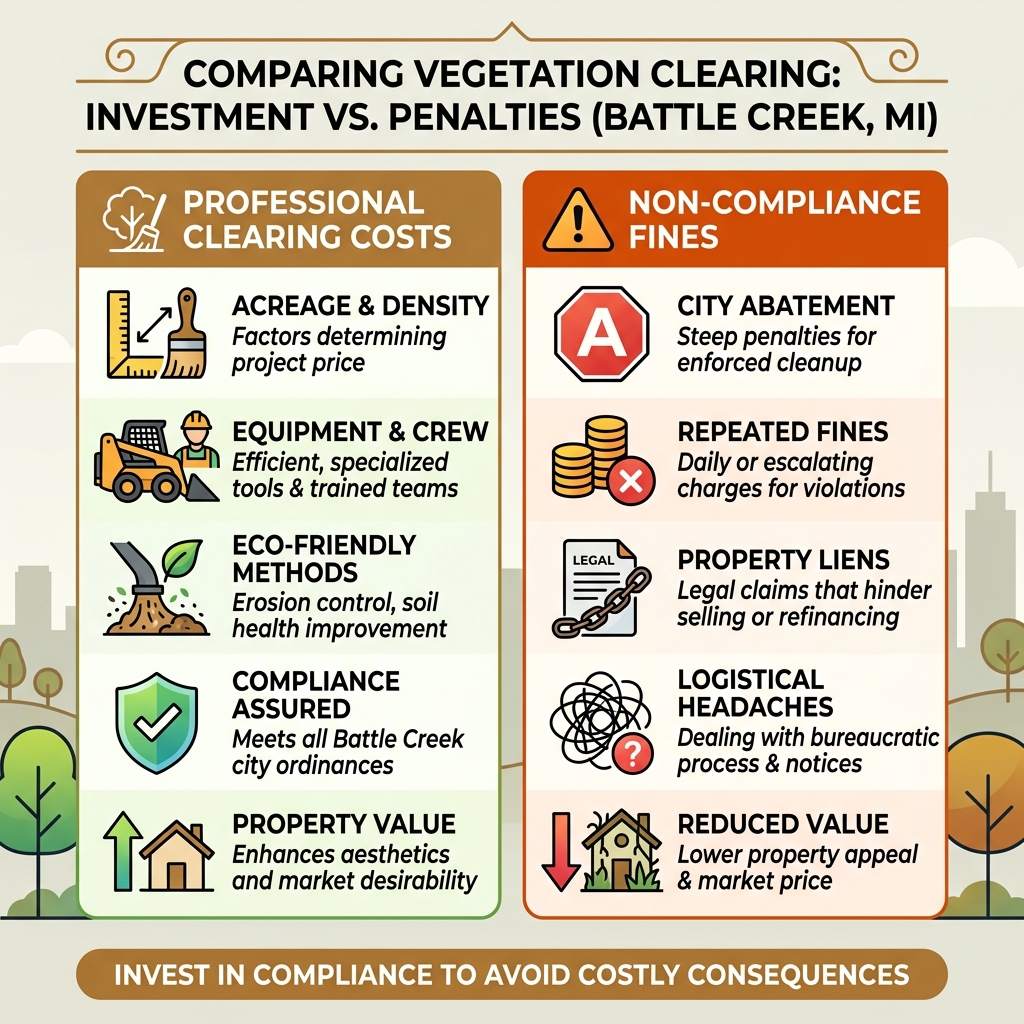
Professional Battle Creek vegetation clearing provides a defined process for evaluating overgrowth, selecting appropriate equipment, protecting designated areas, and preparing the property for its intended use. While the cost of a project varies based on the acreage and the density of the brush, it is consistently more affordable than the long-term costs of property liens and repeated fines. Professional clearing also adds immediate curb appeal and market value to your property, making it a sound financial investment. For those looking for a baseline, we offer a detailed breakdown of Lot Clearing Cost Per Acre.
Penalties for Non-Compliance in Calhoun County
The City of Battle Creek does not take weed and brush violations lightly. Ignoring a notice may lead the city to perform the required abatement and pursue the remedies permitted by local code. Property owners should contact Code Compliance when they have questions about a notice or deadline. If the bill remains unpaid, the city can place a lien on the property, which complicates future sales or refinancing. These liens accrue interest and can eventually lead to tax foreclosure if left unaddressed for several years.
For commercial property owners, staying ahead of these regulations is part of a smart Industrial Vegetation Management strategy. It protects your brand image, ensures the safety of your employees and customers, and ensures you remain in good standing with local government agencies. Overgrown commercial lots are often targets for illegal dumping, which can lead to even more significant environmental liabilities and cleanup costs.
Commercial and Residential Site Preparation
Beyond compliance, Battle Creek vegetation clearing is essential for any new development. Whether you are clearing a lot for a new home in Portage or preparing a commercial site in Kalamazoo, professional grading and clearing ensure a stable foundation. Removing organic matter from the building footprint is critical, as decomposing roots and stumps can cause soil settling and structural cracks in foundations over time.
We also provide right-of-way clearing for utilities and agricultural restoration for farmers looking to put old fields back into production. This involves removing decades of growth to reclaim valuable tillable acreage. When you search for Clearing and Grading Companies Near Me, you are looking for a partner who understands the local soil types—from the sandy loams of Calhoun County to the heavier clays found elsewhere—and how they react to heavy machinery and clearing activities.
Frequently Asked Questions about Battle Creek Land Clearing
What is the 30-foot defensible space requirement in Battle Creek?
In Battle Creek, the fire department requires all property owners to maintain a 30-foot “defensible space” around any structure. This means removing dry grass, dead brush, and any vegetation that could easily ignite and spread fire to the building. In high-risk areas, this zone may be extended to 100 feet. This space allows firefighters to safely operate and defend your home during a wildfire event.
How much does professional land clearing cost per acre in Michigan?
The cost per acre depends heavily on the “fuel load”—the density and size of the vegetation. Project scope depends on vegetation density, tree and stump size, terrain, soil conditions, access, debris handling, and the finish required for the property’s next use. Factors such as terrain slope, soil moisture, and the presence of large rocks also influence the price. We recommend getting a site assessment to receive an accurate, project-specific estimate.
What are the most common invasive species requiring removal in Calhoun County?
Common invasive shrubs found in southern Michigan include autumn olive and multiflora rose, along with several nonnative honeysuckle species. These species spread rapidly via bird droppings and can take over an open field or forest understory in just a few seasons, outcompeting native plants and reducing the land’s value for both agriculture and wildlife. Other concerns include Oriental Bittersweet and Japanese Knotweed, which require specialized removal techniques.
Do I need a permit for vegetation clearing in Battle Creek?
Permit requirements depend on the property and the work being performed. Clearing that affects regulated wetlands, floodplains, inland waters, drainage, or soil disturbance may require state or local review before work begins. However, if you are clearing land near a designated wetland or within a protected floodplain, you may need a permit from the Michigan Department of Environment, Great Lakes, and Energy (EGLE). It is always best to check with the local zoning office before beginning large-scale clearing projects.
When is the best time of year for land clearing in Michigan?
Forestry mulching can be performed year-round, but many landowners prefer the winter months when the ground is frozen. This minimizes soil disturbance and allows for easier access to swampy areas. For weed abatement and grass cutting, the peak season is late spring through early autumn. Clearing during the dormant season also prevents the spread of certain tree diseases like Oak Wilt.
Can I keep the wood chips from the clearing process?
Absolutely. One of the benefits of forestry mulching is that the material stays on your property. You can use the mulch for trail surfacing, garden beds, or simply leave it in place to decompose and nourish the soil. If you prefer the material to be removed, we can arrange for hauling, though this typically increases the project cost.
Conclusion
At BrushTamer, we believe that land management is a responsibility we share with the community. From our roots in the Midwest, we have built a reputation for delivering reliable, high-quality results that respect the environment while meeting the practical needs of property owners. Whether you are in Battle Creek, St. Joseph, or Grand Rapids, our team is ready to help you navigate the complexities of Battle Creek vegetation clearing. We pride ourselves on our transparency, our state-of-the-art equipment, and our deep understanding of Michigan’s unique ecological landscape.
Don’t wait for a city notice or a fire hazard to force your hand. Take control of your property today with professional standards and environmentally responsible techniques. A well-managed property is safer, more beautiful, and more valuable.
Ready to reclaim overgrown property with a clear, site-specific plan? Contact BrushTamer about Battle Creek vegetation clearing to discuss your property, vegetation conditions, access needs, and intended land use.