
Why Hiring a Brush Removal Contractor Is the Smart Move for Overgrown Properties
A brush removal contractor is a specialized land management professional who utilizes industrial-grade machinery, such as forestry mulchers and brush cutters, to clear dense vegetation, invasive species, and woody debris from a property. Unlike standard landscaping, this professional service focuses on reclaiming land that has become unusable due to years of unmanaged growth, ensuring the terrain is restored for agricultural, residential, or commercial use. The process is not merely about aesthetics; it is a fundamental step in land stewardship that addresses safety, ecology, and property utility.
| What They Do | Why It Matters |
|---|---|
| Clear dense brush, saplings, and invasive plants | Reclaims usable land fast |
| Use forestry mulchers, brush hogs, and cutters | Handles terrain standard mowers can’t touch |
| Create defensible space around structures | Reduces wildfire and pest risk |
| Mulch or haul debris on-site | Leaves property clean and ready to use |
| Handle permits and local regulations | Keeps your project legal and compliant |
In Northern Indiana and Lower Michigan, a qualified brush removal contractor helps property owners manage rapid vegetation growth before it limits access, safety, and usability. Small patches of weeds, vines, invasive honeysuckle, and saplings can quickly become dense overgrowth that limits how the property can be used. Before long, your acreage in Mishawaka or South Bend becomes a liability rather than an asset. This overgrowth is not merely an aesthetic issue; it represents a significant fire hazard, a breeding ground for disease-carrying pests, and a major deterrent to property value. Many landowners find themselves overwhelmed by the sheer speed at which the Midwest landscape can reclaim a cleared field, turning a once-open pasture into a dense thicket in just a few seasons.
The transformation of such a property requires more than manual labor; it requires the strategic intervention of a professional. The right brush removal contractor can turn dense overgrowth into a cleaner, more accessible property using equipment matched to the terrain. However, the effectiveness of the reclamation depends entirely on the expertise and equipment of the professional you hire. Choosing an inexperienced operator can lead to soil compaction, damage to desirable timber, and incomplete removal that leads to rapid regrowth. A professional approach protects soil structure, preserves desirable trees, and supports healthier long-term land management.
I’m Leon Miller, owner of BrushTamer. Since founding the company in 2021, I have dedicated my career to helping property owners across Northern Indiana and Lower Michigan reclaim their land. Based in Plymouth, Indiana, BrushTamer serves a wide radius including Granger, Nappanee, and Bristol. We understand the specific soil conditions and vegetation types unique to the Midwest. This guide is designed to provide you with the authoritative knowledge needed to select a brush removal contractor who will deliver high-quality, environmentally responsible results. We believe that every acre has potential, and our goal is to help you unlock that potential through precision clearing and expert land management strategies.
Defining Professional Brush Removal and Land Management
Professional brush removal is the systematic mechanical clearing of the “understory”—the layer of vegetation between the forest floor and the tree canopy—to restore land health, accessibility, and safety. This process is a core component of professional land management and is distinct from general lawn care. While a typical landscaping crew might handle grass and ornamental shrubs, a brush removal contractor employs high-torque, industrial machinery designed to pulverize woody perennials, thickets, and saplings up to several inches in diameter. This specialized equipment allows for the processing of organic material on-site, which is far more efficient than manual cutting and hauling.
In the Midwest, particularly in areas like Middlebury, Wakarusa, and Millersburg, the landscape is prone to aggressive colonization by invasive species. Professional management ensures that these plants are not just cut down, but processed in a way that prevents immediate resurgence. This often involves the use of forestry mulching, which returns organic matter to the soil while clearing the path for future use. By shredding the vegetation into a fine mulch, we create a protective layer that suppresses weed growth and prevents soil erosion, which is a common problem after traditional bulldozing methods.
Distinguishing Brush Removal from Land Clearing
It is important to distinguish between targeted brush removal and comprehensive land clearing. Brush removal specifically targets the “trash” vegetation—the briars, invasive shrubs, and small, low-value trees that choke out the ground level. This is the ideal solution for property owners in Shipshewana or Ligonier who wish to maintain their mature hardwoods while clearing out the messy undergrowth. It is a surgical approach to land management that preserves the canopy while opening up the ground level for walking trails, views, or pasture.
In contrast, land clearing services are often more invasive. This process may involve the total removal of all vegetation, including large timber, followed by extensive stump grinding and soil grading. For those dealing with a dense thicket of autumn olive or honeysuckle, a heavy brush removal ultimate guide approach is usually the most efficient way to reclaim the land without the ecological impact of a total “scrape.” Land clearing is typically reserved for new construction or major agricultural conversions, whereas brush removal is a restoration tool.
The Role of Selective Thinning in Property Health
A high-tier brush removal contractor practices selective thinning to enhance the ecological value of your property. This involves identifying and removing invasive “choke plants” that compete with native species for sunlight, water, and nutrients. According to the USDA Invasive Species Information Center, invasive plants can significantly alter local ecosystems and reduce biodiversity. In the Midwest, species like Buckthorn and Multiflora Rose can quickly dominate a woodlot, preventing the growth of new oak or maple saplings.
By removing these threats in locations like Syracuse and Warsaw, we allow the remaining oaks, maples, and walnuts to thrive. This eco-friendly land clearing method improves the overall health of the forest or pasture. When the “ladder fuel” and invasive weeds are eliminated, the property becomes more resilient to disease and environmental stress. Furthermore, selective thinning improves air circulation within the wooded areas, which reduces the prevalence of fungal diseases that can affect mature trees. Ultimately, this careful management increases both the aesthetic and market value of the land while fostering a more diverse and healthy native habitat.
Why Your Property Needs a Professional Brush Removal Contractor
Hiring a professional brush removal contractor is the most effective way to mitigate wildfire risks, eliminate pest habitats, and significantly increase property value. For Midwest property owners, unmanaged overgrowth can create safety, access, and maintenance challenges that should be addressed before they worsen. Dense, dry brush acts as a primary fuel source for fires and provides a protected environment for pests that can eventually migrate into residential structures. The accumulation of dead wood and dry vines creates a “tinderbox” effect that can be ignited by lightning or accidental sparks.
Fire Safety and Defensible Space Requirements
One of the primary safety functions of professional brush removal is the creation of “defensible space.” This is a buffer zone created by removing flammable vegetation to slow the spread of fire and provide a safe perimeter for emergency responders. According to the National Fire Protection Association (NFPA), maintaining a clean zone around structures is critical for wildfire preparedness. This is especially important for rural properties where fire department response times may be longer.
Fire-safety guidance often emphasizes reducing vegetation around structures, especially by removing dead brush, thinning dense growth, and limiting ladder fuels. By removing “ladder fuel”—the low-hanging brush that allows ground fires to climb into the tree canopy—we significantly reduce the risk of catastrophic loss. Our brush management services are specifically designed to meet these safety requirements for property owners in Laporte, Michigan City, and Valparaiso. We focus on thinning out dense clusters of vegetation and removing dead standing timber that could fall and block access roads during an emergency, ensuring that your acreage is both beautiful and protected.
Pest Mitigation and Wildlife Management
Overgrown land is a primary habitat for unwanted pests. Thick brush provides the ideal damp, shaded environment for rodents, snakes, and wood-destroying insects. More importantly for residents in Chesterton, Portage, and Hammond, dense undergrowth is a major breeding ground for ticks, which carry Lyme disease and other pathogens. The presence of invasive shrubs like Japanese Barberry has been scientifically linked to higher populations of black-legged ticks, as the plant creates a humid microclimate that helps them survive.
By utilizing professional brush clean up services, you eliminate the nesting sites and cover that these pests require. Professional clearing improves air circulation and allows sunlight to reach the ground, which naturally dries out the environment and discourages pest infestations. This makes your property in Gary, Crown Point, or Hobart safe for children, pets, and livestock to enjoy without the constant threat of tick-borne illnesses or rodent damage. Additionally, by removing invasive brush, you encourage the return of beneficial wildlife, such as songbirds and pollinators, who prefer the diverse habitats created by managed land over the monoculture of invasive thickets.
Essential Services and Equipment for Land Reclamation
A modern brush removal contractor uses specialized equipment to process dense vegetation on-site and leave the property cleaner, safer, and easier to access. At BrushTamer, we utilize specialized machinery that allows us to work efficiently across the diverse terrains of the Midwest, from the flat plains of Merrillville and Rensselaer to the rolling hills of Cassopolis and Edwardsburg. The shift from manual labor to mechanical mulching has revolutionized the industry, allowing for projects that once took weeks to be completed in a matter of days.
Core Services Offered by a Brush Removal Contractor
A comprehensive brush removal contractor provides a suite of services designed to reclaim every inch of your property. These typically include:
- Forestry Mulching: This is the most efficient method for modern clearing. A single machine cuts, grinds, and mulches vegetation in place, leaving a nutrient-rich layer of mulch behind. This eliminates the need for burning or hauling debris.
- Stump Grinding: To ensure a clean, mowable finish, track-driven grinders remove stumps to below the soil line. This is essential for projects in Kokomo or Logansport where the land will be repurposed for lawn or pasture.
- Debris Removal: While mulching is the standard, some projects in urban areas like Lafayette or West Lafayette may require the complete hauling of organic waste to local green facilities to meet specific aesthetic or zoning requirements.
- Fence Line Clearing: Reclaiming the perimeter of your property to allow for the installation of new fencing or the maintenance of existing boundaries. This is critical for livestock owners who need to maintain secure enclosures.
Specialized Equipment for Challenging Terrains
The equipment used by a professional is what separates a successful reclamation from a failed attempt. We utilize commercial-grade brush hogging equipment and forestry mulchers that can handle vegetation up to 8 inches in diameter. These machines are equipped with high-flow hydraulic systems and carbide-tipped teeth that can pulverize hardwood saplings and dense vines with ease.

For properties with steep slopes or ravines—common near the riverbanks of South Haven or the glacial topography of Monticello and Peru—specialized track-driven machines are required. These units distribute weight evenly to minimize soil disturbance and can operate safely on inclines where traditional tractors would tip. This equipment allows trained operators to complete difficult clearing work more safely and efficiently than manual cutting alone. By using low-ground-pressure tracks, we can work in sensitive areas without leaving deep ruts or damaging the root systems of the trees you wish to keep, providing a level of efficiency and care that cannot be matched by consumer-grade tools.
Planning a Brush Removal Project for Midwest Properties
The scope of a professional brush removal contractor project depends on vegetation density, terrain, access, equipment needs, and the desired finished condition. Professional clearing requires specialized machinery, trained operators, and a process designed to protect the property while completing the work efficiently. Property owners should view professional clearing as a step toward safer, more usable, and easier-to-maintain land. A well-cleared property is not only more enjoyable but also significantly easier to sell or lease.
Factors That Shape the Project Scope
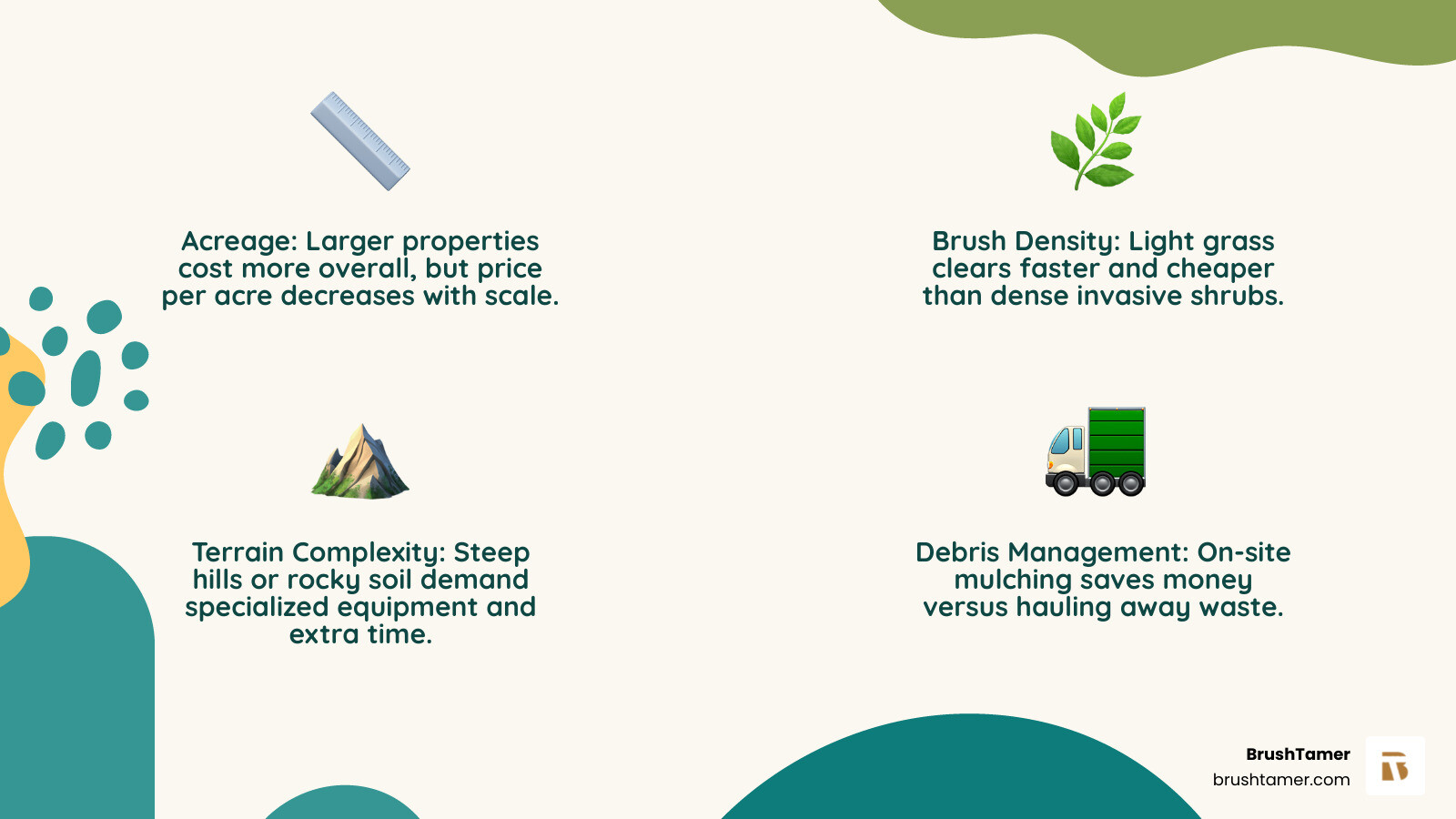
Several variables determine the right clearing plan for a brush removal project. It is rarely a one-size-fits-all calculation:
- Acreage: Larger properties often require a broader clearing strategy, including access planning, equipment staging, and phased vegetation removal. Larger jobs allow the contractor to stay on-site longer, maximizing the efficiency of the equipment.
- Brush Density: Clearing a field of tall grass is significantly faster than clearing a “wall” of 20-year-old invasive shrubs and saplings. Denser woody material requires heavier-duty equipment, slower passes, and a more deliberate clearing process.
- Terrain Complexity: Steep hills, rocky soil, or swampy conditions in Huntington or Bluffton require specialized equipment and more time to navigate safely. If a machine has to move slowly to avoid obstacles, the labor hours increase.
- Debris Management: On-site mulching is often the most efficient debris-management approach because it processes vegetation where it is cleared. If debris must be hauled away, the project may require additional planning for labor, trucking, disposal, and site access.
Optimal Timing for Brush Management
Timing is a critical factor for efficiency in the Midwest. While we operate year-round, there are strategic advantages to different seasons that can affect both the cost and the final result:
- Late Winter/Early Spring: This is often the best time for all about land clearing because the ground is often frozen, which minimizes soil disturbance in areas like St. Joseph and Niles. Additionally, the lack of foliage allows the operator to see the terrain more clearly.
- Late Spring/Summer: This is the ideal time for identifying invasive species while they are in bloom, though we must be mindful of nesting bird seasons in Dowagiac and Three Rivers. Clearing during the growing season can also help in identifying which trees are healthy and which are dead.
- Fall: Excellent for clearing before the snow falls, ensuring your property in Kalamazoo or Portage is clean and safe for the winter months. Fall clearing also prepares the ground for spring planting or seeding.
Regular maintenance helps prevent heavy regrowth and keeps the property easier to manage over time. Once the initial heavy clearing is done, the cost to maintain the land is a fraction of the original reclamation price.
Compliance, Regulations, and Selecting a Reliable Partner
To select a reliable brush removal contractor, property owners must verify the company’s commercial liability insurance, state-specific licensing, safety certifications, and their familiarity with local environmental regulations in Indiana and Michigan. Navigating the legal side of land management is just as important as the physical clearing. A reputable contractor will be familiar with the specific requirements of St. Joseph County, Kalamazoo County, and the various municipalities across our service area, including Battle Creek and Marshall. Failure to comply with local ordinances can lead to heavy fines and project delays.

Key Qualifications for a Reliable Brush Removal Contractor
When vetting land clearing companies, do not choose a contractor without first confirming insurance, equipment, safety practices, and local experience. Incomplete credentials, limited equipment, or unclear safety practices can create unnecessary risk for the property owner.
- Insurance: They must carry comprehensive liability insurance and workers’ compensation. This protects you if an accident occurs on your property in Coldwater or Holland. Always ask for a certificate of insurance (COI) before work begins.
- Licensing: Ensure they are registered to operate in Indiana or Michigan. This ensures they are a legitimate business entity held to state standards.
- Safety Protocols: Ask about their safety training and how they protect your existing landscaping and structures in Grand Rapids or South Haven. A professional will mark utilities and identify “no-go” zones before starting the machines.
- Expertise: Look for a company with a proven track record. BrushTamer was founded in 2021 with a focus on high-quality, client-focused results. Check online reviews and ask for local references to verify their work quality.
Environmental Considerations and Local Permits
In 2026, environmental stewardship is more important than ever. Professional contractors understand the impact of clearing on soil erosion and local wetlands. In areas like Watervliet, Paw Paw, or Bangor, proximity to local river systems or Lake Michigan may trigger specific permitting requirements. Clearing too close to a waterway can lead to runoff issues that affect water quality and local fish populations.
We help our clients navigate land clearing regulations, ensuring that we respect nesting seasons for local wildlife and adhere to soil conservation standards. Proper planning prevents “surprises” from local building departments or environmental agencies in Chicago, Evanston, or Skokie. Whether you are in Des Plaines, Arlington Heights, or Schaumburg, we ensure your project is fully compliant with all local ordinances. This includes understanding the “Right to Farm” acts in agricultural zones and ensuring that any clearing for construction meets the necessary site preparation standards required by local building codes.
Frequently Asked Questions about Brush Removal
What factors affect a brush removal project?
The cost to clear an acre varies significantly based on the density of the vegetation. Project scope varies based on vegetation density, terrain, access, debris handling, and the level of finish needed after clearing. Light brush clearing is usually simpler, while dense woody overgrowth often requires heavier equipment and a more detailed clearing plan. Factors like the presence of large rocks, steep inclines, or the need for debris hauling will also influence the final price. We provide site assessments so property owners understand the recommended clearing approach before work begins.
What is the difference between brush hogging and forestry mulching?
Brush hogging uses a rotary cutter to cut tall grass and light brush up to 3 inches thick. It is primarily a maintenance tool for properties in Waukegan or Zion that are already relatively clear. Forestry mulching uses a high-powered drum to grind entire trees and thick brush into mulch. Mulching is a reclamation tool that handles much heavier growth and leaves a finished, walkable surface. While brush hogging leaves behind cut stalks that can be sharp and unsightly, mulching creates a smooth, park-like finish that is immediately usable for recreation or landscaping.
How long does the brush removal process take?
For most residential properties between 1 and 5 acres, the process typically takes 1 to 3 days. A professional brush removal contractor using a forestry mulcher can clear about 1 to 2 acres per day depending on the density of the vegetation. Manual clearing of the same area could take a crew of workers several weeks. Our goal is to minimize the time our heavy equipment is on your property while ensuring a thorough and high-quality result.
Will the brush grow back immediately?
While clearing removes the existing vegetation, seeds in the soil and root systems of certain species can lead to regrowth. However, forestry mulching provides a thick layer of mulch that acts as a natural weed suppressant, significantly slowing down the return of invasive plants. We recommend a follow-up maintenance plan, such as annual brush hogging or targeted herbicide application, to ensure your land stays clear for the long term. Proper maintenance is the key to protecting your initial investment in land reclamation.
Conclusion
Choosing the right brush removal contractor is the difference between a property that remains a constant headache and one that becomes a source of pride and value. Since 2021, BrushTamer has been the Midwest’s trusted partner for reclaiming land across Northern Indiana and Lower Michigan. From the lakeshore communities of Michigan City and Chesterton to the industrial hubs of Gary and Hammond, we provide the expertise and equipment necessary to handle the toughest overgrowth. We understand that your land is an investment, and we treat every project with the precision and care it deserves.
Whether you are in Elkhart, Goshen, or Kalamazoo, our team is dedicated to providing high-quality, environmentally responsible professional land management. We don’t just clear brush; we give you your land back, ensuring it is safe, usable, and aesthetically pleasing for years to come. By removing invasive species and creating defensible space, we help you protect your home and enhance the natural beauty of the Midwest landscape.
Ready to reclaim overgrown land with help from a professional brush removal contractor? Contact BrushTamer today to schedule a site assessment and learn how our team can help make your property safer, cleaner, and easier to use.