
What You Need to Know About Using a Skid Steer to Clear Land
Using a skid steer to clear land is one of the most controlled ways to convert overgrown property into build-ready or farm-ready ground, without unnecessary soil disruption. Historically, land clearing was a choice between slow manual labor and massive bulldozers that stripped the topsoil and left behind enormous debris piles. The advent of the high-horsepower compact track loader (CTL) changed this dynamic, offering a surgical approach to vegetation management. A skid steer equipped with high-flow hydraulics and forestry-rated guarding can remove invasive brush, saplings, and select trees while protecting soil structure and preserving mature “keeper” trees that add value to your property.
Brush Tamer, founded in 2021, is a professional vegetation management company serving Lower Michigan and Northern Indiana communities. For landowners using a skid steer to clear land across Lower Michigan and Northern Indiana, Brush Tamer brings a professional, site-specific approach built for local soils and invasive pressure. Our operations are built around Midwest realities: mixed hardwoods like oak and maple, aggressive invasives like autumn olive, and soft loams prone to compaction. We understand that a property in the St. Joseph River valley requires a different approach than a sandy lot near Lake Michigan. Our goal is to provide a clean slate for your project while maintaining the ecological integrity of the surrounding landscape.
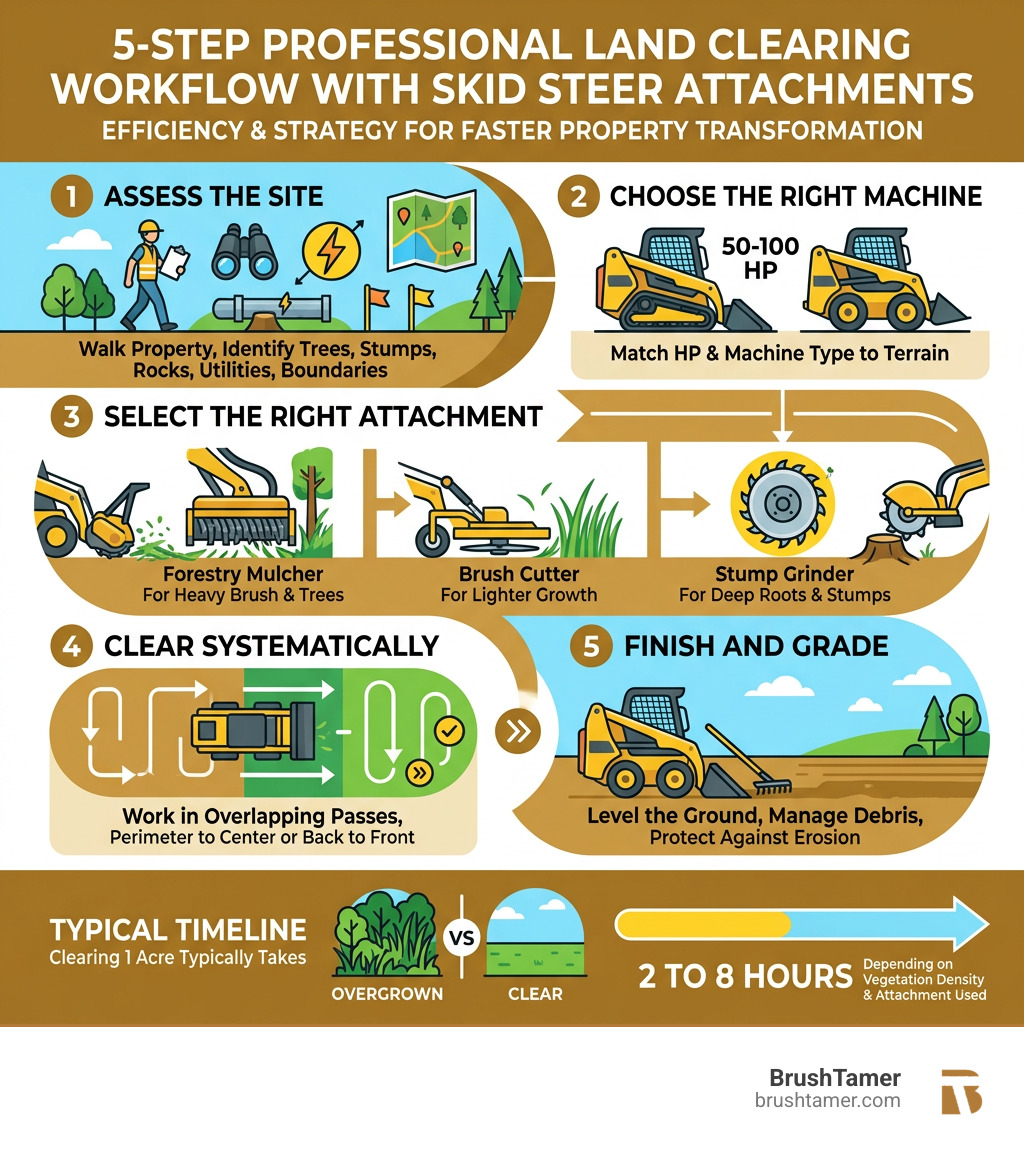
The Professional Land Clearing Workflow
- Site assessment and risk mapping — Before using a skid steer to clear land, Brush Tamer confirms boundaries, access, utilities, and fence-line hazards (wire, posts, drain tile, and easements).
- Machine and attachment matching — We select a tracked loader with the specific hydraulic flow required for your vegetation density. Not all skid steers are created equal; we match the GPM (gallons per minute) to the attachment to ensure maximum efficiency.
- Primary clearing — Targeted growth is removed via mulching, cutting, or extraction. We work in systematic patterns to maintain visibility and ensure a safe operating zone for the crew and the property.
- Debris and stump management — Material is consolidated, stumps are ground as needed, and regrowth triggers are eliminated. This step is crucial for preventing the return of invasive species.
- Finish grading and stabilization — The surface is shaped for drainage and erosion control. We leave the site ready for the next trade, whether that is a foundation crew, a fence installer, or a landscaping team.
Timing and Outcomes
As a planning baseline, using a skid steer to clear land often takes several hours per acre, depending on stem count, diameter, slope, and access. Reclaiming light brush outside Portage moves quickly, while dense, woody invasives near Niles or along river edges outside South Bend demand slower, more deliberate passes. The key advantage of hiring Brush Tamer is predictable results: clean lines, controlled disturbance, and a site prepared for construction, pasture conversion, or long-term property management—without the collateral damage larger machines can cause.
Why a Skid Steer Is the Most Efficient Machine for Midwest Land Clearing
When using a skid steer to clear land, a compact track loader (CTL) is often the best fit for Midwest properties because it pairs high hydraulic power with low ground disturbance. Properties around Grand Rapids, Kalamazoo, South Haven, Valparaiso, and LaPorte frequently need selective clearing that protects mature trees, keeps soil stable, and avoids excessive rutting—conditions where a CTL excels over heavier equipment like bulldozers or large excavators. While a bulldozer pushes everything in its path, creating massive soil disturbance and large piles of debris that must be burned or hauled away, a skid steer with a mulching head processes material on the spot.
Brush Tamer builds each plan around vegetation density, soil sensitivity, and the finish you need, so using a skid steer to clear land produces clean boundaries with minimal rework. The practical result is faster completion, cleaner boundaries, and less follow-up work for grading and erosion repair. The agility of the skid steer allows us to weave between valuable timber, removing only the undergrowth and invasive species that choke out the native ecosystem. This precision is particularly valuable for residential lots where space is limited and property lines are tight.
CTL Advantages for Lower Michigan and Northern Indiana Properties
- Maneuverability around keepers — Brush Tamer can work tight to fence lines, orchard edges, and trails without collateral damage. This is essential for maintaining the aesthetic value of a wooded lot.
- Lower ground pressure — Tracks distribute weight over a larger surface area, protecting soft silty loams near the St. Joseph River and damp ground common in LaPorte County. This prevents the deep ruts that can lead to long-term drainage issues.
- Attachment-driven workflow — Switching from mulching to grappling to grading keeps the project moving without changing machines. This versatility reduces the number of machines on-site, further protecting the soil.
- On-site material management — Forestry mulching converts brush and small trees into a mulch layer that supports soil stability and reduces haul-off needs. This mulch acts as a natural erosion control blanket, which is vital on the rolling hills of West Michigan.
For planning larger projects and sequencing work with other site trades, see our Lot Clearing Guide 2025.
Power and Hydraulics Behind Professional Results
For dense hardwood and invasive thickets, using a skid steer to clear land effectively requires enough hydraulic flow to hold cutter speed under load, so the finish stays consistent. Maintaining cutter-head RPM is the secret to a clean finish; if the RPM drops, the mulch becomes coarse, and the machine bogs down. High-flow systems provide the necessary GPM to keep the rotor spinning even when processing 6-inch diameter hardwoods. For reference on professional tooling options, see these skid-steer attachments, which illustrate the class of equipment used for commercial clearing. By utilizing the right power-to-weight ratio, we ensure that the job is done quickly without sacrificing the quality of the finish.
Essential Equipment and Attachments for Professional Land Clearing
The outcome depends on matching hydraulics and attachments. When using a skid steer to clear land, the wrong setup creates slower progress, rougher finish, and higher mechanical risk. In practice, that means a compact track loader with high-flow hydraulics (commonly 30–45 GPM) powering purpose-built heads capable of processing hardwood stems and tangled undergrowth found around Kalamazoo, Elkhart, and the rural corridors between. Using standard-flow machines for heavy clearing often leads to overheating and poor production rates, which is why Brush Tamer invests in top-tier, high-output equipment.
Brush Tamer selects attachments based on vegetation type, site sensitivity, and end use, especially for fence line clearing where precision and debris control matter. For a broader overview, visit Land Clearing Equipment.
| Attachment Type | Best Use Case | Finish Quality |
|---|---|---|
| Forestry Disc Mulcher | Rural acreage, rapid tree knockdown | Coarse mulch, high production speed |
| Drum Mulcher | Residential areas, precision clearing | Fine, “finished” wood chip appearance |
| Root Grapple | Moving logs, rocks, and debris piles | Clean soil, removes surface mess |
| Stump Grinder | Below-grade root removal | Level ground, ready for seeding |
| Rotary Brush Cutter | Tall grass and light saplings | Rough cut, ideal for pasture reclamation |
How Brush Tamer Matches the Tool to the Property
- Acreage-scale clearing: A Forestry Disc Mulcher is often the best fit for rural parcels because it can fell and process larger stems quickly. The disc acts like a giant flywheel, storing kinetic energy to blast through thick brush.
- Controlled work near homes and roads: In towns like Granger and Mishawaka, Brush Tamer frequently chooses a drum mulcher for tighter discharge control. The drum design keeps debris contained, which is critical when working near windows, vehicles, or pedestrians.
- Finish-stage removal and cleanup: For stumps that must be removed below grade for driveways, pads, or landscaping, we use a dedicated stump grinder and follow with grading tools to leave a stable surface. This ensures that future settling is minimized.
Using the wrong attachment—or an underpowered hydraulic system—creates three predictable problems: slow production, poor finish quality, and higher mechanical risk. For example, using a rotary cutter on 6-inch trees will likely damage the blades and the spindle. Brush Tamer avoids those outcomes by specifying forestry-rated equipment sized for Midwest conditions from day one. We also maintain a variety of specialized buckets and rakes to ensure that once the vegetation is down, the ground is left in the exact condition the client requires.
The 5-Step Professional Process for Clearing Land with a Skid Steer
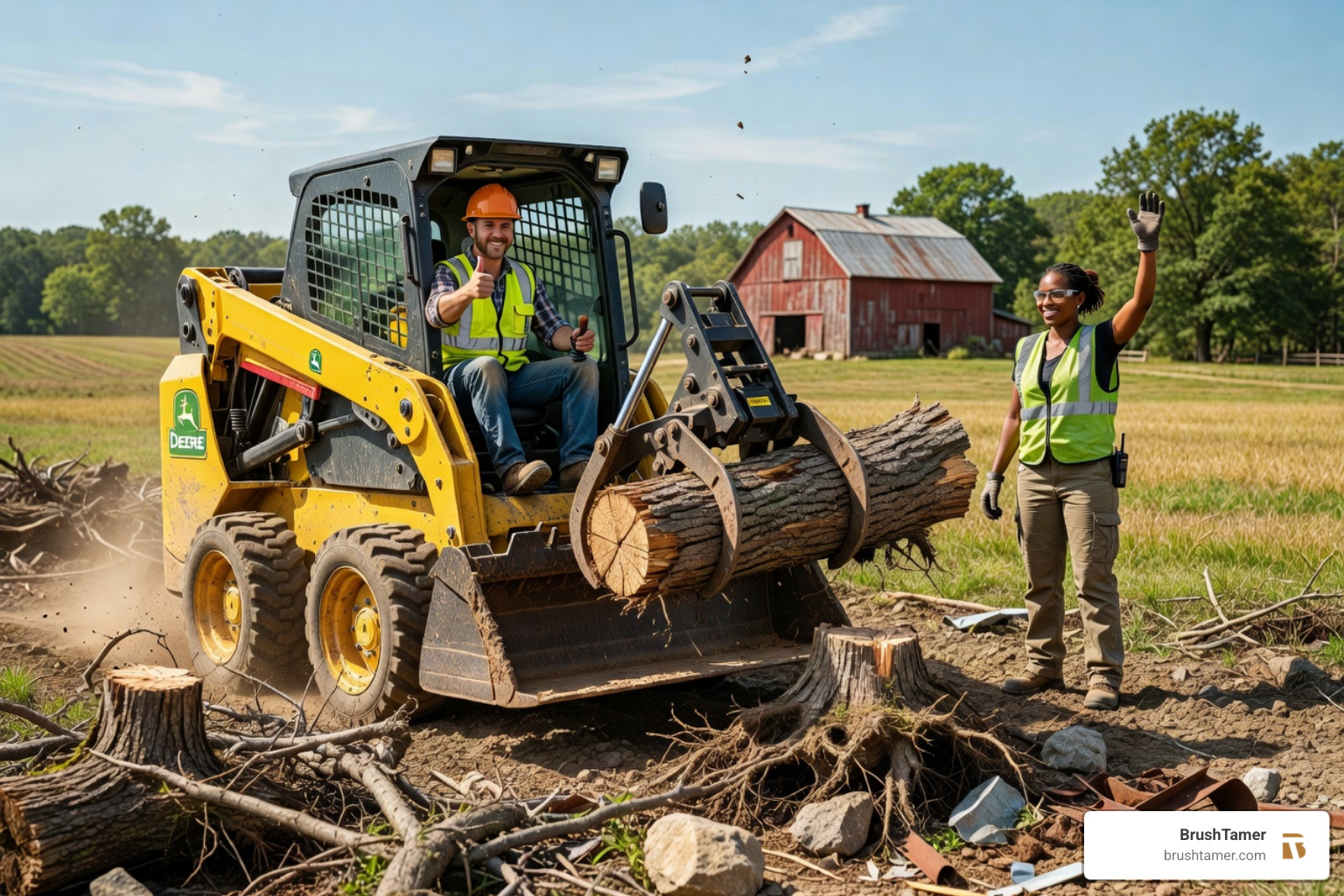
Brush Tamer uses a repeatable process, so using a skid steer to clear land stays safe, controlled, and resistant to fast regrowth. This method is engineered for Lower Michigan and Northern Indiana properties where drainage challenges, soft soils, and invasive thickets create long-term maintenance issues if clearing is done inconsistently. A haphazard approach often leaves behind root fragments that lead to rapid regrowth, or worse, creates drainage basins that flood during the spring thaw.
For full service details, visit land clearing services.
Step 1: Strategic Planning and Site Assessment
Every Brush Tamer project begins with a mapped plan covering access, safety, and scope. We identify boundaries, utility hazards, and “no-go” zones, then mark keeper trees for protection during operations. In areas with older boundaries and fence rows, we flag hidden risks—wire, posts, dumped concrete, drain tile, and boulders—before using a skid steer to clear land. We also consider the sun’s path and wind direction to ensure that the clearing provides the desired privacy or light exposure for the future build.
Deliverable: A clear execution sequence (entry point, pass pattern, staging areas) that maximizes productivity and minimizes disturbance.
Step 2: Selecting the Right Machine for the Job
Brush Tamer matches machine size to vegetation density and ground conditions. For Northern Indiana clay and mixed soils around Warsaw, Goshen, and Elkhart, traction and stability are critical, so we deploy compact track loaders rather than wheeled machines. Tracks distribute weight and reduce rutting on softer ground near wetlands or river corridors. We also ensure the machine is equipped with a forestry kit, which includes heavy-duty cooling systems to prevent the engine from overheating while processing thick wood fiber.
Field rule: Dense, woody growth requires higher horsepower and high-flow hydraulics so the mulching head maintains rotor speed without stalling, which ensures a consistent mulch size.
Step 3: Executing Primary Vegetation Removal
The primary clearing phase removes targeted brush and trees using a forestry mulcher in systematic, overlapping passes. Brush Tamer works from the perimeter inward to establish a safe zone, maintain visibility, and control material flow. This step eliminates common Midwest invasives—autumn olive, buckthorn, and multiflora rose—that frequently overtake edges near Battle Creek, Niles, and Benton Harbor. By mulching these plants into the soil, we deprive them of the light and space they need to return.
For thickets, fence rows, and overgrown corridors, see our Brush Management service line.
Step 4: Managing Obstacles and Debris
After the main cut, Brush Tamer switches attachments to address stumps, embedded roots, and heavy debris. We use grapples for consolidation and haul staging, then grind stumps below grade when the site is destined for building, access roads, or finish landscaping in places like Elkhart and Valparaiso. This phase is where the “heavy lifting” happens, removing the skeletal remains of the vegetation to reveal the true contour of the land.
For scope options and outcomes, visit Stump Grinding & Removal.
Step 5: Post-Clearing Grading and Erosion Control
Brush Tamer finishes by grading for drainage and stabilization. In Lower Michigan’s variable terrain—especially around river bluffs and low areas—erosion control is essential. We shape the site to reduce pooling, protect exposed soil, and leave a consistent surface that other contractors can work from immediately. This often involves back-dragging with a specialized bucket to create a smooth, seed-ready finish that prevents the soil from washing away during the next rainstorm.
For a finish that blends clearing with long-term soil protection, see our Forestry Mulching solutions.
Safety Protocols and Environmental Considerations for Midwest Clearing
Because forestry attachments spin at high speed, using a skid steer to clear land requires strict guarding, training, and maintenance, not shortcuts. Land clearing involves rotating cutting teeth moving at thousands of RPMs, making experienced, professional oversight non-negotiable. A single rock or piece of hidden wire can become a dangerous projectile if the operator is not properly trained and the machine is not correctly guarded. For additional context, see our guide on heavy brush removal.
Operator Protection and Equipment Maintenance
Brush Tamer operates enclosed cabs fitted with reinforced polycarbonate windows specifically designed for forestry applications. These “forestry kits” protect the operator from high-velocity debris that standard glass cannot withstand. Our crew conducts rigorous daily maintenance including hydraulic line inspections and cooling system purges. Mulching generates significant dust and wood fiber that can clog radiators and lead to engine fires if not managed—especially critical during humid Midwest summers in Fort Wayne or Battle Creek. We utilize reversible fans to blow out debris from the cooling stacks every few hours to ensure the machine runs at peak performance.
Adapting to Regional Ground Conditions
Ground conditions across Lower Michigan and Northern Indiana vary significantly. Sandy soils in West Michigan near Benton Harbor allow easier stump extraction but increase undercarriage wear due to the abrasive nature of the sand. Heavy clay in Northern Indiana near Warsaw becomes dangerously slick after rain, requiring expert track management to prevent sliding. Brush Tamer operators adjust speed and attachment height based on soil moisture and rock density to prevent excessive soil disturbance. We also pay close attention to local nesting seasons and environmental regulations to ensure our clearing activities do not disrupt local wildlife or violate wetland protections. By respecting the land, we ensure it remains viable and healthy for its intended use for decades to come.
Frequently Asked Questions
How long does it take to clear an acre with a skid steer?
Professional clearing of one acre typically takes between 2 and 8 hours. The timeframe depends on vegetation density—light brush in Portage clears significantly faster than 8-inch diameter hardwoods in a dense forest near Niles. Other factors include the slope of the land and the presence of obstacles like rocks or old structures. Brush Tamer provides accurate estimates after a site-specific assessment of species, stem count, and terrain.
Do I need high-flow hydraulics for land clearing?
Yes. High-flow hydraulics are required for professional-grade attachments like forestry mulchers and stump grinders. High-flow systems deliver the hydraulic horsepower needed to maintain rotor speed through thick wood. Without sufficient flow, the attachment stalls frequently, extending project timelines and increasing mechanical stress on the loader. Most standard skid steers do not have the cooling capacity or the GPM to run a mulcher effectively for more than a few minutes.
What is the difference between a brush cutter and a forestry mulcher?
A brush cutter is a rotary mower designed for grass, weeds, and small saplings up to roughly 3 inches in diameter. It leaves behind larger chunks of wood and can be messy. A forestry mulcher is a heavy-duty industrial tool that grinds entire trees into fine mulch, leaving a clean, walkable surface of wood chips rather than piles of cut debris. Mulching is generally preferred for residential and commercial sites where a finished look is required.
Can a skid steer handle steep slopes?
Compact track loaders are highly stable due to their low center of gravity and wide footprint, but extreme slopes—such as dunes or river bluffs near St. Joseph—require specialized techniques. Brush Tamer operators are trained to navigate these inclines safely, often working up and down the slope rather than across it to prevent rollovers. This ensures clearing is performed without compromising machine stability or causing slope erosion.
What happens to the debris after clearing?
When Brush Tamer uses a forestry mulcher, debris is converted into a nutrient-rich mulch layer that stays on-site. This mulch acts as a natural erosion barrier and suppresses weed growth while decomposing into the soil over time. If larger logs or rocks need removal, we use root grapples to consolidate and haul away material, leaving the site completely clean. We can also stack logs for firewood if the client requests it.
Do I need a permit to clear my land?
Permit requirements vary by location and site conditions. When using a skid steer to clear land near wetlands or waterways, confirm requirements with the local authority before work begins. In many rural areas of Michigan and Indiana, clearing brush and invasive species does not require a permit, but removing large trees or working near water might. Brush Tamer can help you navigate these local regulations during the site assessment phase to ensure your project remains compliant.
Conclusion
Professional land clearing with a skid steer is the most efficient and environmentally responsible way to transform overgrown acreage into usable property across Lower Michigan and Northern Indiana. By following a rigorous five-step process—from strategic planning to final grading—Brush Tamer ensures that your land is cleared safely, on schedule, and with a focus on long-term soil health. The versatility of the compact track loader allows us to handle everything from dense invasive thickets to precision clearing around valuable timber.
Whether you are preparing a building site in Valparaiso, reclaiming an old orchard in South Haven, or opening up acreage near Lansing, the quality of the equipment and the experience of the operator are the deciding factors. Since 2021, Brush Tamer has been the premier choice for property owners who demand high-quality, reliable vegetation management rooted in Midwest expertise. We take pride in helping our neighbors unlock the full potential of their land.
Ready to see the full potential of your property? Learn more about our services and contact Brush Tamer today to schedule your professional site assessment and take the first step toward a cleaner, more functional landscape.