
Is Land Clearing with Mulcher Equipment Right for Your Property?
Land clearing with mulcher equipment is an efficient, low-impact way to transform overgrown property into clean, usable space without burning debris, hauling large volumes of brush, or unnecessarily disturbing the soil. For property owners in the Midwest, where dense undergrowth and invasive species can quickly reclaim a field or forest edge, this technology offers a path to restoration that respects the natural landscape.
Here’s a quick snapshot of what mulching delivers:
| Factor | Forestry Mulching |
|---|---|
| Method | Single machine cuts, grinds, and spreads vegetation in one pass |
| Debris removal needed? | No — mulch stays on-site |
| Soil disturbance | Minimal — roots and topsoil stay intact |
| Tree size handled | Up to 8″ diameter (up to 15″+ with heavy-duty machines) |
| Daily clearing capacity | 1–15 acres depending on vegetation density |
| Best for | Brush clearing, invasive species, trails, pasture reclamation, firebreaks |
If you’re a property owner staring down acres of overgrown brush, tangled saplings, or invasive species, you’ve probably wondered: is there a way to clear this land without leaving extensive soil disturbance and debris behind? Traditional methods often involve heavy excavators and bulldozers that rip vegetation out by the roots, leaving behind massive craters and piles of debris that must be managed. This often results in a landscape that looks more like a construction site than a natural property.
The answer is yes — and it doesn’t involve a parade of bulldozers, a mountain of slash piles, or a burn permit. Forestry mulching provides a more targeted approach to vegetation removal. It allows for the removal of unwanted vegetation while preserving the trees you want to keep and protecting the soil that supports them. This is particularly important in regions like Northern Indiana and Lower Michigan, where the soil quality varies from sandy loams to heavy clays, and maintaining ground cover is essential for preventing erosion.
Traditional clearing methods strip the land bare. They push over trees, pull stumps, haul debris off-site, and often leave behind compacted, eroded soil that takes years to recover. For many property owners across Northern Indiana and Lower Michigan, that’s not just messy — it’s the wrong tool for the job. When you strip the topsoil, you remove the biological engine of your land, making it harder for native grasses and desired plants to return.
Forestry mulching takes a different approach entirely. One machine moves through dense vegetation and turns everything in its path into a protective layer of organic material — right where it stands. The soil stays intact. The nutrients stay in the ground. And your land is ready to use almost immediately. Whether you are preparing a site for a new home, creating a hunting plot, or simply reclaiming a backyard, the result is a park-like finish that is aesthetically pleasing and ecologically sound.
I’m Leon Miller, owner of BrushTamer and a hands-on land clearing professional based in Plymouth, Indiana, with direct experience in land clearing with mulcher technology across a wide range of terrain types and property sizes throughout the Midwest. In the sections below, I’ll walk you through how this process works, where it performs best, and how to determine whether it fits your property. We will explore the technical mechanics of the machinery, the long-term benefits to your soil, and the specific applications that make this the preferred choice for modern land management.
What is Forestry Mulching and How Does it Work?
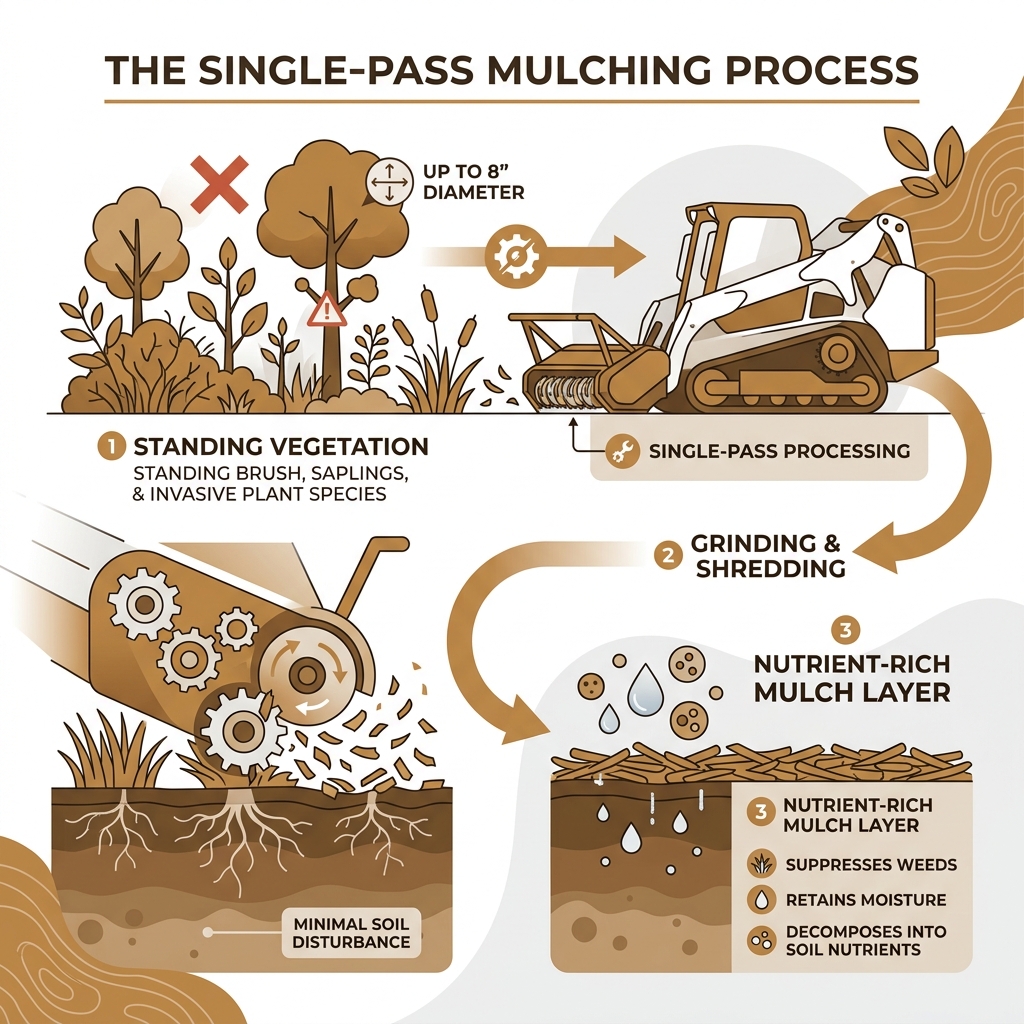
Forestry mulching is an advanced land clearing method that uses a single, specialized machine to cut, grind, and shred vegetation into a nutrient-rich layer of mulch left on the forest floor. Unlike traditional methods that require multiple machines to fell, pile, and haul away debris, our process at BrushTamer is a “single-pass” system. This means we process the material exactly where it stands, which significantly reduces the time and equipment footprint on your property. By eliminating the need for multiple stages of work, we minimize the risk of soil compaction and damage to the surrounding ecosystem.
The core of the operation is a high-speed rotary drum, often referred to as a mulching head. This drum is equipped with robust steel teeth or carbide hammers that rotate at high speeds to pulverize organic matter. Depending on the vegetation type, we utilize either vertical or horizontal axis mulchers. Horizontal drum mulchers are the workhorses of the industry, capable of processing everything from light brush to standing trees. The physics of the drum allow it to strike the vegetation with immense force, shattering the wood fibers and reducing them to small, manageable chips in seconds.
The technical term for this process is mastication. As we navigate the machine through dense brush, the mulching head shreds the woody material into small particles. This creates a fine, organic mulch that is spread evenly across the ground. USDA Forest Service research describes mastication as a mechanical process that shreds woody vegetation and deposits the processed material on the ground. This carpet serves multiple purposes: it suppresses the regrowth of weeds, retains moisture in the soil, and provides a slow-release source of nutrients as the wood decomposes.
At BrushTamer, we integrate this technology into our broader All About Land Clearing strategies to ensure that site preparation is handled with maximum efficiency. We don’t just clear the land; we manage the biomass. By avoiding the need for transport and disposal, we keep the carbon footprint of the project low while immediately returning nutrients to the earth. This process is particularly effective for managing invasive species that would otherwise require chemical treatments or intensive manual labor to control. Mechanical mulching can quickly reduce dense above-ground invasive vegetation, although follow-up management may be necessary for species capable of resprouting or regenerating from seed.
The Strategic Advantages of Land Clearing with Mulcher Technology
Land clearing with mulcher technology provides a cleaner, faster, and more environmentally responsible alternative to traditional bulldozing by eliminating the need for burning or hauling and preserving the natural integrity of the soil. When we clear land, our primary goal is to leave the property in a state that is immediately usable and ecologically stable. Traditional methods often leave the landowner with a secondary problem: what to do with the massive piles of debris. Mulching solves this problem at the source.
One of the most significant benefits is the “No Burn, No Haul” policy. Traditional clearing creates massive slash piles that must either be burned—requiring permits and creating smoke—or hauled away and managed off-site. Burning can be dangerous, especially during dry spells in the Midwest, and it strips the land of the carbon that should be returning to the soil. Mulching avoids this entirely. You can read more about these specific benefits in this archived resource on No Burn, No Haul off. By keeping the material on-site, we maintain the natural balance of the property.
The mulch layer can help protect exposed soil from rainfall and runoff while vegetation becomes reestablished. By keeping the soil structure intact and covering it with shredded organic material, we prevent the “scarred earth” look and the subsequent runoff issues common with bulldozing. This is critical on sloped terrain or near waterways where sediment runoff can cause significant environmental damage. This approach is the cornerstone of our Eco-Friendly Land Clearing services, ensuring that your land remains productive and beautiful for years to come.
| Feature | Mulching with BrushTamer | Traditional Bulldozing |
|---|---|---|
| Soil Impact | Minimal; roots remain to prevent erosion | High; strips topsoil and compacts ground |
| Debris Management | Recycled on-site as nutrient-rich mulch | Piled for burning or hauled to landfills |
| Erosion Control | Immediate; mulch layer stabilizes soil | Poor; bare earth is prone to runoff |
| Permits Required | Usually minimal | Often requires burn or haul permits |
| Nutrient Cycling | 100% of organic matter returned to soil | Lost; organic matter is removed or destroyed |
| Visual Result | Park-like finish; immediate usability | Rough terrain; requires grading and seeding |
Precision Land Clearing with Mulcher for Selective Thinning
Precision land clearing allows us to surgically remove invasive underbrush while preserving selected mature trees and minimizing disturbance around them. This makes selective clearing especially useful for property owners who want to improve woodland access and appearance without clearing the entire canopy. Selective thinning improves the health of the remaining trees by reducing competition for water, sunlight, and soil nutrients.
Our operators use the mulching head to clear right up to the base of desired trees. Because we aren’t ripping out root systems with a dozer blade, the remaining trees don’t suffer from root shock or soil compaction. This selective approach is vital for habitat enhancement and property beautification. It allows you to create walking paths, view corridors, or open understories while maintaining the canopy. For a deeper dive into managing your property’s ecosystem, see our Vegetation Management Ultimate Guide. This guide explains how to balance the removal of invasive species with the preservation of native flora to create a thriving, resilient landscape.
Professional Equipment Selection for Optimal Land Clearing
We select our professional land clearing equipment based on the specific terrain, vegetation density, and project size to ensure we deliver the highest efficiency for our clients. No two properties in the Midwest are exactly alike, so we don’t use a “one-size-fits-all” approach. The success of a mulching project depends heavily on matching the machine’s power and footprint to the environment. Using a machine that is too small leads to inefficiency and poor mulch quality, while a machine that is too large for a delicate site can cause unnecessary soil disturbance.
Our fleet includes high-flow skid steer mulchers, excavator-mounted attachments, and dedicated forestry tractors. The choice of carrier depends largely on the “GPM” (gallons per minute) and “PSI” (pounds per square inch) of the hydraulic system. High-flow systems are essential for maintaining the rotor speed necessary to process dense timber without the machine “bogging down.” For more details on the machinery we bring to the job, check out our guide on Land Clearing Equipment.
- Skid Steer Mulchers: Ideal for smaller residential lots, tight spaces, and selective thinning where maneuverability is key. These machines can navigate between trees with precision, making them perfect for backyard reclamation.
- Excavator Attachments: Best for steep terrain, ravines, and roadside clearing where the machine needs to reach over obstacles or work on slopes that would be unsafe for a traditional tractor. The reach of the excavator arm allows us to clear vegetation on canal banks and steep hillsides without disturbing the soil surface.
- Dedicated Forestry Machines: These are purpose-built beasts with 200+ horsepower, designed for large-scale industrial projects and high-production clearing. They feature reinforced cabs and specialized cooling systems to handle the extreme conditions of continuous heavy mulching.
Maximizing Land Clearing with Mulcher Efficiency in the Midwest
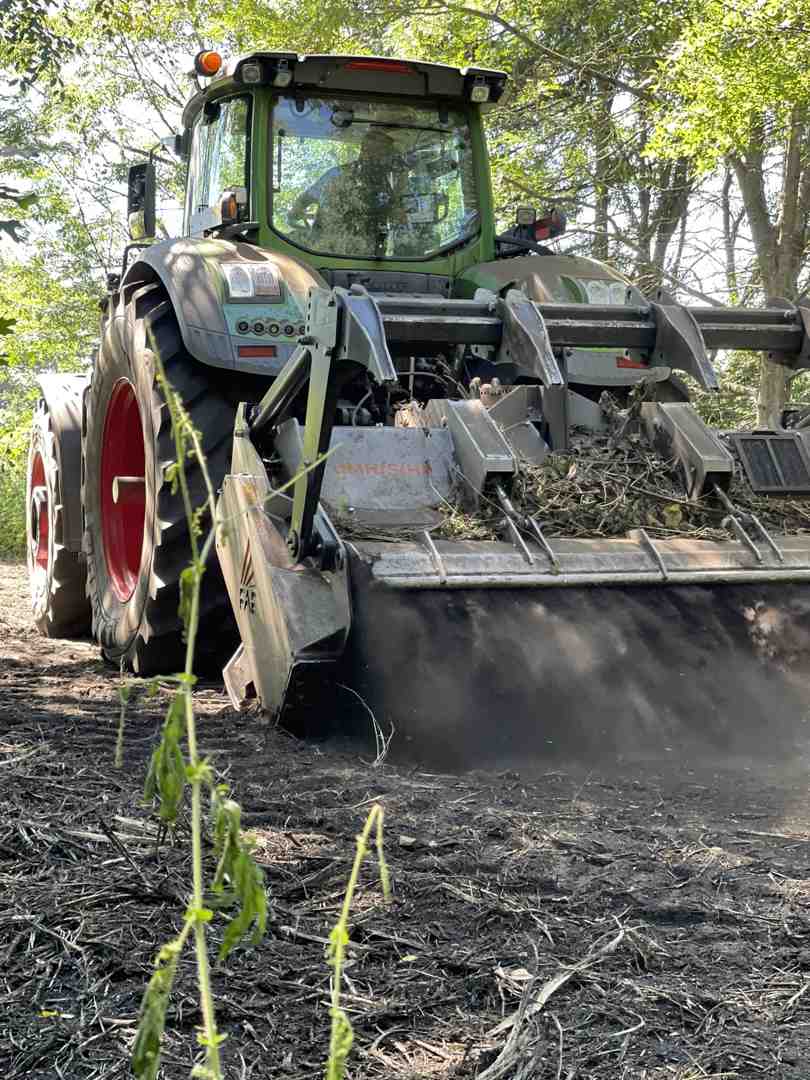
We maximize land clearing efficiency by matching our equipment to the unique soil conditions found across Northern Indiana and Lower Michigan. In areas like Elkhart, Goshen, and Nappanee, we frequently encounter wet or soft soils, especially during the spring and fall. Heavy equipment operating on saturated soils can create deep ruts and increase soil compaction.
To combat this, we prioritize the use of tracked machines with low ground pressure. This “snowshoe effect” allows us to operate effectively in damp conditions without damaging the land’s long-term health. By spreading the weight of the machine over a larger surface area, we can work on sensitive sites where traditional equipment would get stuck or cause damage. This technical expertise is why we are a leader in Forestry Mulching across the region. If you are planning a project for the upcoming season, our Lot Clearing Guide 2025 provides essential insights into timing and site readiness, helping you choose the best window for your specific soil type.
Environmental Impact and Soil Health Benefits of Forestry Mulching
Forestry mulching keeps much of the processed woody material on-site, where it forms a protective organic layer over the soil. When we shred a tree, we aren’t just “getting rid of it”—we are converting the vegetation into organic material that gradually decomposes on the soil surface. This process mimics the natural decomposition cycle of a forest but accelerates it, providing immediate benefits to the soil biology. The mulch acts as a protective blanket, shielding the soil from the impact of heavy rain and extreme temperature fluctuations.
USDA Forest Service research identifies mastication as one site-preparation and vegetation-management option whose effectiveness depends on site conditions and management objectives. These roots act as a natural “rebar” for the soil, holding it together while the new mulch layer protects it from wind and rain. This is especially important when dealing with aggressive plants like the Russian olive – Invasive species. By mulching them in place, we avoid the soil disturbance that often triggers a massive flush of new weed seeds from the seed bank. Traditional pulling or digging often brings dormant seeds to the surface, leading to a secondary infestation that is harder to manage.
The organic mulch layer can also influence soil moisture, temperature, and biological activity as it decomposes. As the mulch gradually decomposes, organic material is returned to the soil surface. This creates a healthy environment for native grasses and wildflowers to return. Furthermore, the mulch layer helps to regulate soil moisture, which is vital during the dry summer months in Indiana and Michigan. By keeping the ground cool and moist, mulching supports the earthworms and other beneficial organisms that aerate the soil and improve its structure over time. This long-term improvement in soil quality is a key reason why many farmers and conservationists prefer mulching over traditional clearing methods.
Productivity and Operational Efficiency of Modern Forestry Mulching
Modern forestry mulching can streamline vegetation clearing by cutting, processing, and distributing material with a single primary machine. In a traditional clearing operation, you might need a feller-buncher to cut trees, a skidder to move them, and a grinder or chipper to process them. Each of these machines requires an operator, fuel, and transport. Mulching combines several clearing and debris-processing steps into a single operation, reducing equipment transitions and material handling. Project requirements vary substantially based on vegetation density, terrain, access, tree size, and the desired finished condition.
The productivity of heavy-duty mulching equipment is another important consideration when planning larger clearing projects. In light brush, we can clear up to 15 acres per day, making it an incredibly fast solution for large properties. In dense forests with significant standing timber, a skid steer mulcher typically handles 1 to 2 acres per day. For large-scale reclamation projects in Lansing or Kalamazoo, this production capacity can shorten the clearing phase on suitable large-acreage projects. Because mulching can leave a more stable surface, some sites may require fewer follow-up earthmoving and debris-management steps than conventional clearing.
For a broader overview of project types and clearing methods, see our Land Clearing Services Complete Guide. Independent USDA Forest Service research also provides useful technical context on mastication equipment, site conditions, and treatment considerations. When comparing clearing methods, consider debris handling, soil disturbance, site access, erosion risk, and the amount of follow-up preparation required. For suitable sites, mulching provides a streamlined process that can leave the property ready for its next phase with fewer separate clearing steps. For a full overview of our service capabilities, please refer to our Land Clearing Services Complete Guide.
Key Applications for Professional Forestry Mulching Services
Professional forestry mulching is well suited to several land-management applications, including right-of-way maintenance, invasive vegetation management, pasture reclamation, and some fuel-reduction projects. One of the most important applications is the reduction of “ladder fuels.” These are the small trees and low-hanging branches that allow a ground fire to climb into the canopy, leading to devastating crown fires. Reducing ladder fuels and dense undergrowth can support broader defensible-space and vegetation-management strategies. This is becoming increasingly important as residential developments push further into wooded areas.
The Forest Service using cutting-edge technology to fight forest fires has long recognized the value of mulching for firebreaks. Beyond fire safety, we use these machines for a variety of specialized tasks:
- Right-of-Way Maintenance: Keeping utility lines, pipelines, and roadsides clear of overgrowth to ensure safety and accessibility for maintenance crews.
- Invasive Species Control: Shredding thickets of honeysuckle, autumn olive, and buckthorn that choke out native vegetation and destroy wildlife habitats.
- Pasture Reclamation: Turning overgrown scrubland back into productive grazing land for livestock. Mulching removes the woody competition, allowing grasses to flourish.
- Fence Line Clearing: Cleaning up property boundaries for new fencing, allowing for a straight and clear path for installation without the need for manual brush cutting.
- Trail Development: Creating recreational trails for hiking, biking, or ATV use. Mulching provides a smooth, natural surface that is ready for immediate use.
For more details on handling particularly difficult overgrowth, see our Heavy Brush Removal Ultimate Guide. We also provide specialized services for Seismic line clearing and other industrial applications where precision and speed are paramount. Whether it’s a small residential lot or a large industrial site, mulching offers a versatile solution for any land clearing challenge.
Frequently Asked Questions about BrushTamer’s Land Clearing Services
What size trees can BrushTamer’s forestry mulchers handle?
Our professional-grade mulchers are engineered to efficiently process trees up to 8 inches in diameter. For larger projects, our high-horsepower dedicated machines are capable of handling trees up to 15 inches or more in a single pass. While we can process larger trees, it is often more efficient to fell them separately and then mulch the remains. This approach ensures the highest quality mulch and prevents excessive wear on the equipment. If you have a site with many large trees, we can develop a custom plan that combines felling and mulching for the best results.
Can BrushTamer’s forestry mulchers grind stumps?
Forestry mulchers can process smaller stumps or grind some material close to ground level, but they do not always replace dedicated stump grinding or full stump removal. By integrating the stump material into the nutrient-rich mulch layer, we remove the tripping hazard and the eyesore while contributing to the soil’s organic matter. This prepares the area for immediate mowing or walking without the need for a separate stump grinder. While we don’t typically grind stumps deep into the earth like a dedicated stump grinder, the flush-cut result is perfect for most land management needs, including pasture reclamation and trail building.
Will grass grow back after BrushTamer’s mulching service?
Grass and other vegetation can reestablish after forestry mulching, but timing depends on soil conditions, mulch depth, sunlight, moisture, seed availability, and follow-up site management. The protective mulch layer we leave behind acts as a “nursery” for seeds, retaining essential moisture and providing nutrients as it breaks down. This creates an ideal environment for rapid germination. In many cases, property owners see native grasses returning that had been shaded out by brush for decades. If you wish to accelerate the process, you can overseed directly into the mulch layer. The mulch provides excellent seed-to-soil contact and protects the new sprouts from birds and wind.
Is mulching safe for my remaining trees?
Forestry mulching can be well suited to selective clearing around trees that property owners want to preserve. Unlike bulldozers, which can compact the soil and tear roots, our tracked mulchers have low ground pressure. We can work right up to the drip line of a mature oak or maple, removing the competing undergrowth while leaving the tree’s critical root zone undisturbed. This actually improves the health of your remaining trees by reducing competition for resources.
Conclusion: Partnering with BrushTamer for Responsible Land Management
Forestry mulching is a versatile option for property owners seeking targeted vegetation removal with limited soil disturbance. It is a fast, clean, and eco-friendly alternative to clearing methods that require extensive excavation, debris removal, or soil disturbance. By choosing land clearing with mulcher technology, you are investing in the long-term health and value of your property while being a good steward of the environment. The process not only clears the land but also enriches the soil, prevents erosion, and creates a beautiful, park-like finish that is ready for immediate enjoyment.
BrushTamer (founded in 2021) is proud to serve property owners throughout Lower Michigan and Northern Indiana. Whether you are in Warsaw, Fort Wayne, or Niles, we bring the expertise and specialized equipment needed to transform your land without the mess. Our commitment to quality and environmental responsibility ensures that your project is handled with the utmost care.
Ready to determine whether land clearing with mulcher equipment is right for your property? Contact BrushTamer today to discuss your site, vegetation, access, and project goals and learn which land clearing services best fit your needs.