
What Is a Disc Plow Used For?
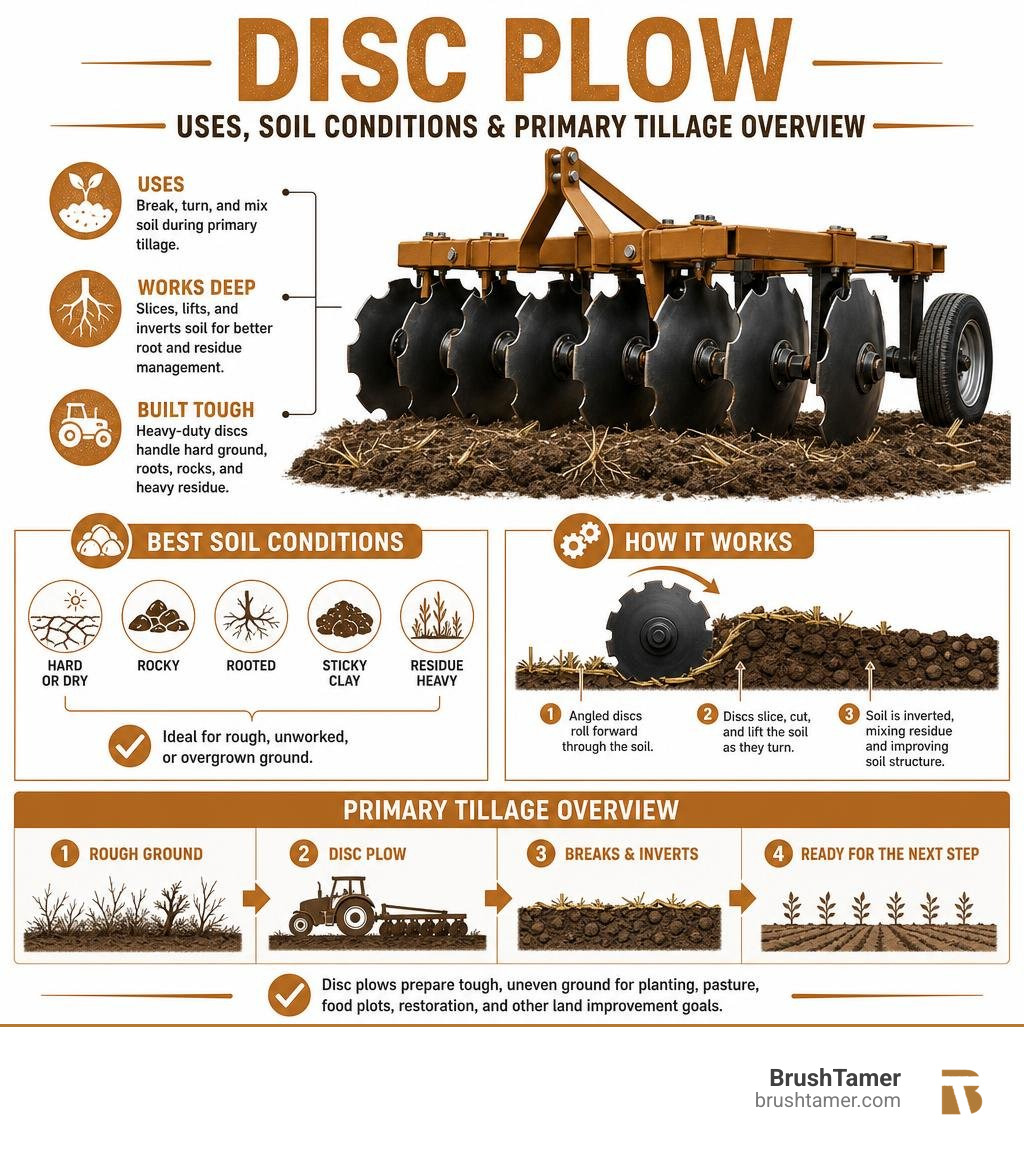
A Disc Plow is a primary tillage tool that uses large, concave steel discs to cut, lift, and turn soil. It is most useful for breaking hard or sticky ground, cutting through roots and heavy residue, and preparing rough land for the next stage of planting or restoration.
| Quick answer | What it means |
|---|---|
| Main job | Break, turn, and mix soil during primary tillage |
| Best ground | Hard, dry, rocky, rooted, sticky, or residue-heavy soil |
| How it works | Angled discs roll through the ground, slice soil, and overturn it |
| Not the same as a disc harrow | A disc plow works deeper; a harrow is usually used later to break clods and smooth the seedbed |
For property owners reclaiming overgrown acreage, a disc plow can be a valuable follow-up tool after brush clearing or forestry mulching. It helps cut remaining roots, incorporate organic material, and create a workable surface for pasture, food plots, conservation cover, or future landscaping.
I am Leon Miller, owner of BrushTamer, founded in 2021, and I work hands-on with land clearing, site preparation, and vegetation management projects in Indiana. My experience with Disc Plow applications helps property owners understand where tillage fits into a practical, responsible land-restoration plan.
What Is a Disc Plow and How Does It Work?
A Disc Plow is a heavy-duty primary tillage implement equipped with individually mounted, concave steel discs that rotate to cut, lift, invert, and aerate hard topsoil while incorporating dense surface trash.
Unlike a fixed-blade mouldboard plow, a Disc Plow uses rotating concave discs that roll through the soil as the tractor moves forward. As a tractor pulls the implement forward, ground resistance turns the steel discs. This rotational force allows the cutting edges to slice smoothly through dense clay, buried taproots, and thick crop residue without balling up or jamming.
By mounting each disc on its own hub and spindle, the implement generates vertical penetration force and lateral soil displacement. The rolling action lowers draft resistance, reducing stress on machinery drivetrains when breaking difficult ground. For property owners across South Bend, IN, Niles, MI, and surrounding areas, Brush Tamer can incorporate Disc Plow tillage into a broader land-preparation process when soil and site conditions call for primary tillage. To learn more about specialized attachments and tools, explore our detailed guide on the Plow Disc.
How a Disc Plow Cuts and Inverts Heavy Soil
A Disc Plow cuts and inverts heavy soil using a combination of forward draft force, concave disc geometry, and dual inclination angles (the disc angle and tilt angle).
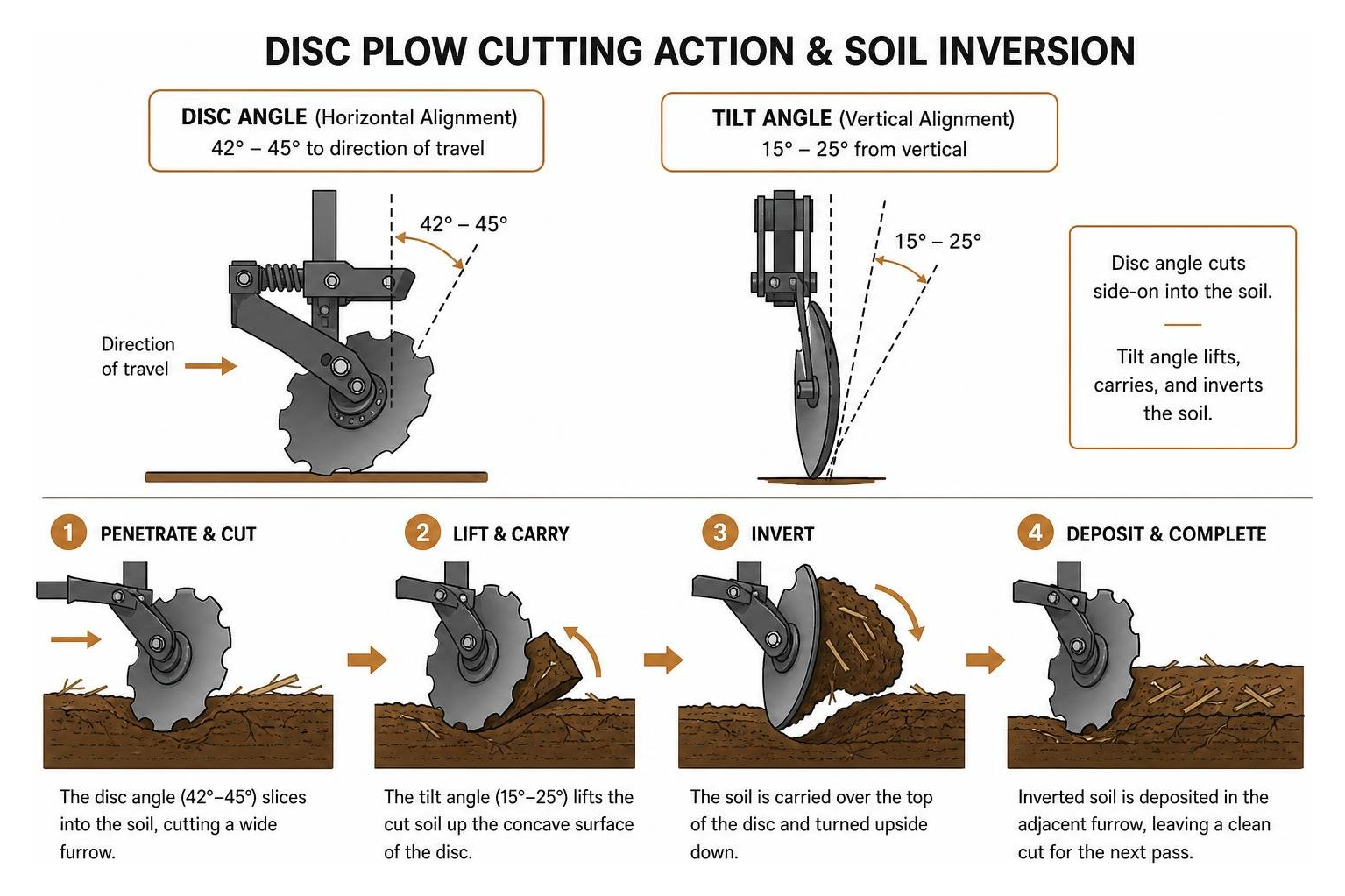
When lowered into the dirt, two critical geometric angles dictate how the blade cuts:
- Disc Angle (Horizontal Alignment): Set between 42 and 45 degrees relative to travel direction, this horizontal angle forces the blade to bite side-on into ground, cutting a wide furrow.
- Tilt Angle (Vertical Alignment): Inclined between 15 and 25 degrees from vertical, the tilt angle enables the concave bowl to lift the sliced earth slab and flip it upside down into the adjacent open furrow.
This soil-flipping action can bury weeds, brush stubble, and crop residue below the surface. Depending on operating depth, soil moisture, and residue load, a Disc Plow can increase soil-to-residue contact and support decomposition while clearing heavy material from the surface. Whether cutting through dense sod in Plymouth, IN, or heavy glacial till in Cassopolis, MI, our professional team ensures precise setup for clean soil inversion across varying soil moisture levels. We break down these foundational steps further in our article on Soil Preparation Techniques From Tilling to Planting.
Essential Components and Frame Anatomy
A heavy-duty Disc Plow relies on a reinforced frame, durable discs, bearing hubs, scrapers, and support components designed to handle demanding primary tillage.
A reinforced steel frame forms the structural backbone of the implement and supports the discs, hubs, scrapers, and rear-wheel assembly during demanding field work. Attached to this frame are key working assemblies:
- Heat-Treated Boron Steel Discs: Fabricated from heavy-gauge boron steel, these concave blades offer maximum wear resistance and high impact toughness against buried field stones.
- Adjustable Scraper Blades: Heavy steel scrapers sit inside each disc concavity to continuously wipe away wet clay, gumbo, and trash, maintaining clean soil-flipping action.
- Heavy-Duty Bearing Hubs: Sealed roller bearings and heavy spindle hubs absorb dynamic axial and radial thrust loads generated during deep tillage.
- Spring-Loaded Rear Furrow Wheel: Running along the furrow wall, this weighted rear wheel counteracts side draft created by angled discs, keeping the implement tracking straight.
Understanding these mechanical dynamics ensures field operations remain consistent even when soil density fluctuates unexpectedly during deep tillage. To examine commercial frame designs and structural layouts utilized in full-scale operations, review the specifications for the Tubular Type Mounted Disc Plough.
Primary vs. Secondary Tillage: Comparing Concave Discs
Primary tillage uses deep-penetrating, heavy concave disc plows to break uncultivated ground and invert soil, whereas secondary tillage relies on lighter disc harrows to refine clods, break surface crusts, and smooth seedbeds.
Understanding operational boundaries between primary breaking tools and secondary seedbed prep implements prevents unnecessary passes, protects soil structure, and optimizes field productivity:
| Feature / Metric | Primary Disc Plow | Secondary Disc Harrow |
|---|---|---|
| Primary Tillage Role | Deep ground breaking, root cutting, soil inversion | Surface clod sizing, residue slicing, seedbed smoothing |
| Typical Working Depth | 7 to 14 inches | 2 to 6 inches |
| Disc Blade Diameter | 24 to 32 inches | 16 to 24 inches |
| Implement Weight Per Disc | 250 to 1,000+ lbs per bottom | 80 to 220 lbs per blade |
| Soil Surface Finish | Rough, deeply inverted furrows with large clods | Smooth, level, pulverized seedbed ready for planting |
While our professional primary plowing opens raw ground across properties in Elkhart, IN, or Goshen, IN, secondary equipment follows later to level the surface. You can view secondary equipment designs by reviewing the 6200 Series Tandem Disc Harrow.
Working Depth and Soil Structure Impact
A Disc Plow can loosen and mix compacted upper soil layers when operating depth and soil conditions are appropriate, although repeated tillage at the same depth can contribute to a compacted tillage layer.
Subsoil layers frequently develop dense hardpans from years of heavy equipment traffic. High-penetration primary tillage deployed by Brush Tamer fractures these restrictive subterranean barriers:
- Compaction Relief: Shattering hardpan layers expands the effective rooting zone, allowing crops to tap into deep subsoil moisture reserves during dry midwestern summers.
- Vertical Water Infiltration: Loosening a compacted layer can improve downward water movement where compaction is limiting infiltration, provided the soil is worked under appropriate moisture conditions.
- Horizon Mineral Blending: Mixing soil layers changes the distribution of organic matter and minerals, so soil testing should guide fertility and pH decisions after deep tillage.
When land exhibits extreme compaction, pairing primary tillage with specialized subsoiling achieves maximum profile fracturing. Read more in our guide on how to Unlock Your Soils Potential A Comprehensive Guide to Subsoiling.
Choosing the Right Tool for Clay, Rocks, and Stubble
A Disc Plow is well suited to heavy clay, rocky ground, woody stubble, and other conditions where rigid tillage tools may struggle.

The engineering advantages of rotating circular blades excel in hard site conditions across Northern Indiana and Lower Michigan:
- Obstacle Rollover Mechanism: When an angled disc contacts a buried boulder or glacial deposit, the circular blade rolls upward over the obstacle, absorbing shock loads.
- Non-Scouring Clay Management: Sticky clay and high-moisture gumbo soils fail to scour on flat mouldboard steel. Rotating steel discs combined with mechanical scrapers shed sticky soil continuously.
- Residue Slicing: Sharp concave edges slice cleanly through heavy cornstalks, brush stubble, and root mats left after land clearing.
For property owners dealing with dense brush or overgrown acreage, hiring Brush Tamer ensures expert land preparation. Learn additional strategies in our guide on How to Prepare Land for Planting the Right Way.
Matching Tractor Horsepower to Equipment Sizing
Horsepower requirements for a Disc Plow vary with disc count, blade diameter, soil density, operating depth, ballast, and implement specifications.
Under-powering a tillage implement causes excessive wheel slippage and shallow penetration, while over-powering lightweight implements risks damaging hitches. Professional machinery pairing ensures optimal draft efficiency and structural integrity.
Heavy clay generally creates greater draft demand than lighter soils, so the same multi-bottom Disc Plow may require a different tractor setup as field conditions change.
Horsepower Requirements for Utility Applications
Utility tractors ranging from 30 to 50 horsepower efficiently pull small 1-bottom or 2-bottom mounted disc units, making them well-suited for small acreage, food plots, and narrow property borders.
These agile equipment setups allow Brush Tamer to manage specialized land prep tasks across properties in Granger, IN, or Edwardsburg, MI, without damaging sensitive soils:
- 30 to 35 HP Class: Suitable for 1-bottom light-duty 3-point units or small utility towable implements.
- 35 to 45 HP Class: Ideal for pulling 2-bottom mounted units with 24-inch to 26-inch blades in medium-density soils.
- 45 to 50 HP Class: Capable of handling heavy 2-bottom units in dense clay, maintaining proper working speeds of 4 to 6 mph.
Unlike standard home equipment or a small Lawn Tractor, professional tractors utilize precise wheel ballasting and front-end weights to maintain steering traction against heavy draft resistance. Proper weight distribution eliminates power hop and keeps equipment operating smoothly.
Sizing Multi-Bottom Heavy-Duty Units
As disc count and working width increase, draft demand rises, so multi-bottom Disc Plow units should be paired with tractors that meet the implement manufacturer’s horsepower, hitch, and ballast requirements.
Matching commercial tractor classes to heavy multi-bottom units ensures maximum field capacity and draft efficiency:
| Bottom Count | Required Tractor Horsepower | Working Width Range | Commercial Application |
|---|---|---|---|
| 3-Bottom Unit | 50 to 70 HP | 35 to 45 inches | Pasture renovation, small farm field prep |
| 4-Bottom Unit | 70 to 90 HP | 48 to 62 inches | Commercial acreage cultivation, heavy residue burial |
| 5-Bottom Unit | 90 to 110+ HP | 65 to 80 inches | Large-scale land reclamation, deep subsoil inversion |
Selecting appropriate operating speeds between 4.5 and 6.0 mph allows disc blades to maintain optimal soil-flipping velocity without over-taxing tractor hydraulics or draft controls. Commercial implement power matching guidelines can be cross-referenced by reviewing detailed Disc Plough Specifications.
Practical Applications: Seedbed Prep and Ground Clearing
A Disc Plow serves a crucial role in full-scale agricultural ground preparation, pasture restoration, weed root eradication, and land reclamation following heavy mechanical clearing.
Primary Disc Plow tillage can convert unworked terrain into open, workable soil that is ready for secondary leveling, seedbed preparation, or other finishing steps. By cutting subterranean roots and flipping topsoil, it sets the stage for final grading, seeding, or conservation planting.
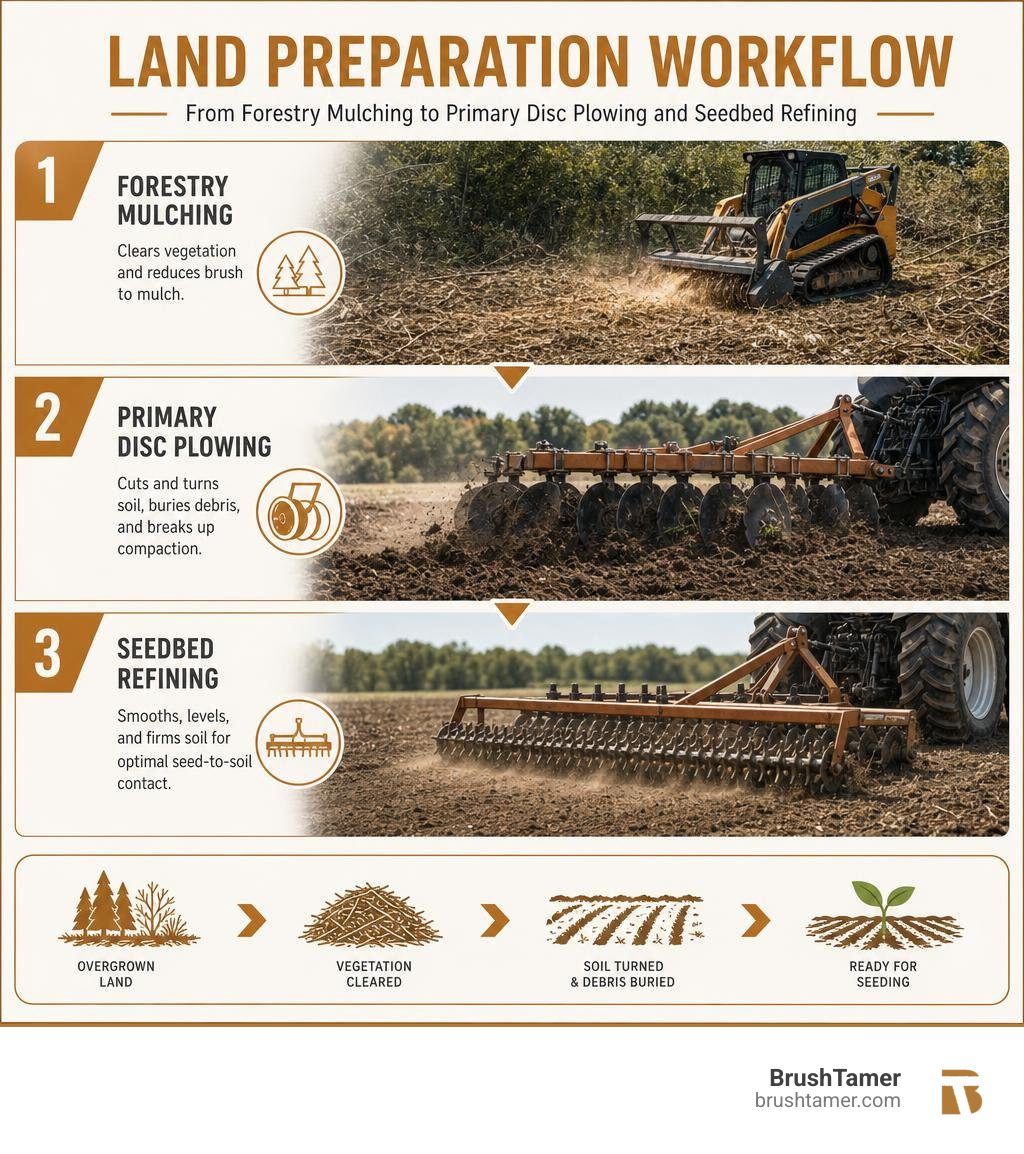
Our team at BrushTamer integrates specialized tillage machinery with advanced Land Clearing Equipment to handle complex site reclamation projects smoothly.
Preparing Secluded Food Plots with Professional Tillage
Compact 3-point disc units and specialized plot plows enable Brush Tamer to prepare high-quality wildlife food plots in narrow, wooded openings inaccessible to large farm machinery.
Establishing remote hunting plots or conservation cover in timbered acres around Laporte, IN, or Three Rivers, MI, presents unique challenges best handled by professionals:
- Navigating Tight Access Trails: Specialized compact implements fit down narrow woods roads, trail networks, and timber openings without causing unnecessary trees or soil damage.
- Penetrating Root-Laced Forest Soils: Serrated or notched disc blades slice cleanly through shallow tree roots, briars, and leaf mold that snag standard equipment.
- Proper Frame Ballasting: Weighted compact units can help Disc Plow blades penetrate untilled soil, although additional finishing may be needed to create consistent seed-to-soil contact before planting.
Land Clearing and Vegetation Management Integration
Integrating Disc Plow tillage after land clearing can cut remaining roots, mix surface residue, and loosen rough ground before final grading or seedbed preparation.
After Brush Tamer crews complete initial brush cutting, stump removal, or forestry mulching across properties in Portage, IN, or Battle Creek, MI, professional disc tillage completes the ground reclamation:
- Root Mat Fracturing: Deep disc blades can cut remaining lateral brush roots, but species capable of resprouting may still require follow-up vegetation management.
- Organic Incorporation: A Disc Plow can mix some surface residue into the soil and increase soil-to-residue contact, although tillage intensity should be balanced with long-term soil-health goals.
- Terrain Leveling: Disc tillage can reduce some surface irregularities, but final grading or secondary harrowing is typically needed when a smooth, uniform finish is required.
To explore local equipment standards and heavy machinery networks, review our guide on locating Tractor Dealers Near Me.
Frequently Asked Questions
What is the main advantage over a mouldboard implement?
The main advantage of a Disc Plow over a mouldboard plow is its ability to operate efficiently in sticky clay, highly abrasive sandy ground, and rocky or root-filled soil without scouring issues or blade breakage.
While fixed mouldboard shanks clog in wet sticky gumbo or shear protective pins when striking subterranean rocks, rotating concave steel blades roll over buried boulders and continuously shed sticky clay using integrated scrapers. This maintains high field productivity in difficult ground across the Midwest, making professional disc tillage the optimal choice for rough acreage.
How do professionals increase tillage penetration in hard soils?
Professional operators increase Disc Plow penetration in dry, highly compacted, or hardpan soils by making technical equipment adjustments:
- Increasing Gang Working Angle: Adjusting the horizontal disc gang angle to a steeper setting relative to the draft direction forces a deeper bite into hard earth.
- Increasing Vertical Tilt Angle: Steepening blade inclination forces the cutting edge downward under tractor draft pull.
- Adding Frame Ballast: Securing weighted ballast into integrated frame weight trays supplies additional downward penetration force.
- Optimizing 3-Point Hitch Alignment: Setting a slight nose-down pitch on front disc blades ensures maximum downward engagement.
Why rely on professional land clearing and tillage service?
Professional land clearing services like Brush Tamer possess heavy commercial machinery, properly calibrated multi-bottom implements, and trained operators to tackle severe compaction, thick root systems, and rocky terrain safely. Partnering with experienced professionals reduces the risk of equipment mismatch, repeated passes, inconsistent adjustments, and poor soil preparation.
Conclusion and Next Steps
Selecting the right primary tillage strategy and understanding how a Disc Plow functions can improve ground preparation and help address specific compaction or residue challenges when soil conditions are appropriate.
Matching equipment, operating depth, and soil conditions can turn rough acreage into workable ground ready for pasture establishment, secondary seedbed preparation, or future landscaping.
At BrushTamer, founded in 2021, we deliver reliable, environmentally responsible land clearing, forestry mulching, and site preparation services across Northern Indiana and Lower Michigan. We handle tough land reclamation projects safely, efficiently, and thoroughly.
If you are preparing overgrown or difficult acreage for its next use, Brush Tamer can help determine whether Disc Plow tillage, land clearing, forestry mulching, or another land-preparation approach is appropriate for your property. Contact Brush Tamer today to discuss your land and the results you want to achieve.