
Land Clearing vs Forestry Mulching: The Ultimate Comparison
Forestry mulching is the best choice for most land clearing in Michigan when the goal is to improve access, control overgrowth, and protect soil. Traditional clearing is typically reserved for projects that require full excavation, deep grading, or foundation preparation—situations where land clearing in Michigan must create a construction-ready surface. For most property owners in Lower Michigan and Northern Indiana, Brush Tamer recommends forestry mulching because it clears efficiently, reduces hauling, and leaves the site stable instead of stripped. Traditional work is a multi-stage process—pushing, grubbing, piling, hauling, and grading—so land clearing in Michigan often takes longer when full removal is required. Forestry mulching is a single-step process that cuts and grinds brush, saplings, and small trees into mulch on-site. That difference matters on properties in Grand Rapids, Kalamazoo, Stevensville, Bridgman, and South Bend where erosion control, appearance, and speed all affect the value of the finished result.
| Feature | Traditional Land Clearing | Forestry Mulching |
|---|---|---|
| Primary Equipment | Bulldozers, Excavators | Forestry Mulchers, Skid Steers |
| Debris Handling | Hauled away or burned where permitted | Processed into mulch on-site |
| Soil Impact | High disturbance | Low disturbance |
| Erosion Risk | Higher | Lower |
| Permit Needs | More common due to earth change | Often reduced when disturbance is limited |
| Finished Look | Bare dirt / rough grade | Clean, natural, park-like finish |
For a deeper dive into these methods, explore our resource All About Land Clearing.
The Traditional Land Clearing Process
Traditional land clearing removes vegetation and root systems completely, but it causes far more disruption than mulching. This method uses heavy equipment to uproot stumps, strip surface material, and create a blank construction-ready area. It is sometimes necessary for major commercial pads, utility corridors, and full foundation excavation in places like Battle Creek or Holland. When you strip the land to bare dirt, you remove the organic horizon of the soil, which can take decades to recover. This process also requires significant logistics for debris management. If burning is not allowed, hundreds of cubic yards of material must be trucked to a landfill or green waste facility, significantly increasing the carbon footprint and the total project cost. For many residential, recreational, and agricultural properties in Niles, Dowagiac, or Three Rivers, that level of disturbance is unnecessary. It can remove valuable topsoil, increase disposal costs, and create additional permitting and stabilization requirements. Brush Tamer evaluates whether full clearing is truly required before recommending that approach. You can learn more in our Land Clearing Services Complete Guide.
Why Forestry Mulching is the 2026 Industry Standard
Forestry mulching is the 2026 industry standard because it delivers cleaner results with less soil disturbance and faster project turnaround. Instead of leaving piles of debris, Brush Tamer processes unwanted vegetation into a mulch layer that helps stabilize the site immediately. This mulch acts as a natural erosion control blanket, retaining moisture and suppressing the regrowth of invasive species like Autumn Olive and Buckthorn. This approach is especially effective across Lower Michigan and Northern Indiana, where variable soils and seasonal moisture make ground protection important. On properties in Cassopolis, Edwardsburg, Elkhart, and Goshen, selective mulching allows us to remove invasive brush, reclaim fence lines, open trails, and improve usable acreage while preserving healthy oaks, maples, and other desirable trees. By leaving the root systems of the soil-stabilizing vegetation intact, we prevent the massive runoff issues often associated with traditional grading. That precision is one reason forestry mulching has become the preferred solution for land clearing in Michigan. Learn more about our specific Forestry Mulching capabilities.
Navigating Regulations for Land Clearing in Michigan
Land clearing in Michigan usually requires permit review when the project involves significant earth disturbance or work near water. The main statewide rule is the Soil Erosion and Sedimentation Control program under Part 91 of the Natural Resources and Environmental Protection Act. In general, projects that disturb one or more acres of soil, or occur within 500 feet of a lake or stream, require careful review and often a permit. For property owners in Berrien County, Cass County, Kalamazoo County, St. Joseph County, and nearby Northern Indiana markets, regulatory compliance is not optional. Brush Tamer plans projects around current requirements so work can move forward without avoidable delays, enforcement issues, or sediment problems. The Michigan Department of Environment, Great Lakes, and Energy (EGLE) provides oversight for these regulations. For detailed technical guidance, refer to the state’s Land Clearing Management manual.
Understanding SESC Permits for Land Clearing in Michigan
SESC permits are commonly required when clearing causes an earth change over one acre or affects land near surface water. That threshold matters in Benton Harbor, St. Joseph, Grand Rapids, and Kalamazoo, where active development and sensitive drainage patterns increase scrutiny. A “significant earth change” is generally defined as any activity that removes the vegetative cover and exposes the raw soil. Because forestry mulching leaves root systems and a protective mulch layer, land clearing in Michigan may face different review considerations than traditional bulldozing. However, if you are clearing for a new driveway or a building pad that will eventually be graded, the permit is almost always required. Local jurisdictions may also apply standards that are stricter than the state baseline. Clay-heavy soils, steep grades, and urban runoff concerns can all affect what is required before work begins. Brush Tamer helps clients understand the site conditions and project scope that influence permit needs before scheduling equipment. Our Lot Clearing Guide 2025 provides more context on these requirements.
Wetland and Water Body Protections
Clearing near wetlands, streams, inland lakes, and Great Lakes shorelines requires added caution because vegetation protects water quality and bank stability. Removing too much cover near the water can increase sediment movement, raise water temperatures, and destabilize shorelines. Michigan’s Part 303 (Wetlands Protection) and Part 301 (Inland Lakes and Streams) are strictly enforced. Even if you own the land, you cannot simply clear brush in a designated wetland without a permit from EGLE. This is especially important in Southwest Michigan communities such as South Haven, Paw Paw, Watervliet, and along shared watershed areas near Elkhart and South Bend. Brush Tamer evaluates setbacks, riparian buffers, and selective clearing limits before work starts so projects remain technically sound and locally appropriate. Forested wetlands also present windthrow risk when surrounding trees are removed too aggressively. If you clear a dense stand of trees on the edge of a wetland, the remaining trees may not have the root structure to withstand high winds. That is why selective professional clearing is often the right strategy on wooded parcels where long-term stand health matters as much as immediate access.
Strategic Applications Across Lower Michigan and Northern Indiana
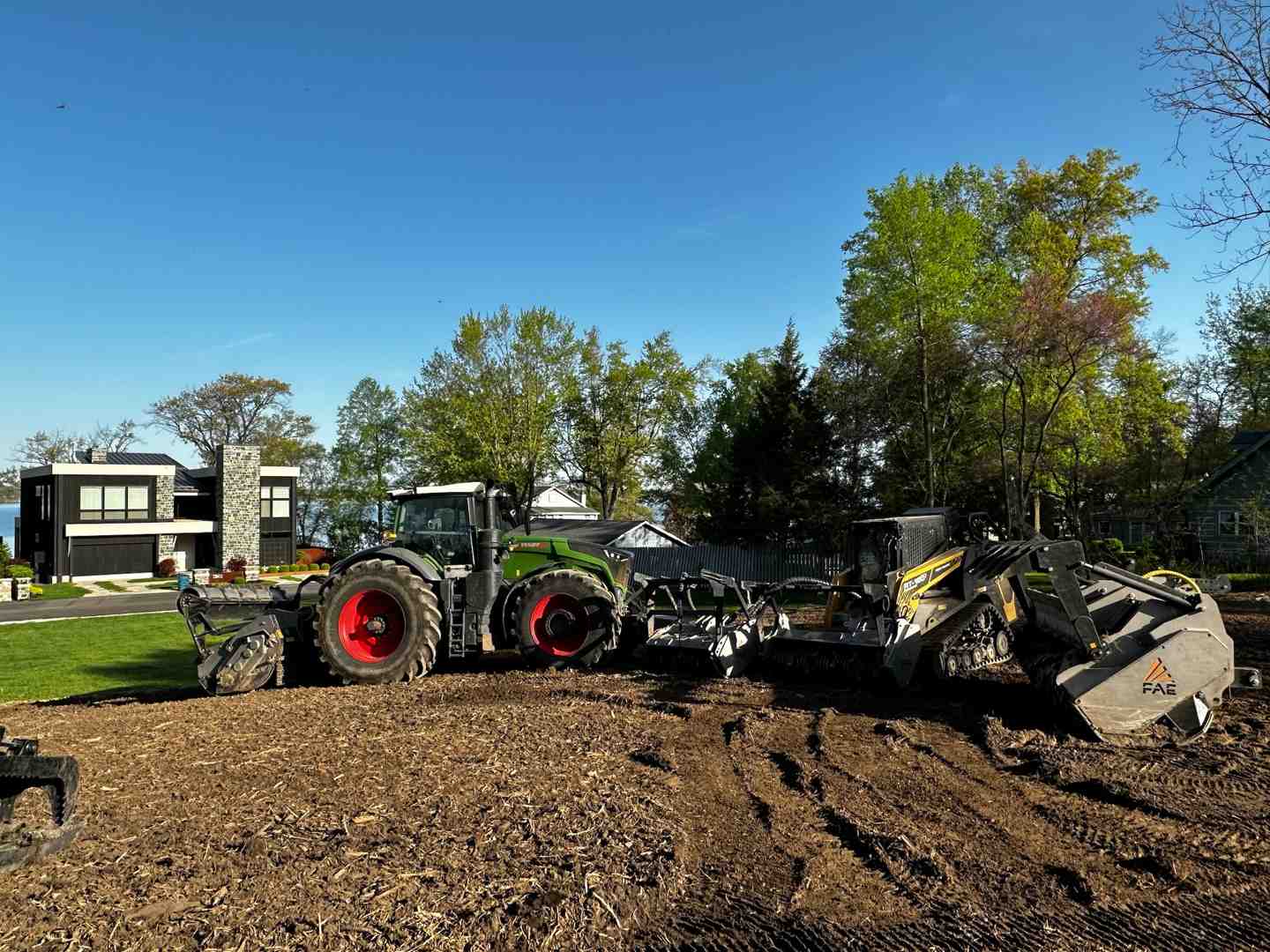
Land clearing in Michigan is most effective when the method matches the property’s end use—access, site prep, trails, habitat, or right-of-way visibility. Brush Tamer clears land for residential site preparation, commercial expansion, pasture recovery, trail systems, habitat improvement, and right-of-way access across communities such as Grand Rapids, Kalamazoo, Portage, Stevensville, Bridgman, Elkhart, Goshen, and South Bend. Regional conditions vary widely. Sandy sites near the Lake Michigan shore behave differently than clay-heavy interior parcels, and low wet ground in Southwest Michigan requires a different operating approach than suburban lots near Holland or Grand Rapids. That is why project planning, machine selection, and finish expectations must be tailored to the location.
Residential and Commercial Site Preparation
Residential and commercial site preparation requires clean access, controlled clearing limits, and a finish that keeps the next phase moving. For home sites in Portage, Kalamazoo, or Stevensville, Brush Tamer focuses on removing unwanted overgrowth so owners, builders, and survey teams can clearly see the topography and usable envelope. This “visibility clearing” is often the first step in the design process, allowing architects to place the home in the most scenic and stable location. On commercial properties, the goal is usually speed and predictability. We support projects tied to future parking areas, utility corridors, solar field preparation, expansion zones, and visibility improvements. In markets such as Grand Rapids, Holland, and South Bend, forestry mulching often accelerates the schedule by eliminating long delays associated with debris piles and off-site disposal. Explore our full suite of Land Clearing services.
Habitat Management and Recreational Trails
Habitat management and trail clearing improve property use without sacrificing the character of the land. Brush Tamer uses selective clearing to create trail networks, restore overgrown lanes, open food plot access, improve edge habitat, and remove invasive pressure while preserving desirable canopy. This is a strong fit for recreational and rural properties in South Haven, Bangor, Cassopolis, Three Rivers, and Goshen, where owners want better access and better land function without converting the site into bare ground. Strategic vegetation management can also improve sight lines, support hunting access, and reclaim neglected acreage. By removing the “mid-story” of invasive brush, we allow sunlight to reach the forest floor, which encourages the growth of native grasses and forbs that are essential for local wildlife like white-tailed deer and wild turkey. This type of Brush Management is essential for maintaining the health of Michigan’s diverse ecosystems and increasing the enjoyment of your private property.
Seasonal Advantages and Best Management Practices
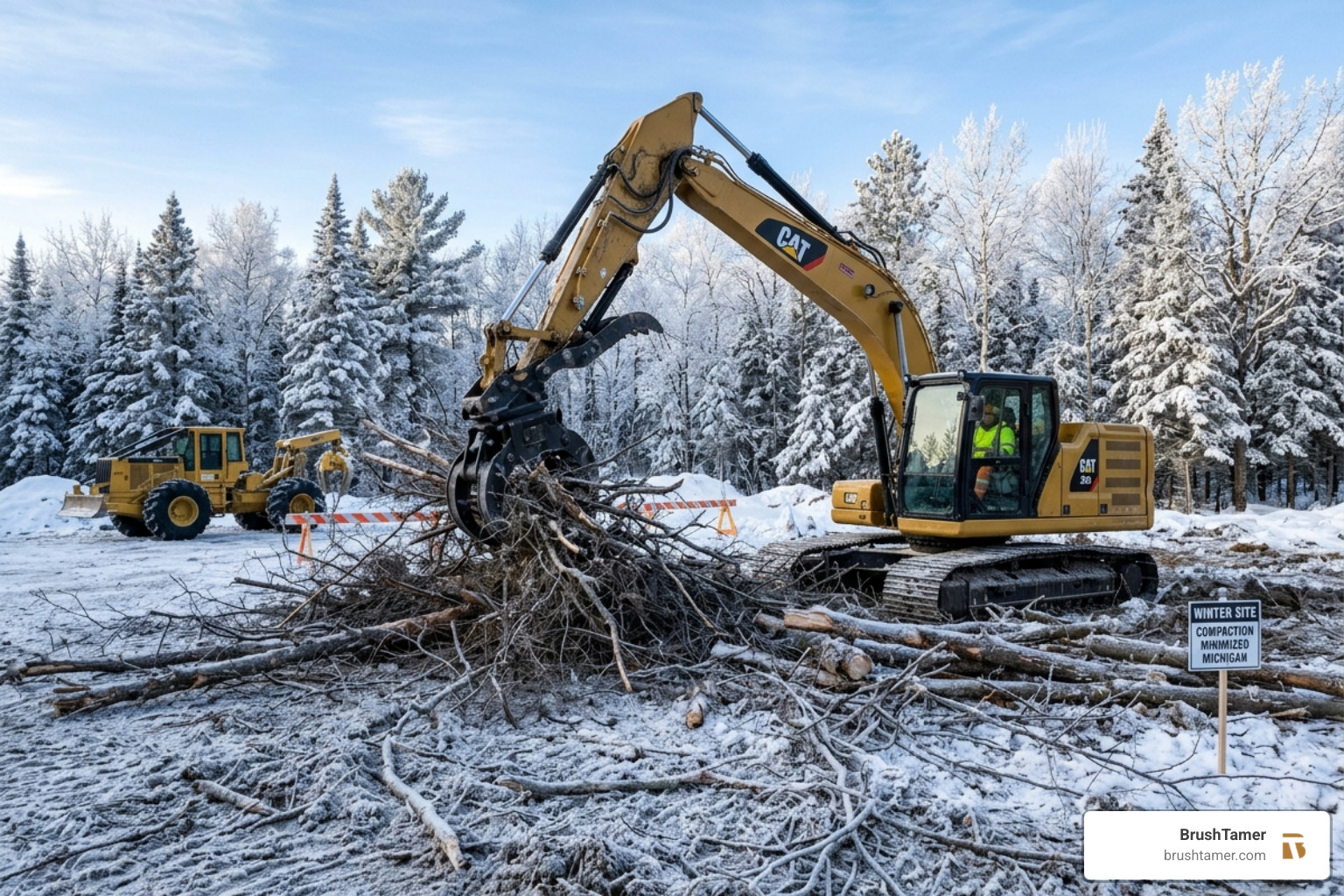
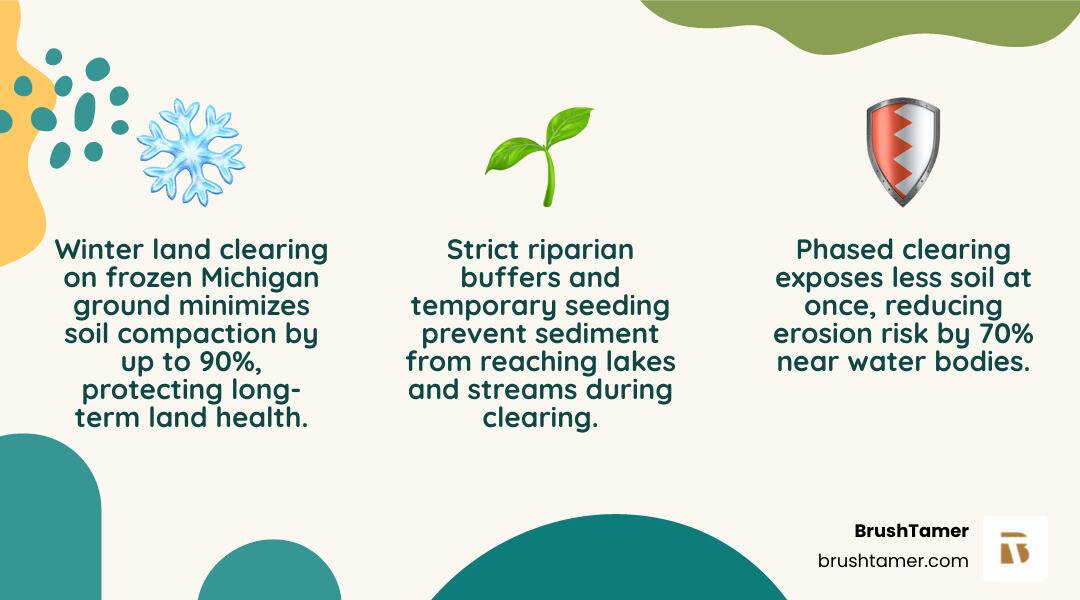
Winter is often the best season for land clearing in Michigan because frozen ground reduces rutting, compaction, and disturbance. On suitable sites, frozen conditions allow Brush Tamer to work with better flotation and cleaner travel patterns than during wet spring periods. This is particularly critical for protecting the root zones of trees you intend to keep. When the ground is soft, heavy machinery can compress the soil, cutting off oxygen to tree roots and leading to long-term decline. That advantage is especially important in Watervliet, Paw Paw, Three Rivers, and other areas where seasonal moisture can make ground protection a major project concern. While timing always depends on site goals and weather conditions, winter frequently provides the best balance of access, efficiency, and land preservation.
Protecting Water Quality and Soil Health
Protecting water quality and soil health requires limiting disturbance, controlling runoff, and preserving stable buffers where needed. Brush Tamer applies best management practices based on site layout, slope, soil type, and proximity to water. For larger sites, phased clearing can reduce the amount of exposed ground at one time. Near ditches, streams, and lakes, selective limits and retained vegetation help reduce sediment movement. For land clearing in Michigan, we also account for oak wilt risk periods; Michigan guidance commonly advises avoiding pruning/wounding oaks from April 15 through July 15. On wooded tracts, we also evaluate wind exposure so remaining trees are not left vulnerable after surrounding vegetation is removed. Learn more about Eco-Friendly Land Clearing.
Professional Equipment and Safety Standards
Professional land clearing depends on purpose-built equipment operated with strict safety controls. Brush Tamer uses modern hydraulic machinery, including tracked loaders, forestry mulchers, and Vermeer stump grinders, to match the scope and finish of each project. Our machines are equipped with high-flow hydraulic systems that allow the mulching heads to maintain high RPMs even in dense material, resulting in a finer, more consistent mulch. That equipment allows us to clear efficiently while protecting surrounding structures, retained trees, and finished areas. Safety planning includes utility coordination, controlled work zones, and site-specific operating procedures for every project in Elkhart, Goshen, Grand Rapids, Kalamazoo, and surrounding service areas. You can view our Land Clearing Equipment lineup to see the tools we bring to your property.
Frequently Asked Questions about Land Clearing in Michigan
The most common questions about land clearing in Michigan involve permits, method selection, and project timelines. These answers are written to help property owners in Lower Michigan and Northern Indiana understand what to expect when hiring Brush Tamer.
Do I need a permit to clear brush on my property?
You may need a permit if the work involves significant earth disturbance or takes place near water. In Michigan, projects disturbing more than one acre or located within 500 feet of a lake or stream often trigger SESC review. Local township or county requirements in places such as Berrien County, Cass County, and Kalamazoo County can be stricter, so permit review should happen before work begins. Forestry mulching often avoids some of these permits because it does not technically “disturb” the soil in the same way a bulldozer does.
Is forestry mulching better than burning debris?
Yes, forestry mulching is usually the better professional option for most properties. It eliminates debris piles, reduces hauling, avoids open burning concerns, and leaves a protective mulch layer that supports erosion control. On residential and mixed-use properties in Stevensville, Bridgman, and South Bend, that cleaner finish is often the fastest path to a usable site. Burning can also be dangerous during dry Michigan summers and often requires a permit from the local fire department.
How long does it take to clear one acre of land?
Most one-acre clearing projects take about one to two days, depending on vegetation density and site conditions. Light brush on accessible ground in Dowagiac may move quickly, while heavy woods or wet terrain in Three Rivers can require more time. Brush Tamer sets timelines based on actual conditions, desired finish, and safe production rates.
What happens to the stumps after mulching?
Forestry mulching grinds the tree down to ground level, but the root ball remains in the soil. This is ideal for erosion control and soil health. If you plan to build a foundation or a paved driveway, those stumps will eventually need to be excavated or ground deeper with a dedicated stump grinder. For trails, pastures, and general yard expansion, the flush-cut stumps are usually left to decay naturally over time.
Are you insured for land clearing in Michigan?
Yes, Brush Tamer carries full commercial liability insurance specifically for land clearing and vegetation management. This protects the property owner from liability in the event of accidental damage to structures or utilities. We also coordinate with MISS DIG to ensure all underground lines are marked before we begin any work on your property.
Conclusion
At BrushTamer, we believe that land clearing in Michigan should be a process that adds value to your property while respecting the natural environment. By choosing forestry mulching and professional site preparation, you ensure that your land remains healthy, usable, and beautiful for years to come. Whether you are in Lower Michigan or Northern Indiana, we are committed to delivering high-quality, client-focused results that stand the test of time. Ready to move forward with land clearing in Michigan? Contact BrushTamer to schedule a site walkthrough and scope plan.