
Why Mitigation for Wildfires Is the Most Important Step You Can Take as a Property Owner
Mitigation for wildfires is the strategic implementation of fuel reduction and structural hardening techniques designed to minimize the risk of fire ignition and spread on a property. For homeowners in Northern Indiana and Lower Michigan, mitigation for wildfires involves land management that creates defensible space, ensuring that structures can survive a wildfire even without direct fire department intervention. In the Midwest, the threat is often hidden within dense woodlots and overgrown invasive thickets that have accumulated decades of fuel.
Effective mitigation for wildfires follows a tiered priority system that addresses the property from the structure outward:
| Priority | Action | Zone |
|---|---|---|
| 1 | Professional removal of all combustibles within 5 ft of structures | Immediate (0-5 ft) |
| 2 | Expert thinning of vegetation and tree crown spacing | Intermediate (5-30 ft) |
| 3 | Strategic fuel breaks and heavy brush clearing by Brush Tamer | Extended (30-100 ft) |
| 4 | Structural hardening (vents, roof, windows) | On-structure |
| 5 | Community-wide coordination and professional fire planning | Community level |
Mitigation for wildfires matters in the Midwest because wildfire conditions are becoming more frequent, driven by changing weather patterns and the expansion of residential developments into previously wild areas. Over the last decade, more than 35,000 structures have been destroyed by wildfires across the U.S., and roughly one-third of all American homes are now located in the Wildland Urban Interface (WUI). This is the critical zone where residential neighborhoods meet wildland vegetation, and it is where the danger to life and property is highest. In regions like South Bend, Elkhart, and Mishawaka, Indiana, as well as Grand Rapids and Kalamazoo, Michigan, the risk is often underestimated because the landscape appears lush and green. However, seasonal droughts can quickly turn this greenery into a volatile fuel source.
Because many wildfires start from human activity, mitigation for wildfires focuses on reducing ignition pathways around structures. A fire does not need to reach your doorstep to be destructive; flying embers can travel miles ahead of a fire front, igniting dry gutters or wooden fences. Radiant heat alone can ignite a home from 100 feet away if the surrounding fuel load is not managed. I am Leon Miller, owner of Brush Tamer. Founded in 2021 and based in Plymouth, Indiana, Brush Tamer is a premier land management and forestry mulching company. We provide professional, high-capacity land clearing services across Northern Indiana and Lower Michigan. Our expertise in mitigation for wildfires focuses on transforming high-risk landscapes into resilient, defensible properties. This guide outlines the professional standards required to protect your investment from the increasing threat of wildfire.
Understanding Wildfire Mitigation in the Wildland Urban Interface (WUI)
Wildfire mitigation in the Wildland Urban Interface (WUI) is the application of science-based land management practices to reduce the vulnerability of human developments to natural fire cycles. In the WUI, where homes in towns like Granger, Indiana, or Niles, Michigan, are nestled among dense woodlots and grasslands, the accumulation of natural fuels creates a high-risk environment that requires professional oversight to manage safely. The WUI is not a static boundary; it is a set of conditions where fuel, weather, and topography interact with human structures.
In the WUI, mitigation for wildfires applies beyond forests—grass and shrub fuels can be just as dangerous. In 2021, 80% of homes lost to fires were outside of forests, frequently occurring in shrub-heavy landscapes or grasslands where fire moves rapidly. As development expands into these vulnerable areas, the statistics highlight the urgency of professional mitigation. More than 35,000 structures have been lost in the last decade, and one-third of houses in the U.S. now sit in the WUI. This expansion means that traditional fire suppression methods are often stretched thin, making individual property mitigation the most reliable form of protection.
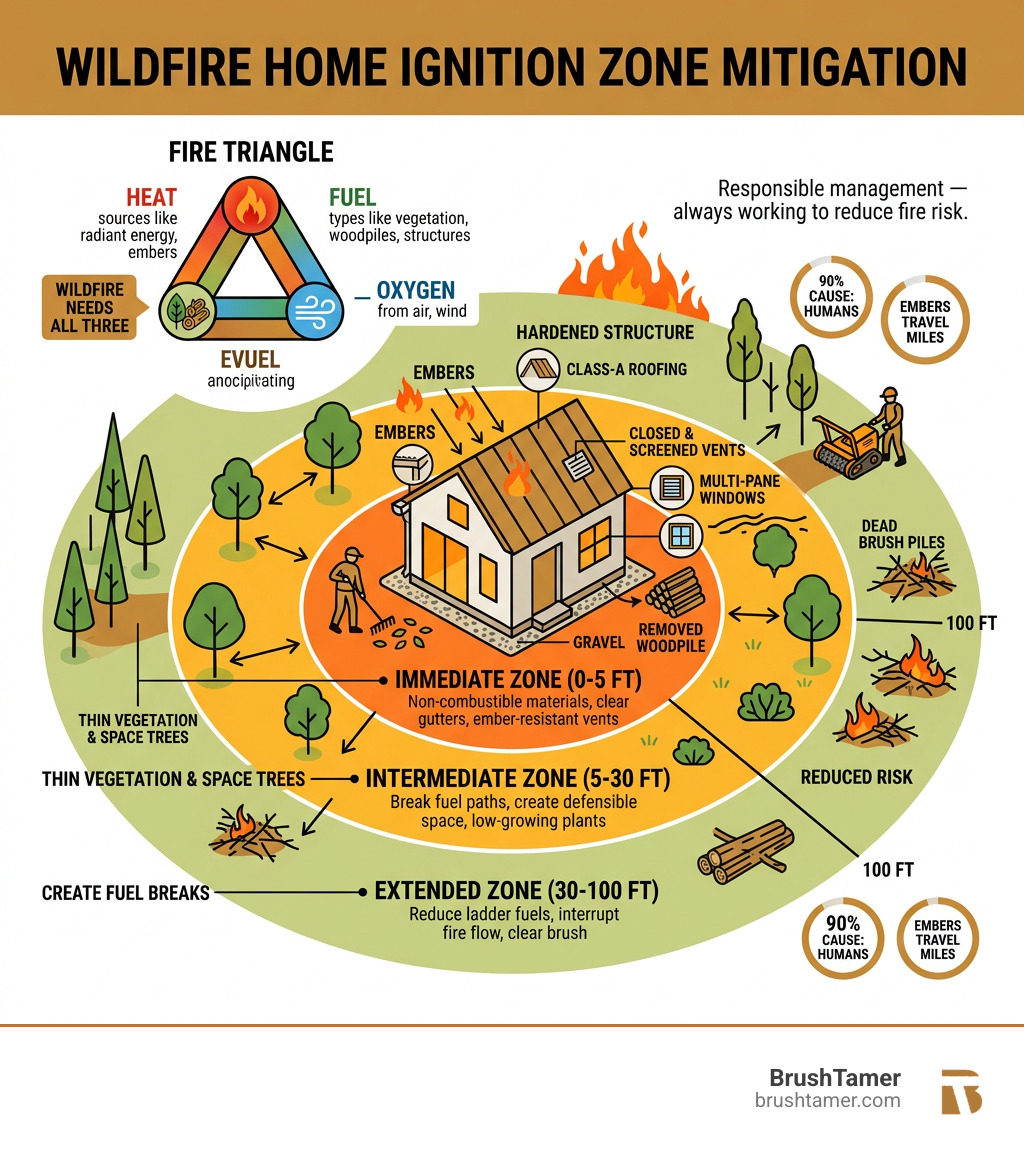
Mitigation for wildfires targets two major drivers of home loss: radiant heat and ember ignition. Radiant heat can ignite siding or shatter windows from a distance of 100 feet, while embers—tiny firebrands carried by the wind—are responsible for the majority of home ignitions. These embers find vulnerabilities in dry gutters, vents, or under decks, often smoldering for hours before erupting into a full-scale structure fire. Professional Land Management by Brush Tamer is the only reliable way to break the “fire triangle” (heat, fuel, and oxygen) on a property. By systematically removing the fuel component, we prevent a wildfire from transitioning into a catastrophic structure fire. Our approach involves analyzing the specific fuel types on your property, from the volatile oils in certain evergreens to the dry leaf litter of hardwood forests, to create a customized mitigation plan.
The Three Zones of Defensible Space: A Strategy for Mitigation of Wildfires
Defensible space is a managed buffer—and a core element of mitigation for wildfires—between a structure and surrounding vegetation. This strategy relies on managing the Home Ignition Zone (HIZ), which is divided into the Immediate, Intermediate, and Extended zones. Brush Tamer specializes in implementing Vegetation Management Solutions that remove ladder fuels—the low-hanging branches and shrubs that allow ground fires to climb into the tree canopy. Without these ladder fuels, a fire is much more likely to stay on the ground, where it is easier to control and less likely to cause catastrophic damage to mature trees or structures.
| Zone | Distance | Key Requirement |
|---|---|---|
| Zone 1: Immediate | 0–5 Feet | Non-combustible zone; professional removal of all flammable vegetation. |
| Zone 2: Intermediate | 5–30 Feet | Managed landscaping; expert tree crown spacing and fuel reduction. |
| Zone 3: Extended | 30–100+ Feet | Large-scale fuel load reduction; professional brush clearing and deadwood removal. |
By adhering to A Practical Guide to Surface Fuel Reduction, Brush Tamer ensures that fire intensity is lowered before it reaches the home, providing a critical window for suppression efforts. This tiered approach is based on decades of fire science research showing that the condition of the home and its immediate surroundings are the primary factors in whether a structure survives a wildfire.
The Immediate Zone (0-5 Feet)
For the mitigation of wildfires, the Immediate Zone is the most vital area for structure survival and must be maintained as a non-combustible buffer. Brush Tamer assists property owners by identifying and removing high-risk vegetation, such as decorative shrubs or overhanging branches, that act as kindling. In communities like Goshen and Warsaw, Indiana, we often find homes with wood mulch and dense plantings against the foundation. Professional mitigation involves replacing these materials with gravel or river rock and ensuring the area is free of dry leaves and pine needles. This zone is designed to prevent embers from igniting anything directly against the house, which is the most common cause of home loss.
The Intermediate and Extended Zones (5-100+ Feet)
Beyond the five-foot mark, the focus shifts to professional tree spacing and canopy management. As part of mitigation for wildfires, Brush Tamer uses site-appropriate tree spacing to reduce canopy-to-canopy fire spread. This level of precision requires professional equipment and expertise to maintain the health of the trees while maximizing safety. We focus on removing “islands” of vegetation that could carry fire toward the structure.
In the Extended Zone (30-100+ feet), we utilize Heavy Brush Removal Ultimate Guide techniques to eliminate dead trees, fallen logs, and invasive thickets. In Lower Michigan and Northern Indiana, invasive species like Autumn Olive and Honeysuckle create dense, flammable fuel loads that can burn with extreme intensity. Brush Tamer’s forestry mulching services create strategic fuel breaks that slow the spread of fire and provide firefighters with a safe place to work. As the USDA notes, it is essential to establish natural or artificial fuel breaks to slow the spread of catastrophic fire to protect both residential structures and the surrounding ecosystem. Our goal is to transition the forest from a high-risk fuel load to a healthy, fire-resilient landscape.
Hardening the Home: Protecting Structures from Flying Embers
Home hardening is the process of retrofitting a structure with ignition-resistant materials to prevent embers from entering or igniting the building. While Brush Tamer manages the surrounding landscape to stop the fire’s path, hardening ensures the structure itself can withstand the intense heat and ember showers that characterize WUI fires. This dual approach of landscape management and structural reinforcement is the gold standard for wildfire resilience.
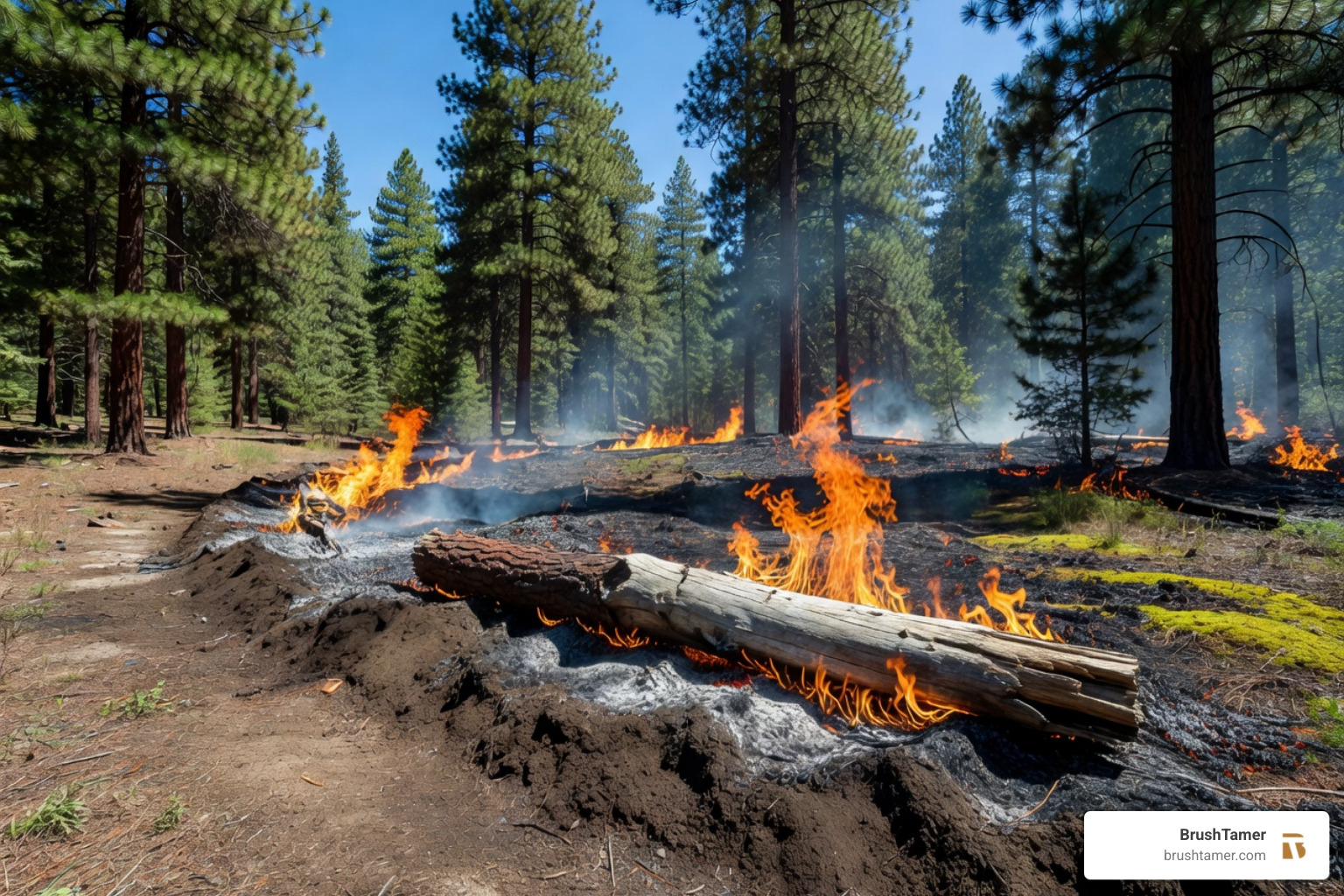
Embers are the primary cause of home destruction in the WUI, often igniting fires miles away from the main front. They can be sucked into attic vents, land in gutters filled with debris, or accumulate under wooden decks. Professional hardening standards include:
- Vents: Installing 1/8-inch metal mesh over all crawlspace and attic vents to block embers while maintaining airflow. Standard vents often have larger openings that allow firebrands to enter the home’s interior.
- Roofing: Utilizing Class A fire-rated materials such as metal, clay tile, or specialized asphalt shingles. The roof is the most vulnerable surface of the home during an ember storm.
- Windows: Upgrading to dual-pane tempered glass, which is significantly more resistant to the thermal shock of a wildfire than single-pane glass. Tempered glass prevents the window from shattering and allows fire to enter the home.
- Decks: Ensuring the area beneath decks is professionally cleared of all flammable debris and utilizing fire-resistant timber or non-combustible materials for the deck surface itself.
Guidance from FEMA and wildfire research organizations supports these hardening measures, especially around vents, roofs, and gutters. During the 2018 Camp Fire, homes built to modern fire-resistant standards had a 43% survival rate, whereas older, unhardened homes had a survival rate of only 11.6%. Brush Tamer’s land clearing services complement these structural improvements by ensuring that the heat flux reaching the home is minimized, allowing the hardening measures to perform as designed.
Landscape-Scale Mitigation and Community Resilience
Landscape-scale mitigation involves broad, coordinated fuel reduction strategies, such as mechanical thinning and the creation of strategic fuel breaks, to protect entire neighborhoods and ecosystems. For communities in Valparaiso, Indiana, or St. Joseph, Michigan, resilience depends on professional land management that extends beyond individual property lines to create a unified defense against wildfire. When multiple neighbors engage in mitigation, the collective risk to the entire community drops exponentially.
A Community Wildfire Protection Plan (CWPP) is a critical tool for identifying regional risks and outlining mitigation priorities. These plans are developed through collaboration between local fire departments, government agencies, and land management professionals. Brush Tamer supports these community-wide efforts through Forestry and Wildlife Management services that reduce fuel loads across large acreages. Furthermore, our Erosion Control Services ensure that the land remains stable and productive following large-scale clearing, preventing the secondary disasters of soil loss and water contamination that often follow fire events.
Advanced Technology in Mitigation for Wildfires
Professional mitigation now leverages cutting-edge technology to predict and prevent fire spread. Tools such as FlameMapper and LandFire allow Brush Tamer to analyze topography and fuel types to forecast fire behavior accurately. We utilize geospatial mapping and real-time data on drought conditions to prioritize high-risk areas for clearing. This scientific approach ensures that fuel reduction efforts are placed where they will have the greatest impact on community safety. By understanding how wind moves through a specific valley or how fire climbs a particular slope, we can design fuel breaks that are strategically positioned for maximum effectiveness.
Personal Preparedness and Professional Coordination
While Brush Tamer manages the physical landscape, property owners must maintain professional standards in their personal preparedness. This includes:
- Insurance Audits: Ensure your documentation and coverage details are current and easy to access during an evacuation or recovery process.
- Evacuation Planning: Identifying multiple egress routes from the neighborhood and practicing them under different conditions.
- Emergency Kits: Maintaining a “Go Bag” with essential supplies, medications, and important documents in a fire-resistant container.
- Communication: Establishing a designated out-of-area contact for family coordination during an emergency to ensure everyone is accounted for if local cell towers are compromised.
Professional Mitigation for Wildfires in the Midwest
In the Midwest, specifically across Northern Indiana and Lower Michigan, wildfire risk is characterized by dense understory brush, invasive species, and the accumulation of surface fuels in residential woodlots. Unlike the crown fires of the West, Midwest fires are often ground-driven, fueled by thickets of Buckthorn and Honeysuckle that can carry fire directly to structures in towns like Benton Harbor, Michigan, or Fort Wayne, Indiana. These invasive species not only outcompete native plants but also create a much higher fuel load than a healthy, native ecosystem would naturally support.
Professional forestry mulching is the gold standard for fuel reduction in these regions. Brush Tamer’s high-performance equipment grinds standing brush and small trees into a moisture-retaining mulch. This process not only removes the immediate fire hazard but also suppresses the growth of flammable weeds and nourishes the soil. Our Land Clearing Services Complete Guide explains how we tailor these services to the specific ecological needs of the Midwest, ensuring that we protect the long-term health of your land while maximizing safety.
We serve a broad geographic area, providing expert services to clients in South Bend, Elkhart, Mishawaka, and Granger, Indiana, as well as Grand Rapids, Kalamazoo, and Battle Creek, Michigan. By focusing on the removal of invasive species and the reduction of ladder fuels, we provide a “clean” aesthetic that significantly enhances property safety and value. Detailed information on our methods can be found on our forestry mulching service page. Our equipment allows us to work in tight spaces and on varied terrain, making us the ideal partner for residential properties in the WUI.
Professional Standards for Mitigation for Wildfires
Brush Tamer was founded in 2021 with a commitment to providing environmentally responsible, high-capacity land management. We do not simply clear land; we manage it for long-term resilience. Whether you require more info about land clearing or more info about brush management, our team utilizes professional-grade machinery to deliver results that meet the highest safety and aesthetic standards. From the dunes of Michigan City to the suburbs of Chicago, Brush Tamer is the trusted partner for wildfire mitigation, providing peace of mind through expert execution and a deep understanding of fire science.
Frequently Asked Questions about Mitigation for Wildfires
What is the most effective wildfire mitigation strategy?
The most effective strategy is the combination of professional defensible space creation and structural hardening. Managing the first 30 feet around a structure (Zones 1 and 2) through professional fuel reduction has the most significant impact on structure survival. Brush Tamer ensures that these zones are cleared of ladder fuels, preventing ground fires from intensifying as they approach the home. When this is combined with ember-resistant construction, the likelihood of a home surviving a wildfire increases dramatically.
How do flying embers destroy homes miles away from a fire?
Embers, or firebrands, are lofted by the heat of a wildfire and carried by wind currents. They land in “fuel traps” such as leaf-filled gutters, wooden decks, or attic vents. Once they land, they can smolder and eventually ignite the structure. Professional mitigation involves removing these fuel traps and hardening the structure to prevent ember entry, which is a non-negotiable step for properties in the WUI. Even a small ember can ignite a massive structure fire if it finds the right fuel source.
Why is professional forestry mulching superior to other clearing methods?
Professional forestry mulching is superior because it addresses the entire fuel profile, including “ladder fuels” that simple mowing cannot reach. Brush Tamer’s mulching process grinds woody debris into a dense carpet that retains soil moisture and prevents the rapid spread of fire. This method is more efficient, environmentally friendly, and provides a longer-lasting fire break than traditional clearing or mowing. It also eliminates the need for burn piles, which can themselves be a fire hazard, and leaves the soil protected from erosion.
Conclusion
Wildfire mitigation is a continuous commitment to property stewardship and safety. By combining professional landscape management with structural hardening, homeowners in Northern Indiana and Lower Michigan can significantly increase their resilience against the growing threat of wildfires. This is not a task for self-service; it requires the expertise, scientific understanding, and high-capacity equipment that only a professional firm can provide. Consistent mitigation for wildfires can be the difference between a survivable event and a total loss.
At Brush Tamer, we are dedicated to serving communities from Valparaiso and Portage to Grand Rapids and Kalamazoo. We help our clients build safer, more beautiful, and more resilient properties by taming the brush and managing the land with precision. Our approach is rooted in fire science and a deep respect for the natural landscape of the Midwest.
Don’t wait for a fire emergency to expose weaknesses around your home. Mitigation for wildfires is most effective when it’s planned, staged, and maintained. Contact us to build a site-specific mitigation plan that strengthens defensible space, reduces ember pathways, and supports long-term property resilience.