
Stump Removal Kokomo Indiana: Lessons from Kokomo’s Historic Sycamore Stump
Stump removal Kokomo Indiana has deep local roots, and Kokomo’s historic Sycamore Stump shows how challenging large root systems and buried timber can be. The historic Kokomo, IN Sycamore Stump, estimated to be between 800 and 1,500 years old, originally grew along the north bank of Wildcat Creek, roughly two miles north of New London. When the original tree was standing, it reached over 100 feet in height with a 57-foot circumference trunk, and its lowest branch measured 8 feet in diameter. American sycamores (Platanus occidentalis) thriving in alluvial river bottomlands develop exceptionally deep, expansive root networks designed to anchor heavy wood against severe flood currents and high Midwest prairie winds. The rich, moist floodplains along Wildcat Creek provided ideal conditions for centuries, allowing the tree to anchor deep within Howard County’s alluvial soils.
When civic leaders preserved the ancient tree after storm damage, the project revealed the same core challenge modern stump removal in Kokomo, Indiana still solves: separating dense root systems from stable ground. To cut the stump free from its location along Wildcat Creek, workers had to stand directly in the active creek bed while one crew member was lowered into the hollow 15-foot snag to operate a massive two-man crosscut saw from the inside out. Removing such an enormous wooden structure required extensive manual excavation around dense surface roots and heavy taproots before the stump could finally be detached from the earth.
Transporting the 21-Ton Giant in 1916
Moving the giant sycamore stump to Highland Park in 1916 required careful planning, heavy rigging, and the strongest mechanical power available at the time. Crew members loaded the massive wooden structure onto a reinforced flatbed wagon, pulling it across rural Howard County using a 35-horsepower Rumley steam tractor engine. The 57-foot circumference stump was so wide that it nearly blocked the entire road during transit, requiring careful route planning around narrow wooden bridges, overhead wires, and unpaved dirt corridors. Temporary timber planking was laid across soft agricultural soil paths to keep the heavy tractor wheels from sinking into the ground.
Once installed in Highland Park, the hollow stump was placed on a heavy concrete platform to ensure long-term structural stability. For a time, it was used as a long-distance telephone booth capable of holding a dozen people simultaneously before being enclosed in a protective visitor shelter to prevent vandalism and environmental degradation. Today, this historical effort contrasts sharply with modern hydraulic land clearing and stump grinding equipment. While early 1900s crews relied on steam engines, block-and-tackle rigging, and hand saws to drag heavy timber across rural dirt roads, today professional land management contractors utilize high-powered hydraulic machinery to manage land clearing and site preparation quickly, safely, and efficiently.
Modern Methods for Stump Removal Kokomo Indiana

Modern stump removal in Kokomo, Indiana uses mechanical grinding and hydraulic excavation to manage buried wood, root systems, and unstable ground conditions. Tree root systems often extend well beyond the visible stump, which is why professional assessment matters before grinding or excavation begins. In local clay soils across Howard County—such as heavy Morley silty clay loams and Miami silt loams—native species like oak, maple, walnut, and sycamore form dense, stubborn root networks that can disrupt surrounding turf, underground pipes, and hardscaping if not handled properly by experienced land clearing professionals. Soil moisture levels in Central Indiana cause clay soils to compact tightly around deep root structures, making mechanical grinding essential.
High-rpm cutter wheels featuring heavy-duty carbide-tipped teeth slice systematically through hardwood stumps, turning dense subterranean wood into organic mulch chips below ground level. High-horsepower engines drive these grinding wheels back and forth across the stump face. For complete site preparation, heavy excavation equipment utilizes hydraulic thumbs, root rippers, and bucket attachments to extract both the main stump mass and the primary lateral root network, ensuring complete and permanent removal of the subterranean root structure. For broader site preparation guidance, read BrushTamer’s complete guide to land clearing services.
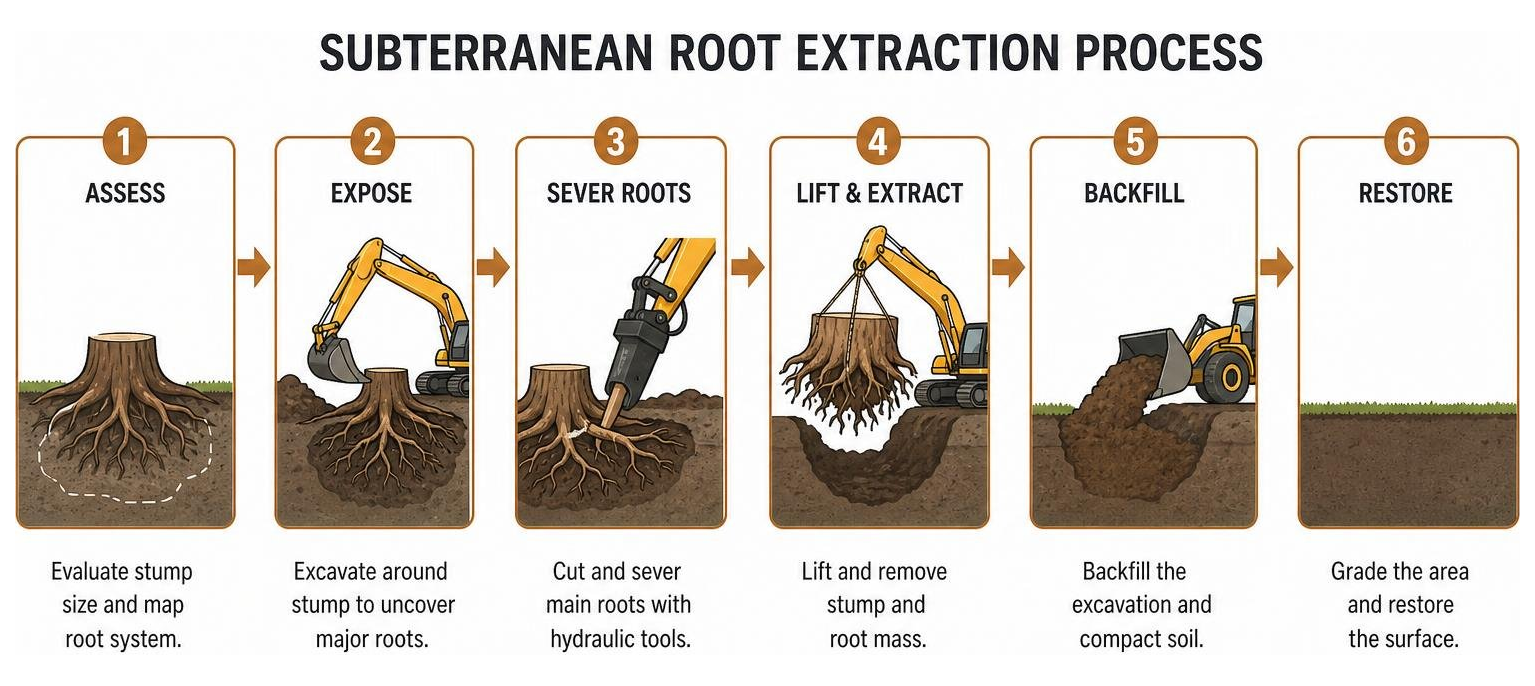
Comparing Full Removal and Stump Grinding
Choosing between stump grinding and full stump removal in Kokomo, Indiana depends on how you plan to use the land after the work is complete.
| Feature | Stump Grinding | Full Stump Removal |
|---|---|---|
| Primary Method | Shaves stump 6–12+ inches below grade using a carbide cutter wheel | Excavates the stump ball and primary lateral root network |
| Ground Impact | Minimal disruption to surrounding lawn | Creates a large excavation hole requiring backfill |
| Debris Produced | Leaves organic wood chip mulch on site | Generates a large root ball and stump debris for disposal |
| Best For | Lawn restoration, turf re-seeding, minor landscaping | Structural foundations, paving, concrete driveways |
| Regrowth Risk | Low for most species; roots naturally decay | Zero risk; entire root mass is removed |
Stump grinding converts the subterranean wood into organic mulch chips, which fill the grinding cavity before being capped with topsoil and lawn seed. Full removal extracts the root ball and major roots, reducing regrowth risk and creating a cleaner base for backfilling, grading, and future land use. Leaving untreated, decaying stumps in residential yards also creates potential harborage for wood-boring pests, including carpenter ants, subterranean termites, and wood wasps, which can eventually migrate to nearby homes or wooden structures. Winter freeze-thaw cycles in Kokomo can also cause buried decaying wood to create subsurface voids that collapse in spring. To learn more about clearing methods, read our article comparing Land Clearing vs Forestry Mulching.
Choosing Stump Removal Kokomo Indiana for Residential Properties
Residential property owners in Kokomo need complete stump removal when preparing land for major landscape construction, concrete driveways, swimming pools, or building foundations. Leaving buried roots behind before pouring concrete or laying stone leads to severe ground settling, soil subsidence, and structural cracking as the subterranean wood gradually rots over time.
When planning residential site work, evaluating equipment access, soil compaction standards, utility depth, and grading goals is essential. Whether you are clearing space for an outdoor living area, building a patio, or preparing a new home build site, removing deep subterranean roots creates a solid, stable foundation. Professional mechanical extraction prevents future sinkholes and ensures long-term land stability. Soil restoration typically involves backfilling the root cavity with dense fill dirt followed by topsoil.
City Regulations and Right-of-Way Permits in Kokomo
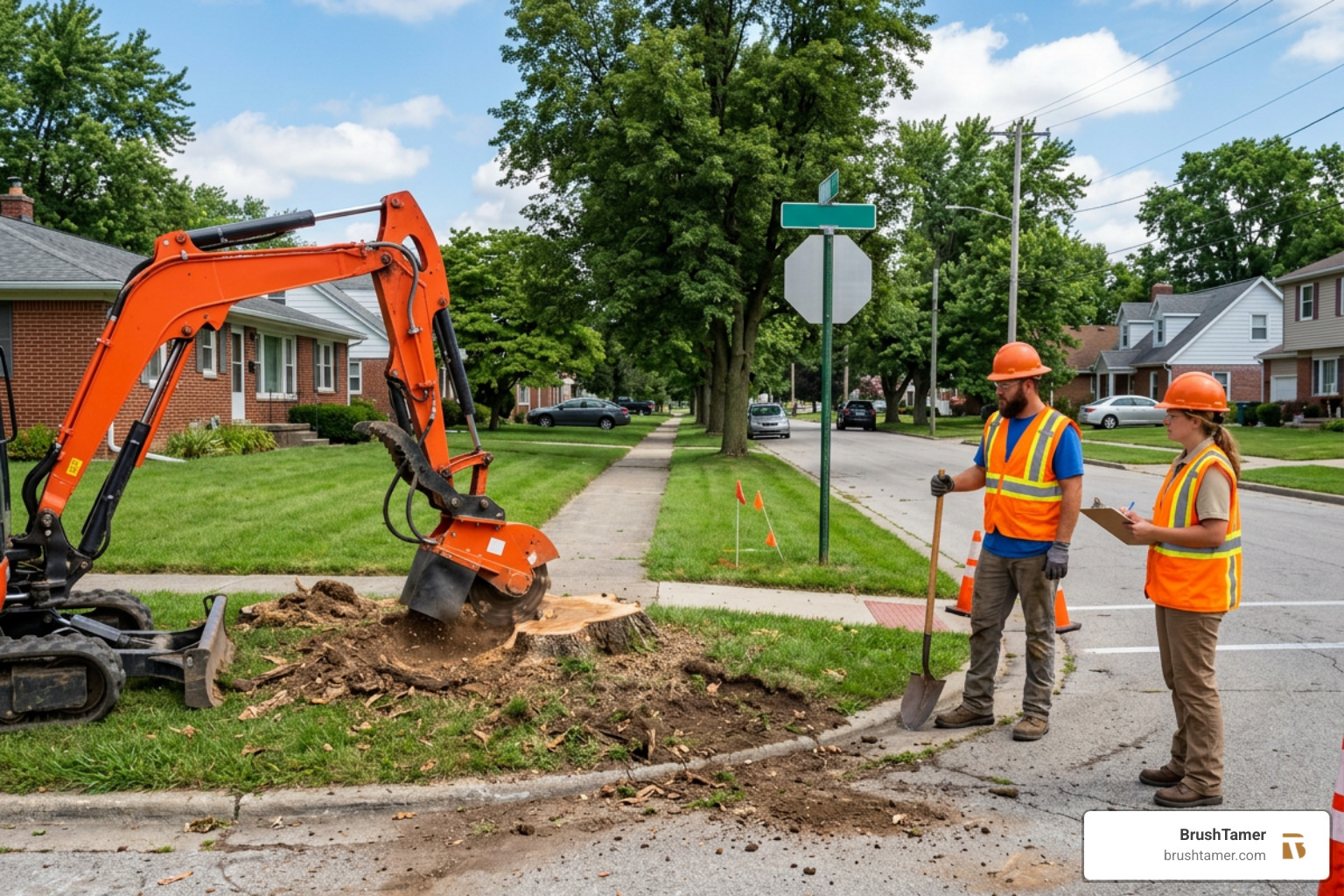
Excavations performed within public right-of-way zones or municipal tree lawns in Kokomo are strictly regulated by municipal standards. According to the city’s right-of-way guidelines set forth in official city documents like the FEB 12 2020 handbook update, any cuts, bores, open trenching, or mechanical disturbance of street tree lawns require official authorization from the Board of Public Works and Safety. Tree lawns—the grassy strips situated between public sidewalks and street curb lines—fall under municipal oversight to protect public infrastructure, maintain city stormwater flow, and safeguard buried municipal utility infrastructure.
Prior to disturbing any public tree lawn or street-adjacent landscape, property owners and professional contractors must ensure compliance with city requirements and locate all underground utility lines. Calling Indiana 811 at least two business days before digging protects gas, electric, water, sewer, and telecommunications lines from accidental damage during mechanical grinding or hydraulic root extraction. Indiana law mandates maintaining a two-foot hand-digging tolerance zone on either side of marked utility lines to prevent dangerous and costly utility strikes. Equipment operators must use hand digging or vacuum excavation within this tolerance zone before operating mechanical grinding teeth.
Navigating Right-of-Way Rules for Stump Removal Kokomo Indiana
Obtaining a municipal permit requires submitting complete applications and engineering documentation to the City of Kokomo Department of Engineering, Traffic, and Inspection Services. Permit applications are subject to a mandatory 5-day review period before ground excavation or heavy grinding equipment can operate in the public right-of-way. Applicants must provide site plans showing the work area, traffic safety controls if street lanes are affected, and proof of liability insurance naming the City of Kokomo as an additional insured.
Kokomo right-of-way work may require permit review, documentation, and city authorization before excavation begins.
- Check current City of Kokomo right-of-way requirements before beginning street-adjacent excavation.
- Driveway, sidewalk, and curb-adjacent work may require separate municipal review.
Performing excavation or tree lawn root removal without proper municipal authorization can lead to stop-work orders and required site restoration.
Protected Pavements, Fees, and Restoration Standards
To protect municipal roadways and public infrastructure investments, Kokomo enforces strict rules regarding “Protected Pavements.” If excavation affects asphalt, concrete, or decorative pavement, contractors should confirm restoration standards with the City of Kokomo before work begins.
- Recently resurfaced pavement may be subject to additional municipal review and restoration requirements.
- Street-adjacent work should be reviewed against current Kokomo right-of-way rules before equipment is mobilized.
- Contractors should verify pavement status before any excavation near public infrastructure.
- Decorative surfaces may require special approval and restoration planning.
After mechanical work is completed in a public right-of-way, contractors must restore tree lawns and green spaces to their original condition using clean topsoil, proper mechanical soil compaction, and INDOT Section 621 compliant seed mixes (such as Class R turf seed mixtures). Backfilling must be done in compacted lifts to prevent ground settling. If restoration standards are not met, the City of Kokomo may require corrective action to bring the right-of-way back into compliance.
Frequently Asked Questions About Kokomo Tree Care
How deep does standard stump grinding go for Kokomo residential yards?
Standard mechanical stump grinding reaches 6 to 12 inches below ground level, which is ideal for backfilling with clean topsoil and re-establishing healthy grass turf across residential lawns. Deep-root grinding can reach up to 18 inches below grade when preparing a site for shallow paving, retaining wall footings, garden beds, or underground utility installations. For deeper structural construction or major building foundations, full hydraulic excavation is recommended to ensure complete root network removal.
How long should you wait to replant a new tree after stump removal?
It is best to wait several months before planting a new tree in the exact same location, or to plant the new sapling at least three to five feet away from the original stump cavity. Decaying wood chips and subterranean root fibers left underground consume soil nitrogen during the microbial decomposition process, which can starve newly planted saplings of essential nutrients. Amending the soil with nitrogen-rich organic compost and allowing the ground to settle prevents root stunt, nutrient deficiency, and structural settling.
How does calling 811 protect property owners during stump extraction?
Before stump removal in Kokomo, Indiana, contacting Indiana 811 helps ensure buried utilities are located and marked before mechanical grinding or excavation begins. Marking these underground hazards prevents catastrophic line strikes, widespread utility outages, costly repair liabilities, and severe personal injury during heavy mechanical digging, trenching, or high-rpm stump grinding. Skipping utility coordination can create serious safety, service, and restoration risks.
What should be done with wood chips generated during stump grinding?
Wood chips can be retained on site for use as landscape mulch or mixed into garden beds. However, if the removed tree was infected with root decay fungi or infested with carpenter ants or termites, the chips should be hauled off site to protect surrounding vegetation and nearby structures. Cavities can then be backfilled with topsoil and reseeded.
Why do some tree species sprout new growth after stump grinding?
Certain trees like willow, locust, and silver maple possess aggressive root systems that can push up sucker sprouts even after the top stump is ground down. Applying a targeted herbicide treatment to remaining root ends or choosing complete hydraulic excavation prevents unwanted regrowth.
Professional Land Services Across Northern Indiana
BrushTamer delivers professional stump removal Kokomo Indiana property owners can rely on, along with land management, vegetation control, and stump grinding services across Northern Indiana and Lower Michigan. We service residential, commercial, and agricultural properties throughout Howard County, including Kokomo, as well as surrounding communities like Logansport, Peru, Lafayette, West Lafayette, Marion, Fort Wayne, Wabash, and Rochester.
For Kokomo property owners, professional stump removal is not just about eliminating visible wood. It is about creating a stable, usable surface that supports the next phase of the property, whether that means turf restoration, driveway installation, drainage correction, fence construction, pasture improvement, or preparation for a larger land clearing project. BrushTamer evaluates access routes, slope, soil conditions, nearby utilities, drainage patterns, and the intended final use of the site before selecting the right equipment and removal method. That planning helps reduce unnecessary ground disturbance while ensuring the remaining grade is clean, compacted, and ready for restoration.
Our team also understands the practical differences between rural acreage, residential lots, commercial frontage, and agricultural ground across North Central Indiana. A stump near a Kokomo sidewalk or curb may require right-of-way awareness and utility coordination, while a stump in a field edge near Logansport or Peru may be part of a broader vegetation management plan. Specialized track machinery helps BrushTamer complete stump removal efficiently while reducing unnecessary disturbance to surrounding turf. In every setting, BrushTamer focuses on safe execution, regulatory compliance, responsible debris handling, proper soil compaction, and thorough site cleanup.
Whether you need a single tree stump ground below turf level, complete subterranean root extraction for a new residential construction project, or large-scale land clearing for agricultural expansion, our team provides dependable results with an environmentally responsible approach. Ready to prepare your Kokomo property for its next use? Contact BrushTamer today to schedule a professional site consultation for stump removal in Kokomo, Indiana.