
The Science Behind Heavy Vegetation Control in Shipshewana
Heavy vegetation control in Shipshewana helps property owners reclaim overgrown land by using professional forestry mulching, brush management, and site preparation methods that protect long-term land usability. For property owners in Shipshewana, Middlebury, and Bristol, this process is the most effective way to reclaim land that has been overtaken by aggressive brush and saplings. Since 2021, BrushTamer has helped Northern Indiana property owners manage dense vegetation with specialized equipment, careful planning, and a focus on clean, usable results. This is not a simple mowing task; it is a sophisticated method of soil restoration and site stabilization that requires industrial-grade equipment and professional expertise. Forestry mulching uses specialized cutting heads to grind brush, saplings, and woody vegetation into mulch directly on-site. This mechanical action does more than just clear space; it alters the physical state of the vegetation, accelerating the natural decomposition cycle that would otherwise take decades to occur.
Using high-powered forestry mulchers, BrushTamer operators process organic material directly on-site. This process creates a protective layer that regulates soil temperature, retains moisture, and cycles vital nutrients back into the ground, effectively turning a “weed problem” into a “soil solution.” In the sandy loam soils common throughout LaGrange County, this organic layer is critical for preventing the depletion of topsoil. Our approach ensures that the biomass is processed into a fine consistency that accelerates decomposition, providing an immediate boost to the local ecosystem’s health. The mulch acts as a natural sponge, capturing rainwater and preventing the rapid runoff that often leads to nutrient leaching in agricultural zones. By maintaining this organic cover, we ensure that the microbial life within the soil is protected from the harsh UV rays of the sun and the extreme temperature fluctuations common in the Michiana region.
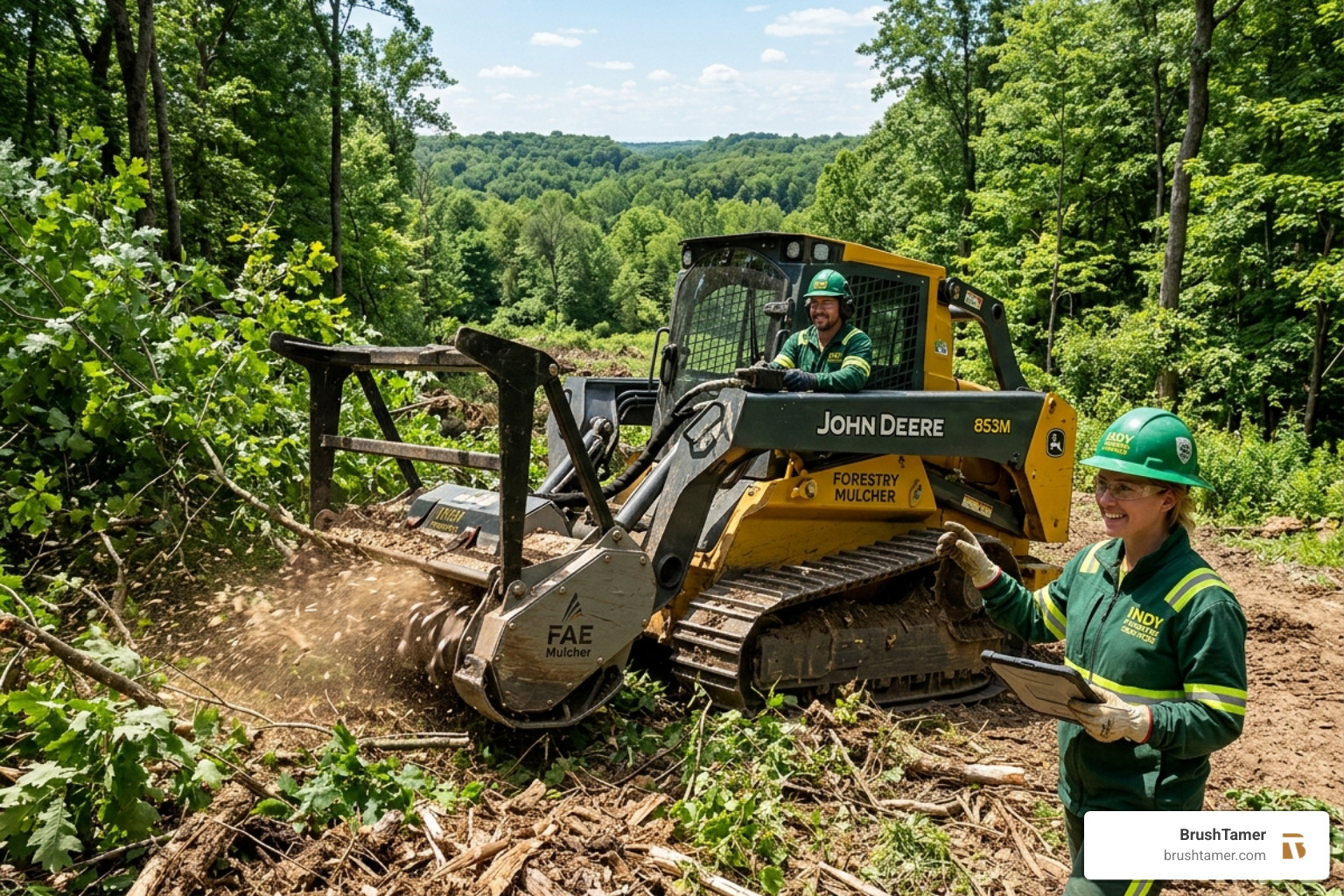
When Brush Tamer implements Vegetation Management Solutions, we focus on the long-term health of the Northern Indiana and Lower Michigan landscape. Traditional “push and burn” methods often leave the soil scorched and vulnerable to wind and rain erosion, destroying the microbial life necessary for future growth. In contrast, modern vegetation control maintains the integrity of the topsoil. The mulch produced by our machinery acts as a natural erosion control blanket, which is particularly critical on sloped terrains found near the Fawn River and other local waterways. This scientific approach ensures that once the overgrowth is removed, the land beneath it is healthier and more stable than it was before the intervention. Furthermore, the elimination of burn piles removes the risk of soil sterilization, a common side effect of high-heat fires that can leave patches of land barren for years. Our method preserves the delicate balance of the earth while providing a clean, park-like finish that is ready for immediate use or secondary landscaping.
Ecological Benefits of Heavy Vegetation Control Shipshewana
The primary ecological benefit of professional heavy vegetation control in Shipshewana is the immediate restoration of local biodiversity through the systematic removal of aggressive invasive species. In our region, plants like buckthorn, autumn olive, and garlic mustard can quickly create dense monocultures, choking out the native Indiana flora that local wildlife depends on for survival. By selectively removing these invaders, Brush Tamer opens the canopy and forest floor to sunlight, allowing dormant native seeds to germinate and thrive once again. This restoration of the “seed bank” is vital for the long-term resilience of the local environment. When native oaks, maples, and wildflowers are allowed to return, they provide the necessary food and shelter for local pollinators and bird populations that have been displaced by invasive thickets.
According to our Heavy Brush Removal Ultimate Guide, maintaining a balanced ecosystem requires more than just clear-cutting; it requires a deep understanding of how different species interact within the Michiana climate. When we clear away dense undergrowth, we are often improving the habitat for birds and small mammals that require “edge” environments or open woodland floors. Furthermore, by removing dead and diseased wood, we reduce the fuel load on your property, significantly lowering the risk of devastating wildfires during the dry Indiana summers. This proactive management strategy protects both the environment and the structural assets on your land. By thinning out overcrowded stands of saplings, we also reduce the competition for water and nutrients, allowing the most healthy and desirable trees on your property to grow stronger and more resistant to pests and diseases.
Why Professional Heavy Vegetation Control Shipshewana Outperforms Manual Labor
Professional heavy vegetation control in Shipshewana outperforms manual labor because it utilizes hydraulic efficiency and specialized safety protocols that cannot be replicated by hand tools or standard residential equipment. A professional Brush Tamer crew can clear in a single afternoon what would take a team of laborers weeks to accomplish by hand. This efficiency is driven by high-flow hydraulic systems found in our modern skid steers and excavators, which allow for the continuous shredding of trees up to six or eight inches in diameter without the need for manual felling or hauling. The sheer power of these machines allows them to process entire trees from the top down, turning limbs, trunks, and foliage into mulch in a matter of seconds, which eliminates the logistical nightmare of disposing of massive amounts of woody debris.
Safety is the most critical factor in choosing professional services over manual efforts. Attempting to clear heavy brush manually involves significant risks from falling limbs, sharp thorns, and hidden debris. Our Commercial Vegetation Control services utilize enclosed-cab machinery with ballistic-grade glass and ROPS (Roll-Over Protective Structures), ensuring that the operator is protected while the machine does the heavy lifting. This professional approach ensures the job is done right the first time, without the liability, physical toll, or safety hazards associated with manual clearing efforts. Additionally, professional operators are trained to identify hazards such as overhead power lines, underground utilities, and unstable ground conditions that a DIY property owner might overlook, providing a level of risk mitigation that is essential for any large-scale land project.
Innovations in Forestry Management: Highlights from the 2026 Midwest Sportsmen Classic
The 2026 Midwest Sportsmen Classic, held at the Michiana Event Center in Shipshewana, Indiana, serves as the premier showcase for the latest innovations in land management technology. A primary attraction at the event is the display of FAE equipment, which represents the cutting edge of heavy vegetation control. For Shipshewana-area property owners, modern forestry equipment can turn dense brush, saplings, and invasive growth into manageable ground cover. Attendees can see firsthand how specific models of forestry attachments handle the toughest Indiana brush, from dense thickets to standing timber. The event brings together land management experts, equipment manufacturers, and property owners to discuss the evolving challenges of maintaining rural acreage in the Midwest. It is a hub for learning about the mechanical advancements that make modern land reclamation faster and more environmentally sustainable than ever before.
For property owners comparing heavy vegetation control in Shipshewana, the right equipment determines whether brush is temporarily cut back or converted into a stable mulch layer. Depending on the project scope, BrushTamer may use equipment such as rotary cutters, skid steer mulchers, stump cutters, or excavator attachments.
- Rotary Cutters: The RCM/SSL model, designed for high-speed maintenance of large fields and meadows, capable of handling thick grass and light woody growth.
- Mulchers for Skid Steers: Including the PATRIZIO, UML/SSL, DML/SSL, and the heavy-duty BL4/SSL, which are the workhorses of the industry, featuring Bite Limiter technology to optimize power consumption.
- Stump Cutters: The SCL/SSL, essential for removing the “trip hazards” and underground root balls left behind after tree removal, ensuring a smooth surface for future mowing.
- Excavator Attachments: The BL0/EX, BL1/EX, and PML/HY mulchers, which allow for precision clearing on steep banks, ditches, and hard-to-reach areas where traditional machinery cannot safely operate.
High-Performance Hydraulic and PTO-Driven Heads
The performance of modern Industrial Vegetation Management equipment relies on the distinction between hydraulic and PTO-driven heads, both of which Brush Tamer utilizes depending on the project scope. For skid steers and excavators, hydraulic heads use the machine’s fluid power to spin the cutting drum at high speeds. These are ideal for the versatile, “surgical” clearing often required on residential properties in Shipshewana and Middlebury. They allow the operator to lift, tilt, and angle the mulching head to grind standing trees from the top down, ensuring complete destruction of the biomass. The flexibility of hydraulic systems means that operators can work around sensitive structures, such as fences or outbuildings, with extreme precision, minimizing the risk of collateral damage while maximizing the clearing area.
PTO-driven (Power Take-Off) heads are typically mounted on high-horsepower tractors and are the workhorses for large-scale acreage. These units are capable of sustained, high-torque output over hundreds of acres, making them perfect for agricultural borders and utility rights-of-way. Whether it is a hydraulic mulcher on a compact track loader or a PTO-driven rotary cutter, these innovations allow Brush Tamer to process thick vegetation into fine mulch in a single pass. This technology has revolutionized how we manage land throughout Northern Indiana and Lower Michigan, providing a level of efficiency that was impossible just a decade ago. By matching the specific drive system to the terrain and vegetation density, we ensure that every project is completed with the optimal balance of speed and thoroughness, reducing the overall time the machinery needs to be on your property.
Transforming Your Property: Key Takeaways from the Shipshewana Seminars
A major highlight of the Shipshewana show is the “Transforming Your Property” seminar series, which focuses on the strategic side of land management. The key takeaway for Shipshewana landowners is that vegetation control should always be aligned with specific land goals—whether that is creating a world-class hunting property, improving pasture for livestock, or increasing the curb appeal of a rural estate. Brush Tamer’s expertise lies in translating these goals into a mechanical reality using the right tools for the specific terrain. These seminars often highlight the importance of “strategic thinning,” where certain trees are preserved to provide shade and structure while the invasive understory is completely removed to improve visibility and access.
According to our Vegetation Management Ultimate Guide, property transformation is a multi-step journey that begins with professional assessment. The seminars emphasize that the initial clearing is just the beginning of a long-term management plan. By understanding the “why” behind the clearing—such as creating better sightlines for security or improving access to water for livestock—landowners can make more informed decisions about which areas to mulch and which to leave as natural cover. This holistic view of land management ensures that every acre of your Shipshewana property is serving its intended purpose while maintaining its market value. Land management discussions often emphasize safer access, healthier vegetation patterns, and more practical use of rural acreage.
Advanced Mechanical Methods for Dense Overgrowth and Invasive Species
Advanced mechanical methods for dense overgrowth prioritize forestry mulching because it is a low-impact, high-efficiency solution that eliminates the need for burning or hauling debris. While traditional land clearing is still used for major commercial construction, forestry mulching has become the preferred choice for most property owners in Northern Indiana and Lower Michigan. The following table illustrates why Brush Tamer’s mulching services are the superior choice for heavy vegetation control in Shipshewana:
| Feature | Forestry Mulching | Traditional Land Clearing |
|---|---|---|
| Soil Impact | Minimal; enriches soil with organic matter | High; removes topsoil and causes compaction |
| Debris Management | Left on-site as nutrient-rich mulch | Requires hauling, burning, or separate disposal planning |
| Erosion Risk | Very Low; mulch protects the surface | High; leaves bare dirt exposed to elements |
| Permitting | Often easier or not required for maintenance | Usually requires extensive permits and silt fencing |
| Aesthetics | Immediate park-like finish | Bare, scarred earth requiring reseeding |
| Operational Simplicity | Single-machine process with limited debris handling | More complex process with multiple steps |
Brush Tamer specializes in Services Forestry Mulching, providing a clean, professional finish that allows you to walk or drive across your land immediately after the project is completed. This method is particularly effective for managing storm damage in areas like Elkhart and Goshen, where fallen limbs and tangled brush can be processed into a uniform layer of ground cover in a fraction of the time required by traditional methods. By avoiding the use of heavy bulldozers that scrape the earth, we preserve the delicate root systems of the trees you wish to keep, ensuring that the clearing process does not inadvertently harm the health of your remaining forest.
Forestry Mulching: The Gold Standard for Soil Restoration
Forestry mulching is the gold standard for soil restoration because it mimics the natural decomposition process of the forest floor at an accelerated rate. By grinding woody material into small chips, Brush Tamer increases the surface area available for microbes and fungi to break down the carbon. This process builds organic matter in the soil, which is essential for healthy plant growth and moisture retention. In the agricultural heartland of Shipshewana, preserving the quality of the soil is a core value that we uphold in every project. The resulting mulch layer acts as a thermal insulator, protecting the soil from the deep freezes of Indiana winters and the scorching heat of the summer, which helps maintain a stable environment for beneficial soil organisms.
As noted in our Category Forestry Mulching resources, the mulch layer also serves as a “seedbed preparation” tool. If you plan to sow native grasses or wildflowers after clearing, the mulch provides a moist, protected environment for seeds to take root. This is a significant improvement over traditional methods that leave the soil hard-packed and nutrient-depleted. Our process ensures that your land is not just cleared, but actively prepared for its next phase of life. The mulch also suppresses the immediate regrowth of weeds by blocking sunlight from reaching the soil surface, giving your desired plantings a competitive advantage during the critical early stages of growth.
Targeted Invasive Species Management: Buckthorn and Garlic Mustard
Invasive species management is a specialized subset of heavy vegetation control that requires professional identification and mechanical precision. Plants like Oriental Bittersweet, Bush Honeysuckle, and Buckthorn are “land-takers” that spread rapidly and prevent native species from growing. Buckthorn, in particular, can grow up to 25 feet tall and produces berries that are spread by birds, creating a cycle of infestation that can ruin a woodlot in just a few seasons. These species often exhibit allelopathic properties, meaning they release chemicals into the soil that inhibit the growth of other plants, effectively creating a biological desert where only the invasive species can survive.
Using our Services Brush Management techniques, Brush Tamer can target these specific species with surgical accuracy. For Buckthorn and Autumn Olive, the most effective strategy is to mulch the standing plants to the ground level. Because our mulchers can handle stems up to 6 inches in diameter, we can clear massive thickets of honeysuckle in a fraction of the time it would take to attempt manual removal. This mechanical intervention is the first and most important step in reclaiming your property from these “green invaders.” Once the primary biomass is removed, property owners can more easily implement follow-up treatments to ensure these aggressive plants do not return, finally breaking the cycle of infestation.
Brush Hogging for Large Acreage Maintenance
For large, open fields in Northern Indiana that are overgrown with thick grass and woody shrubs but do not yet have mature trees, brush hogging is a practical maintenance solution. Unlike a standard lawn mower, a professional brush hog (or rotary cutter) uses heavy, swinging blades that can strike rocks or thick stalks without sustaining damage. This allows for the rapid maintenance of large parcels that have been neglected for several seasons. It is an essential tool for keeping agricultural land in a state of readiness and preventing the encroachment of woody species that would eventually require more intensive forestry mulching.
This method is ideal for maintaining pastures, clearing trails, and keeping fence lines visible in towns like Shipshewana, Bristol, and White Pigeon. Regular maintenance with a rotary cutter keeps the vegetation at a manageable height, reducing the risk of fire and keeping the property in compliance with local aesthetic standards. BrushTamer provides scheduled maintenance services to help fields remain accessible, manageable, and usable throughout the year. By establishing a regular mowing schedule, landowners can encourage the growth of healthy forage grasses while discouraging the establishment of woody saplings and invasive weeds, maintaining the utility and beauty of the landscape indefinitely.
Navigating Indiana Vegetation Ordinances and Environmental Compliance
Navigating Indiana vegetation ordinances requires an understanding of local “rank vegetation” codes, which mandate that uncultivated growth in residential and semi-rural zones must be managed to prevent public nuisances. Owning property in Northern Indiana comes with responsibilities defined by these local laws. In areas such as St. Joseph County and the town of Shipshewana, there are strict rules regarding weeds and overgrowth. These laws are designed to prevent blight, protect property values, and ensure public safety by reducing fire hazards and maintaining visibility at intersections. Ignoring local vegetation rules can create avoidable compliance issues, making professional vegetation management a practical step for many landowners.
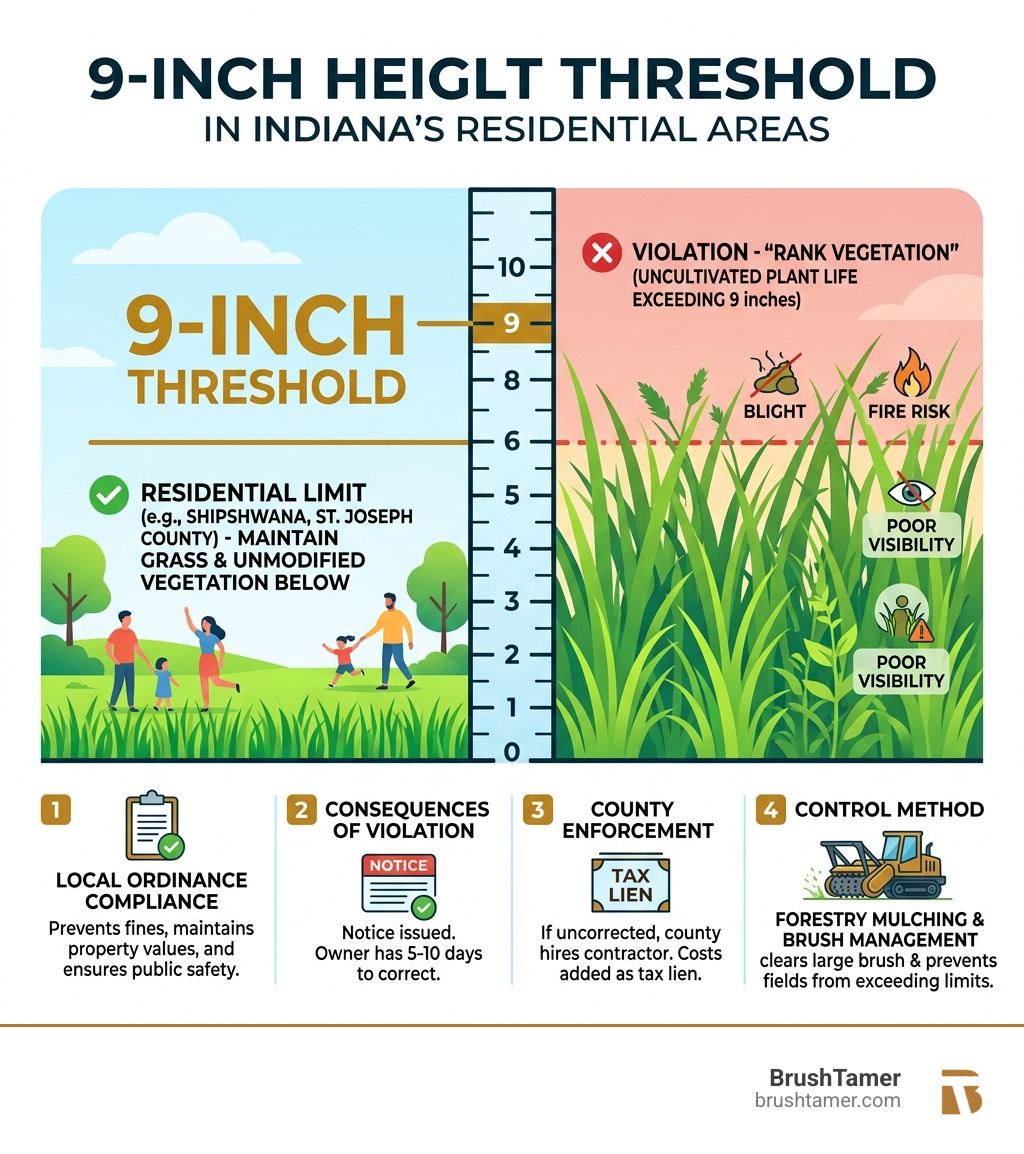
A well-maintained Shipshewana property is a legal requirement that Brush Tamer helps you fulfill. For instance, the Michiana Shores 2025 Tree Ordinance emphasizes the preservation of native trees while strictly regulating the removal of vegetation. Understanding these local nuances is a core part of the professional service we provide. We help plan land clearing projects with local requirements in mind, reducing the risk of compliance problems. Our team stays up-to-date on the latest changes to municipal codes, ensuring that our clients are always protected from the risks of improper land management.
Understanding Local Weed and Rank Vegetation Codes
Local codes in Northern Indiana often define “rank vegetation” as any uncultivated plant life that exceeds a specific height—frequently 8 or 9 inches in residential and developed zones. According to the Draft Weed and Rank Vegetation Ordinance, the county has the authority to issue a notice of violation to property owners who fail to maintain their land. If vegetation is not addressed after proper notice, local authorities may pursue enforcement steps allowed under applicable ordinance procedures. Proactive vegetation management gives property owners more control over timing, scope, and final results than waiting for enforcement action.
These ordinances generally exempt active agricultural crops and managed gardens, but they are very strict about vacant lots and front yards. By hiring Brush Tamer for heavy vegetation control in Shipshewana, you are taking a proactive step to avoid these “forced abatements.” We provide the professional results and documentation needed to satisfy municipal inspectors and keep your property in good standing with the local government. Our services ensure that your land remains an asset rather than a liability. We also help property owners understand the distinction between “naturalized landscaping” and “neglected overgrowth,” helping you maintain an aesthetic that is both ecologically friendly and legally compliant.
Permitting and Selective Clearing in Protected Zones
When your property contains wetlands, floodplains, or riparian buffers, vegetation management becomes significantly more complex. These are “protected zones” where the Indiana Department of Natural Resources (DNR) or local planning commissions have jurisdiction. In these sensitive areas, total clear-cutting is often prohibited to protect water quality, but the selective clearing of invasive species is frequently encouraged to maintain the health of the ecosystem. Navigating the permit process for these areas requires a detailed understanding of environmental regulations and a commitment to low-impact clearing methods.
Our experience as The Best Plymouth Brush Clearing Service for Your Land allows us to navigate these complex regulations on your behalf. We help identify where permits are required and where maintenance can proceed. Selective clearing allows Brush Tamer to remove “trash trees” and invasive vines that threaten the health of the waterway while leaving the deep-rooted native trees that prevent bank erosion. This balanced, professional approach protects both your property rights and the local environment in the Michiana region. By working within the framework of environmental compliance, we ensure that your land management activities contribute to the long-term sustainability of Indiana’s natural resources.
Conclusion
At BrushTamer, we believe your land deserves a professional, thoughtful approach rooted in careful planning and responsible vegetation management. Whether you are located in Shipshewana, Elkhart, Goshen, or South Bend, the challenges of overgrowth and invasive species are a constant pressure on property value and utility. By choosing professional heavy vegetation control in Shipshewana, you are taking a proactive step toward safer access, cleaner terrain, and healthier long-term land conditions. Our methods are designed to provide immediate results while fostering the long-term productivity of the soil and the surrounding ecosystem.
Since 2021, BrushTamer has provided sustainable land management solutions throughout Northern Indiana and Lower Michigan, including heavy vegetation control in Shipshewana for properties challenged by dense brush, saplings, and invasive growth. From the initial clearing of dense thickets to long-term acreage maintenance, we are here to help you reach your land goals with the most advanced equipment and environmentally responsible techniques available. If you are ready to reclaim your property from the brush and restore its potential, explore our Services Land Clearing and let Brush Tamer provide the professional results your land deserves. Your land deserves careful stewardship; let BrushTamer help restore access, manage overgrowth, and support healthier long-term land use.
Ready to reclaim overgrown land with professional heavy vegetation control in Shipshewana? Contact BrushTamer today to discuss your property goals and schedule a site assessment with our team.