
Why Farmers and Landowners Are Searching for Agricultural Clearing Services Midwest
Agricultural clearing services Midwest are professional land management services that remove trees, brush, stumps, and overgrown vegetation so farmland can return to productive use quickly and safely. Across the Midwest, productive farmland can quickly lose usability when brush, saplings, and invasive vegetation are left unmanaged. The fertile soils and seasonal growth cycles of the Midwest can also support aggressive woody species and invasive brush. When left unmanaged, these areas quickly transition from productive acreage to liability-filled thickets.
Across Northern Indiana and Lower Michigan, landowners seek clearing because unmanaged edges and idle acreage reduce usable acres, limit equipment access, and accelerate invasive spread. This means fewer plantable rows, less grazeable pasture, and higher repair risk from hidden stumps and saplings. For a modern farm operation, every usable acre matters, and unmanaged brush can reduce planting space, limit access, and complicate long-term land management.
| Service | Best For |
|---|---|
| Forestry mulching | Brush and tree removal without soil disturbance |
| Fence line clearing | Restoring property boundaries and access |
| Pasture restoration | Reclaiming overgrown grazing land |
| Field preparation | Prepping land for planting and crop production |
| Invasive species removal | Eliminating buckthorn and other harmful plants |
| Food plot creation | Clearing land for wildlife or small-scale farming |
| Stump grinding | Removing root systems after tree clearing |
In communities like Plymouth, South Bend, Mishawaka, Goshen, Elkhart, Bristol, Middlebury, Nappanee, Benton Harbor, St. Joseph, Niles, and Dowagiac, the pattern is consistent: brush advances into fence lines, saplings thicken field edges, and neglected corners become equipment hazards. The Midwest climate creates a rapid growth cycle for species like Autumn Olive and Multiflora Rose. Waiting another season can increase vegetation density, allowing small saplings to become established trees that require a more intensive clearing plan.
BrushTamer is a dedicated land clearing contractor based in Plymouth, Indiana, founded in 2021, focused on delivering results farms can immediately use—clean boundaries, accessible lanes, and acreage ready for production. We understand that for a farmer, land clearing is about operational efficiency and the long-term viability of the family legacy. Our approach combines heavy-duty industrial power with the precision required to protect Midwest topsoil.
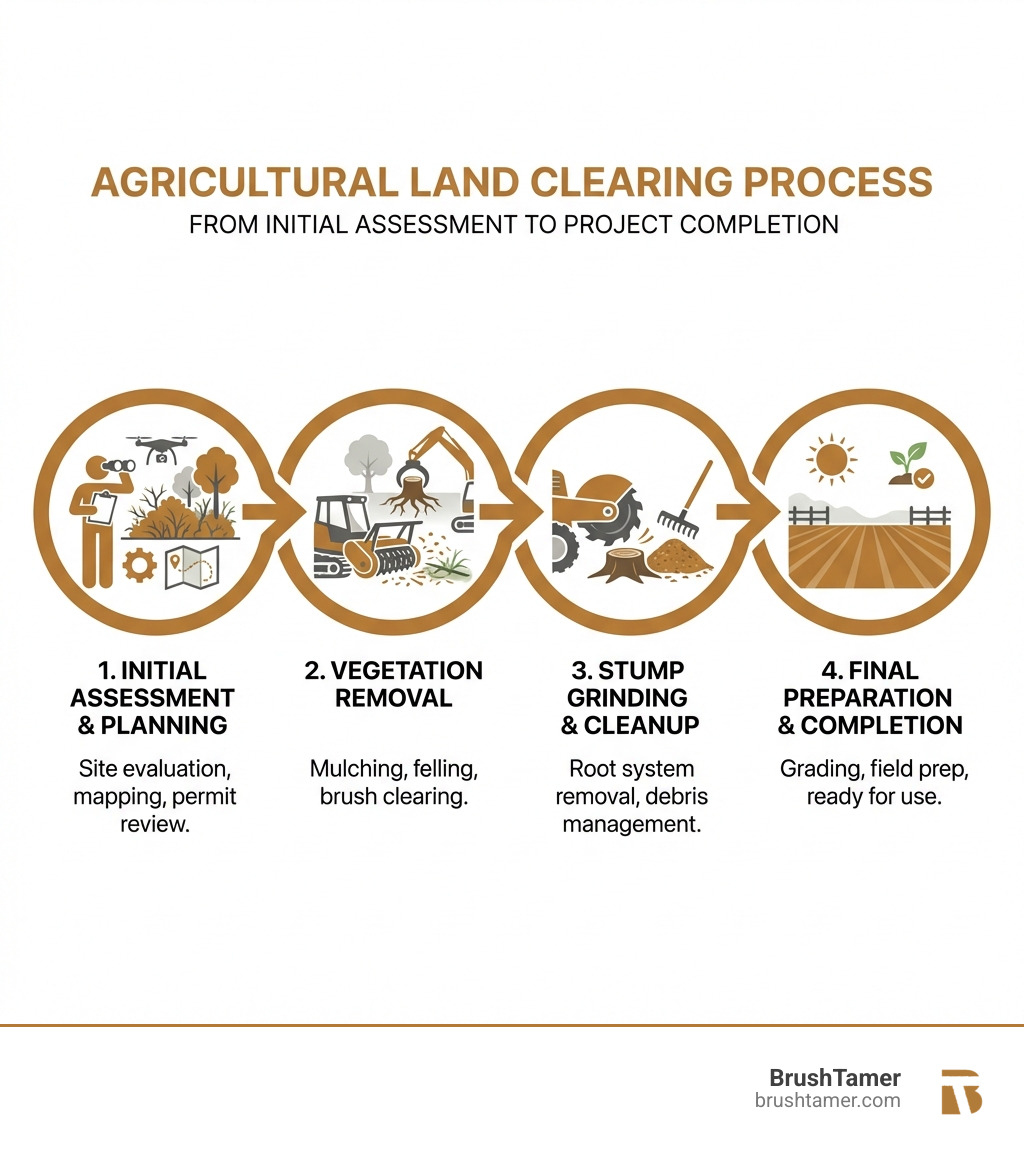
The Importance of Professional Agricultural Clearing Services Midwest
Professional agricultural clearing services Midwest convert overgrown, low-utility acreage into dependable farm ground with predictable access and fewer long-term maintenance problems. Turning overgrown acreage into working farmland requires a clearing plan that accounts for vegetation density, equipment access, drainage, and future land use.
For landowners in South Bend, Mishawaka, Plymouth, Warsaw, Valparaiso, Goshen, Elkhart, Bristol, Middlebury, and Nappanee, professional clearing is operational restoration. When woody growth encroaches, it narrows headlands, blocks turns, shades out forage, and creates hidden obstacles that damage tires, mowers, and planters. A hidden stump can damage equipment, interrupt fieldwork, and create avoidable delays during critical production windows. Furthermore, overgrown field edges create moisture traps that can lead to increased fungal pressure on crops near the tree line.
With professional agricultural clearing services Midwest landowners can rely on, BrushTamer helps restore field edges, reopen access, and prepare acreage for its next use. This process is the first step in a Detailed Guide to Agricultural Land Conversion, turning neglected woods or brush into high-value acreage. We evaluate land through the lens of the producer, identifying where clearing can improve usable acreage, access, drainage, and long-term field performance.

Specialized Field Preparation for Row Crops and Mixed Operations
Specialized field preparation creates a smooth, equipment-ready surface by removing woody vegetation and problem areas that interfere with modern planting and harvest operations. In the Midwest, where the window for planting and harvesting can be narrow due to weather, any delay caused by poor field conditions is magnified. Professional clearing ensures that when the weather breaks, your equipment can run at full capacity without navigating around brush piles.
For row-crop and mixed operations around South Bend, Mishawaka, and Warsaw, field readiness is measured by how consistently equipment can run. Stumps and dense brush pockets slow operations and raise repair costs during the busiest weeks of the year. When a field is properly prepared, the transition from the headland to the main rows is seamless, allowing for the precise application of seed and fertilizer that modern precision agriculture demands.
BrushTamer’s Land Clearing Services focus on production-minded outcomes:
- Restoring Workable Radius: Clearing overgrown field edges to restore the turning radius required for large-scale modern implements.
- Optimizing Sunlight and Airflow: Removing saplings and brush that shade crops, which can lead to uneven drying and reduced yields.
- Equipment Protection: Eliminating stumps and woody regrowth that pose a constant threat to expensive tires and hydraulic systems.
- Drainage Support: Preparing uniform surfaces that support consistent drainage patterns, preventing the formation of wet spots.
The goal of agricultural clearing services Midwest farms can trust is acreage ready for the next operation—planting, mowing, or spraying—without surprises. We aim to provide a “clean slate” for the farmer, ensuring that the land is as productive as possible from the very first pass.
How Clearing Supports Livestock Management
Agricultural clearing services support livestock management by restoring pastures and access lanes so grazing is safer and easier to maintain. For livestock producers, the quality of the forage is directly tied to the management of the land. When invasive brush takes over, it actively competes with the grasses and legumes that provide nutrition for the herd.
In livestock-focused communities like Nappanee, Bristol, and Middlebury, pasture performance drops when thorny brush and woody invasives take hold. Animals avoid those areas, concentrating grazing pressure elsewhere and accelerating pasture decline. This leads to overgrazing in some areas and underutilization in others, reducing the overall carrying capacity of the farm. Furthermore, certain invasive species common in the Midwest can be toxic to livestock, making their removal a matter of animal health.
BrushTamer’s Brush Management reclaims grazing utility without unnecessary disruption. We target non-productive woody growth, reopen access for mowing and fence maintenance, and leave land in a condition that supports the next step in your pasture plan. For farms running cattle, horses, or small ruminants, the outcome is measurable: more usable acres, cleaner fence lines, and fewer hazardous obstructions in high-traffic areas. By removing the brush, we allow the sun to reach the soil surface, encouraging the regrowth of high-quality forage.
Advanced Methods for Agricultural Land Transformation
Advanced agricultural land transformation uses modern, contractor-operated methods—especially forestry mulching—to remove vegetation efficiently while protecting soil structure and simplifying debris management. The evolution of land clearing technology has moved away from the “brute force” methods of the past, which often left the land scarred. Today, agricultural land clearing should prioritize precision, soil protection, debris management, and a clear next-use plan.
Across Lower Michigan and Northern Indiana, older clearing approaches often created lasting problems: rutted ground, bare soil that erodes, and debris piles that linger for months. These piles often become havens for pests and can take years to fully decompose. BrushTamer applies purpose-built equipment and a production mindset so land can move directly into the next phase of use. By processing the vegetation exactly where it stands, we eliminate the need for hauling and the associated soil compaction that comes with heavy truck traffic.
Modern agricultural clearing services in the Midwest are most effective when they:
- Strategic Methodology: Match the method to the end goal, whether it’s a quick pasture restoration or a deep-root crop conversion.
- Soil Preservation: Control ground pressure through the use of tracked machinery to protect sensitive farm soils from compaction.
- On-Site Management: Manage debris on-site to reduce hauling delays and keep organic matter where it belongs.
- Boundary Precision: Maintain access and visibility along boundaries and lanes, ensuring that property lines are clearly defined.
Benefits of Forestry Mulching for Soil Health
Forestry mulching benefits soil health by minimizing disturbance, protecting the surface from erosion, and returning organic material to the ground as a natural mulch layer. In the context of Midwest agriculture, where topsoil is the most valuable asset a landowner possesses, the protection of this layer is paramount. Traditional clearing methods that involve scraping the ground can remove the nutrient-rich top layer of the soil.
In practical Midwest conditions—including the sandy loams common in parts of Berrien County and the heavier clays found across Marshall County and St. Joseph County—keeping topsoil in place is non-negotiable. Traditional dozing can shear off the most productive layer and expose subsoil that behaves differently under moisture, often leading to drainage issues. Mulching, by contrast, leaves the root structures of the soil-stabilizing grasses intact while processing the woody material above.
BrushTamer’s Forestry Mulching leaves soil structure intact. The mulch created acts as a protective blanket, preventing heavy Midwest rains from washing away topsoil and helping to regulate soil temperature. Over time, this mulch decomposes, returning organic matter to the ground and creating a rich environment for future crops or grasses. Forestry mulching is a practical method for agricultural land clearing because it processes woody vegetation on-site while helping protect exposed soil. This process helps to rebuild soil health in areas that may have been neglected for decades.
| Feature | Forestry Mulching | Traditional Clearing (Dozer) |
|---|---|---|
| Soil Disturbance | Minimal to none | High (strips topsoil) |
| Debris Management | Mulched on-site | Burning or hauling required |
| Erosion Control | Excellent (mulch cover) | Poor (leaves bare dirt) |
| Speed | Very fast | Moderate |
| Permits | Often easier to obtain | Often requires more oversight |
Specialized Blueberry Orchard Removal and Reclamation
Specialized blueberry orchard removal clears aging or unproductive bushes and root systems so the site can be redeveloped into a new planting plan or transitioned into different agricultural use. Blueberry farming is a staple of the regional economy, but like any perennial crop, orchards eventually reach a point of diminishing returns. When an orchard becomes diseased or too old to produce efficiently, the removal process must be thorough to prevent the carryover of pathogens.
This need is especially common in Lower Michigan near Benton Harbor, St. Joseph, and surrounding fruit-growing areas, where orchard blocks reach an end-of-life point and become a barrier to the next revenue cycle. Old bushes and woody crowns make the ground uneven and difficult to reset. Because blueberries thrive in specific soil conditions, the reclamation process often involves balancing the soil while removing the physical obstructions of the old plants.
BrushTamer’s Blueberry Orchard Removal service uses specialized equipment to grind woody bushes and root balls, preparing the ground for Repurposing Blueberry Fields. This specialized Blueberry Reclamation helps fruit growers transition land into traditional row crops or fresh plantings, delivering a cleaner reset that supports faster redevelopment. Our process ensures that the woody debris is finely shredded, allowing it to be incorporated back into the soil or removed easily.
Technical Equipment and Regional Expertise
BrushTamer’s technical equipment is purpose-selected for Midwest agricultural clearing, balancing power with low ground impact to protect productive farm soils. We recognize that the diverse terrain of the Midwest—ranging from flat plains to rolling, wooded hills—requires a versatile fleet that can adapt to changing conditions. Our equipment is maintained for dependable performance during critical agricultural windows, including field preparation, pasture restoration, and seasonal clearing.
Our fleet includes the Yanmar SV100 excavator paired with a Fecon VMX50 mulching head, providing the muscle needed for heavy clearing without the footprint that destroys sensitive ground. This specific combination allows us to reach into tight areas, such as steep ditch banks or narrow fence rows, with surgical precision. Skid steers and excavators equipped with high-flow hydraulics handle trees up to 11 inches in diameter, turning them into beneficial mulch in seconds. When the job requires more than surface clearing, our Stump Grinding & Removal attachments neutralize root systems so they won’t interfere with plows or discs, ensuring that the land is truly ready for the tractor.
Serving Northern Indiana and Lower Michigan
BrushTamer is a local partner for farmers across the region, with firsthand knowledge of specific soil types—from the sandy loams of Berrien County, Michigan, to the heavy clays of Marshall County, Indiana. We understand how these soils react to moisture and how to time our operations to minimize compaction. Our deep roots in the community mean we aren’t just contractors; we are neighbors who care about the long-term health of the local agricultural landscape. Our service area includes:
- Indiana: South Bend, Mishawaka, Goshen, Elkhart, Bristol, Middlebury, Nappanee, Plymouth, Warsaw, and Valparaiso. We are familiar with the drainage challenges and the unique needs of the farming communities in Elkhart and LaGrange counties.
- Michigan: Benton Harbor, St. Joseph, Niles, Dowagiac, Kalamazoo, and Grand Rapids. We support the diverse fruit belt and the expanding grain operations of the southern Michigan counties.
Because BrushTamer is based in Plymouth, we mobilize equipment to your site quickly, keeping your project on schedule with planting season demands. We know that in farming, timing is everything, and a delay of a few days can mean the difference between a successful crop and a missed opportunity.
Fence Line Clearing and Boundary Maintenance
Professional fence line clearing restores property boundaries, improves access, and protects fence infrastructure from vegetation damage. A fence is a significant investment, and allowing brush to grow up through the wire is the fastest way to destroy that investment. Over time, the weight of vines and the expansion of tree trunks will stretch wire, rot wooden posts, and eventually cause the entire structure to fail.
Fence repair and maintenance become difficult when years of honeysuckle, autumn olive, and woody growth bury the fence line. BrushTamer specializes in precision clearing along property lines, removing brush that weighs down wire and rots wooden posts. This is a key part of our Brush Removal Category of services, delivering the clean boundaries and functionality every landowner needs. By clearing a wide path along the fence, we also create a maintenance lane that allows for easy inspection and repair in the future. See our Lot Clearing Guide 2025 for additional guidance on maintaining these boundaries.
Regulatory Compliance and Environmental Stewardship
Regulatory compliance and environmental stewardship in agricultural clearing mean completing work legally and safely with controls that protect water and soil—especially in the lake-influenced landscapes of Northern Indiana and Lower Michigan. The Midwest is home to vital freshwater resources, and agricultural practices must be conducted with a high degree of responsibility to protect these watersheds for future generations.
BrushTamer approaches each project with a clear standard: remove what limits land use while protecting what sustains long-term productivity. That includes identifying invasive species pressure, avoiding unnecessary ground disturbance, and planning work sequences that reduce runoff risk. We believe that good farming and good stewardship go hand-in-hand. By removing invasive species, we are helping to restore the native balance of the land, allowing indigenous hardwoods and grasses to thrive once again.
When BrushTamer performs agricultural clearing services Midwest, we actively identify invasive species that threaten native ecosystems. Removing buckthorn and multiflora rose stops these plants from choking out productive woods and pastures. When working near the many lakes and rivers of Northern Indiana and Lower Michigan, we ensure our methods prevent silt from entering waterways, helping clients navigate local permitting requirements or resources like the EPA Land Permits when applicable. Our goal is to leave the land better than we found it, ensuring that the clearing process doesn’t create new environmental challenges.
Permitting and Safety Standards in the Midwest
Permitting and safety standards in the Midwest require verifying local requirements and protecting existing drainage and water flow. County, township, and state requirements can vary, especially near wetlands, drainage corridors, and protected waterways. We help our clients understand these complexities before the first machine ever hits the ground.
Projects near regulated features—wetlands, drainage corridors, and protected waterways—can require additional oversight depending on township, county, or state guidance. Clearing that ignores drainage can create standing water and washouts that reduce field access when you need it most. In many parts of the Midwest, the intricate network of clay tiles and drainage ditches is the lifeblood of the farm; our operators are trained to identify and protect these critical pieces of infrastructure during the clearing process.
BrushTamer follows strict guidelines to keep operators and your property safe throughout the process. We assess topography before starting, ensuring our work supports existing drainage tiles and natural water flow. This proactive approach prevents the accidental destruction of tiles that could lead to field flooding. For a deeper dive into these requirements, see our Land Clearing Services Complete Guide. Safety is our top priority for the crew and the families who live on the properties we service.
Frequently Asked Questions about Agricultural Clearing
How long does it take to clear a 10-acre pasture?
The timeline for a pasture reclamation project depends on acreage, vegetation density, terrain, weather, access, and whether stump grinding or follow-up preparation is required. Mulching light brush and saplings to restore grazing moves quickly, often allowing for several acres to be completed in a single day. However, removing large trees, grinding stumps for crop conversion, or dealing with extremely dense invasive thickets extends the timeline. Weather also plays a factor, as we may pause work during extreme rain to prevent soil damage. BrushTamer works to meet your agricultural deadlines and communicates realistic schedules before work begins.
Is forestry mulching better than burning brush piles?
For many agricultural land clearing projects, forestry mulching is a strong alternative to burning because it manages debris on-site and leaves protective organic material behind. Burning creates air pollution, carries fire-spread risk, and leaves scorched earth that resists growth for several years. Furthermore, burn piles often require constant monitoring and can be restricted by local ordinances. Forestry mulching recycles nutrients immediately, eliminates hauling, and leaves soil protected with a layer of organic matter. It is the most neighbor-friendly clearing method—no smoke, no unsightly piles, and no waiting for burn permits. It also allows you to use the land immediately after the machine leaves.
Can you clear land during the winter months?
Yes, winter is an excellent time for land clearing in the Midwest. When the ground is frozen, equipment may have a lower impact on soil, helping reduce rutting and compaction risk when site conditions are appropriate. Additionally, many invasive species are easier to identify and access when the leaves are off the trees. Clearing in the winter ensures your land is ready for the first spring thaw, allowing you to stay ahead of the planting season.
Conclusion
BrushTamer delivers professional agricultural clearing services Midwest landowners rely on to reclaim acreage, restore access, and prepare fields and pastures for productive use across Northern Indiana and Lower Michigan. Our commitment to the agricultural community is rooted in the belief that well-managed land is the foundation of a successful farm operation.
Founded in 2021 and based in Plymouth, Indiana, BrushTamer combines modern equipment, region-specific expertise, and a stewardship-first approach that protects soil and drainage while achieving clear, usable results. From fence line restoration near Goshen and Elkhart, to pasture reclamation around Nappanee and Bristol, to agricultural redevelopment serving Benton Harbor, St. Joseph, Niles, and Grand Rapids, our work holds up through Midwest seasons. We take pride in helping our clients maximize their land’s potential while preserving its health for the next generation.
If you need acreage ready for planting, grazing, or redevelopment—without lingering piles or preventable soil loss—BrushTamer is prepared to evaluate your site and deliver a scope that matches your timeline and end goal. Let us help you tame the brush and get your land back to work. Contact us today!