
Why Forest Thinning in Kalamazoo Matters for Your Property
In Kalamazoo and across Southwest Michigan, forest thinning in Kalamazoo is often the turning point for overcrowded, stressed woodlands. Many private woodlands have become overcrowded, one of the most common reasons landowners pursue forest thinning in Kalamazoo. This stressed condition makes them vulnerable to invasive species like Autumn olive, devastating diseases such as Oak Wilt, and destructive pests like the Emerald Ash Borer. Furthermore, these dense, unmanaged forests pose a serious wildfire risk to homes and communities.
Forest thinning in Kalamazoo is the professional, science-based solution to these problems. It is a proactive land management practice involving the selective removal of trees and vegetation to restore forest health, improve safety, and enhance property value. For landowners, thinning transforms a struggling, inaccessible woodland into a thriving, resilient ecosystem that can be safely used and enjoyed for decades.
This guide will explore the significant benefits of forest thinning, what to look for in a professional service, and how the process works to achieve your specific goals for your property.
What is Forest Thinning? A Closer Look at the Science
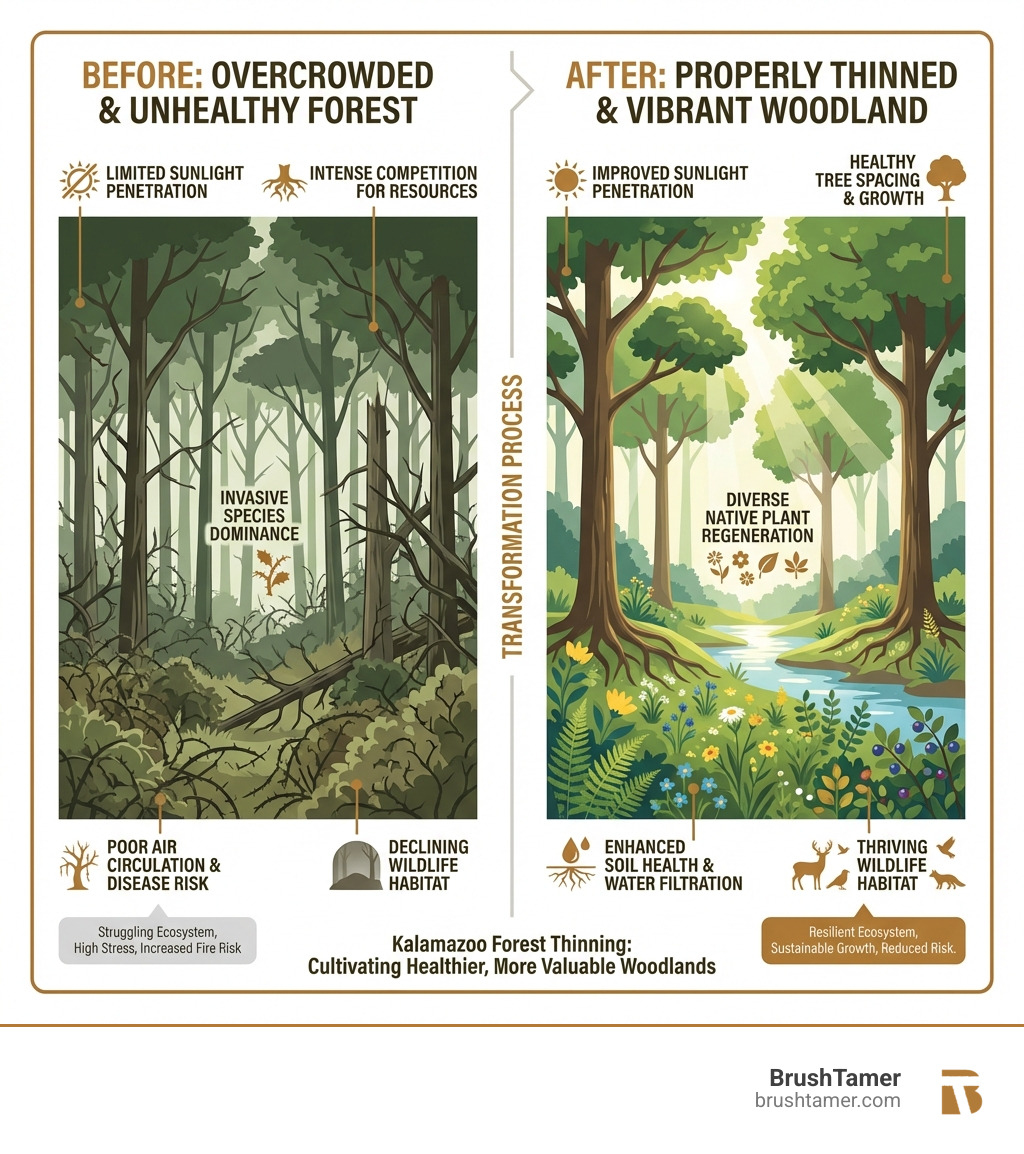
Forest thinning in Kalamazoo is the deliberate, strategic removal of selected trees and vegetation to improve the health and growth of what remains. Unlike land clearing or commercial logging, the primary goal of thinning is not to remove all trees, but to carefully manage the density and composition of the forest to achieve specific ecological objectives.
In many stands that need forest thinning in Kalamazoo, trees compete intensely for light, water, and nutrients. As their canopies close together, they block sunlight from reaching the forest floor, which suppresses the growth of crucial understory plants and young trees. This intense competition weakens all trees, making them stunted, stressed, and more susceptible to being toppled by storms or succumbing to pests and diseases.
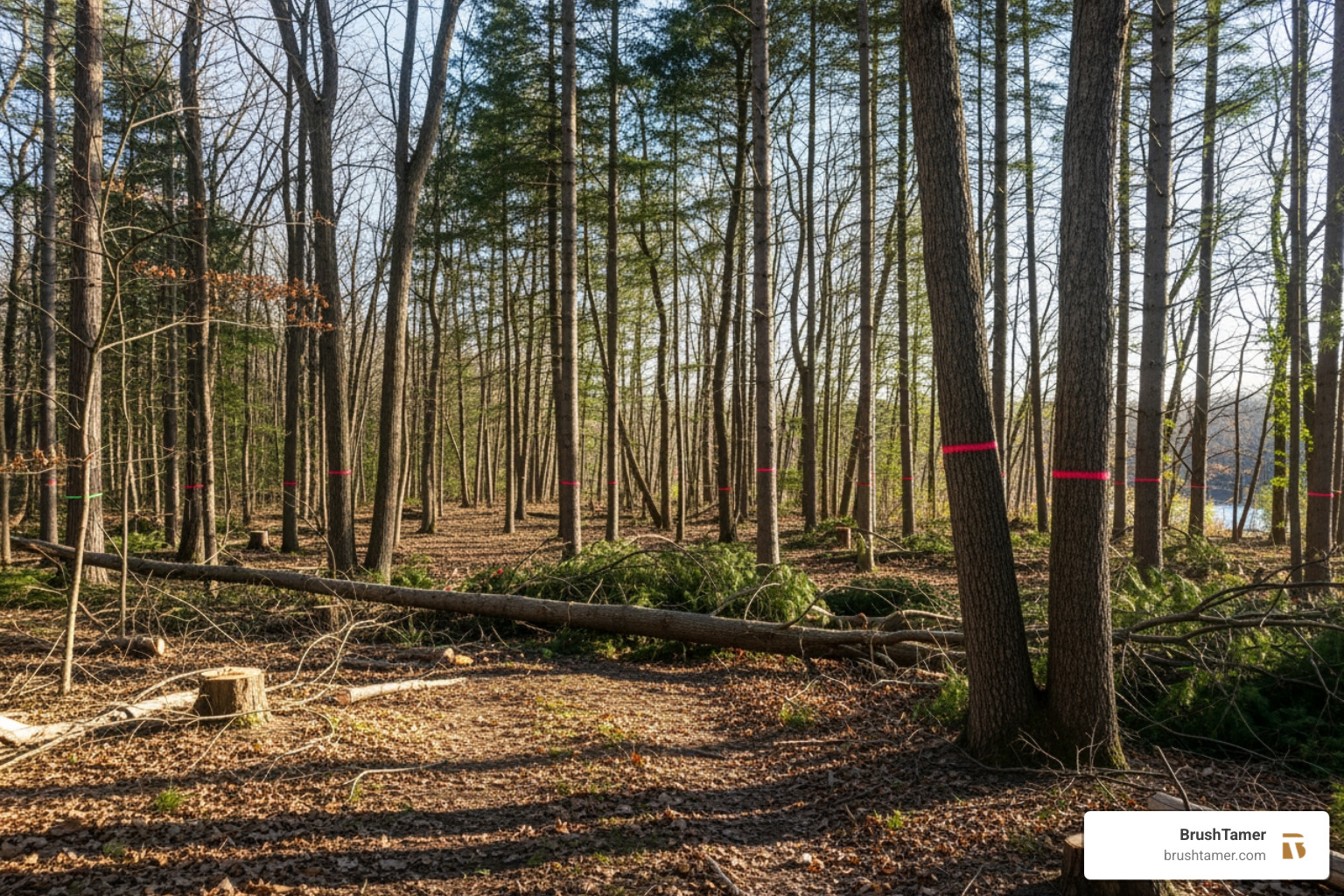
The thinning process involves a professional forester assessing the woodland and identifying which trees to remove and which to leave. Trees targeted for removal are often those that are diseased, damaged, of poor form, or are an undesirable or invasive species. Others are removed to provide adequate growing space for more promising, healthier “leave trees.” By optimizing the spacing, these remaining trees gain access to more sunlight, water, and soil nutrients, allowing them to grow stronger, healthier, and more resilient. This science-based intervention effectively resets the forest’s competitive balance and kickstarts a cycle of healthy, vigorous growth.
The Comprehensive Benefits of Professional Forest Thinning
Professional forest thinning in Kalamazoo improves safety, usability, and long-term forest resilience through selective, goal-driven removal. By moving a forest from a state of stress to a state of vigor, thinning creates a more sustainable and enjoyable environment for landowners.
Drastically Reducing Wildfire Risk
In communities like Portage, Battle Creek, and Richland, where development meets woodland, wildfire prevention is a critical concern. Overgrown forests are loaded with flammable material. Thinning directly addresses this by reducing fuel loads. We strategically remove smaller trees, shrubs, and dead vegetation that act as “ladder fuels,” which can carry a small ground fire up into the treetops, creating a dangerous and difficult-to-control crown fire. By breaking up this continuous fuel source and reducing overall vegetation density, thinning creates a landscape where wildfires are less likely to start, spread more slowly, and are far less intense, protecting both your property and the surrounding community. For related wood clearing needs, especially dense understory and edge growth, see our Heavy Brush Removal Ultimate Guide.
Creating Thriving and Diverse Wildlife Habitats
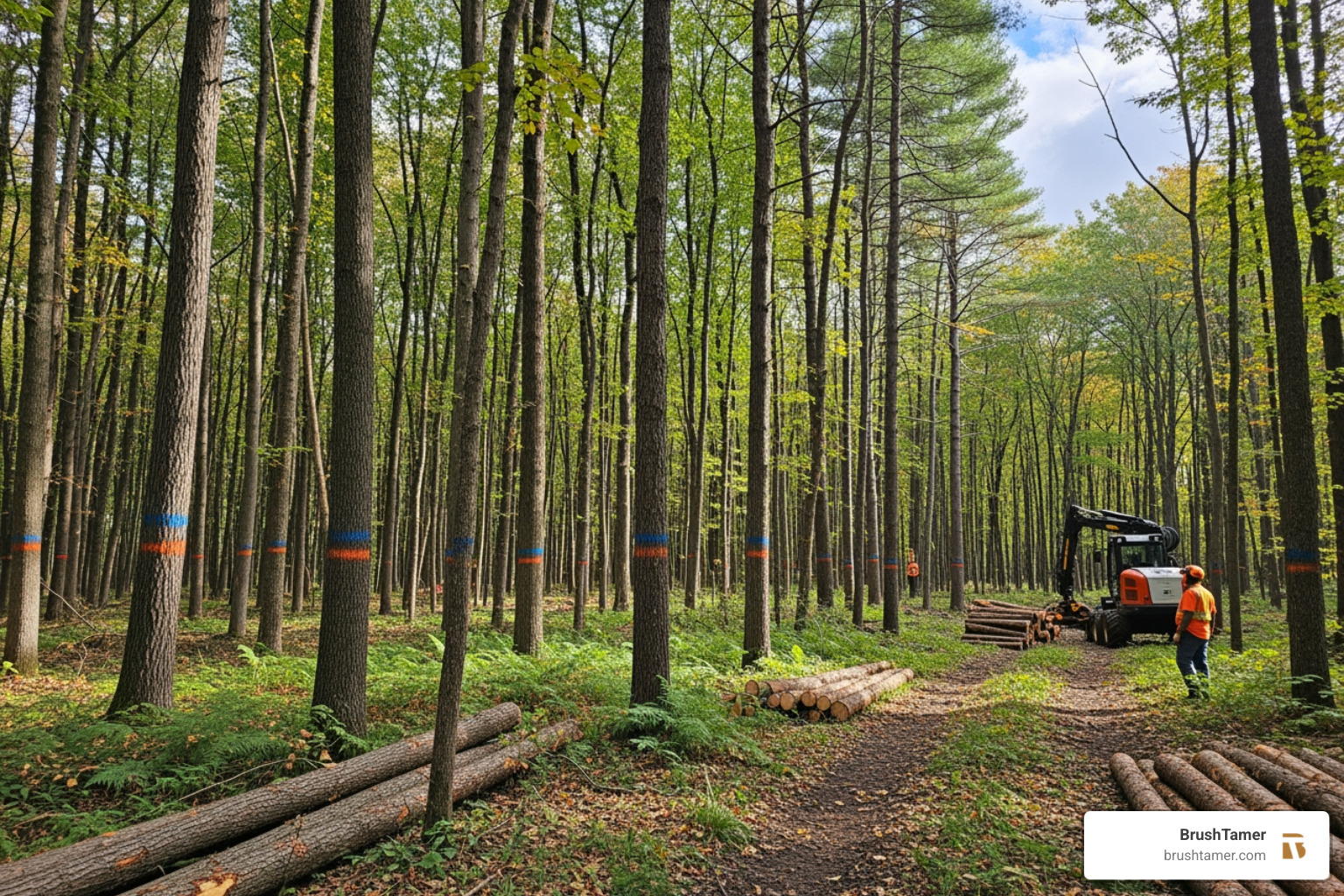
Thinning is one of the most effective tools for improving wildlife habitat. By opening the forest canopy and allowing sunlight to reach the ground, we stimulate a lush growth of native grasses, wildflowers, and shrubs. After forest thinning in Kalamazoo, this new layer of vegetation can provide essential food and cover for a wide array of wildlife, from game species like whitetail deer and wild turkey to numerous non-game species. As emphasized by programs like Forestry for Michigan Birds, creating this structural diversity—with healthy canopy trees, a mid-story, and a vibrant understory—is vital for supporting diverse bird populations. Our practices create a mosaic of conditions that foster biodiversity and support a healthy, functioning ecosystem. For more on this topic, see our Forestry and Wildlife Management resources.
Protecting Water Quality and Improving Soil Health
The health of Kalamazoo’s forests is directly linked to the quality of its water. In a dense forest, much of the rainfall is caught in the canopy and evaporates before it reaches the ground. Thinning allows more precipitation to reach the forest floor, where the newly established groundcover slows runoff, prevents soil erosion, and dramatically improves water infiltration. This process is essential for recharging groundwater aquifers, which supply our drinking water. The City of Kalamazoo has recognized this connection in its own land management, such as on property in Ross Township, where timber harvests were planned specifically to improve the quality of water filtered through the soil. Thinning is a proactive measure to protect our shared water resources.
Building Resistance to Disease and Pests
A thinned forest is a healthier forest, better equipped to defend itself against threats. By reducing competition, the remaining trees are less stressed and more vigorous, enabling them to naturally resist pests and fight off diseases. This is particularly important in Southwest Michigan for combating the spread of Oak Wilt, a lethal fungal disease. Thinning can remove infected trees and reduce the risk of transmission between neighboring oaks. It also helps mitigate the long-term impact of the Emerald Ash Borer by promoting the growth of other, more resilient tree species. Furthermore, improved air circulation within the canopy reduces the damp conditions that favor fungal growth, leading to a more robust and structurally sound forest.
Identifying the Best Forest Thinning Services: 5 Qualities to Look For
When considering forest thinning in Kalamazoo, choosing the right service provider is crucial for ensuring project success and achieving your landowner goals. It’s not just about removing trees; it’s about thoughtful, professional land management. At BrushTamer, we uphold high standards, and we believe you should look for these five key qualities in any service you consider.
1. Expertise in Modern, Low-Impact Thinning Techniques
The best forest thinning services use modern, low-impact techniques that prioritize the long-term health of your forest and soil. This includes methods like selective harvesting, where individual trees are chosen for removal based on their health and spacing, and pre-commercial thinning, which focuses on improving the growth of desirable young trees. Crown thinning, a technique for individual trees, can also be applied at a broader scale to promote overall forest health.
We specialize in advanced methods such as Forestry Mulching and Brush Hogging. These techniques not only efficiently clear underbrush and smaller trees but also return organic matter to the soil, enhancing its health and moisture retention. Unlike traditional methods, forestry mulching eliminates the need for burning slash, significantly reducing air pollution and preventing soil compaction that can occur with heavy machinery or repeated burning. Our approach aims to minimize disturbance, ensuring that your forest thrives for years to come.
2. Certified, Insured, and Compliant Operations
A professional forest thinning service must be certified, insured, and compliant with all safety regulations. This is a non-negotiable quality that protects you and your property. Look for companies that employ ISA Certified Arborists, who have proven expertise in tree biology and care. Reputable services like BrushTamer also operate in strict accordance with American National Standards (ANSI) and MIOSHA General Industry Standards for safe work practices.
Full liability insurance is another critical component. It shields you, the landowner, from liability for any accidents or damages during the project. Our commitment at BrushTamer to professional accountability, risk management, and safety protocols ensures your property is in responsible hands.
3. A Comprehensive Approach to Land Management
Effective forest thinning is part of a broader, holistic land management strategy. A top-tier service will consider the entire ecosystem of your property, not just individual trees. This includes comprehensive site evaluations and the development of long-term forest stewardship plans custom to your goals.
Key aspects of this comprehensive approach involve invasive species control, targeting problematic plants like Phragmites and Autumn olive that can choke out native vegetation. We also conduct soil health assessments to understand nutrient levels and drainage, ensuring that thinning practices support optimal growing conditions. Our commitment to Professional Land Management means we’re looking at the big picture, fostering a resilient and thriving environment for decades.
4. Experience in Urban and Suburban Environments
Forest thinning in Kalamazoo often takes place in urban and suburban settings, which present unique challenges compared to remote wilderness areas. Proximity to structures, homes, and utility lines demands specialized expertise and precision. A skilled service will have experience in safely navigating these environments, prioritizing public safety and minimizing disruption to your daily life and your neighbors.
This includes solutions for limited access areas, careful debris management, and consideration for noise levels during operations. The City of Kalamazoo’s block pruning program, for example, demonstrates the need for specialized approaches in managing trees within developed areas. Our expertise in Commercial Vegetation Control ensures that we can handle complex projects in residential and commercial settings with the utmost care and efficiency.
5. Local Knowledge and Regional Expertise
The best forest thinning services possess deep local knowledge of the ecosystems and regulations specific to Southwest Michigan and Northern Indiana. This regional expertise is crucial for making informed decisions that benefit your property, from understanding native tree species and soil types to navigating local ordinances.
Our team at BrushTamer is intimately familiar with the requirements in communities like Kalamazoo, Portage, Battle Creek, Sturgis, Three Rivers, Niles, and Goshen. Since our founding in 2021, we have focused on serving these areas, ensuring our practices are both effective and compliant with all local guidelines. This local insight allows us to provide custom solutions that respect the unique character of your land and community.
The Process: What to Expect from a Forest Thinning Project with BrushTamer
Starting on a forest thinning project with BrushTamer is a streamlined and transparent process, designed to meet your specific needs and achieve lasting results. From the initial consultation to the final follow-up, we ensure you are informed and involved every step of the way.
Initial Consultation and Forest Management Plan
Our process begins with a comprehensive initial consultation. One of our expert foresters will visit your property for a thorough site evaluation. During this visit, we’ll discuss your specific landowner goals—whether it’s improving wildlife habitat, enhancing aesthetics, reducing fire risk, or preparing for future use. We conduct a detailed tree inventory, identifying species, assessing individual tree health, and noting any signs of disease or pest infestation.
Based on this assessment, we develop a customized written forest management plan that outlines work areas, sequencing, access, and protection priorities. This plan outlines the proposed thinning techniques, the expected project sequence, and the site protections we’ll use to minimize disturbance. Our transparent process ensures you understand every aspect of the project before any work begins, allowing us to align our services with your vision for your land.
Optimal Timing for Thinning in Southwest Michigan
The timing of forest thinning can significantly impact its effectiveness and the health of your remaining trees. In Southwest Michigan, the dormant season, typically late fall through winter, is often optimal for many thinning operations. Working during these colder months, especially when the ground is frozen, helps to reduce soil disturbance and compaction, protecting the delicate forest ecosystem.
Winter operations also minimize the risk of spreading certain tree diseases, such as Oak Wilt, which is often transmitted by insects attracted to fresh wounds during warmer seasons. While the dormant season is ideal for many larger-scale projects, our year-round capabilities allow us to address urgent needs, like invasive species management, at the most effective time for their control.
Long-Term Goals and Outcomes
The ultimate outcome of a well-executed thinning project is a healthy, resilient, and usable forest that aligns with your long-term vision. The immediate results include improved aesthetics and better access for recreation like hiking or hunting. Over time, these efforts culminate in a more structurally diverse and ecologically robust woodland. This stewardship improves long-term usability and supports healthier stand development across your property.
Frequently Asked Questions about Forest Thinning in Kalamazoo
How much does forest thinning cost in Kalamazoo?
The cost of forest thinning in Kalamazoo is highly variable, as each project is unique. There is no standard per-acre price. Key factors that influence the cost include the total acreage, the density of trees and undergrowth, the terrain’s difficulty (steep slopes or wetlands increase complexity), and your specific goals, such as fuel reduction versus habitat improvement. The type of equipment needed and the chosen methods also affect the final investment. For an accurate price, we provide a custom quote based on a thorough site evaluation of your property and desired outcomes.
Do I need a permit for forest thinning on my property?
Whether a permit is required for forest thinning in Kalamazoo County depends on the project’s scale, your property’s zoning, and any environmental overlays like wetlands. Routine thinning for forest health on private land may not require a permit, but any activity classified as commercial harvesting or significant land alteration often will. Ordinances vary between townships, so it is crucial to check with your local township and the Kalamazoo County planning department. If wetlands are present, state and federal regulations may also apply. As part of our initial consultation, we can help guide you in understanding the local requirements for your project. For information on public land management, you can visit the Michigan DNR website: Learn More about DNR land management.
Is forest thinning the same as land clearing?
No, forest thinning and land clearing are fundamentally different services with distinct goals. Forest thinning is a selective process focused on improving the health and structure of an existing forest. The objective is to reduce competition and improve growth for the remaining trees, leaving a healthy, functional woodland behind. In contrast, land clearing involves the complete removal of all trees and vegetation from a site. The goal of clearing is typically to prepare the land for a new use, such as construction, agriculture, or creating an open pasture. Thinning maintains the forest, while clearing removes it. For a detailed look at clearing, see our Land Clearing Services Complete Guide.
Your Partner for a Healthier Kalamazoo Forest
At BrushTamer, we are deeply committed to fostering healthier, more resilient forests across Southwest Michigan and Northern Indiana. Our professional expertise in forest thinning in Kalamazoo delivers significant ecological benefits, improves property value, and improves the overall usability of your land. We believe in proactive forest stewardship that ensures the long-term health and beauty of your natural resources.
Our client-focused approach means we listen to your goals, assess your property with precision, and implement solutions that are both effective and environmentally responsible. If you’re ready to transform your dense, overgrown woodland into a vibrant, thriving ecosystem, we invite you to partner with us.
Improve the health and safety of your woodland with forest thinning in Kalamazoo. Contact BrushTamer to schedule a site evaluation and map out next steps.