
Why Habitat Restoration Is One of the Most Important Environmental Challenges of Our Time
Habitat restoration is the scientific process of assisting the recovery of an ecosystem that has been degraded, damaged, or destroyed. It involves a strategic combination of removing environmental stressors, reintroducing native biological diversity, and repairing hydrological or soil-based systems to return the land to a self-sustaining, healthy state. This process is not merely about aesthetics; it is about restoring the biological machinery that supports life on Earth.
For property owners in Northern Indiana and Lower Michigan, understanding what is habitat restoration is the first step toward restoring native plants, improving habitat function, and reducing invasive pressure. Since BrushTamer was founded in 2021, we have observed a significant increase in the need for professional intervention to combat the aggressive spread of invasive species and the fragmentation of local woodlots. Across the Midwest, habitat fragmentation and invasive species are accelerating biodiversity loss and weakening ecosystem function. This crisis is not just a global issue; it is happening in the wetlands of South Bend, the forests of Kalamazoo, and the prairies of Elkhart. The loss of native biodiversity leads to a collapse in ecosystem services, affecting everything from local air quality to the stability of our food systems.
The Core Components of Professional Restoration
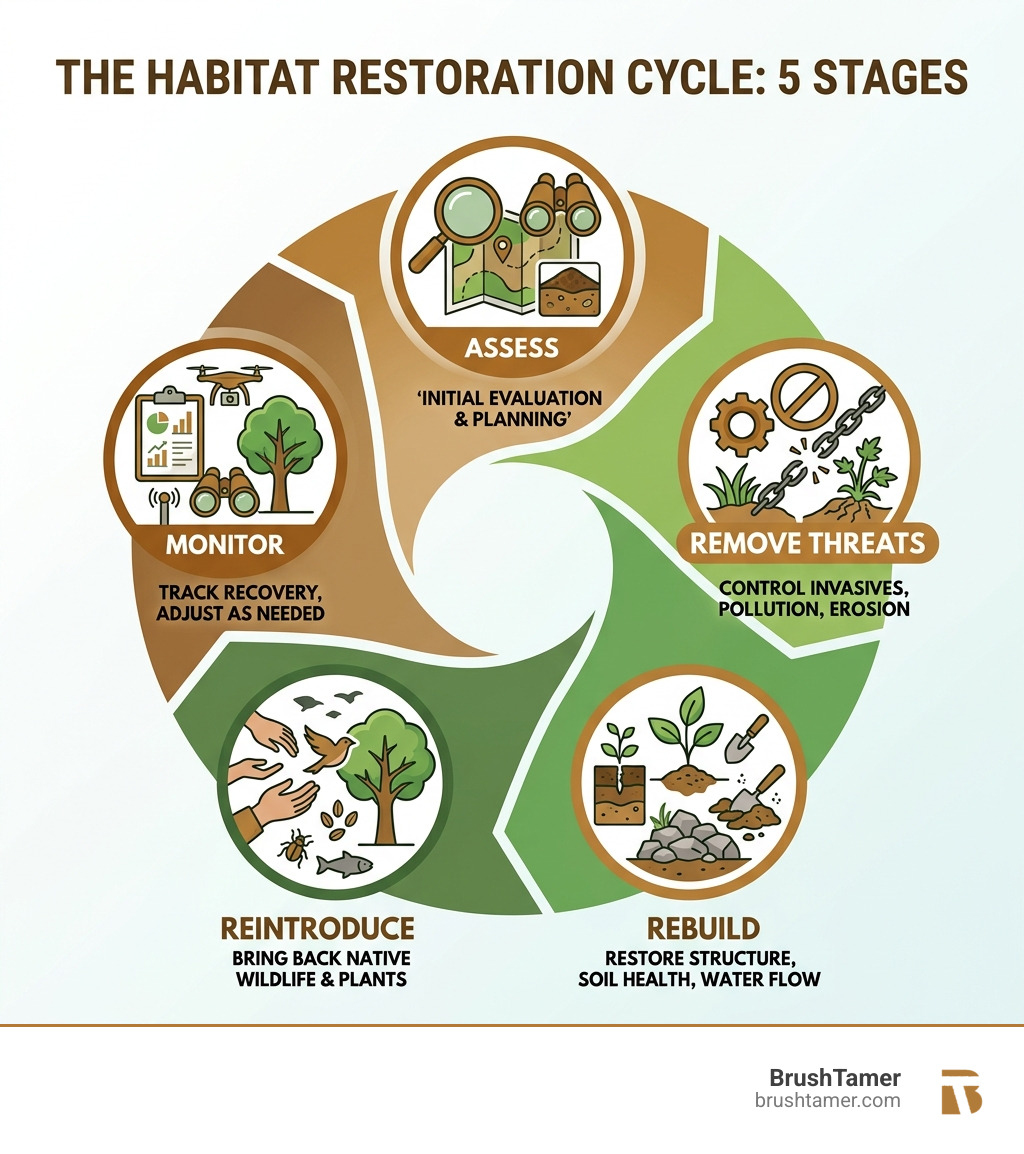
To achieve a successful outcome, habitat restoration must be approached as a comprehensive management cycle rather than a one-time event. At BrushTamer, we focus on five critical pillars:
- Threat Abatement: Identifying and eliminating the primary drivers of degradation, such as invasive Autumn Olive, Buckthorn, or Honeysuckle. This requires understanding the life cycle of these plants to prevent rapid regrowth.
- Structural Reconstruction: Re-establishing the physical architecture of the habitat, including the forest understory and soil profile. This often involves mechanical intervention to reverse soil compaction and clear canopy-choking brush.
- Biological Reintroduction: Facilitating the return of native flora and fauna that have been displaced by human activity. This may involve seeding native grasses or simply creating the conditions for the dormant seed bank to emerge.
- Ecological Monitoring: Utilizing data-driven assessments to track the progress of the recovery over multiple seasons. Monitoring allows us to adjust management strategies based on how the land responds.
- Long-term Stewardship: Implementing professional maintenance schedules to ensure the land does not regress into a degraded state. Restoration is a journey, not a destination.
I’m Leon Miller, owner of BrushTamer. Since 2021, our team has specialized in providing the heavy-duty mechanical solutions required to jumpstart these processes. We don’t just clear land; we prepare the foundation for a thriving, resilient ecosystem. In the following sections, we will explore the technical nuances of restoration and why professional execution is the only viable path for large-scale ecological recovery in our region.
What is Habitat Restoration?

Habitat restoration is the intentional activity that initiates or accelerates the recovery of an ecosystem with respect to its health, integrity, and sustainability. Unlike conservation (protecting what remains), ecological restoration is a corrective approach that repairs past damage and restores ecosystem function. It is the difference between preserving a dying forest and actively healing it so it can grow once more.
At BrushTamer, we apply the rigorous principles of Restoration Ecology to every project. This involves a deep understanding of the site’s historical “reference state”—the condition the land would be in had it not been subjected to industrial, agricultural, or invasive degradation. By identifying specific stressors like soil compaction or altered drainage patterns, we can deploy professional-grade machinery to remove these barriers, allowing the land to once again provide clean air, water filtration, and wildlife support. This scientific approach ensures that we are not just making the land look “natural,” but making it function naturally.
Defining Restoration in the Modern Midwest Context
Today, restoration often accounts for ‘novel ecosystems’—places where past conditions can’t be fully recreated, but ecological function can be rebuilt. Due to permanent changes in local hydrology and climate patterns, it is often impossible to return a site to its exact 1800s state. Instead, the goal of Ecological restoration – Wikipedia is to restore the functional performance of the land. For a property owner in Mishawaka or Niles, this means creating a landscape that is resilient to modern weather extremes while supporting the native species that remain in our regional gene pool. We focus on ecological integrity—the ability of an ecosystem to support and maintain a community of organisms that has a species composition, diversity, and functional organization comparable to those of natural habitats within the region.
The Critical Distinction: Passive vs. Active Restoration
Understanding the difference between passive and active approaches is essential for any landowner considering a restoration project. While passive restoration relies on the removal of a disturbance and waiting for natural succession, it is rarely successful in the Midwest due to the sheer volume of invasive seed banks that have accumulated over decades.
- Passive Restoration: This involves stopping the damage (e.g., fencing off a woodlot from cattle) and allowing nature to take its course. This is only effective in mildly degraded areas with intact native seed banks and minimal invasive pressure. In most cases in Northern Indiana, passive restoration simply allows invasive species to take over more quickly.
- Active Restoration: This is the professional standard. It involves direct intervention, such as high-efficiency forestry mulching, soil amendment, and the intentional planting of native species. In cities like Goshen and Granger, active restoration is the only way to overcome the “green wall” of invasive shrubs that prevent native regeneration. Active restoration provides the necessary “reset” that allows native species to compete on a level playing field.
| Feature | Passive Restoration | Active Restoration (BrushTamer Standard) |
|---|---|---|
| Primary Driver | Natural Succession | Professional Mechanical Intervention |
| Speed | Decades (often fails) | Rapid (visible results in 1-2 seasons) |
| Success Rate | Low in invasive-heavy areas | High; controlled and predictable |
| Best For | Pristine sites with minor issues | Highly degraded or invasive-heavy sites |
Why Habitat Restoration is Critical in 2026
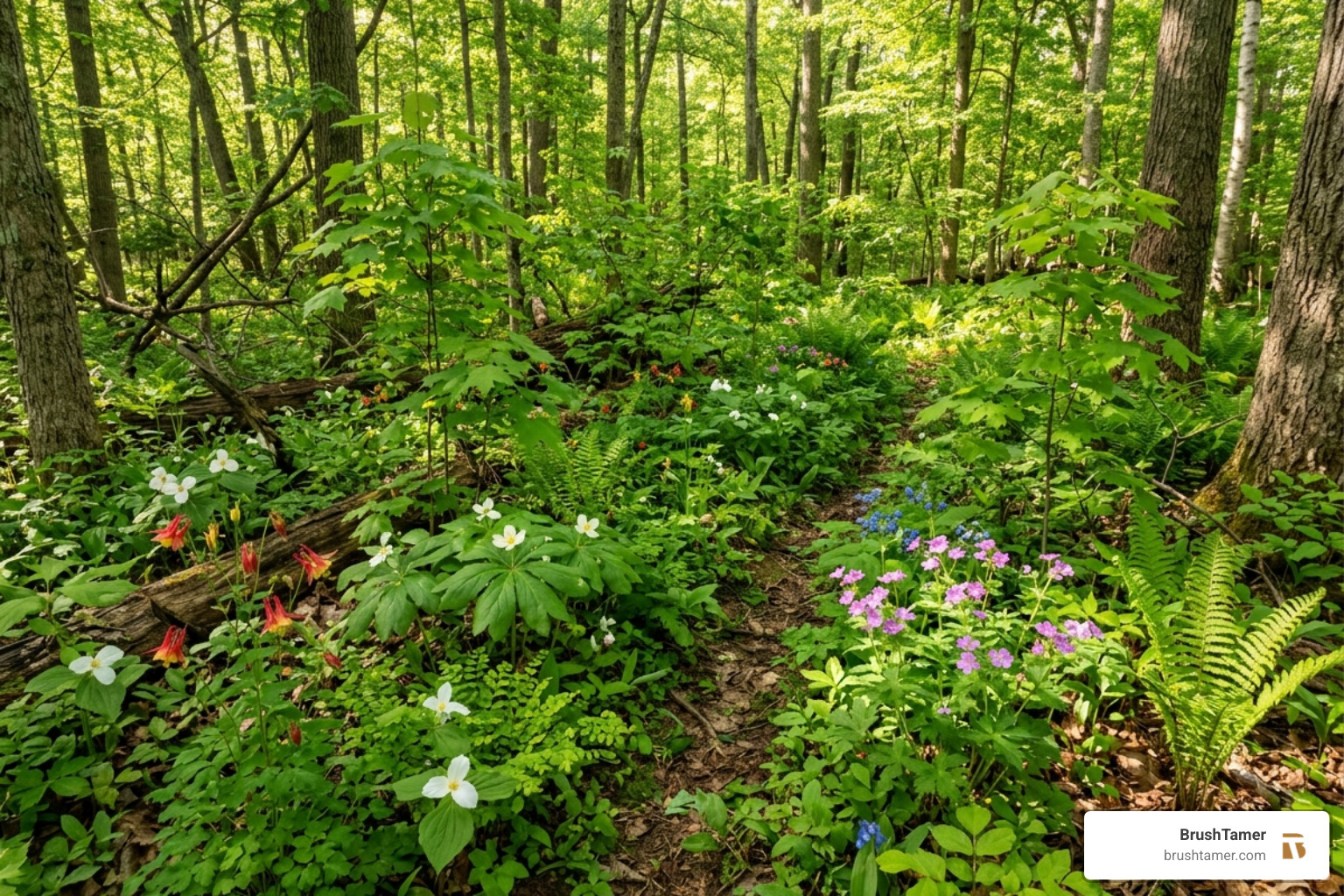
Habitat restoration is critical in 2026 because it provides the only viable mechanism for mitigating the dual crises of biodiversity loss and climate instability at a local level. Healthy, restored ecosystems act as natural infrastructure, providing flood mitigation, carbon sequestration, and essential habitat for pollinators that support the agricultural economies of Northern Indiana and Lower Michigan. As weather patterns become more volatile, the resilience of our local landscapes becomes a matter of public safety and economic stability.
In our region, the loss of forest structure has reached a tipping point. Many woodlots in areas like Battle Creek and Portage have become ecological “dead zones” where invasive species have completely halted the growth of new oak and maple trees. Implementing a professional Forestry and Wildlife Management plan is no longer optional for responsible land stewardship; it is a necessity to ensure these forests exist for the next generation. By utilizing an In-Depth Guide to Forest Understory Treatment, BrushTamer helps landowners break the cycle of degradation and restore the complex web of life that depends on a diverse forest floor. Without this intervention, our local forests will eventually collapse as the aging canopy trees die without successors.
Economic and Practical Benefits for Property Owners
For property owners in St. Joseph and Benton Harbor, restoration is a high-impact improvement for long-term land health and usability. Degraded land can create ongoing management challenges, including erosion, poor drainage, and reduced ecological performance. Professional restoration mitigates these risks by stabilizing the landscape. For example, restored wetlands and riparian buffers act as nature’s sponges. During extreme weather events, these systems can reduce flood impacts by slowing runoff and storing water on-site. A property that is ecologically healthy is more resilient to pests, diseases, and extreme weather, reducing long-term maintenance costs.
Furthermore, the restoration of unproductive land can create new opportunities for recreation or specialized agriculture, as seen in The Apple Doesn’t Fall Far: Exploring the World of Restoration Orchards. Whether you are managing a private estate in Granger or a commercial property in Elkhart, restoring the land’s natural function increases its long-term utility and market value. It transforms a “problem area” into a functional asset that provides beauty, privacy, and ecological value.
Essential Ecosystem Services Provided by Restored Habitats
When BrushTamer restores a site, we are re-installing the biological “hardware” of the planet. These systems provide services that are impossible to replicate through artificial means:
- Pollination Support: Restoring native wildflower corridors is essential for the survival of bees and butterflies that pollinate local crops. This is vital for the fruit belt of Southwest Michigan.
- Groundwater Recharge: Deep-rooted native grasses and forbs allow rainwater to penetrate the soil, filtering pollutants and replenishing our aquifers rather than running off into storm drains.
- Carbon Capture: Healthy, growing forests and wetlands are the most efficient carbon sinks available, helping to offset regional greenhouse gas emissions through natural sequestration.
- Soil Preservation: Professional vegetation management prevents the loss of valuable topsoil, ensuring the land remains fertile and productive for future use.
Core Techniques for Successful Ecosystem Recovery
Successful ecosystem recovery requires the precise application of mechanical vegetation control, hydrological restoration, and soil rehabilitation. At BrushTamer, we utilize specialized, low-impact machinery to execute these techniques without causing the collateral damage often associated with standard construction or DIY land clearing methods. Our approach is surgical, focusing on the removal of specific threats while preserving the integrity of the surrounding environment.
Whether we are Repurposing Blueberry Fields in Van Buren County or restoring an oak savannah in Cass County, our approach is rooted in ecological science. We focus on removing the biological barriers that prevent native species from thriving, creating a “blank canvas” for natural recovery. This often involves a multi-step process of clearing, mulching, and monitoring to ensure that the restoration takes hold and becomes self-sustaining.
Professional Invasive Species Management
The primary obstacle to restoration in the Midwest is the presence of aggressive invasive species. Plants like Autumn Olive, Japanese Honeysuckle, and Glossy Buckthorn create dense monocultures that shade out native seedlings and alter soil chemistry. Manual removal is often futile, as these plants resprout vigorously from the roots, often coming back thicker than before if not handled correctly.
BrushTamer’s solution involves high-efficiency forestry mulching. Our equipment grinds invasive vegetation into a fine mulch that remains on-site, suppressing further weed growth and returning nutrients to the soil. This process opens the canopy, allowing sunlight to reach the forest floor for the first time in decades. Following the initial clearing, we provide ongoing brush management services to ensure that the invasive seed bank is exhausted and native species can establish dominance. This mechanical “reset” is the most effective way to handle large-scale infestations.
Hydrological Restoration and Wetland Recovery
Water movement is the defining characteristic of many Indiana and Michigan habitats. Historically, many of our local wetlands were ditched or drained for agriculture, which destroyed their ability to filter water and support wildlife. Restoring these areas requires a professional understanding of local topography and hydrology to ensure that water flows and settles as it did historically.
By working with the principles of the Natural Landscape Company IN – Indiana Habitat Restoration, we can identify and reverse these historical alterations. This may involve removing old drainage tiles or re-contouring land to allow for natural flood cycles. In the U.S., the loss of wetlands has been catastrophic, but through professional intervention, we can restore these vital areas to their role as water purifiers and wildlife nurseries. Restored wetlands are among the most biodiverse habitats in the Midwest, supporting a vast array of birds, amphibians, and aquatic life.
Professional Restoration Services in Lower Michigan and Northern Indiana
Professional restoration services in our region are defined by a deep commitment to ecological health and the use of specialized technology. BrushTamer provides comprehensive land management across a broad geography, including Grand Rapids, Kalamazoo, South Bend, and Elkhart. We specialize in the heavy lifting required to transform overgrown, degraded properties into thriving natural habitats. If you require land clearing services that prioritize the long-term health of your ecosystem, our team is the regional authority. We understand that every acre is unique and requires a tailored approach.
Targeted Habitat Enhancement for Regional Landscapes
Every project we undertake is customized to the specific ecological needs of the site. In Northern Indiana and Lower Michigan, we focus on several high-priority habitat types that are currently under threat:
- Oak Savannah Restoration: This rare ecosystem requires the careful thinning of invasive trees and the promotion of native grasses. We use precision thinning to release legacy oaks from competition, allowing them to spread their canopies and produce acorns.
- Riparian Buffer Management: We restore the vegetated zones along the St. Joseph and Kalamazoo Rivers, which are critical for preventing bank erosion and protecting water quality. These buffers act as the last line of defense for our waterways.
- Early Seral (Young Forest) Creation: Many declining bird species, such as the Golden-winged Warbler, require the dense cover of young forests. We use forestry mulching services to create these essential habitat patches within larger forest blocks, ensuring a mosaic of different forest ages.
The Role of Specialized Machinery in Ecological Health
One of the most significant advantages of hiring BrushTamer is our use of low-impact, high-precision machinery. Standard construction equipment is often too heavy, leading to severe soil compaction that can take decades to reverse. Our specialized units are designed to “walk” over the land, distributing weight evenly to protect the delicate soil structure and the root systems of desirable native trees.
Furthermore, our stump grinding services allow for the complete removal of invasive root systems, ensuring that the ground is immediately ready for the reintroduction of native flora. This professional approach ensures that the restoration process is an act of healing, not further disturbance. We serve a wide range of communities, including Edwardsburg, Cassopolis, Three Rivers, and Stevensville, providing the expertise needed to manage complex Midwest landscapes. By using the right tools for the job, we ensure that the restoration is effective, efficient, and environmentally responsible.
Overcoming Challenges in Large-Scale Restoration Projects
Overcoming challenges in large-scale restoration requires a multi-year commitment and a professional management strategy that bridges the gap between ecological theory and on-the-ground practice. Large projects, such as those modeled by Rewilding Middlebury, often face logistical and biological hurdles that require expert navigation. Managing 50, 100, or 500 acres is a vastly different task than restoring a small backyard garden.
Navigating the Science-Practice Gap
One of the primary difficulties in restoration is the “science-practice gap.” While academic research provides the framework, the physical reality of managing 100 acres of dense buckthorn in Buchanan or New Buffalo requires specialized equipment and experience. BrushTamer excels in this area, translating ecological goals into actionable mechanical plans. We understand the local soil types, weather patterns, and species compositions that define our region. We know when to clear, how to mulch, and how to manage the site to ensure that the scientific goals are met through practical, efficient means.
Addressing Public Perception and Funding
Large-scale restoration often involves significant visual changes to a property. To the untrained eye, the removal of invasive brush can look like standard clearing. We assist our clients in understanding the “why” behind the work, ensuring that neighbors and stakeholders recognize the long-term benefits of the project. We emphasize that the initial “messy” phase is a necessary step toward a beautiful, functional landscape. Additionally, we can help landowners understand common project pathways and stakeholder requirements for larger restoration efforts.
Managing Unrealistic Timelines
Ecological recovery does not happen overnight. It is a process that requires patience and consistent monitoring. Depending on conditions, what is habitat restoration in practice is a multi-season process—early results can appear quickly, while full ecosystem recovery takes longer. Our professional management plans account for this, providing the necessary follow-up care to ensure the project remains on track and the investment is protected. We help landowners set realistic expectations and celebrate the milestones of recovery as they occur.
Frequently Asked Questions about Habitat Restoration
What are the primary causes of habitat degradation in the Midwest?
Habitat degradation in Northern Indiana and Lower Michigan is primarily driven by historical land-use changes, including the drainage of wetlands for agriculture and the suppression of natural fire regimes. In 2026, the most immediate threat is the proliferation of invasive species which outcompete native flora and destroy the food webs that support local wildlife. Urbanization and pollution also play significant roles in fragmenting remaining natural areas, making them more susceptible to invasive takeover and reducing their ability to support diverse wildlife populations.
How long does it take to see measurable results from a BrushTamer restoration project?
While the physical transformation of the property is immediate upon completion of our mechanical clearing, ecological results follow a seasonal timeline. You will typically see a flush of native vegetation in the first growing season as sunlight reaches the soil for the first time in years. A fully functioning, self-sustaining habitat generally takes 3 to 7 years of professional monitoring and maintenance to ensure that invasive species do not return and that native populations are stable. The speed of recovery depends on the initial state of the land and the presence of a native seed bank.
Why is professional waste management important in restoration?
For many projects, what is habitat restoration without good biomass handling? A missed opportunity—mulching on-site can protect soil and support recovery. At BrushTamer, we utilize a “closed-loop” approach where invasive vegetation is mulched back into the soil. This prevents the need for hauling debris to landfills and provides a natural, nutrient-rich layer that protects the soil from erosion and suppresses weed seeds. This method is far superior to burning or hauling, as it keeps organic matter on-site where it can support the recovering ecosystem. It also avoids the carbon emissions associated with transporting large amounts of green waste.
Can I restore my property myself?
Large-scale habitat restoration requires specialized, heavy-duty machinery and a deep understanding of ecological systems. Attempting to clear invasive species with standard consumer tools often leads to rapid regrowth and can inadvertently damage the soil or native trees you wish to save. Professional equipment allows for a level of efficiency and precision that is impossible to achieve manually. Hiring BrushTamer ensures the job is done correctly the first time, using low-impact equipment that protects the long-term health of your land and saves you years of frustration.
Conclusion
The future of our Midwest landscapes depends on our willingness to take responsibility for the land we manage. What is habitat restoration? It is a strategic, scientific, and necessary intervention to ensure that our forests, wetlands, and prairies remain functional for generations to come. It is the belief that we can reverse the damage of the past and create a more resilient future.
Ready to start your restoration journey? Contact our experts for professional land clearing and restoration support today. Let’s work together to bring your land back to life.