
Why Subsoiling Matters for Your Property
Your soil is your most critical asset, a complex living system that underpins the productivity and resilience of your entire property. However, modern agricultural and land management practices, characterized by larger, heavier equipment, can inadvertently damage this foundation through subsoil compaction. Compaction below the normal tillage layer creates a dense, restrictive hardpan that chokes off productivity, blocks water movement, and physically obstructs root development. Subsoiling is a specialized, high-impact operation designed to address this critical issue by fracturing these dense subsoil horizons that conventional passes cannot reach.
This invisible barrier is often the hidden cause of many persistent field problems. Symptoms are not always as obvious as standing water after moderate rainfall. Look for inconsistent crop height and vigor across a field, patches of plants showing signs of nutrient deficiency (like yellowing leaves) despite adequate fertilization, or crops that wilt prematurely at the first sign of dry weather. These are all indicators that root systems are trapped in a shallow layer of topsoil, unable to access the vast reserves of water and nutrients held deeper in the profile. These hardpans form from the cumulative pressure of repeated axle loads, seasonal field traffic in less-than-ideal conditions, and the natural settling of soil particles—particularly in the heavier clay and loam textures common across the Midwest. Without professional intervention, these compacted layers progressively worsen, limiting infiltration, elevating runoff and erosion risk, and starving plants of essential moisture during critical growth stages.
BrushTamer delivers subsoiling as a precision, data-driven operation. We don’t guess; we diagnose. Our specialists use advanced tools and field analysis to identify the exact depth and severity of compaction. Based on this data, we select the appropriate shank and wing configuration, set the correct working depth to shatter the hardpan without wasting energy, and execute the operation only when soil conditions are optimal to ensure true fracturing rather than smearing. This professional approach safeguards your investment, restores long-term soil function, and integrates subsoiling into your broader agronomic and conservation goals.
Understanding when, where, and how to subsoil requires extensive expertise and specialized equipment. Our specialists combine on-site diagnostics with regional soil expertise to determine whether subsoiling is warranted, and how to maximize its benefits without disrupting surface residue or creating new issues. The result is predictable performance, measurable gains in soil function, and sustained productivity improvements.
What is Subsoiling and Why is it Necessary?
Subsoiling is a non-inversion, deep tillage intervention designed to disrupt and fracture compacted soil layers (hardpans) that form 12–20 inches or more below the surface. Unlike a moldboard plow or disk—which primarily rework the top 6–8 inches and can inadvertently create a dense “plow pan” at the base of their working depth—subsoilers use robust shanks, often fitted with wings, to lift and shatter the subsoil. This process generates a network of vertical and lateral fractures, creating pathways for air, water, and roots while preserving valuable surface residue and organic matter, especially when using low-disturbance designs.
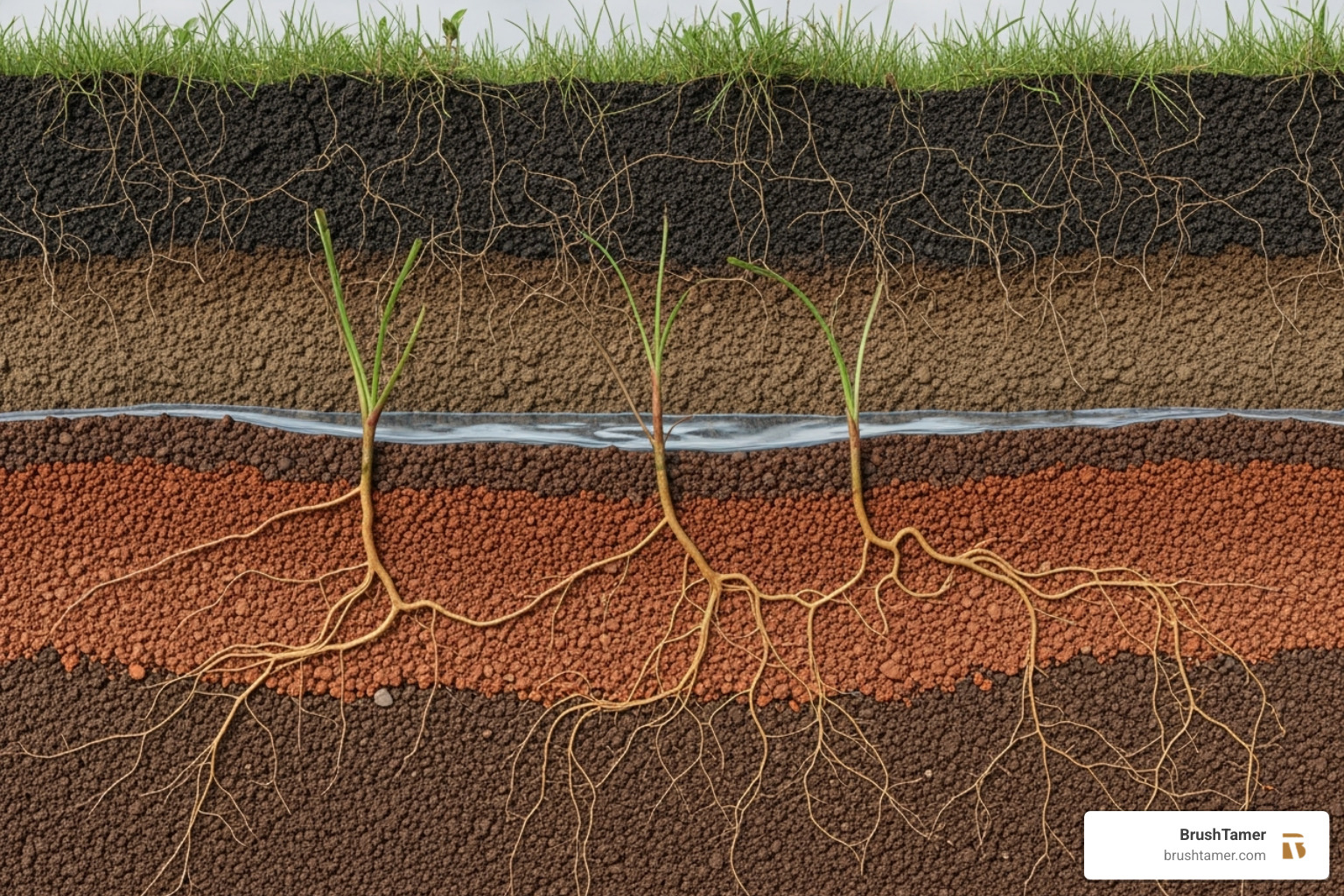
Compaction arises from repeated traffic, with heavy axle loads from combines, grain carts, and manure spreaders concentrating immense force in specific tramlines. Over time, these forces compress soil particles, destroying soil structure, collapsing vital macropores, and forming a dense, impermeable hardpan. The result is a physical barrier that impedes water infiltration and forces plant roots to spread laterally in the shallow topsoil. In wet weather, water ponds on the surface and runs off, carrying valuable topsoil and nutrients with it. In dry periods, the crop’s access to deeper moisture reserves is cut off, leading to drought stress and significant yield loss. Heavier soil textures—clays, clay loams, and silty loams—are especially susceptible to compaction, and these soils are prevalent throughout Indiana, Ohio, Michigan, and neighboring states. For a technical foundation on soil compaction processes, see resources from land-grant programs such as Purdue Extension.
Subsoiling vs. Other Tillage
- Conventional Tillage (moldboard, disk, field cultivator): Reworks surface horizons but can reinforce a compacted interface (plow pan) at the base of the tillage zone.
- Vertical Tillage: Aims to size residue and create a shallow, uniform seedbed but lacks the depth and lifting force to fracture deep compaction.
- No-Till: An excellent system for preserving and building soil structure, but it cannot mechanically reverse a pre-existing, deep hardpan. Biological activity can slowly improve structure, but this can take many years.
- Subsoiling: A corrective, surgical operation that targets subsoil density directly. It creates structural pathways that reconnect the surface with deeper horizons, serving as a foundational reset that can enhance the performance of other systems, including no-till and strip-till, by maintaining surface residue when low-disturbance shanks are used.
When Professional Subsoiling is Appropriate
Subsoiling delivers maximum value only when there is clear, diagnosed evidence of root-limiting compaction at a definable depth. Sandy soils, which lack the structure to form dense pans, rarely warrant deep intervention and can be degraded by unnecessary passes. Clay and silty loam fields with persistent poor infiltration, shallow rooting, or yield maps showing consistent underperformance in traffic areas are prime candidates for a targeted program.
BrushTamer conducts structured evaluations to justify every pass. This begins with a field history review, analyzing multi-year yield maps to pinpoint chronic low-performing zones and correlating them with known traffic patterns. We then perform on-site diagnostics, using a soil probe to physically feel for the hardpan and a digital penetrometer for quantitative mapping. This instrument measures the pressure (in pounds per square inch, or PSI) needed to penetrate the soil profile. Readings consistently exceeding 300 PSI indicate a root-limiting barrier. Our diagnosis maps the presence, thickness, and depth of these hardpans, which informs the precise prescription for shank type, wing configuration, spacing, and depth, ensuring the operation solves the right problem at the right depth.
The Core Subsoiling Benefits for Soil Health and Crop Productivity
When expertly executed under the right conditions, subsoiling fundamentally re-engineers the soil’s physical architecture. This structural reset triggers a cascade of positive effects on water dynamics, root exploration, nutrient availability, and biological activity. The operation directly reduces bulk density in the compacted horizon and creates a network of continuous macropores that reconnect the thirsty topsoil to the vast water and nutrient reservoirs in the subsoil.
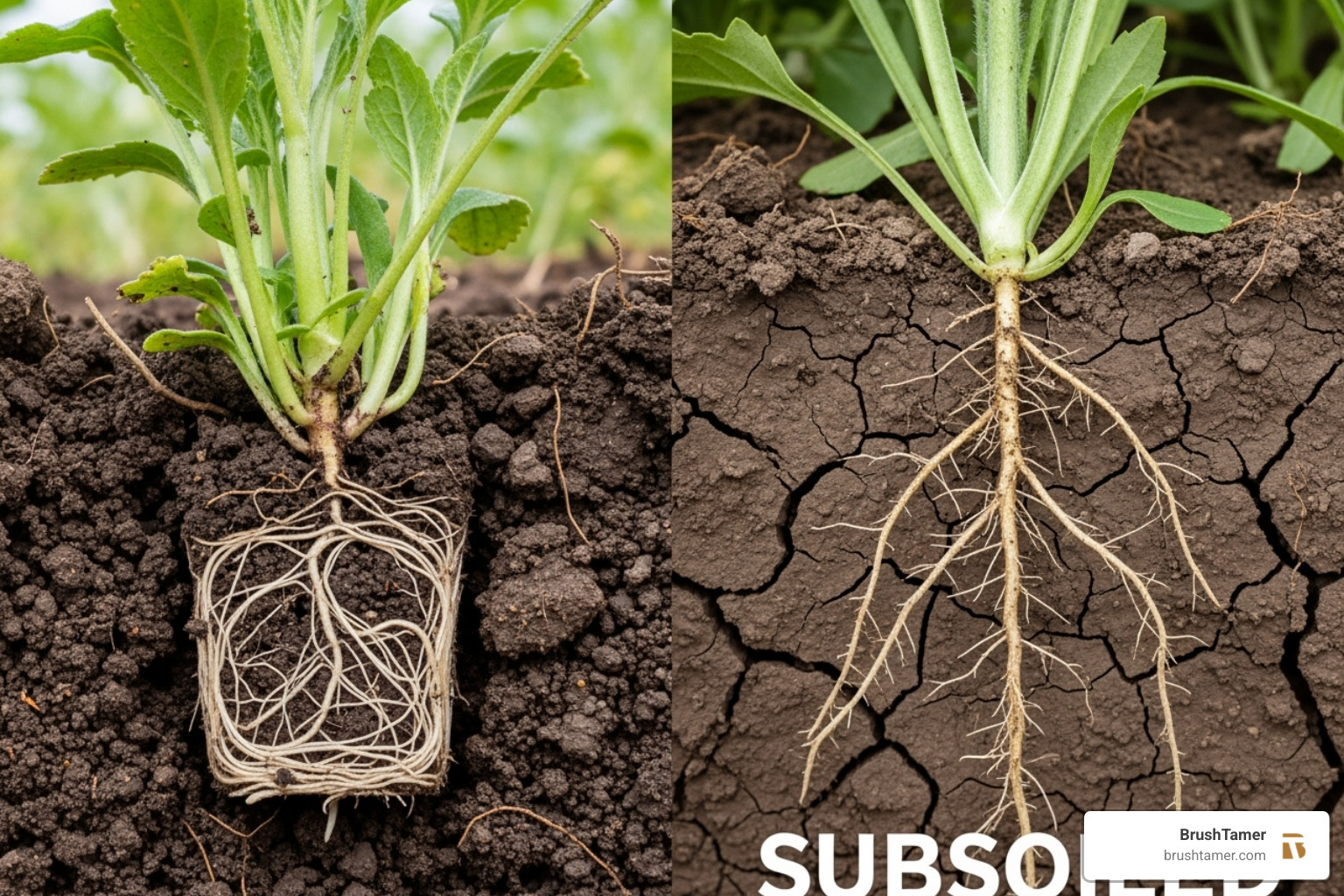
The mechanism is a function of physics: properly set shanks operating in dry soil lift and fracture the compacted layer, creating interconnected pore networks while leaving the surface largely intact (especially with modern low-disturbance designs). These new pathways completely change how water, air, and roots interact with the entire soil profile.
Physical and Hydrologic Improvements
- Reduced Bulk Density and Increased Macroporosity: Subsoiling lowers soil bulk density (the weight of soil in a given volume), a key measure of compaction. While healthy loams may have a bulk density of 1.3 g/cm³, compacted layers can exceed 1.7 g/cm³, a level at which root growth effectively stops. Fracturing creates large pores (macropores) that lower this density, reducing resistance to root growth and enabling critical oxygen exchange with the atmosphere.
- Faster Infiltration and Reduced Runoff: Water from heavy rainfall moves rapidly through the newly fractured zone instead of ponding on the surface or running off. This dramatically reduces soil erosion, keeps valuable topsoil and nutrients in the field, and helps recharge the soil profile.
- Enhanced Water Storage and Drought Buffering: By breaking the hardpan, subsoiling unlocks a much larger volume of soil for water storage. This allows the soil to act like a bigger sponge, capturing more water during wet periods and making it available to the crop during dry spells, providing critical drought resilience.
Root System Expansion and Stability
- Deeper, More Prolific Rooting: This is the primary goal. For tap-rooted crops like soybeans or alfalfa, subsoiling allows their main root to grow vertically uninhibited. For fibrous-rooted crops like corn, it prevents the flat, “pancaked” root system common in compacted soils, encouraging a deep, V-shaped architecture. This extensive system can explore a vastly larger soil volume, accessing more water and nutrients.
- Improved Standability and Mechanical Anchoring: Stronger, deeper roots provide better anchorage for the plant. This improves standability and reduces the risk of lodging (plants falling over) from high winds or heavy rain, especially in taller crops like corn, protecting yield potential late in the season.
Nutrient Access and Biological Activity
- Improved Nutrient Interception and Cycling: A larger root system can intercept more nutrients. This is especially important for immobile nutrients like phosphorus (P) and potassium (K), which can become stratified in the top few inches in long-term no-till systems. Better aeration also enhances the nitrogen cycle, promoting beneficial nitrifying bacteria and reducing the risk of denitrification, a process where soil nitrogen is lost as a gas in waterlogged, anaerobic conditions.
- Stimulated Biological Activity: The introduction of oxygen into the subsoil awakens a dormant ecosystem. It creates a favorable habitat for earthworms, whose burrows form stable macropores, and for beneficial aerobic microbes and fungi. Arbuscular mycorrhizal fungi, for example, form a symbiotic relationship with roots, effectively extending their reach for water and nutrients and contributing to the formation of stable soil aggregates.
Longevity and Management Integration
The durability of these benefits hinges on post-subsoiling management. Uncontrolled traffic can re-compact the soil in a single season. This is why integrating subsoiling with Controlled Traffic Farming (CTF), where all machinery is confined to permanent tramlines, is the gold standard for preserving the restored soil structure for five years or more. Additionally, planting a cover crop immediately after subsoiling is a powerful synergistic practice. Deep-rooted species like tillage radish, sorghum-sudangrass, or certain clovers act as “biological subsoilers,” growing their roots into the fissures. As they decay, they leave behind channels filled with organic matter, further stabilizing the new pore network and feeding soil biology. For additional technical depth, review this expert overview.
The Economic Impact of Subsoiling
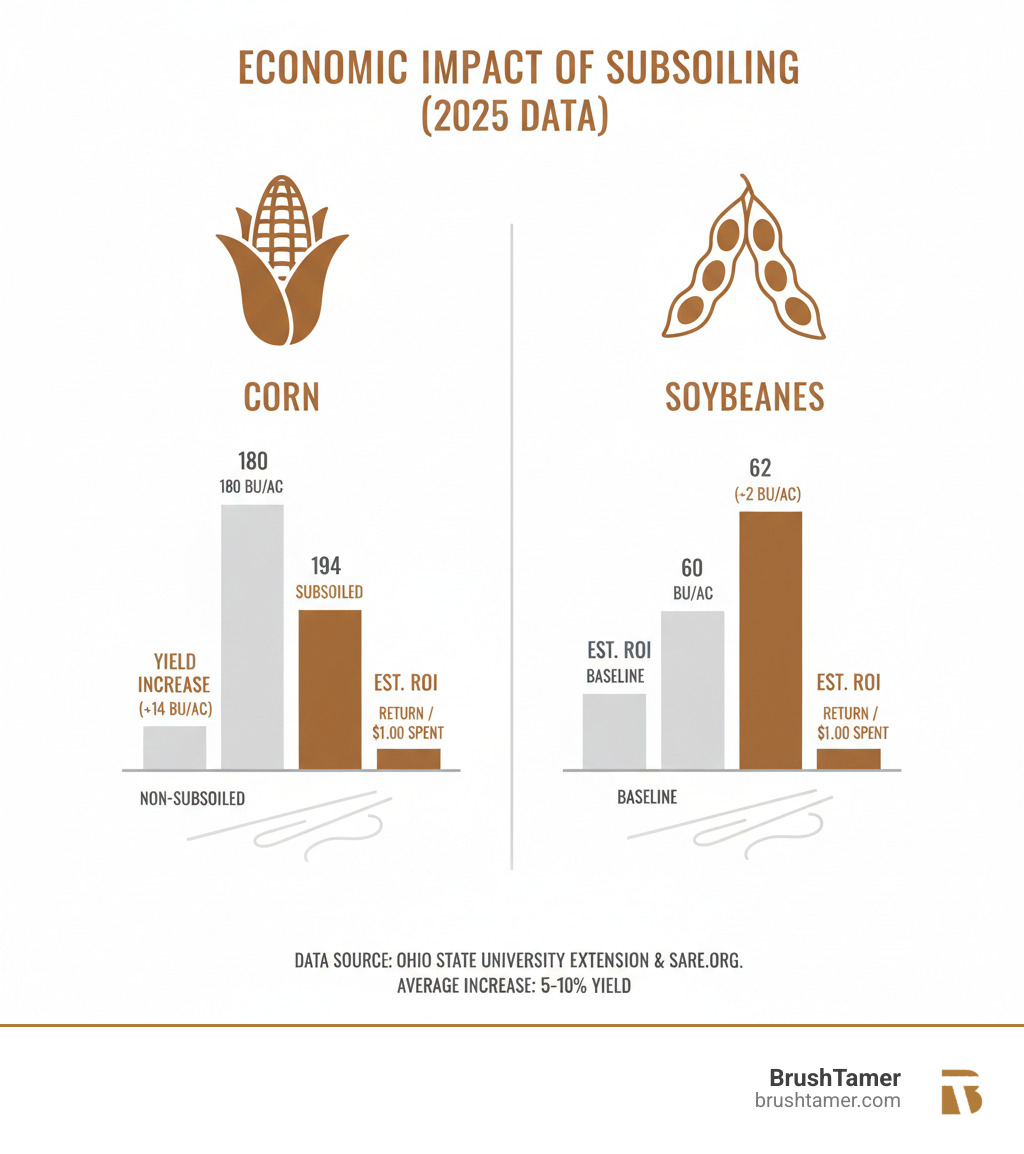
While the agronomic benefits are clear, subsoiling is ultimately an economic decision. Viewing it as a capital investment in the farm’s primary asset—the soil—clarifies its value. When performed correctly in fields with diagnosed compaction, subsoiling translates into quantifiable financial returns through direct yield increases and indirect cost savings. Research across various crops and regions consistently shows significant yield gains. Data from Ohio State University, for instance, reported average corn yield increases of about 14 bushels per acre with in-row subsoiling, and soybean gains approaching 2 bushels per acre under suitable conditions. Across numerous studies, a 5–15% yield uplift is a common and realistic expectation when deep compaction is the primary limiting factor.
These outcomes generate a compelling return on investment (ROI). For example, consider a field where subsoiling costs $30 per acre. A 14-bushel corn yield increase at $4.50/bushel generates $63 in new revenue, for a net return of $33 per acre and an ROI of 110% in the first year alone. Many operations pay for themselves within the first season, with benefits often persisting for several years, especially when paired with controlled traffic.
Indirect Economic Gains and Risk Mitigation
Beyond the direct harvest bump, the financial benefits accumulate in other critical areas:
- Improved Input Efficiency: When water infiltrates properly instead of running off, it keeps fertilizers and herbicides in the root zone where they belong. This improves the efficacy of every dollar spent on inputs and reduces nutrient loss to the environment.
- Reduced Operating Costs: Tillage and planting operations in loosened, well-structured soil require less draft force. This translates directly to lower fuel consumption per acre and reduced wear and tear on tractors and implements.
- Drought and Weather Resilience: This is one of the most valuable, yet hardest to quantify, economic benefits. In a dry year, the ability of roots to access deep subsoil moisture can be the difference between a partial crop and a total loss. Conversely, in a wet spring, faster drainage can allow for more timely planting. This resilience reduces downside risk and brings stability to year-over-year revenue.
- Enhanced Land Value: Productive, resilient soil is the foundation of a valuable farm. A documented history of proactive soil management, including corrective actions like subsoiling, enhances the long-term asset value of the property.
What Drives Cost and Payback
The cost of professional subsoiling and the subsequent payback period are influenced by several factors:
- Site Conditions: Heavier, denser, and drier soils require more draft power and fuel, which can increase the per-acre cost.
- Implement Specification: Winged shanks fracture a broader column of soil, often enabling wider shank spacing and fewer passes, but they demand significantly more horsepower per shank. In-row configurations are highly efficient, targeting disruption only where the crop will be planted.
- Equipment Power: Subsoiling is a power-intensive operation. Expect substantial requirements—often 50–80 HP per shank—depending on depth, soil texture, and moisture.
- Field Size and Traffic Plan: Larger, efficiently shaped fields allow for better operational efficiency. An optimized traffic plan is crucial for preserving the benefits and maximizing the long-term ROI.
BrushTamer evaluates these economic variables alongside the agronomy. We align implement selection, depth, spacing, and timing with your specific production system to ensure the operation delivers measurable, defensible value. By integrating subsoiling into a holistic soil management plan, we help ensure the investment contributes to both short-term yield and long-term asset performance.
Professional Subsoiling: Equipment, Techniques, and Best Practices
Effective subsoiling is a science that rewards precision. The same operation that delivers exceptional gains under the right conditions can underperform, waste fuel, or even cause harm when depth, moisture, or equipment setup are misaligned. BrushTamer’s professional approach hinges on deploying purpose-built implements, calibrated settings based on field diagnostics, and highly trained operators to consistently achieve optimal soil shatter in the compacted zone while protecting surface structure and residue.

Equipment Selection and Configuration
The choice of equipment is dictated by the specific field conditions and management goals.
- Shank Type and Wings: Shank design is critical to the soil action. Straight-leg shanks are common, but parabolic or bent-leg shanks can increase the upward ‘lifting’ motion, creating more fracture with less draft. Low-disturbance shanks are designed to slice through the soil with minimal surface and residue disruption, making them ideal for no-till or conservation tillage systems. Adding wings to the shank tip significantly enlarges the fractured wedge of soil, allowing for wider spacing between shanks and improving operational efficiency.
- In-Row vs. Broad-Area: In-row subsoiling, often performed with RTK guidance, targets compaction directly beneath future crop rows. This is a highly efficient approach that concentrates horsepower and soil disruption only where it’s most needed. Broad-area setups are used when compaction is more uniform across a field or when traffic patterns are not controlled.
- Complementary Components: Modern subsoilers often feature leading coulters to cut through heavy residue and prevent clogging, as well as rear attachments like rolling baskets or harrows. These finishing tools help break up any large clods brought to the surface and create a more level, manageable field condition.
Timing and Soil Condition: The Shatter vs. Smear Dilemma
Timing is the single most critical factor for success. The goal is to operate when the subsoil is dry and friable, allowing it to fracture like a pane of glass.
- Moisture is Key: If the soil at the target depth is too wet, it will be in a ‘plastic’ state. Instead of shattering, the shank will smear and compress the sides of the channel, creating a new, even more impermeable layer and worsening the compaction problem. Our specialists conduct field tests to confirm soil moisture is below the plastic limit before any work begins.
- Seasonal Window: For the Midwest, late summer and early fall typically offer the most reliable window of dry conditions. Performing the work during this period also allows winter freeze–thaw cycles to further mellow the soil, helping to stabilize the newly created aggregates ahead of spring planting.
Field Execution and Quality Control
- Speed, Depth, and Consistency: Operating speed must be carefully managed, typically between 3–5 mph, to optimize the soil lifting and shattering action. Working depth must be set 1-2 inches below the diagnosed compacted layer—deep enough to shatter the entire pan, but not so deep that horsepower and fuel are wasted lifting uncompacted soil. We use RTK-level GPS guidance to ensure perfectly parallel passes with no overlaps or untreated gaps.
- Traffic Management: A controlled traffic plan is essential to protect the investment. Immediately after subsoiling, all subsequent axle loads must be kept off the freshly loosened zones. The same GPS guidance lines used for subsoiling should be used for all future passes, establishing permanent tramlines and preserving the macropore continuity for years.
- Integrated Practices: Where appropriate, we coordinate the subsoiling operation with the establishment of a cover crop. Seeding immediately after the pass allows cover crop roots to quickly occupy and stabilize the new fissures, reinforcing the structure and jump-starting biological activity.
Our approach is comprehensive and conservative: diagnose first, subsoil only when justified, and execute with the specific goals of your field in mind. This aligns with our broader commitment to responsible, efficient operations and complements the philosophy behind our Environmentally Friendly Land Clearing. The result is a clean, effective intervention that solves the subsoil problem without introducing new ones.
Frequently Asked Questions about Subsoiling Benefits
We address common questions below to clarify how and when subsoiling adds value—and how BrushTamer ensures the operation is done correctly.
How deep should subsoiling be?
Depth is set just below the compacted layer identified during diagnostics—commonly in the 12–18 inch range, but always based on measured conditions. BrushTamer verifies depth with field probing and adjusts settings to ensure true shattering rather than overworking or undercutting the target zone.
How often does a field need to be subsoiled?
Frequency depends on soil texture, axle loads, and traffic management. Many fields benefit from intervals of multiple years when controlled traffic and residue protection are in place. BrushTamer bases re-application on performance monitoring rather than a fixed calendar, preventing unnecessary passes.
Can subsoiling be done on any soil type?
No. It is generally suited to soils with identifiable compaction—typically clays and silty loams. Sandy soils rarely form dense pans and can be degraded by deep disturbance. Our team confirms suitability before recommending any operation.
Will subsoiling disrupt no-till or residue cover?
With low-disturbance shanks and appropriate spacing, residue can remain largely intact. BrushTamer selects implements and settings to preserve surface protection while addressing subsoil density.
What if the field has subsurface drainage (tile) or known obstructions?
We review field maps, drainage layouts, and historical notes before setting depth and routing. Where necessary, we adjust patterns to avoid infrastructure and safeguard assets.
When is the best time to schedule the work?
Late summer through early fall often provides the driest, most predictable window for quality fracturing in the Midwest. We schedule around forecasted moisture and field readiness to protect outcomes and minimize disruption to other operations.
How does BrushTamer confirm results?
We validate fracture depth and effectiveness post-pass inspections and ongoing adjustments with our machine. In ongoing programs, we track infiltration indicators, rooting profiles, and performance metrics to determine durability and future needs.
For a recommendation specific to your fields, BrushTamer provides site evaluations and a detailed plan of work aligned with your cropping system and conservation goals.
Conclusion
Subsoiling is a strategic, corrective operation that restores the soil’s structural connectivity where compaction has restricted water movement and root growth. Its value depends on diagnosis, timing, depth control, and implement selection—variables that demand professional execution. When those elements are aligned, fields gain a more resilient soil architecture, better access to moisture and nutrients, and more reliable performance across variable seasons.
BrushTamer delivers subsoiling as part of an integrated soil management approach, ensuring each pass is justified, precisely executed, and supported by follow-through practices that preserve the gains. If you suspect deep compaction or want a defensible assessment of the potential return in your fields, our team is ready to help. Learn more about our Professional Land Management and schedule a site evaluation to unlock the productive potential beneath your surface.