
Why Right of Way Tree Removal Matters for Property Owners and Infrastructure
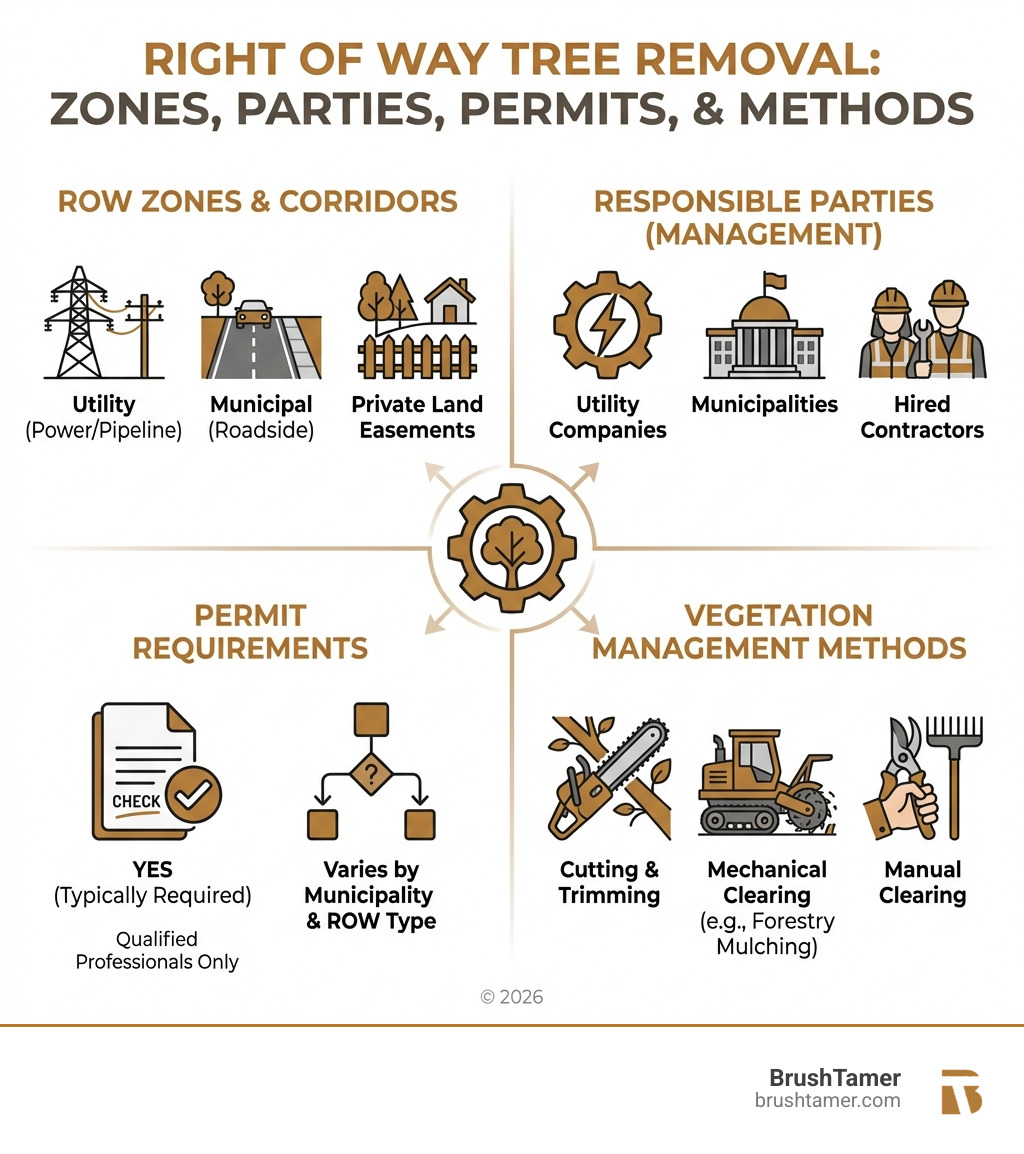
Right of way tree removal is a critical maintenance operation that prevents widespread power outages, protects public safety, and keeps utility and transportation corridors legally compliant across Northern Indiana and Lower Michigan. It involves the systematic removal or control of trees, heavy brush, and invasive vegetation inside a designated easement. This ensures that power lines, natural gas pipelines, public roads, and communications infrastructure remain accessible for maintenance and reliable for the residents, businesses, and public agencies that depend on them daily.
| Question | Professional Standard |
|---|---|
| Who manages ROW tree removal? | Utilities, municipalities, and qualified contractors like BrushTamer |
| Who owns trees in a ROW? | The adjacent property owner typically owns the land and trees, while the easement holder has management rights |
| Why is professional removal required? | High-voltage and buried-utility hazards plus enforceable safety standards require qualified crews |
| Do you need a permit? | Often yes—requirements vary by city, township, and utility right-of-entry rules |
| Who handles cleanup? | BrushTamer uses industrial mulching to process debris on-site when appropriate |
Rights of way are working corridors—not ornamental buffers—and professional right of way tree removal keeps those corridors safe, visible, and serviceable. In communities such as South Bend, IN, Elkhart, IN, Mishawaka, IN, Kalamazoo, MI, and Grand Rapids, MI, these easements commonly run along overhead distribution and transmission lines, natural gas and hazardous liquid pipelines, road and rail corridors, and shared utility routes. In this region, vegetation risk is significantly amplified by the unique climate of the Great Lakes. Heavy ice loading, wet snow, and high-wind events can pull large limbs into energized conductors or block access roads needed for emergency repairs. When ROW vegetation is managed on a planned cycle, utilities reduce fault conditions, pipeline operators maintain clear aerial visibility, and property owners avoid the chaos of surprise emergency work during a storm.
I’m Leon Miller, owner of BrushTamer. BrushTamer was founded in 2021 to provide professional forestry mulching, vegetation management, and right of way clearing across Northern Indiana and Lower Michigan. We understand that managing a right of way is about more than just cutting trees; it is about balancing the legal rights of the utility with the property goals of the landowner. This guide explains how ROW clearing works, what landowners can expect, and how BrushTamer delivers technically correct, permit-aware results that protect both your property and the region’s infrastructure.
Understanding the Legal Framework of Right of Way Tree Removal
A right of way is a legal right that allows a person or entity to pass through property owned by another, typically established through an easement. For infrastructure purposes, an easement grants a utility company or municipality the perpetual right to access, maintain, and clear a specific portion of your land so their services remain functional, safe, and accessible for emergency repairs. This legal framework is essential for the stability of the modern grid.
While the underlying land ownership remains with the resident in Mishawaka, IN or Portage, MI, the easement “runs with the land.” This means the legal obligation to allow vegetation management persists regardless of property transfers or sales. These boundaries are clearly defined in property deeds and plat maps, which the BrushTamer team reviews to ensure all work is performed within legal limits. Understanding the difference between an “easement by prescription” (established through long-term use) and a “recorded easement” (documented in the deed) is vital for property owners to understand their rights.
Common Types of Infrastructure Easements
- Utility ROW: Dedicated to overhead electrical transmission and distribution lines, as well as underground water and sewer systems. These often require the most aggressive clearing to prevent electrical arcing.
- Transportation ROW: Encompasses the area adjacent to public roads, sidewalks, and railways to maintain clear sightlines for drivers and proper drainage to prevent road flooding.
- Pipeline ROW: High-security corridors for natural gas, oil, or hazardous liquid pipelines. These require strict visibility for aerial monitoring and must be kept clear of deep-rooted trees that could damage the pipe’s protective coating.
- Communication ROW: Paths for fiber optic and telecommunications infrastructure, often shared with electrical utilities on the same poles or in the same underground trenches.
Safety Hazards and Regulatory Standards
Near energized electrical infrastructure, right of way tree removal must follow applicable utility clearance requirements, OSHA line-clearance rules, and relevant safety codes such as the NESC. In the Midwest, crews must account for “sag and sway”—the physical movement of power lines due to heat-induced expansion or wind-driven oscillation. If a tree is too close, electricity can “jump” or arc to the branch, causing a fire or a lockout on the circuit.
Liability for encroachment is a significant concern for property owners in Goshen, IN and Battle Creek, MI. An encroachment occurs when a tree, structure, or even a large pile of debris interferes with the easement holder’s ability to maintain the corridor. Unauthorized vegetation within a public ROW can create compliance issues, and hazardous trees near infrastructure can trigger urgent corrective action. This is why industrial vegetation management and professional right of way tree removal are critical preventative measures for both the easement holder and the landowner.
Primary Drivers for Professional Infrastructure Protection
The primary driver of professional infrastructure protection is maintaining enforceable clearance zones that prevent service interruptions and enable rapid, safe access for inspections and repairs. For utilities and pipeline operators across Northern Indiana and Lower Michigan, vegetation control is an operational requirement—not a cosmetic choice. Major reliability events, including the 2003 Northeast blackout, show why planned vegetation management is essential for transmission corridors.
According to FERC Transmission Line Management guidance, vegetation can initiate large-scale reliability events when a single line fault cascades into broader system stress. This matters for customers served by major networks spanning Fort Wayne, IN, South Bend, IN, Elkhart, IN, Kalamazoo, MI, and Grand Rapids, MI, where feeder lines and transmission routes cross wooded parcels and fast-regrowth edges. Without consistent clearing, the risk of a localized tree fall turning into a regional blackout increases exponentially.
| Outage Cause | Frequency Impact | Recovery Time |
|---|---|---|
| Tree/Limb Failure | High (Year-round) | Variable (Complex) |
| Weather Alone | Moderate | High (Event-based) |
| Wildlife | Low | Fast (Localized) |
The Role of Integrated Vegetation Management (IVM)
Integrated Vegetation Management (IVM) is the most reliable way to keep ROW corridors stable over multiple growth cycles. BrushTamer applies IVM principles during right of way clearing to reduce repeat problems such as resprouting, edge encroachment, and invasive brush dominance. IVM is a science-based approach that seeks to create a sustainable plant community that is compatible with the infrastructure.
In practical field terms across Granger, IN, St. Joseph County, and Southwest Michigan townships, IVM means:
- Mechanical control: Using forestry mulchers to reset overgrowth efficiently and remove high-risk stems.
- Selective chemical control: Applying targeted herbicides to the stumps of incompatible species to stop regrowth while leaving native grasses unharmed.
- Cultural control: Encouraging the growth of low-growing shrubs and grasses that naturally outcompete taller, high-risk tree species.
Aerial Patrols and Pipeline Visibility Requirements
Pipeline ROW clearing is driven by visibility and access requirements for monitoring and emergency response. In areas such as Niles, MI and Benton Harbor, MI, operators rely on aerial patrols (planes or drones) to identify erosion, third-party encroachment, or signs of a leak. If canopy closure hides the corridor, these inspections become less reliable, and response time for a potential leak suffers. BrushTamer’s pipeline right-of-way clearing services support corridor visibility, repair access, and long-term vegetation control where right of way tree removal is required.
Advanced Methods in Right of Way Vegetation Management
Modern right of way tree removal utilizes high-efficiency mechanical methods—specifically forestry mulching—combined with Integrated Vegetation Management (IVM) to achieve long-term corridor stability. BrushTamer applies a complete guide of land clearing services approach to ensure every project in Valparaiso, IN or Lafayette, IN meets the highest industrial standards. Traditional methods like “hand-cutting and piling” are often too slow and labor-intensive for modern infrastructure needs.
Industrial Forestry Mulching Technology
The cornerstone of BrushTamer’s operation is the use of high-performance forestry mulchers. Unlike traditional clearing methods that involve bulldozing and burning, forestry mulching grinds standing timber and underbrush into a fine mulch in a single pass. This technology uses a high-speed rotor equipped with alloy teeth to pulverize vegetation. Key technical advantages include:
- Soil Stabilization: The resulting mulch layer acts as an immediate erosion control blanket, protecting the soil from heavy rains and suppressing the germination of invasive weed seeds.
- Minimal Ground Disturbance: Because mulchers do not rip out root systems like bulldozers, the soil structure remains intact, which is vital for maintaining the integrity of buried pipelines or cables.
- Operational Efficiency: It can reduce the need for multiple machines such as chippers, haul trucks, and loaders, helping limit site disruption and simplify project coordination.
Commercial Vegetation Control and Herbicide Standards
To ensure the longevity of a cleared ROW, BrushTamer implements commercial vegetation control techniques. This involves the application of selective herbicides to the stumps of removed trees to prevent resprouting. Many deciduous species common to Indiana and Michigan, such as Willow, Boxelder, and Silver Maple, can grow several feet in a single season if not chemically treated. By targeting only the root systems of incompatible species, native grasses and wildflowers are allowed to flourish, creating a stable ecosystem that requires less frequent mechanical intervention. This “low-volume basal” or “cut-stump” treatment is highly targeted and environmentally responsible, ensuring that only the intended targets are affected.
Property Owner Rights and Responsibilities in the Midwest
Property owner rights and responsibilities in the Midwest are defined by the specific terms of the easement: you retain ownership of the land, while the easement holder retains the right of access and vegetation-management authority to protect the corridor. In Northern Indiana and Lower Michigan, this typically means you can use the land for gardening, grazing, or recreation, but you cannot allow trees, permanent structures, or tall plantings that prevent safe maintenance or access.
In cities and townships around South Bend, IN, Elkhart, IN, LaPorte, IN, Portage, IN, Kalamazoo, MI, and Grand Rapids, MI, utilities commonly provide advance notice for planned maintenance cycles via mailers, door tags, or contractor outreach. However, property owners should be aware that emergency conditions are handled differently. After major wind or ice events, crews may enter the ROW without prior notice to restore essential services. BrushTamer supports these time-sensitive projects with professional equipment and site-conscious execution so the corridor is restored while minimizing unnecessary disturbance outside the easement.
Identifying Right of Way Boundaries and Hazard Trees
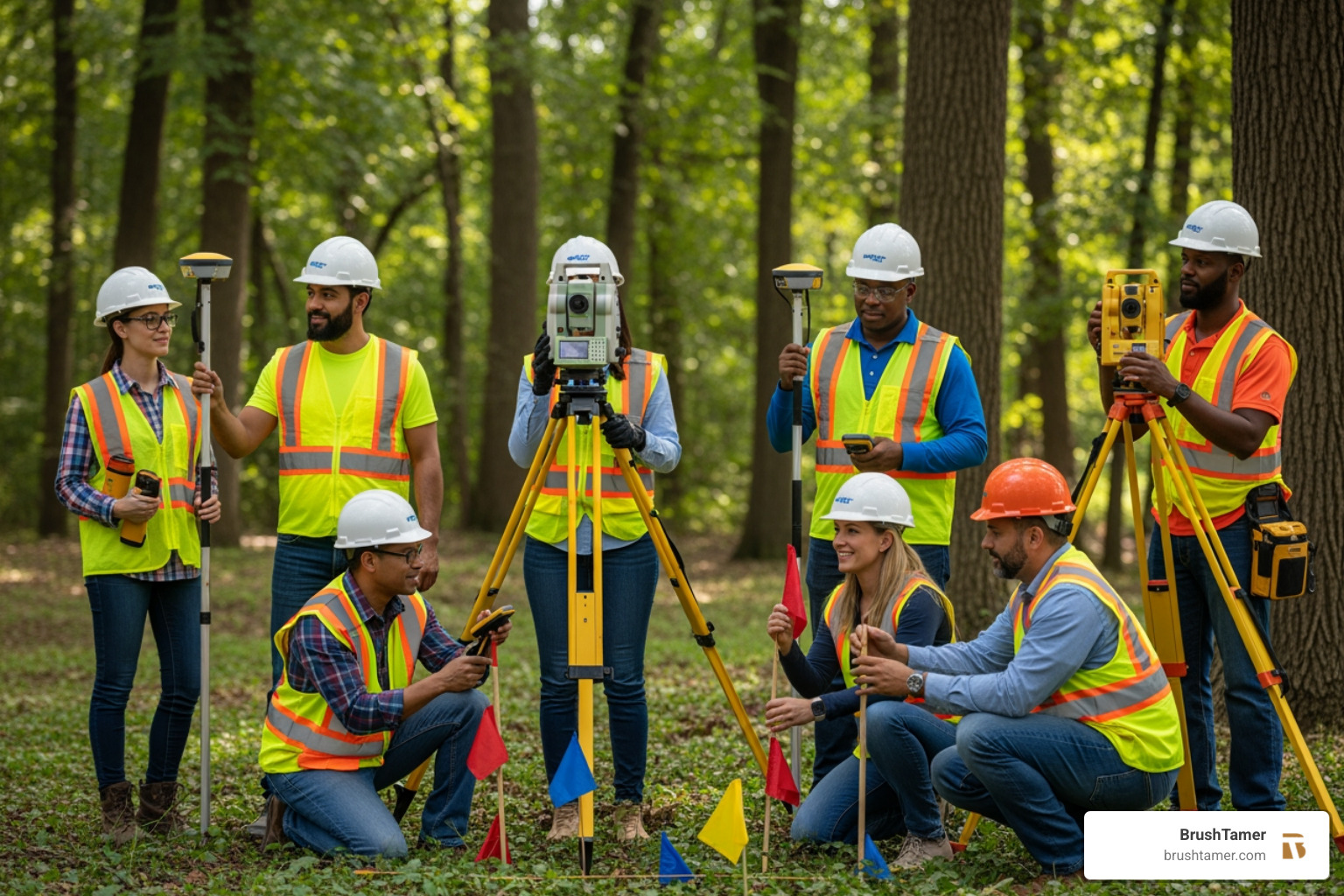
Identifying ROW boundaries starts with verifying the recorded easement and marking the work limits before any equipment mobilizes. BrushTamer reviews available documentation and field indicators to keep clearing inside the legal corridor. Common ways ROW limits are confirmed include:
- Property surveys and recorded documents showing the specific easement width and location relative to property lines.
- Utility markers indicating underground infrastructure routes, which often serve as the centerline for the easement.
- Centerline measurements where easement language defines offsets (often 15–60+ feet from a centerline, depending on the voltage of the line or the pressure of the pipe).
Landowners should also be aware of “Danger Trees.” These are trees located outside the legal right of way that are tall enough or diseased enough to strike the infrastructure if they fall. Utilities often have the right to remove these specific hazards to ensure grid reliability.
Planting Guidelines for Compatible Vegetation
The safest long-term strategy is to keep ROWs in low-growing, compatible vegetation so future clearing is simpler and less disruptive. BrushTamer helps landowners align corridor conditions with utility expectations using proven brush management principles. Recommended compatible options for Midwest ROW conditions include Serviceberry (shrub varieties), Native Dogwoods, and Native Prairie Grasses. Conversely, species like Oak, Maple, and most Evergreens are predictably incompatible near overhead lines due to their eventual height and canopy spread. If you’re planning landscaping near an easement in Mishawaka, IN, Goshen, IN, or Battle Creek, MI, contact BrushTamer for corridor-compatible recommendations that support safe access, long-term usability, and responsible land stewardship.
Environmental Stewardship and Habitat Benefits
Environmental stewardship in right of way management focuses on converting overgrown, choked corridors into early-successional habitats that support native biodiversity and pollinator populations. In the Great Lakes region, professional clearing is a vital tool for combating invasive species like Autumn Olive, Asian Honeysuckle, and Buckthorn, which quickly dominate unmanaged areas and choke out native flora. By removing these invasive species, BrushTamer helps restore the natural balance of the land.
Utility corridors, when managed correctly, act as “pollinator highways”—providing the open, sunny conditions required by bees, butterflies, and birds that are often lost in dense, unmanaged forests. These linear preserves can connect fragmented habitats, allowing wildlife to move safely across the landscape. This is particularly important for species like the Monarch butterfly and various native bees that rely on the milkweed and wildflowers that thrive in cleared, sunny ROWs.
Promoting Native Ecosystems in Indiana and Michigan
When BrushTamer performs heavy brush removal, the goal is to facilitate the growth of native Midwest grasses. These species provide superior erosion control and fire resistance compared to invasive brush. Key native species we encourage include:
- Big Bluestem: A foundational prairie grass of the Midwest that provides excellent structure.
- Indiangrass: Provides vital cover for nesting birds and small mammals.
- Switchgrass: Known for its incredibly deep root systems and soil-binding capabilities, which are essential on sloped ROWs.
Long-Term Maintenance Cycles
Vegetation management is a cyclical process, not a one-time event. Most utilities in Granger, IN and Mishawaka, IN operate on a 4-to-7-year maintenance schedule. BrushTamer ensures that every project concludes with a clean, professional finish. The mulching process leaves the site ready for immediate use, whether for agricultural purposes or as a maintained natural area. This proactive approach helps keep the corridor functional, accessible, and easier to maintain over future growth cycles. By maintaining these cycles, we prevent the need for the “clear-cutting” of large, mature trees in the future.
Frequently Asked Questions about Right of Way Management
Who is responsible for tree removal in a right of way?
Responsibility for right of way tree removal typically lies with the easement holder—such as the utility company or municipality—when the work is required to maintain the corridor for public safety. However, if a tree on private property is identified as a hazard to the ROW, the property owner may be required to facilitate its removal. BrushTamer can help clarify these boundaries and responsibilities for properties across Northern Indiana and Lower Michigan, ensuring that the work is done according to the specific legal requirements of the easement.
Why is professional removal required near power lines?
Professional removal is required because working near energized conductors is extremely hazardous and governed by strict OSHA and ANSI Z133 standards. Unqualified individuals are prohibited from working within 10 feet of overhead lines. BrushTamer reviews available property documentation and field indicators to help keep clearing activity within the defined work area. Attempting to trim trees near power lines yourself can result in fatal electrical shocks or significant damage to the grid.
What happens to the debris after a tree is removed?
Debris management is handled through industrial mulching or chipping. When you hire BrushTamer for pipeline right-of-way clearing, forestry mulchers grind all vegetation into a nutrient-rich mulch that is left on-site. This eliminates the need for hauling or burning, providing an environmentally sound solution that benefits the soil and prevents erosion in areas like Kalamazoo, MI and Battle Creek, MI. The mulch eventually breaks down, returning nutrients to the soil and supporting the growth of compatible ground cover.
Can I build a fence or shed within a right of way?
Generally, permanent structures like sheds, garages, or pools are prohibited within a right of way because they obstruct access for maintenance and repairs. Fences may be allowed in some cases, but they often require a specific encroachment agreement and may need to be removed if the utility needs access. It is always best to consult with the easement holder and a professional clearing service like BrushTamer before placing any structures near a utility corridor.
How do I know if a tree on my property is a “hazard tree”?
A hazard tree is any tree that has a structural defect that makes it likely to fall and strike a target—in this case, the utility infrastructure. Signs of a hazard tree include deep trunk cracks, large dead limbs, fungal growth at the base, or a significant lean toward the lines. BrushTamer can help identify these risks during a site assessment and coordinate with the utility for safe removal.
Conclusion
Right of way tree removal keeps Northern Indiana and Lower Michigan infrastructure safe, inspectable, and reliable while helping property owners stay aligned with easement requirements. When performed correctly by professionals, ROW clearing reduces the risk of catastrophic outages, supports critical pipeline monitoring, and prevents encroachment issues that can trigger urgent corrective work. It is a balance of engineering necessity and environmental stewardship.
BrushTamer, founded in 2021, provides professional vegetation management built for real-world ROW conditions—tight access, fast-regrowth species, and strict safety expectations. Whether you’re located in South Bend, IN, Elkhart, IN, Fort Wayne, IN, Valparaiso, IN, Kalamazoo, MI, or Grand Rapids, MI, our team delivers corridor-focused results using proven methods and industrial-grade equipment. We take pride in our ability to clear the way for progress while respecting the land and the people who own it.
Need professional right of way tree removal or corridor-focused vegetation management on your property? Contact BrushTamer today to discuss a compliant, precise plan that protects access, supports easement requirements, and respects the long-term health of your land.