
Why Canopy Reduction Matters for Northern Indiana Property Owners
Canopy reduction for Northern Indiana property owners reduces storm-load risk, supports tree longevity, and protects nearby structures across the region. BrushTamer’s targeted pruning for canopy reduction for Northern Indiana helps keep mature trees stable through snow, ice, and wind events.
Canopy reduction for Northern Indiana is a science-based tree care practice that reduces a tree’s size and density while preserving its natural structure. When performed by BrushTamer’s ISA Certified Arborists, the work focuses on strategic branch removal that keeps weight balanced, protects key structural limbs, and supports long-term vitality. This differs fundamentally from topping, which creates hazardous regrowth and long-term decay.
Northern Indiana communities such as South Bend, Mishawaka, Granger, Elkhart, and La Porte routinely experience heavy lake-effect snow, damaging ice, and strong summer winds. Overgrown crowns in these conditions act like sails, catching wind and holding snow and ice that overload limbs. Without proactive canopy management, large trees can crack, shed branches, or even uproot, putting roofs, vehicles, and outdoor spaces at risk.
Well-managed trees using BrushTamer’s canopy reduction services provide consistent benefits year-round:
- Lower risk of storm-related failures through canopy reduction for Northern Indiana trees near homes, drives, and utilities
- Increased property value and curb appeal in residential areas from Goshen and Nappanee to Crown Point and Valparaiso
- Better shade that supports energy efficiency without overwhelming roofs, gutters, or lawns
- Healthier, more resilient trees that remain assets instead of liabilities
Research from the USDA Forest Service on urban tree canopies in Midwest microclimates confirms that properly pruned trees are more resilient to weather stress and disease pressure. Building on this research, BrushTamer has developed a region-specific approach to canopy reduction for Northern Indiana that aligns with ANSI A300 standards and focuses on safety, environmental responsibility, and long-term performance.
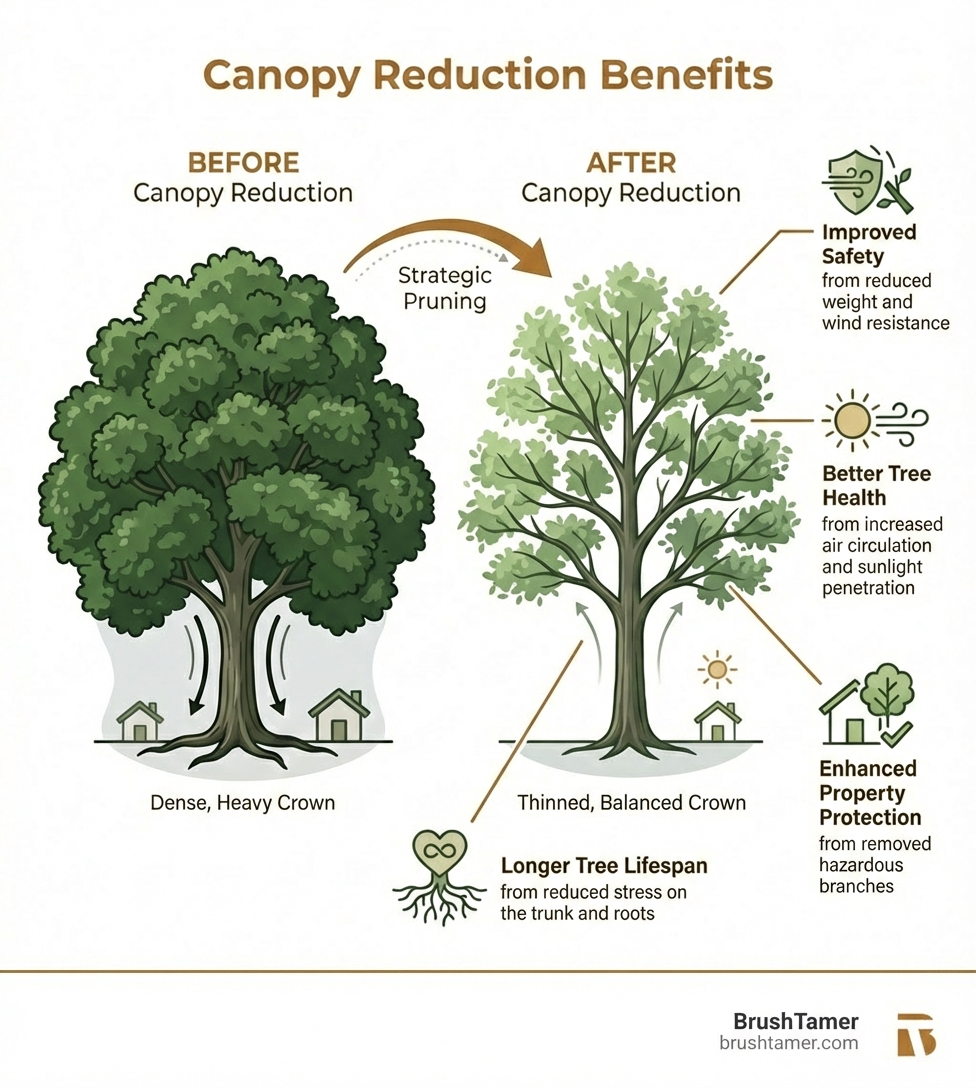
What is Canopy Reduction and Why is it Essential in Northern Indiana?
Canopy reduction is the targeted trimming of a tree’s crown to safely decrease height, spread, and density while preserving structural strength, and it is essential in Northern Indiana because it prevents weather-related failures before they threaten people and property. BrushTamer applies this technique to keep large shade trees safe and sustainable across communities from South Bend and Elkhart to Valparaiso and Michigan City.
Canopy reduction is a professional tree care method in which trained arborists selectively remove or shorten specific branches to control size and weight. In Northern Indiana, this is a proactive risk-management tool that directly addresses the way local storms load and stress trees. Instead of drastic cutting, BrushTamer focuses on maintaining strong branch unions, healthy leaf area, and balanced structure.
Northern Indiana’s climate combines heavy snow, periodic ice, and high winds that routinely test mature trees. A dense, unmaintained canopy traps snow and ice and catches wind, which:
- Increases the likelihood of limb breakage.
- Amplifies leverage on roots and trunk during storms.
- Raises the odds of partial or total tree failure near homes, drives, and power lines.
By implementing canopy reduction for Northern Indiana properties before severe weather seasons, BrushTamer helps reduce emergency limb failures and unplanned removals.

The Two Main Types of Canopy Reduction
The two main types of canopy reduction are crown thinning and crown reduction, and both are performed according to ANSI A300 standards when BrushTamer services trees across Northern Indiana and Southwest Michigan.
- Crown Thinning:
- Focuses on selectively removing interior and competing branches.
- Improves air circulation and sunlight penetration throughout the crown.
- Reduces wind resistance without noticeably shrinking the tree.
- Lowers disease pressure and helps maintain interior foliage.
- Crown Reduction:
- Shortens the length of select limbs to decrease overall height and spread.
- Uses proper reduction cuts back to lateral branches capable of taking over growth.
- Preserves the natural outline of the tree instead of leaving flat or stubbed tops.
- Provides safe clearance from roofs, driveways, and infrastructure in towns such as Portage, Chesterton, and Hobart.
Both methods must be custom to species, age, and site conditions. BrushTamer’s arborists integrate current research, including findings from scientific research on tree microclimates in the Midwest, to ensure each reduction cut supports long-term canopy stability.
How Northern Indiana’s Climate Impacts Your Trees
Northern Indiana’s climate impacts trees by repeatedly loading, saturating, and stressing their structure, making professional canopy reduction an essential part of responsible property management. Without scheduled maintenance, even healthy trees in places like Gary, Merrillville, and Munster can develop hidden weaknesses.
Key regional stressors include:
- Lake-Effect Snow: Heavy, wet snow near Lake Michigan, especially around Michigan City and La Porte, quickly overloads extended limbs.
- Summer Thunderstorms: High winds push against dense crowns, magnifying the chance of uprooting in saturated soils.
- Freeze-Thaw Cycles: Repeated freezing and thawing expands small cracks and can worsen existing structural defects.
- Saturated Soil Periods: Spring rains reduce root stability, making unbalanced trees more vulnerable to windthrow.
BrushTamer’s canopy reduction for Northern Indiana program is designed around these conditions. By reducing wind sail, redistributing weight, and removing structurally weak wood, our team increases tree stability before storms arrive. For properties that also require broader vegetation control around structures, fields, or right-of-way corridors, we integrate canopy work with our Vegetation Management Solutions to keep entire sites safer and more manageable.
Key Benefits of Professional Canopy Reduction for Your Property
The key benefits of professional canopy reduction for your property are extended tree life, reduced storm damage risk, and improved curb appeal across Northern Indiana and Southwest Michigan communities. BrushTamer’s strategic pruning creates safer, healthier trees that improve property values in areas from Goshen and Plymouth to Niles and Kalamazoo.
Enhancing Tree Health and Longevity
Enhancing tree health and longevity through canopy reduction works by lowering stress on branches and roots while improving internal light and air flow. For older trees near homes in South Bend, Mishawaka, Elkhart, and Benton Harbor, this type of structural care often determines whether a tree declines early or performs reliably for decades.
Key health benefits include:
- Better Air Circulation: Thinning dense interiors reduces humidity and leaf wetness that encourage fungal diseases
- Improved Sunlight Distribution: More light reaches interior leaves and lower branches, maintaining live growth throughout the crown
- Reduced Mechanical Stress: Removing overloaded, extended limbs decreases strain on attachment points and the trunk
- Root System Support: A balanced canopy better matches the root system’s capacity, especially in compacted urban soils
As part of BrushTamer’s broader land stewardship approach, canopy reduction is often coordinated with our Forestry and Wildlife Management services to align individual tree care with larger habitat and property goals.
Improving Safety and Reducing Liability
Improving safety and reducing liability happens when canopy reduction eliminates predictable failure points before they cause damage. For high-traffic residential and commercial sites in Crown Point, Merrillville, Schererville, Hammond, and Gary, this represents a core risk-management strategy.
BrushTamer’s arborists focus on:
- Identifying and removing dead, cracked, or decayed limbs (deadwooding) within the crown
- Addressing weakly attached branches, codominant stems, and crossing limbs that can fail under load
- Creating safe clearance from roofs, parking areas, play spaces, sidewalks, and power lines
- Stabilizing imbalanced canopies over driveways and entry points in towns like Valparaiso, Portage, and Chesterton
By integrating canopy reduction into routine maintenance schedules, property owners support safer conditions and may reduce the likelihood of costly emergency calls after storms.
Boosting Aesthetics and Usable Space
Boosting aesthetics and usable space occurs when canopy reduction transforms dense, shadowed areas into bright, functional parts of the landscape. In neighborhoods from Granger and Osceola to St. Joseph and Bridgman, intentional pruning helps properties stand out while staying practical.
Results clients often see after BrushTamer completes canopy reduction for Northern Indiana and Lower Michigan sites include:
- More balanced, intentional tree forms that frame homes instead of overpowering them
- Improved views toward streetscapes, lakes, or fields without fully removing shade
- Increased natural light for turf and foundation plantings beneath the canopy
- Expanded, comfortable outdoor living areas under trees for patios, play sets, or seating
These visual and functional gains complement broader land clearing or vegetation work, giving properties a coordinated, finished look that supports long-term value.
Identifying the Need for Canopy Reduction for Northern Indiana Trees
Identifying the need for canopy reduction for Northern Indiana trees requires watching for specific structural and health warning signs, then scheduling a professional assessment with BrushTamer when any of those signs appear. This approach keeps trees on properties from Hobart, Dyer, and Munster to Sturgis and Paw Paw on a proactive maintenance path instead of waiting for storm damage.
Common Signs Your Tree Needs Attention
Common signs your tree needs attention include overly dense canopies, dead branches, and structural imbalances that indicate canopy reduction rather than simple touch-up pruning. Property owners in Highland, East Chicago, Whiting, and nearby communities should contact BrushTamer if they notice:
- Overly Dense Canopy: The crown blocks most sunlight, appears heavy, and sways minimally in the wind
- Dead or Broken Branches: Visible deadwood, hanging branches, or cracked limbs anywhere in the canopy
- Rubbing or Interfering Branches: Limbs that cross, rub, or rest on roofs, gutters, siding, fences, or power lines
- Unbalanced Shape or Lean: A lopsided crown or new lean, especially after recent storms or soil saturation
- Storm-Related Wounds: Fresh splits, torn bark, or branch stubs following snow, ice, or high winds
- Sparse Interior Foliage: Green growth only at the outer edges of the canopy, with bare interior branches
- Fungal Activity at the Base: Mushrooms or conks on the trunk or near the root flare, suggesting internal decay
Each of these indicators points to increased structural stress or compromised wood. When BrushTamer evaluates these conditions, our arborists determine whether canopy reduction, targeted removal, or a broader vegetation strategy is most appropriate for the site.
When to Call a Professional in the Michiana Region
When to call a professional in the Michiana region is as soon as you see any warning signs or whenever a large tree is close to a structure, access point, or utility line. Waiting for branches to fail increases risk and can turn a manageable pruning project into a removal.
BrushTamer recommends that property owners in South Bend, Granger, Elkhart, Niles, Buchanan, and surrounding areas schedule:
- Post-Storm Inspections: After heavy snow, ice, or severe thunderstorms to identify hidden cracks and new weaknesses
- Routine Assessments Every 3-5 Years: For mature trees near homes, parking areas, or public-facing frontage
- Pre-Construction Reviews: Before additions, new driveways, or hardscape projects near tree root zones
- Checks for High-Use Areas: Around sidewalks, play areas, business entrances, and shared access roads
When BrushTamer completes canopy reduction or related work, we manage resulting limbs and debris as part of a clean, turnkey service. Our crews handle hauling and disposal through dedicated Brush Clean-Up Services, so properties in communities across Northern Indiana and Southwest Michigan are safe, tidy, and ready for use immediately after the project.
The Professional Process and What to Expect
The professional process for canopy reduction in Northern Indiana is a structured service in which BrushTamer’s ISA Certified Arborists evaluate each tree, define clear pruning goals, perform ANSI-compliant cuts, and leave the site fully cleaned and ready for use. This predictable, safety-focused workflow serves clients from Fort Wayne and Lafayette to Kalamazoo and Battle Creek.
The Arborist’s Approach to Canopy Reduction for Northern Indiana
BrushTamer’s arborists follow a step-by-step method that prioritizes safety, tree biology, and local site conditions.
- Site Assessment:
- Inspect tree health, structure, and past pruning history.
- Review proximity to homes, barns, commercial buildings, utilities, and property lines.
- Consider soil conditions, exposure, and prevailing storm patterns.
- Custom Pruning Plan:
- Define objectives such as storm hardening, clearance, or crown balancing.
- Identify specific limbs to remove or shorten, including dead, diseased, and structurally weak branches.
- Align the plan with species characteristics and accepted industry standards.
- Precise Execution:
- Use proper branch collar cuts to protect natural defense zones.
- Apply the three-cut method on larger limbs to prevent bark tearing and trunk injury.
- Employ appropriate climbing and lift equipment to work safely around structures and utilities.
- Thorough Cleanup:
- Chip and remove branches, logs, and fine debris.
- Leave lawns, driveways, and beds in orderly condition.
- Integrate debris handling with our Brush Removal Services for clients managing multiple trees or larger tracts.
This systematic approach ensures that canopy reduction for Northern Indiana and Southwest Michigan properties is not just a one-time trim but a long-term management strategy custom to each site.
Why “Topping” Is a Damaging and Outdated Practice
Topping is a damaging and outdated practice because it removes large portions of the crown without regard for structure, leaving trees weaker, more hazardous, and more expensive to manage over time. BrushTamer does not offer topping and instead uses reduction and thinning methods that support both safety and health.
Problems created by topping include:
- Severe stress from sudden, excessive leaf loss.
- Rapid, weakly attached regrowth that is more likely to fail in storms.
- Large, open wounds that invite decay and insect activity.
- Distorted, unnatural shapes that diminish curb appeal.
- Higher long-term costs as topped trees require frequent corrective work or early removal.
In contrast, professional canopy reduction selectively removes or shortens limbs back to appropriate lateral branches, preserving the tree’s natural form and building a stable structure over time.
Common Indiana Trees That Benefit from Reduction
Several common Indiana and Southwest Michigan tree species benefit from well-planned canopy reduction, especially in urban and suburban settings where space, structures, and storm exposure are key considerations.
Species that often respond well when BrushTamer implements structural pruning and reduction include:
- Red, White, and Pin Oaks: Strong but prone to dense, heavy crowns that catch wind and snow in cities like Indianapolis, Carmel, and Fishers.
- Maple Species (including Silver Maple): Fast-growing with relatively brittle wood that can shed limbs without weight management.
- Sycamore: Large, vigorous trees that often require selective reduction to fit within residential lots and along streets.
- Black Walnut and Pin Oak: Beneficiaries of early structural pruning to establish a central leader and well-spaced scaffold branches.
Using resources such as the Indiana Community Tree Selection Guide, BrushTamer designs species-specific canopy programs that keep these trees compatible with surrounding buildings and infrastructure while maintaining their ecological and aesthetic value.
Frequently Asked Questions about Canopy Reduction Services
Frequently asked questions about canopy reduction services center on timing, cost, and weather resilience for Northern Indiana and Southwest Michigan properties. BrushTamer answers these questions directly so property owners from Anderson and Noblesville to Portage and St. Joseph can plan tree care with confidence.
How often do trees in Northern Indiana need canopy reduction?
Trees in Northern Indiana need canopy reduction every 3 to 5 years for most mature specimens, with adjustments based on species, site exposure, and tree health. BrushTamer sets maintenance intervals after an on-site evaluation so each tree receives attention at the right time.
Factors that influence the ideal schedule include:
- Species: Fast-growing maples and sycamores often need more frequent work than slower-growing oaks
- Age and Condition: Older or previously damaged trees may require closer monitoring
- Site Exposure: Trees highly exposed to lake-effect snow or prevailing winds, such as those in Michigan City, New Buffalo, or along open fields, may need more regular reduction
- Past Pruning History: Trees with old topping cuts or structural defects often benefit from staged corrective work
Across Northern Indiana, BrushTamer incorporates canopy work into broader vegetation management plans to keep sites consistent and predictable.
What factors influence the cost of canopy reduction services?
Factors that influence the cost of canopy reduction services include tree size, site complexity, and the scope of pruning required. BrushTamer provides project-specific quotes after evaluating each property in person.
Key cost drivers include:
- Tree Size and Height: Larger, taller trees demand more time, equipment, and crew resources
- Species and Structure: Dense or intricate branching patterns can increase complexity
- Accessibility: Limited access, steep slopes, or obstacles near the tree affect equipment setup
- Proximity to Hazards: Work near homes, commercial buildings, utilities, or roads requires additional safety controls
- Tree Condition and Amount of Reduction: Heavily overgrown or compromised trees often require more extensive, technical pruning
How does proper reduction help trees survive Indiana’s weather?
Proper reduction helps trees survive Indiana’s weather by lowering wind and snow loads, improving structural integrity, and eliminating predictable failure points before storms hit. This directly supports resilience for trees in communities from Warsaw and Wabash to Lafayette and West Lafayette.
BrushTamer’s reduction work provides several weather-related advantages:
- Reduced Sail Effect: Thinned crowns allow wind to pass through instead of pushing against a solid mass of foliage
- Less Weight from Snow and Ice: Shortened and lightened limbs carry less load during winter events
- Stronger Structure: Selective cuts promote a stable branch framework with appropriate spacing and attachment angles
- Removal of Weak or Compromised Limbs: Dead, decayed, or poorly attached branches are removed before they can fail
By pairing canopy reduction for Northern Indiana with ongoing inspections, BrushTamer turns mature trees into resilient assets capable of handling the region’s shifting climate patterns.
Partnering with Experts for Your Northern Indiana Property
Partnering with BrushTamer for canopy reduction in Northern Indiana and Southwest Michigan ensures that large trees are managed as long-term assets rather than unpredictable liabilities. Our team combines arboricultural expertise with land management experience to protect homes, businesses, and natural resources from South Bend and Mishawaka to Kalamazoo and Coldwater.
Since 2021, BrushTamer has focused exclusively on professional land clearing and vegetation management, building a reputation for reliable, high-quality results delivered with a client-focused, environmentally responsible approach. When we perform canopy reduction for Northern Indiana and Lower Michigan properties, the work is integrated with overall site goals, whether that involves:
- Protecting roofs, drives, and outdoor spaces from falling limbs.
- Improving views and access around lakes, fields, and woodlots.
- Coordinating canopy work with underbrush control and selective clearing.
- Supporting habitat and forestry objectives alongside safety and aesthetics.
Our ISA Certified Arborists and trained crews serve a broad regional footprint, including communities such as Goshen, La Porte, Valparaiso, Crown Point, Fort Wayne, Lafayette, Niles, St. Joseph, Benton Harbor, and surrounding areas. By entrusting canopy reduction for managing trees, brush, and land assets over the long term.
For a plan that fits your site, contact BrushTamer to schedule an on-site assessment for canopy reduction in Northern Indiana.