
Why Surface Fuel Reduction Is Essential for Property Safety
Surface fuel reduction removes or manages combustible material on the forest floor, leaves, grasses, twigs, and underbrush, to reduce wildfire spread. For many properties, surface fuel reduction is one of the most effective steps a landowner can take to lower wildfire risk.
Quick Overview:
- What it is: The strategic removal and management of flammable vegetation at ground level, including dead leaves, fallen branches, grasses, and low-growing shrubs.
- Why it matters: An abundance of surface fuel provides a continuous path for fire to spread rapidly across a landscape. It also serves as a “ladder,” allowing flames to climb into tree canopies and create dangerous, uncontrollable crown fires.
- Primary methods: Modern mechanical techniques like forestry mulching, brush hogging, and mastication offer precise, efficient, and low-impact ways to reduce fuel loads.
- Key benefit: Creates a fire-resilient property that can withstand a wildfire with minimal damage, protecting homes, infrastructure, and ecological assets.
- Maintenance: An initial treatment provides significant protection for 5-10 years, but a long-term maintenance plan is crucial for sustained safety as vegetation regrows.
If you own forested property in Lower Michigan or Northern Indiana, surface fuel reduction becomes more urgent as leaf litter and underbrush accumulate each season. For generations, this buildup was viewed as a natural part of the forest cycle. However, a combination of historical fire suppression and a changing climate has transformed this material into a significant and growing hazard.
Historically, frequent, low-intensity ground fires were a natural part of Midwest ecosystems, clearing out this undergrowth and maintaining open, healthy forests. A century of aggressive fire suppression has disrupted this cycle, leading to unnaturally dense woodlands choked with fuel. Now, combined with hotter, drier summers and more frequent droughts, properties from South Bend and Kalamazoo to Grand Rapids and Elkhart face an unprecedented wildfire risk. This dense ground-level material not only provides a path for fire to spread but also acts as ladder fuel, enabling small surface fires to escalate into catastrophic crown fires that are nearly impossible to control. Scientific research consistently confirms that managing these surface fuels is the most critical factor in preventing this dangerous escalation and protecting your property, even during extreme weather conditions.
At BrushTamer, we use forestry mulching and mechanical clearing to deliver surface fuel reduction that supports safer access, healthier stands, and a more resilient property. Our team creates safer, healthier, and more resilient landscapes that mitigate wildfire risk while aligning with your long-term vision for your land.
Understanding Surface Fuels and Wildfire Risk
In surface fuel reduction, ‘surface fuels’ refers to the organic, combustible layer on or just above the forest floor. This layer is the primary determinant of how a wildfire will start, spread, and behave on your land. Understanding its components and characteristics is the first step toward effective mitigation.
Surface fuels include:
- Fine fuels: Grasses, fallen leaves, pine needles, and small twigs. These ignite easily and are responsible for the initial spread of most fires. In the Midwest, the accumulation of oak leaves and pine needles can create a highly flammable carpet that dries out within hours of a rain event.
- Coarse fuels: Small branches, pinecones, and larger woody debris. These burn for longer and release more heat, contributing to fire intensity. While a single log may not start a fire, a concentration of coarse fuels can sustain high temperatures that damage the root systems of healthy trees.
- Live fuels: Low-lying shrubs, herbaceous plants, and small saplings that can burn readily during dry conditions. Species like Autumn Olive and Buckthorn are particularly problematic in Michigan and Indiana because they grow densely and contain volatile oils or structures that ignite easily.
When surface fuel reduction is neglected, these materials create a continuous fuel bed that allows fires to spread quickly across the ground. In the woodlots and forests surrounding South Bend, Kalamazoo, and Elkhart, the condition of this surface layer often dictates whether a stray spark becomes a manageable ground fire or a rapidly spreading threat to homes and property.
The Science of Fuel Loading and Moisture
Fire professionals analyze four key characteristics of surface fuels to predict how a fire will behave. The first is Fuel Load, which is the total weight of burnable material per unit area, usually measured in tons per acre. Higher loads make surface fuel reduction more urgent because fires burn hotter and longer, making them harder to extinguish.
Fuel Size and Shape also play a role. Fine fuels like grass and leaves have a high surface-area-to-volume ratio, allowing them to dry out quickly and ignite almost instantly. Coarser fuels like branches and logs ignite more slowly but release a tremendous amount of heat over a longer period. Fuel Arrangement describes how fuels are positioned. Continuity is critical; a continuous carpet of pine needles will carry fire much faster than scattered patches of debris. Compaction also matters; loosely arranged fuels with plenty of oxygen burn more intensely than compacted leaf litter.
Finally, Fuel Moisture is the amount of water in a fuel, expressed as a percentage of its oven-dry weight. When fuel moisture is low, fires start more easily, spread faster, and burn more completely. This is why fire danger is greatest during drought periods in areas like Portage, Mishawaka, and Crown Point. For deeper guidance on surface fuel reduction and fuel assessment, reference the National Wildfire Coordinating Group’s publications.
From Surface Fuels to Crown Fires: Breaking the Chain
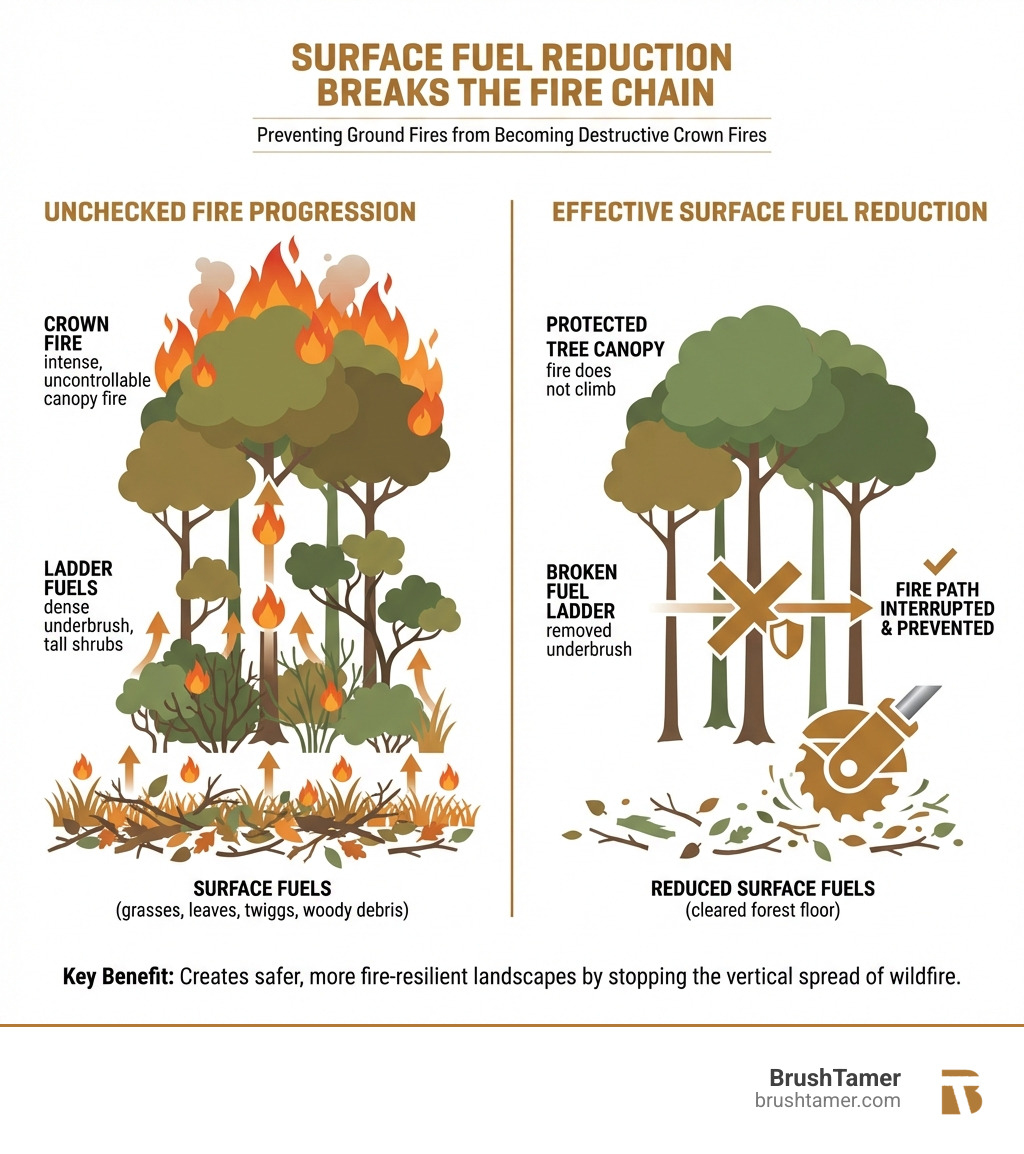
Surface fuels pose the greatest danger when they create a vertical bridge to the tree canopy. This progression is the primary mechanism behind the most destructive wildfires and unfolds in a predictable sequence. By understanding this sequence, landowners can better appreciate why surface fuel reduction is the cornerstone of property defense.
- Ignition and Surface Spread: A fire starts in the fine surface fuels (leaves, grass) and begins to spread across the ground. At this stage, the fire is relatively low-intensity and can often be managed by local fire departments.
- Ladder Fuel Ignition: If the surface fire encounters ladder fuels—dense shrubs, low-hanging tree branches, or small understory trees—the flames climb upward, moving from the ground into the lower canopy. This is the critical transition point where a manageable fire becomes a major threat.
- Torching and Crown Fire: The fire ignites the crown of a single tree or a small group of trees (known as “torching”). If the tree canopy is dense, this can transition into a full-fledged crown fire, where the fire advances from treetop to treetop, independent of the surface fire. These fires are exceptionally fast-moving, intense, and virtually impossible for ground crews to suppress.
This dangerous sequence is a major concern in the overgrown woodlots around St. Joseph, Benton Harbor, and Warsaw, where decades of fire exclusion have allowed dense ladder fuels to develop. BrushTamer’s strategy of strategic surface fuel reduction is designed to break this chain reaction by removing the critical ground-level and ladder fuels, ensuring a surface fire cannot escalate. Our projects near Granger, Valparaiso, and Columbia City consistently demonstrate that when these fuels are professionally managed, the potential for a crown fire drops dramatically, as validated by research from agencies like the U.S. Forest Service fire and fuels program.
Primary Methods for Surface Fuel Reduction
For many landowners, surface fuel reduction is most practical through mechanical treatments that work without smoke, burn windows, or complex permitting. These techniques allow for year-round work without the complexities of prescribed burning. At BrushTamer, we utilize specialized equipment to achieve these goals efficiently.
Our preferred methods include:
- Forestry Mulching: This is our primary tool. A specialized machine grinds small trees, brush, and undergrowth in place, converting hazardous fuels into a beneficial layer of mulch. This process is highly selective, allowing us to remove ladder fuels while protecting mature, high-value trees in areas like Goshen and Fort Wayne. The resulting mulch helps retain soil moisture, prevent erosion, and inhibit the regrowth of invasive species.
- Brush Hogging: Ideal for maintaining open fields, pastures, and defensible space zones, a brush hog is a rotary mower that quickly cuts down tall grasses, weeds, and small saplings. It’s an efficient way to manage fine fuels around homes and outbuildings in communities like Lafayette and Plymouth.
- Mastication: Similar to forestry mulching, this involves shredding woody material. The term is often used for larger-scale projects or when a specific shred size is required to meet fuel load objectives in dense thickets. Mastication is particularly effective for breaking up the horizontal continuity of fuels in dense stands of young timber.
For landowners, these methods make surface fuel reduction predictable: you can target ladder fuels, improve access, and reduce continuity without broad disturbance. They are precise, can be performed in most weather conditions, and do not require the smoke permits, extensive planning, and liability associated with prescribed burning. You can see our specialized machines in action on our Land Clearing Equipment page.
Tailoring Treatments to Midwest Ecosystems
Effective fuel reduction is not one-size-fits-all. Treatments must be tailored to the specific forest types and ecological conditions of the Midwest. BrushTamer commonly works in two dominant settings:
Dry Oak-Hickory Forests: Common on upland sites near Rochester, Fort Wayne, and Niles, these forests are naturally adapted to frequent, low-intensity fire. Decades of fire suppression have allowed them to become overcrowded. Our treatments focus on thinning understory trees, removing invasive shrubs like autumn olive and buckthorn that create dense ladder fuels, and reducing the deep layers of leaf litter to restore a more open, fire-resilient structure.
Wetter Floodplain and Mesic Forests: Found along rivers and in lower-lying areas near Grand Rapids and Battle Creek, these forests are less fire-prone but can become a significant hazard during droughts. Here, our work often emphasizes creating robust defensible space around structures, ensuring clear access for emergency vehicles, and breaking up fuel continuity along property lines. In these environments, we focus on removing dead-and-downed material that can act as a slow-burning fuel source during dry spells.
Balancing Ecological Roles with Fire Hazard Goals
While surface fuels represent a hazard, they also play vital ecological roles. A responsible fuel reduction plan removes the danger while preserving these benefits. Surface fuels and woody debris support nutrient cycling, as decomposition returns essential nutrients to the soil. They also provide critical wildlife habitat; downed logs, snags (standing dead trees), and brush piles provide cover, nesting sites, and food for countless species, from salamanders and turtles to birds and small mammals.
BrushTamer designs projects in Crown Point and Berrien Springs to create a fuel mosaic—a landscape with varying levels of fuel. We don’t aim to sterilize the forest floor. Instead, we concentrate fuel reduction in the highest-risk areas, such as the defensible space zone immediately around your home. We strategically retain coarse woody debris, like large, isolated logs that are in contact with the ground and unlikely to carry fire. We also thin shrub layers rather than removing them entirely, creating space to prevent fire spread while retaining some cover for wildlife.
Managing Invasive Species as Fuel Hazards
Invasive species are a primary driver of increased fuel loads in Northern Indiana and Southwest Michigan. Plants like Autumn Olive, Glossy Buckthorn, and Japanese Honeysuckle grow much more aggressively than native species. They create dense, tangled thickets that not only choke out native flora but also provide a massive amount of fine and medium-sized fuel.
Because these invasives often retain their leaves longer into the fall or leaf out earlier in the spring, they can alter the local microclimate, sometimes drying out the surrounding area and increasing fire risk. Furthermore, their growth habit often creates a perfect “ladder” from the ground to the mid-canopy. Our surface fuel reduction programs prioritize the eradication or heavy thinning of these species. By replacing these dense invasive thickets with a managed layer of mulch or native grasses, we significantly lower the fire intensity potential of the site. This nuanced approach, which we detail further on our Forestry and Wildlife Management page, ensures that properties around Michigan City and New Buffalo become safer from wildfire while remaining healthy, functional ecosystems.
Soil Health and Moisture Retention
One of the most common concerns landowners have regarding surface fuel reduction is the potential for soil erosion or drying. However, when performed correctly using forestry mulching, the process actually enhances soil health. The mulch layer created by our machines acts as a protective blanket over the soil. This layer reduces the impact of raindrops, preventing surface erosion, and significantly slows the evaporation of soil moisture.
In the sandy soils often found near Lake Michigan, moisture retention is critical for the health of mature trees. By reducing the competition from dense underbrush and providing a mulch cover, we help the remaining trees stay hydrated and healthy, which in turn makes them more resistant to pests, diseases, and fire. Healthy, well-hydrated trees are much less likely to ignite than those stressed by drought and competition. This holistic view of land management ensures that your property is not just “cleared,” but actively improved for the long term.
Promoting Native Fire-Adapted Species
Many of the native tree species in our region, such as White Oak and Bur Oak, have evolved with fire. They possess thick, corky bark that protects them from low-intensity ground fires. By performing surface fuel reduction, we are essentially mimicking the natural fire cycles that once maintained these oak openings and savannas.
When we remove the shade-tolerant, fire-sensitive species (like Red Maple or invasive shrubs) that have encroached into these stands, we allow more sunlight to reach the forest floor. This encourages the growth of native wildflowers and grasses, which are not only beautiful and beneficial for pollinators but also represent a much lower fire hazard than a dense thicket of woody brush. This restoration of the native ecosystem is a key goal for many of our clients in rural areas of Indiana and Michigan who want to return their land to its historical, resilient state.
Implementing and Maintaining Fuel Treatments for Long-Term Resilience
Implementing a fuel treatment is a powerful first step, but long-term resilience requires a commitment to maintenance. Vegetation is dynamic; it grows back. BrushTamer builds multi-year maintenance plans so surface fuel reduction stays effective as vegetation regrows. Creating a truly fire-resilient landscape involves a prioritized approach that systematically dismantles the fire ladder.
On every property we service around South Bend and Portage, we apply this proven hierarchy:
- Reduce Surface Fuels First: This is the foundation. By removing the continuous layer of leaves, grasses, and fine debris, we take away the primary mechanism for fire spread. The goal is to reduce surface fuel loads to a point where flame lengths would be less than four feet, allowing for safe and effective suppression.
- Increase Canopy Base Height: This means removing ladder fuels to create vertical separation between the surface and the tree crowns. We achieve this by pruning lower branches of mature trees up to a height of 10-15 feet and removing smaller understory trees that act as a bridge for flames.
- Decrease Crown Density and Continuity: In overgrown stands, we selectively thin trees to reduce crown density and create horizontal separation. The goal is to have at least 10-12 feet of space between the edges of tree canopies, making it difficult for a crown fire to jump from tree to tree.
- Favor and Retain Large, Healthy Trees: Large, mature trees with thick bark and high canopies are the most fire-resistant elements in a forest. Our treatments prioritize retaining these valuable assets while removing the smaller, more flammable vegetation around them.
Applying these principles consistently creates effective defensible space and a fire-resilient landscape, a core component of our Professional Land Management services for properties in Hammond, Valparaiso, and Anderson.
The Critical Role of Treatment Maintenance
Maintenance is not an afterthought; it is an essential part of any fuel management plan. Without follow-up, the benefits of the initial treatment will diminish over time as nature reclaims the space. The speed of regrowth depends on soil quality, sunlight, and moisture, but the general timeline for Midwest properties is predictable.
- Years 1-3: The treated area remains highly effective. The mulch layer from forestry mulching suppresses new growth, and fuel loads are minimal. This is a good time for spot-treating any invasive species that may sprout from the seed bank in the soil.
- Years 4-7: Regrowth of shrubs and saplings becomes more noticeable, and a new layer of leaf litter begins to accumulate. The area is still effective at slowing fire, but ladder fuels may start to re-establish. A follow-up treatment, such as brush hogging or selective mulching, may be needed in high-risk zones.
- Years 8-10+: Without maintenance, many areas in Northern Indiana and Southwest Michigan—including Wabash, Logansport, and Sturgis—can return to a hazardous condition. Fuel loads and continuity may approach pre-treatment levels, requiring a more intensive effort to restore safety.
BrushTamer recommends a proactive maintenance schedule including annual monitoring. Walk your property, especially after windstorms or during droughts, to assess new fuel accumulation. Plan for a maintenance treatment every 5-10 years, depending on the site’s productivity and your risk tolerance. This is often much less intensive and less costly than the initial clearing. Our Vegetation Management Solutions are designed to keep properties near Greencastle and Fishers in a perpetually maintained, fire-resistant state.
Measuring Treatment Effectiveness and Community Safety
How do you know surface fuel reduction worked? We use clear, objective metrics to demonstrate a tangible reduction in wildfire risk for our clients in Kokomo, Warsaw, and across the region. We conduct pre- and post-treatment estimates of surface fuel loading (tons per acre) to quantify the reduction in available fuel. Establishing fixed photo points provides a powerful visual record of the structural changes over time, documenting the reduction in ladder fuels and increased canopy separation.
Using professional software (like BehavePlus), we can model how a potential wildfire would behave under specific weather conditions before and after treatment. This allows us to show the predicted reduction in flame length, rate of spread, and fire intensity. We also monitor for positive ecological outcomes, such as the regeneration of desirable native plants and grasses once dense, invasive undergrowth is removed.
Beyond individual property safety, surface fuel reduction contributes to community-wide resilience. When multiple landowners in an area like New Buffalo or Granger manage their fuels, it creates a landscape-scale buffer that can protect entire neighborhoods. This collective effort makes it easier for fire departments to establish control lines and protect homes. By pairing on-the-ground measurements with fire science guidance from institutions like the National Interagency Fire Center, BrushTamer ensures your investment delivers meaningful, measurable, and lasting risk reduction. When you’re ready to plan surface fuel reduction for your property, contact BrushTamer to schedule a site visit and get a clear, property-specific plan.