
Your Guide to Choosing the Perfect Riding Mower
A lawn tractor is a riding mower designed for properties larger than half an acre, featuring a steering wheel, comfortable seat, and powerful engine that can handle various lawn care tasks beyond basic mowing. These versatile machines combine efficiency with comfort, allowing you to cover more ground in less time while reducing physical strain.
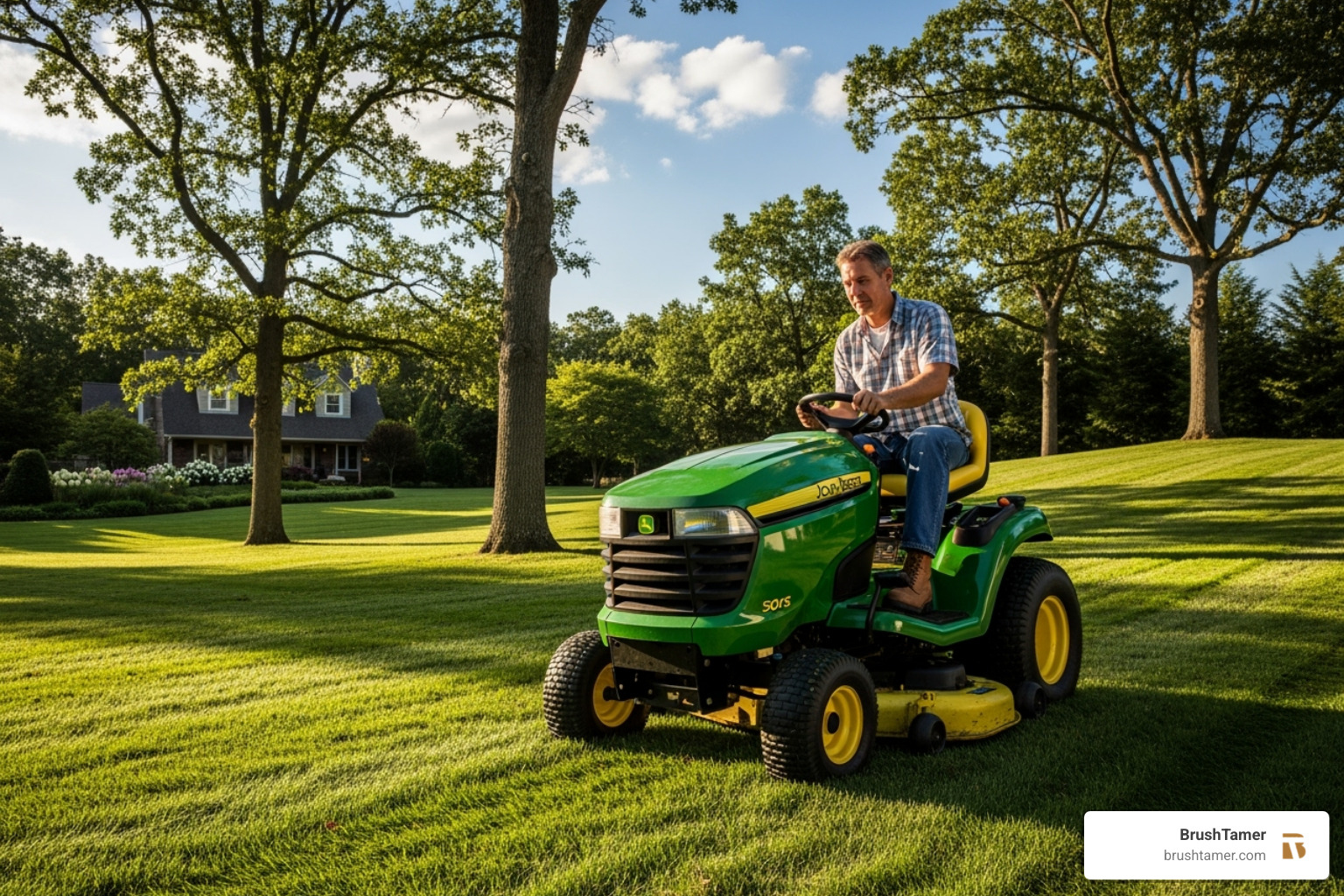
For generations, maintaining a large lawn was a physically demanding, time-consuming chore. The advent of the lawn tractor revolutionized property care for homeowners, changing it from a weekend-long struggle with a push mower into a manageable, even enjoyable, task. It represents a significant investment in not just your property’s appearance, but in your own time and physical well-being. Unlike a basic riding mower, a true lawn tractor is built on a more robust frame, designed not just to cut grass, but to be a year-round utility vehicle for your land.
Key Lawn Tractor Features:
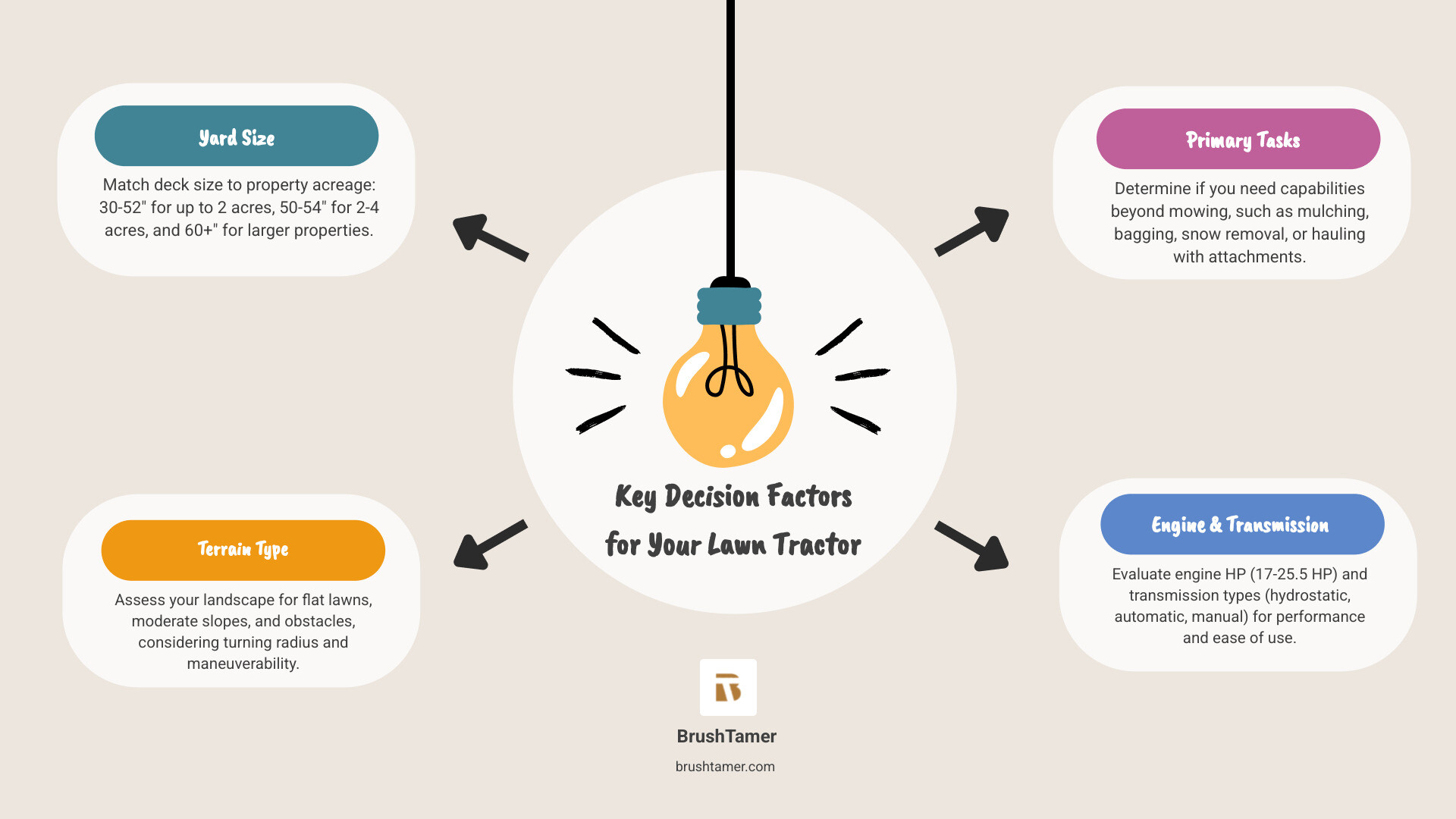
- Engine Power: 17-25.5 HP range for different property sizes
- Deck Size: 30-60 inches cutting width to match your acreage
- Transmission: Hydrostatic, automatic, or manual gear drive options
- Versatility: Compatible with attachments for year-round use
- Terrain Capability: Handles flat lawns to moderate slopes
The average lawn tractor costs around $2,000, with prices varying based on features, deck size, and engine power. Popular brands include John Deere, Cub Cadet, and Troy-Bilt, with engines typically manufactured by Kohler, Briggs & Stratton, or Kawasaki.
When choosing a lawn tractor, match the deck size to your property: 30-52 inches for up to 2 acres, 50-54 inches for 2-4 acres, and 60+ inches for larger properties. Consider your terrain type, obstacles, and whether you need attachments for tasks like snow removal or hauling.
Lawn Tractor vs. Zero-Turn Mowers:
- Lawn tractors offer better stability on slopes and attachment compatibility
- Zero-turn mowers provide superior maneuverability around obstacles
- Lawn tractors are generally more comfortable for longer mowing sessions
I’m Leon Miller, owner of BrushTamer, and through years of land management work, I’ve seen how the right lawn tractor can transform property maintenance from a chore into an efficient, enjoyable task. My experience with various terrain types and vegetation challenges has taught me that selecting the proper equipment is crucial for achieving professional results.
Decoding the Specs: What Really Matters in a Tractor
Think of shopping for a lawn tractor like buying a car – you wouldn’t just look at the paint job, right? You’d want to know what’s under the hood, how it handles, and whether it’ll get you where you need to go. That’s exactly what we’re doing here: diving into the nuts and bolts that make your lawn tractor tick.
Understanding these technical specifications isn’t just about impressing your neighbors with fancy terms. It’s about making sure you get a machine that’ll handle your specific yard challenges without breaking a sweat (or your back).
Engine Power and Performance
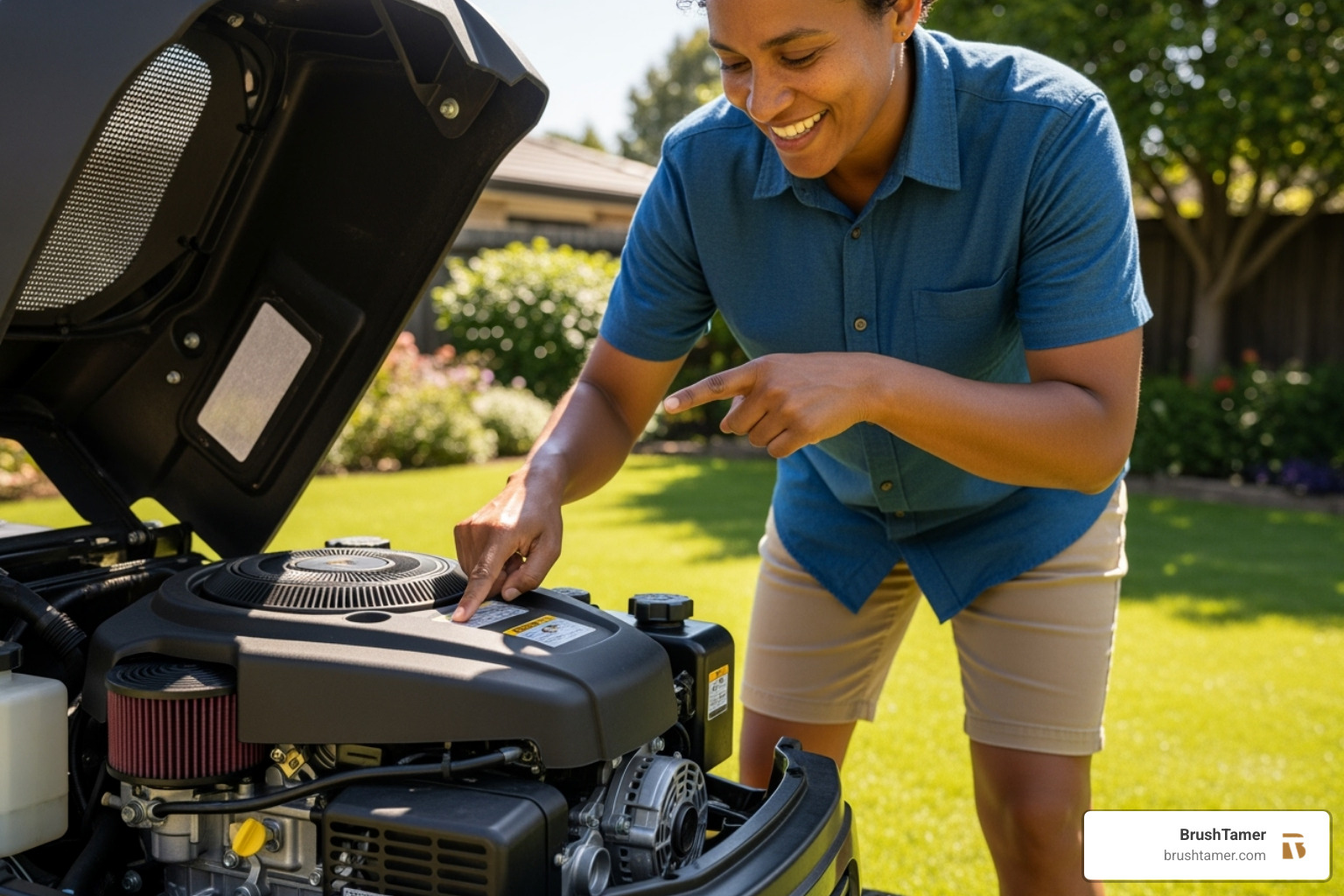
Your lawn tractor’s engine is like the heart of an athlete – it needs to be strong enough to handle whatever you throw at it. Most residential lawn tractors pack between 17 HP to 25.5 HP, and here’s the thing: more horsepower isn’t always better, but it sure helps when you’re dealing with thick grass or steep slopes.
You’ll encounter two main engine types, and each has its own personality. Single-cylinder engines are the reliable workhorses you’ll find in many entry-level models. They’re straightforward, dependable, and perfect for smaller properties. V-twin engines, on the other hand, are the smooth operators – they run quieter, deliver more consistent power, and typically last longer thanks to better cooling and balance.
Most lawn tractors run on gas engines because they’re convenient and cost-effective. You can fill up at any gas station, and maintenance is usually straightforward. Diesel engines are less common in residential models, but they’re absolute powerhouses when it comes to engine torque – that’s the twisting force that keeps your blades spinning through tough conditions without bogging down.
It’s also important to understand the relationship between horsepower (HP) and torque. While horsepower relates to the speed at which the engine can work, torque is the rotational force that does the heavy lifting. Think of it this way: horsepower gets you across a flat, open lawn quickly, but torque is what powers the blades through thick, wet grass or helps you pull a heavy cart up a slope without the engine sputtering. A V-twin engine, with its superior balance and design, often delivers higher, more consistent torque. Many modern engines also feature Overhead Valve (OHV) technology, which improves fuel efficiency, reduces emissions, and provides more power compared to older side-valve designs. This engineering refinement means today’s 20 HP engine is often far more capable than one from a decade ago.
When you’re shopping, look for engines from trusted names like Kohler, Briggs & Stratton, and Kawasaki. These brands have earned their reputation through decades of reliable performance in residential yards just like yours.
Mower Deck Deep Dive
The mower deck is where your lawn tractor earns its keep – it’s the business end that transforms your overgrown yard into a manicured masterpiece. Cutting width ranges from a compact 30 inches all the way up to a generous 60 inches, and this choice dramatically affects your mowing efficiency. A wider deck means fewer passes, which translates to more time relaxing on your perfectly cut lawn instead of still cutting it.
But size isn’t everything – construction quality matters just as much. Stamped decks are formed from a single piece of steel, making them lighter and more budget-friendly. They’re perfectly adequate for typical residential mowing on relatively smooth terrain. Fabricated decks, however, are the heavy-duty champions, welded together from multiple pieces of thicker steel. They can take a beating and keep on cutting, making them ideal if your property has rougher areas or the occasional stick or rock.
Beyond the construction, look for features like anti-scalp wheels. These small wheels are attached to the edges of the deck and prevent it from digging into the ground on uneven terrain, which prevents unsightly scalping or gouging of your lawn. The type of blades you use also plays a crucial role. High-lift blades are designed to create powerful suction, ideal for bagging systems as they lift clippings efficiently into the collection bags. Mulching blades have a more curved design with multiple cutting edges to chop grass into fine particles that decompose quickly. Standard or combination blades offer a balance between the two, suitable for side-discharging.
Modern decks come loaded with thoughtful features that make your life easier. A deck cleanout port lets you hook up a garden hose and blast away grass buildup – no more flipping your tractor over for maintenance. Depending on your lawn’s needs, you can choose between mulching (which chops clippings fine and returns nutrients to your soil), bagging (for that pristine, clipping-free look), or side discharge (the fastest option for large areas).
Transmission and Drivetrain
The transmission is what turns your engine’s power into smooth, controlled movement – and trust me, the right transmission can make mowing feel effortless instead of exhausting. Hydrostatic transmission is the gold standard for modern lawn tractors, operating like an automatic car with infinitely variable speed control. Many models feature Twin Touch pedals – one for forward, one for reverse – making precise maneuvering around flower beds and trees incredibly intuitive.
Automatic transmission gives you preset speed ranges without the complexity of a manual clutch, while gear drive (manual) systems require you to shift gears like an old-school car. Manual transmissions are typically the most economical option, but they can be tiring if you’re constantly changing speeds or navigating obstacles.
Here’s a feature that’ll spoil you: cruise control. Once you’ve experienced maintaining a steady pace across long stretches of lawn without keeping your foot pressed down, you’ll wonder how you ever mowed without it. The ease of use factor can’t be overstated – a smooth, responsive transmission transforms mowing from a chore into something you might actually enjoy.
Matching the Machine to Your Mission: Yard Size, Terrain, and Tasks
A lawn tractor is more than a mower; it’s a versatile workhorse that can transform your property maintenance routine. Finding the right fit for your property’s unique challenges and your year-round needs is like finding the perfect dance partner – everything just flows better when it’s the right match!
How Deck Size Impacts Mowing Time
The cutting deck width of your lawn tractor is probably the single most important factor in determining how much time you’ll spend mowing. It’s simple math: wider decks cover more ground with each pass, which means you’ll finish faster and have more time for the things you actually enjoy.
Here’s how deck size translates to real-world mowing efficiency:
| Deck Size (inches) | Recommended Yard Acreage | Estimated Mowing Time Per Acre (minutes) |
|---|---|---|
| 42 | Up to 1 acre | 45-60 |
| 48 | 1 to 2 acres | 35-50 |
| 54 | 2 to 4 acres | 30-40 |
| 60 | 4 acres or more | 25-35 |
Note: These are estimates. Actual mowing time can vary based on terrain, grass height, obstacles, and operator speed.
A 42-inch deck is perfect for smaller properties with tighter spaces and more obstacles. You’ll appreciate the maneuverability around flower beds and trees. Moving up to a 48-inch deck gives you a nice balance of efficiency and control for medium-sized yards.
For larger properties, a 54-inch deck really starts to shine. You’ll notice the time savings immediately, especially on open areas. And if you’re managing 4 acres or more, a 60-inch deck becomes a game-changer – you’ll cut your mowing time nearly in half compared to smaller decks.
Conquering Your Landscape: Terrain and Obstacles
Every property tells its own story through its landscape, and your lawn tractor needs to be ready for whatever plot twists your yard throws at it. Understanding how different terrains affect your mowing experience helps you choose the right machine for the job.
Flat lawns are the easiest terrain to tackle. Almost any lawn tractor will perform beautifully here, allowing you to focus on creating those satisfying mowing patterns that make your neighbors wonder if you hired a professional crew.
Sloped terrain requires more thoughtful consideration. While lawn tractors generally offer excellent stability compared to other riding mowers, you need to respect the incline limits. Always check your operator’s manual for safe operating angles. Engines with higher horsepower and a lower center of gravity provide better stability when climbing hills or navigating gentle slopes.
Hilly properties and challenging terrain demand even more from your machine. Look for lawn tractors with robust frames, excellent traction, and sufficient horsepower to power up inclines without straining the engine. Some advanced models offer 4-Wheel Drive for superior traction on uneven or slippery ground – it’s like giving your lawn tractor hiking boots for better grip.
Maneuverability becomes crucial when your property is dotted with trees, flower beds, or other obstacles. A tighter turning radius allows you to make sharper turns around obstacles, reducing the amount of trimming you’ll need to do later. 4-Wheel Steer is an incredible feature that dramatically reduces turning radius by allowing the rear wheels to turn with the front wheels. It’s like your lawn tractor suddenly becomes a nimble dancer, gliding effortlessly around obstacles.
The true power of a lawn tractor is open uped through its versatility with attachments, turning it into a year-round workhorse. Beyond mowing, consider the other tasks you perform on your property. A tow-behind utility cart is invaluable for hauling mulch, soil, firewood, or yard debris, saving your back from countless wheelbarrow trips. For lawn health, a plug aerator attachment pulls cores of soil from your lawn to reduce compaction and improve water and nutrient absorption, while a dethatcher removes the layer of dead grass that can choke out new growth. In the fall, a leaf sweeper can make cleanup a breeze. For those with larger properties, a broadcast spreader attachment ensures even application of fertilizer or seed. These attachments leverage the tractor’s engine and sturdy frame, dramatically increasing the return on your investment.
Safety should always be your top priority when operating any power equipment. Lawn tractors are powerful machines that demand respect and proper operation. For comprehensive safety guidelines and best practices, check out the helpful resources at the Outdoor Power Equipment Institute’s Tips to Stay Safe about Mower Safety.
The Buyer’s Journey: Price, Warranty, and Where to Purchase Your Lawn Tractor
Navigating the final steps of your purchase, from budget to long-term protection, ensures you get the best value and support for your new lawn tractor. Think of it as crossing the finish line of a marathon – you’re almost there, but these last steps are crucial for a successful outcome.
Where to Buy and How to Get It Home
Once you’ve found your perfect lawn tractor, the question becomes: where should you buy it? Each option has its own advantages, and the best choice depends on your priorities and comfort level.
Authorized dealers often provide the gold standard experience. These folks eat, sleep, and breathe outdoor power equipment. They can walk you through every feature, help you compare models side-by-side, and answer those specific questions about your property that generic websites can’t address. Plus, they typically offer professional dealer setup and inspection – meaning your lawn tractor arrives ready to work, not just assembled.
The real value of a dealer relationship shines through over time. When you need parts, service, or just have a question about operation, you’re dealing with people who know your specific machine and your property’s needs. It’s like having a local mechanic who actually cares about keeping you moving.
Big box stores bring convenience and competitive pricing to the table. You can check out multiple models in person, often with the ability to grab other yard supplies during the same trip. While the staff might not have the specialized knowledge of a dedicated dealer, many are quite knowledgeable about the basics and can help with general comparisons.
Online purchasing has become increasingly popular, offering the widest selection and often detailed comparison tools. Many manufacturers now provide excellent online resources, including detailed specifications, user manuals, and customer reviews. The key is ensuring you’re buying from reputable sources that offer proper warranty support.
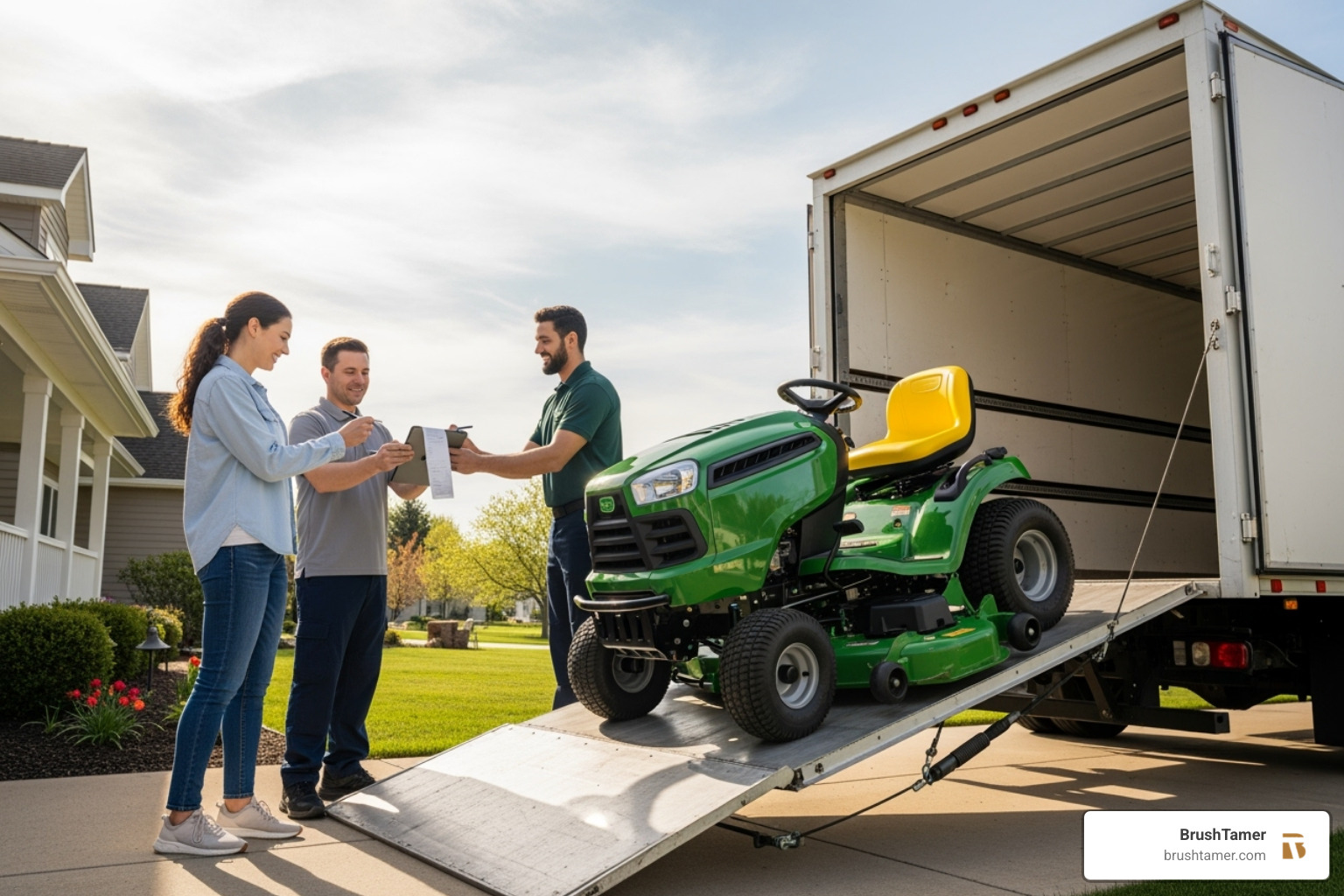
When it comes to getting your new machine home, most retailers offer various delivery options. Many dealers provide free delivery within a reasonable radius, while others offer professional setup services where technicians deliver, inspect, and even provide a brief orientation on your new lawn tractor. This can be incredibly valuable, especially if you’re new to riding mowers or upgrading to a more complex model.
The New vs. Used Dilemma
A significant consideration for many buyers is whether to purchase a new or used lawn tractor. A new machine offers the latest technology, a full manufacturer’s warranty, and the peace of mind that comes with being the first owner. However, a well-maintained used tractor can offer substantial savings. If you’re considering the used market, due diligence is key. Always ask for the tractor’s age and, more importantly, its engine hours—this is the equivalent of mileage on a car. A tractor with under 300 hours is generally considered low-use. Inspect the machine thoroughly: check for rust on the deck, look for oil leaks around the engine, test the steering for excessive play, and examine the condition of the tires, belts, and blades. Ask the owner for maintenance records if available. A test drive is non-negotiable. Listen for any unusual engine noises, test the transmission’s responsiveness, and engage the mower deck to ensure it runs smoothly. While you forgo a warranty, buying a quality used machine from a reputable brand can be a fantastic way to get more power and features for your money.
Warranty Options
A solid warranty is like a safety net for your investment. It protects you against manufacturing defects and gives you confidence that the manufacturer stands behind their product. When evaluating lawn tractor warranties, you’ll typically see coverage ranging from 2 years/120 hours up to 4 years/700 hours for premium models.
Bumper-to-bumper warranties are the most comprehensive, covering virtually everything on your lawn tractor except normal wear items like blades, belts, and tires. These warranties demonstrate the manufacturer’s confidence in their product quality and engineering.
Some warranties offer different coverage periods for major components. For example, the engine or transmission might have longer coverage than other parts, recognizing that these are the most critical and expensive components to replace.
The fine print matters here. Pay attention to what actions might void your warranty – things like improper maintenance, using the wrong oil, or attempting unauthorized modifications. Most warranties require you to follow the maintenance schedule outlined in your owner’s manual, which is good practice anyway.
Warranty service typically goes through authorized dealers, which is another reason to consider where you’re buying. A dealer who can handle both your purchase and any future warranty work creates a smoother ownership experience.
Understanding your warranty coverage helps you make informed decisions about maintenance, repairs, and even which model to choose. It’s not just about what could go wrong – it’s about having confidence that you’re protected if something does.
Conclusion: The Right Tool for a Beautiful Property
Choosing the right lawn tractor comes down to matching its power, deck, and features to your property’s size, terrain, and the jobs you need to do. Throughout this guide, we’ve explored how engine power from 17 to 25.5 HP can handle different property demands, why deck construction matters for durability, and how transmission types affect your mowing experience.
The key is finding that sweet spot where your machine’s capabilities align perfectly with your landscape’s needs. A 42-inch deck might be perfect for your one-acre property, while larger estates benefit from the efficiency of a 60-inch cutting width. Hydrostatic transmission makes maneuvering around obstacles a breeze, and features like 4-Wheel Steer can transform how you steer tight spaces.
With the right lawn tractor, you’re not just buying a machine – you’re investing in time savings and the satisfaction of a beautifully maintained property. There’s something deeply rewarding about completing your weekly mowing routine efficiently, knowing your equipment is perfectly suited to the task.
From our experience in land management, we understand that while a well-chosen lawn tractor is an invaluable asset for maintaining residential lawns, some vegetation challenges go beyond what even the most robust garden tractor can handle. Dense brush, heavily overgrown fields, or large-scale land reclamation projects require specialized equipment and expertise that’s simply outside the scope of residential mowing equipment.
When your property needs go beyond regular lawn maintenance – whether it’s forestry mulching, stump removal, or clearing overgrown areas – that’s where professional services become essential. At BrushTamer, we’re equipped with the specialized knowledge and heavy-duty machinery to tackle these larger challenges with an environmentally responsible approach.
Your lawn tractor will serve you well for years of regular maintenance, but when it’s time to reclaim overgrown land or prepare areas for new landscaping, we’re here to help you take on those bigger projects. Learn more about professional Land Clearing Services.