
Why Property Owners Choose to Remove Their Blueberry Bushes
Blueberry bush removal becomes necessary when these once-productive plants decline, when land needs repurposing, or when disease and overgrowth take over. Whether you’re dealing with aging bushes that no longer produce quality fruit, planning a new development project, or simply reclaiming overgrown property, removing blueberry bushes is more complex than it first appears.
Quick Answer: Key Steps for Blueberry Bush Removal
- Assess the situation – Evaluate plant age, density, root system, and future land use
- Choose the right timing – Late fall through early spring (dormant season) is best
- Select removal method – Mechanical grinding, root crown destruction, or chemical treatment
- Address the root system – Shallow fibrous roots and crowns must be completely removed to prevent regrowth
- Prepare the soil – Reintegrate organic matter, test pH, and grade for future use
- Hire professionals – Specialized equipment and expertise ensure complete removal and proper site preparation
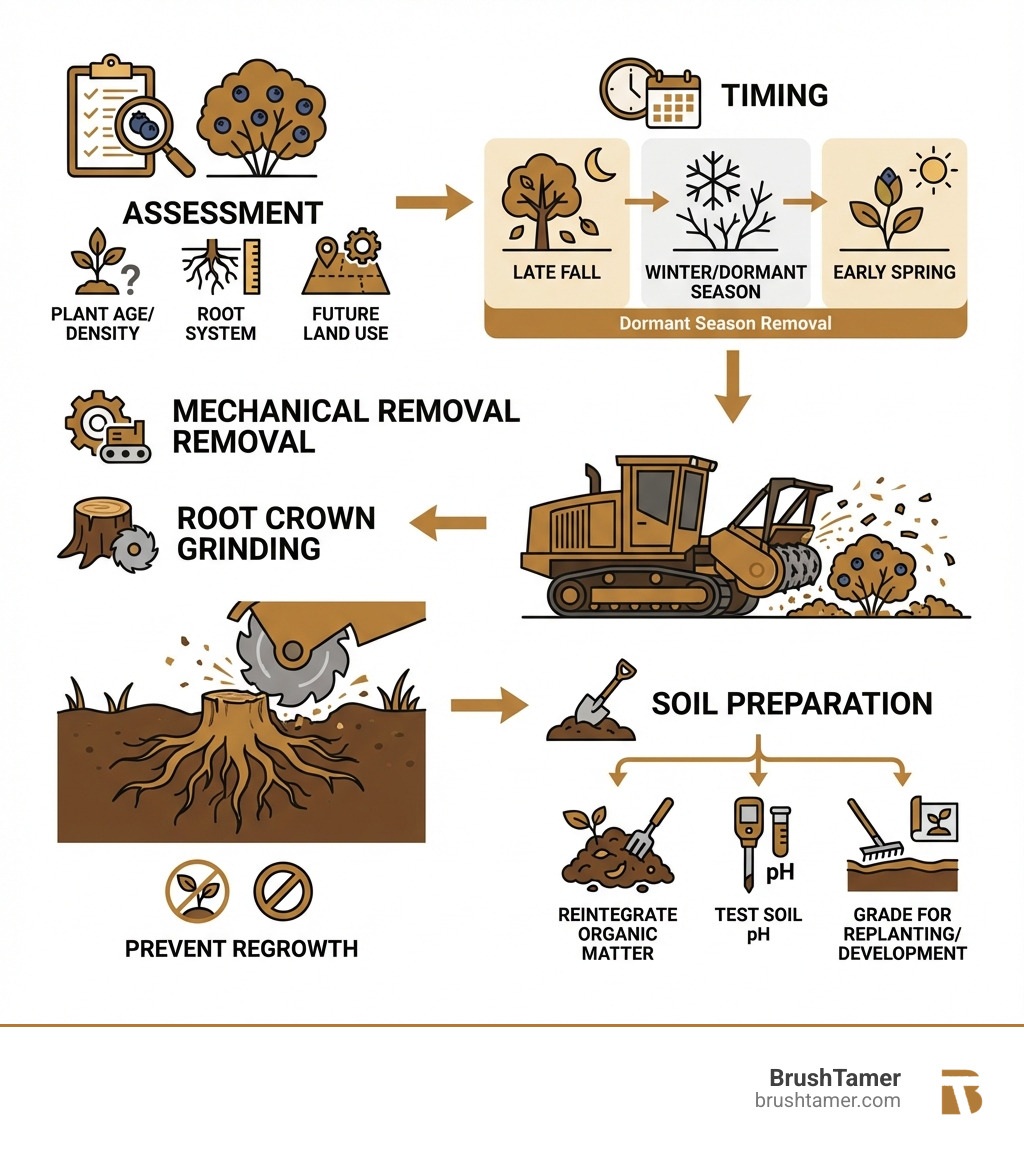
With blueberry bush removal, the challenges are real, especially once bushes are mature and densely planted. Mature blueberry bushes develop extensive root systems, and commercial plantings can have over 1,000 plants per acre planted in tight rows. The shallow but fibrous root crowns must be thoroughly destroyed to prevent regrowth. Traditional methods like hand-pulling or burning are inefficient and impractical at this scale.
I’m Leon Miller, owner of BrushTamer, and I’ve specialized in blueberry bush removal across Northern Indiana and Lower Michigan for years, using forestry mulching and specialized equipment to efficiently clear both small patches and large commercial orchards. Our reintegration process grinds bushes and roots into small pieces that enrich the soil rather than creating disposal problems.
Common Reasons for Blueberry Bush Removal
Even the most beloved blueberry bushes eventually reach a point where removal becomes the most practical and beneficial solution for your property. We understand that saying goodbye to a once-productive patch can be bittersweet, but the reasons for blueberry bush removal often stem from a desire to improve land usability, improve productivity, or prepare for new endeavors.
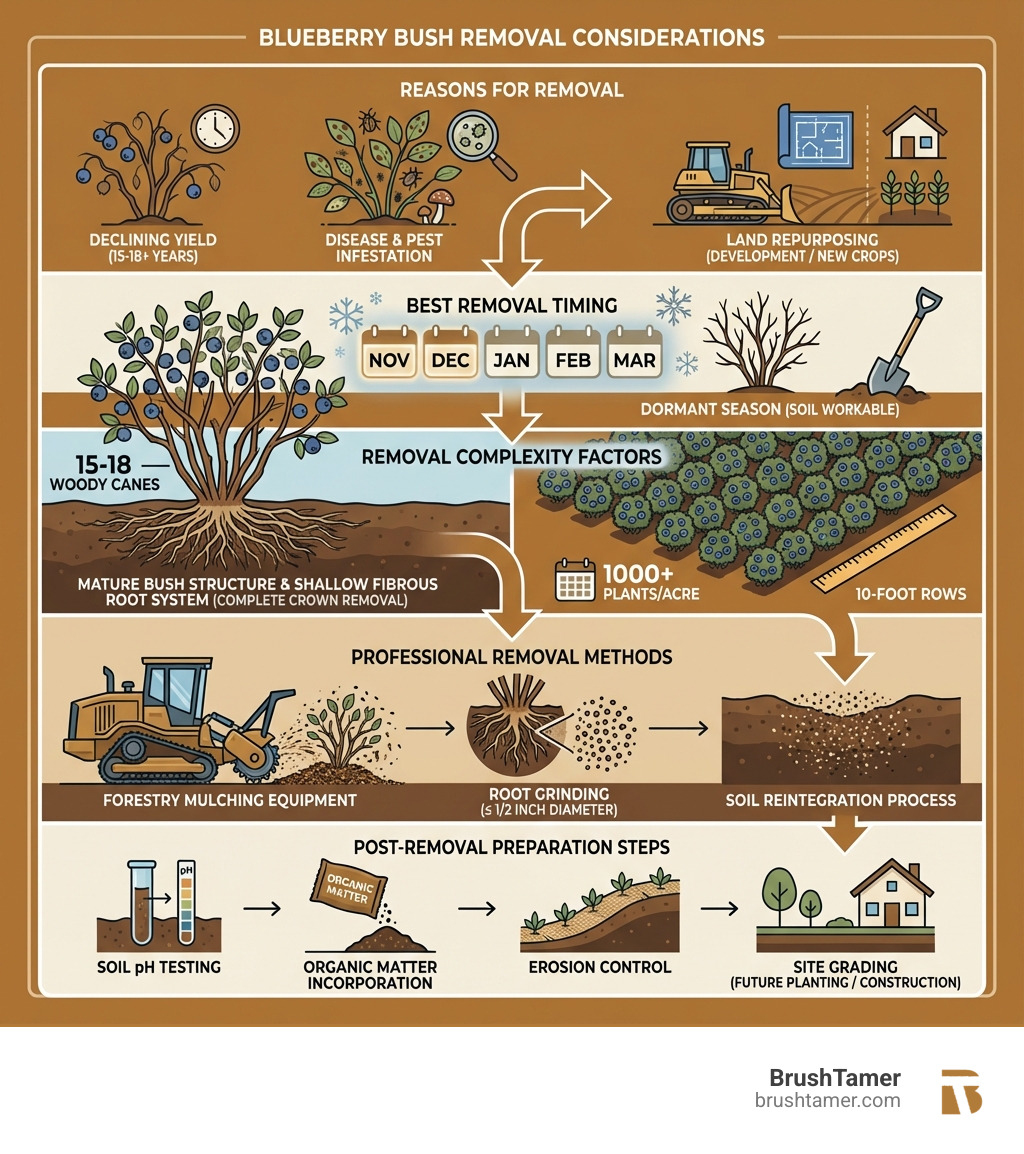
One of the primary drivers for removal is declining yield and overall plant health. While young blueberry bushes, typically within their first 2-4 years, are known for producing the biggest and tastiest berries, older canes (those seven years or more) become progressively less productive. A mature blueberry plant, which can have 15-18 canes originating from its crown after just three years, requires constant renewal through pruning to maintain fruit quality and quantity. However, even with diligent pruning, plants eventually become over-mature, leading to significantly reduced harvests of smaller, less flavorful fruit. When your bushes are no longer providing the abundant bounty they once did, it might be time to consider removal.
Furthermore, blueberry bush removal is often the cleanest solution when overgrowth turns a once-neat patch into an unruly thicket. These bushes, with their dense, woody canes, can become difficult to maintain, prune, and harvest effectively. Overgrown patches can also start to encroach on other desirable plants or structures on your property, creating an aesthetic and practical challenge.
Land development is another common driver of blueberry bush removal, especially when access, utilities, or grading are planned. Perhaps you’re planning to expand a structure, install new infrastructure, or simply reconfigure your landscape in areas like South Bend, Elkhart, or Goshen. Clearing existing vegetation, including blueberry bushes, is a necessary first step to prepare the site for its new purpose.
Sometimes, property owners decide to switch crop types or repurpose their agricultural land. If you’re transitioning from blueberry cultivation to another type of farming or even converting an old orchard into a new commercial space, complete and efficient removal of the existing bushes is crucial. Our team specializes in repurposing blueberry fields, ensuring a clean slate for your next venture.
Finally, disease infestation and pest problems can necessitate the removal of entire blueberry patches. While we always advocate for prevention and treatment where possible, some diseases or pest outbreaks can be so severe or widespread that removing the affected plants is the only way to safeguard the health of your soil and prevent further spread to other crops or nearby properties. Early intervention, even if it means removal, is often the most responsible course of action for long-term land health.
When is the Best Time of Year for Removal?
Timing is a critical factor in successful blueberry bush removal. While the actual act of clearing can be done year-round with professional equipment, we typically recommend performing large-scale blueberry bush removal during the dormant season. This period, generally spanning from late fall through winter and into early spring, offers several advantages.
During dormancy, growth slows, and leaf-off conditions improve visibility, which helps crews complete blueberry bush removal cleanly and thoroughly. This can make the work cleaner and limit the plant’s ability to rebound from missed fragments, though complete root-crown destruction remains the goal.
More importantly, working during the dormant season minimizes disruption to the surrounding environment and soil. The ground is often firmer, especially in frozen conditions common in Northern Indiana and Lower Michigan during winter, reducing the likelihood of significant soil compaction or deep ruts from heavy machinery. This also means we’re avoiding the peak growing season for other plants, further minimizing any unintended impact on your landscape.
Performing blueberry bush removal in late fall or early winter allows ample time for the soil to settle and for any necessary post-removal amendments to be made, thoroughly preparing the site for spring planting or construction projects. This foresight ensures that once the bushes are gone, your land is immediately ready for its next chapter, whether that’s a new crop, a building project in Valparaiso, or a restored natural area in Kalamazoo.
The Complexities of Blueberry Bush Removal
Beneath the seemingly simple facade of a blueberry bush lies a surprisingly complex structure, especially when dealing with mature plants or extensive commercial plantings. Understanding these complexities is key to effective and lasting blueberry bush removal. It’s not just about cutting down what’s visible; it’s about tackling the hidden challenges in the root system and the sheer density of the plants.
Tackling Mature and Overgrown Bushes
Mature blueberry bushes are far from delicate. They develop woody canes that can be challenging to manage, often becoming dense and tangled. After several years, a single bush can boast 15-18 substantial canes originating from its crown. This density, combined with their height, can create an impenetrable thicket, making manual removal arduous and ineffective.
The real challenge, however, lies beneath the surface with their extensive root crowns. These are the central points from which all the canes and roots emerge. If the root crown isn’t completely destroyed, the bush has a high potential to regrow, turning your removal efforts into a recurring battle. This is particularly true when blueberry bush removal is needed for patches neglected for years.
Beyond the physical difficulty, overgrown bushes can also lead to environmental concerns, such as shading out native plants and altering local ecosystems. Our approach to Professional Land Management ensures that while we clear your land, we also consider the ecological balance, especially when dealing with large-scale projects in areas like South Bend or Granger.
Understanding the Blueberry Root System
Blueberry bushes are unique in their root structure, and this plays a significant role in why blueberry bush removal requires specialized techniques. Unlike many plants with deep taproots, blueberries possess a shallow, fibrous root system. This means their roots spread out horizontally, often quite close to the soil surface, rather than diving deep. While this shallow nature can seem like an advantage for removal, it presents its own set of challenges.
The extensive network of fine, thread-like roots means that simply pulling the bush out can leave numerous fragments behind. More importantly, the root crown must be fully destroyed to prevent regrowth after blueberry bush removal. In practice, the root crown must be thoroughly fragmented and the root mass ground down so no viable crown material remains. Any remaining pieces of the root crown or substantial root fragments can lead to vigorous regrowth, undoing all the hard work.
This necessity for thorough root crown removal underscores why traditional methods often fail to provide a lasting solution. It’s a precise process that requires specialized equipment to ensure complete eradication and prevent future issues. The delicate balance of minimizing soil disturbance while ensuring complete root removal is a hallmark of our professional approach. For more general information on blueberry care, including their root systems, you can refer to resources like Arbor Day Foundation’s blueberry care instructions.
The Challenge of High-Density Plantings
In commercial settings, blueberry bush removal is complicated by tight spacing and high planting density.
Imagine attempting to manually remove over a thousand mature, woody bushes with complex root systems from a single acre. The sheer volume makes manual methods inefficient and economically unfeasible. Each pass of heavy equipment adds complexity, so the work must be planned and sequenced to avoid missed crowns and unnecessary disturbance.
This high-density environment demands large-scale solutions and specialized equipment designed to handle the volume and the intricate root structure efficiently. Our expertise in Commercial Vegetation Control is precisely custom for these scenarios, ensuring that even the largest blueberry orchards in areas like Knox, Plymouth, or Paw Paw can be cleared quickly and effectively, preparing the land for its next use without delay.
Professional Blueberry Bush Removal Techniques
When it comes to effective blueberry bush removal, relying on professional techniques is not just a convenience; it’s a necessity for thoroughness, efficiency, and long-term success. We employ a combination of advanced mechanical methods and, where appropriate, targeted chemical treatments, all designed to ensure complete eradication and prepare your land for its next chapter.
Mechanical Removal: The Gold Standard
For most blueberry bush removal projects, especially large-scale ones, mechanical removal stands as the gold standard. Our primary tool for this is forestry mulching. This powerful process involves using specialized machinery to grind and shred blueberry bushes and their extensive root systems directly into the soil.
Forestry mulching offers multiple benefits:
- Complete Root Crown Destruction: The equipment is designed to pulverize the tough root crowns, eliminating the source of potential regrowth.
- Efficiency and Speed: What would take weeks or months with manual labor can be completed in days, even for large orchards in areas like Warsaw, Fort Wayne, or Kalamazoo.
- Soil Enrichment: As the bushes are ground down, they are incorporated back into the soil as organic matter. This natural mulch enriches the soil, improving its structure and fertility for future plantings. This process is far superior to simply removing and disposing of the material, which can be costly and labor-intensive.
- Minimized Soil Disturbance: Unlike traditional excavation that can leave large trenches and compact soil, forestry mulching processes the material in place, reducing overall soil disruption.
Our Forestry Mulching Services are custom to handle the unique challenges of blueberry bushes, ensuring a clean and productive outcome for your land.
The Reintegration Process for Complete Blueberry Bush Removal
At BrushTamer, we’ve refined a unique “reintegration process” that goes beyond simple clearing. This approach is specifically designed for complete blueberry bush removal, ensuring that the land is not only clear but also optimally prepared for future use. Our goal is to “put them back in the ground” in a beneficial way.
This process involves a variable sequence of specialized equipment, including flails, mulchers, and rotovators. Each piece of machinery plays a crucial role in breaking down the blueberry bushes:
- The bush portion of the plants is shattered into pieces less than 4 inches long.
- The stubborn root crowns are busted into pieces the size of a golf ball or smaller.
- The fibrous roots are carefully ground down to a 1/2-inch diameter or less.
This meticulous breakdown ensures that no viable plant material remains to regrow, making it an incredibly effective method for preventing regrowth from roots. The resulting finely processed organic matter is then reintegrated directly into the soil, creating a nutrient-rich base that is immediately ready for replanting or other agricultural practices. This means a smoother, more fertile foundation for whatever comes next for your land in regions like Sturgis, Coldwater, or Auburn. Our Blueberry Orchard Removal Services exemplify this advanced approach.
Chemical Treatments: A Job for Licensed Professionals
While our primary method for blueberry bush removal is mechanical, there are specific situations where targeted chemical treatments, particularly herbicides, may be considered. However, it is crucial to emphasize that this is a task for licensed professionals only, due to the need for precise application, adherence to safety precautions, and understanding of environmental regulations.
Timing varies by site and goal, which is why chemical options, when used, should be handled only by licensed professionals following label requirements. These are often more effective than general-purpose herbicides like glyphosate on tough, woody vegetation.
When using chemical treatments, we prioritize methods that minimize environmental impact and protect non-target plants. One common professional technique is stump treatment rather than broad foliar spraying. This involves applying a concentrated herbicide directly to freshly cut stumps. This method ensures the chemical is absorbed by the target plant’s root system with minimal to no impact on surrounding desirable vegetation, provided extreme care is taken not to spill the herbicide on the soil. As highlighted by extension experts, applying herbicide to freshly cut stumps is designed to be absorbed by the targeted plant and have minimal impact on nearby plants.
Safety precautions are paramount. Our licensed applicators are thoroughly trained to read and follow all herbicide labels, ensuring proper application rates, protective gear, and environmental safeguards. We understand the local regulations in areas like Berrien Springs, Benton Harbor, and La Porte, ensuring that any chemical application is done responsibly and effectively. For more expert insights on woody shrub control, you can refer to resources like Ask Extension.
Preparing Your Land for What’s Next
Once the blueberry bushes are successfully removed, the work isn’t quite finished. The next crucial step is to prepare your land for its intended future, whether that’s replanting, construction, or natural restoration. Our comprehensive approach ensures that your property is left in optimal condition, ready for its next purpose.
Post-Removal Soil Management
Effective blueberry bush removal sets the stage for healthy soil, but careful post-removal soil management is essential to maximize your land’s potential. Our reintegration process already returns valuable organic matter to the soil, but further steps may be needed depending on your future plans.
Blueberry bushes thrive in highly acidic soil, typically with a pH between 4.0 and 5.2. If your goal is to replant blueberries, maintaining this acidity will be important. However, if you plan to grow different crops or use the land for construction, testing soil pH will be a critical first step. Based on these results, we can advise on amending acidic soil to suit your new planting goals or to neutralize it for construction purposes.
Incorporating organic material is a natural benefit of our forestry mulching process, as the shredded blueberry bushes enrich the soil. This improves soil structure, water retention, and nutrient availability. For land intended for construction or specific landscaping, leveling and grading the site might be necessary. Our team offers comprehensive Clearing and Grading Services in areas like South Bend, New Carlisle, and Portage, ensuring your land is perfectly prepared for new crops, building foundations, or any other vision you have for your property.
Environmental Considerations and Restoration
At BrushTamer, our commitment extends beyond simply clearing land; we prioritize an environmentally responsible approach to blueberry bush removal. This means carefully considering the ecological impact of our work and striving for sustainable outcomes.
One of our key considerations is minimizing soil disturbance. Our mechanical methods, particularly forestry mulching, process material in place, which significantly reduces the need for extensive digging or hauling. This approach helps to maintain the existing soil structure and prevents the exposure of dormant weed seeds.
Furthermore, preventing erosion is paramount, especially on sloped terrain or large cleared areas. By reintegrating organic matter into the soil, we help stabilize it and improve its ability to absorb water, naturally reducing runoff. For more challenging sites, we can implement specific Erosion Control Services to protect your valuable topsoil and waterways.
Our approach also considers protecting native species where present. By focusing on the target blueberry bushes and minimizing collateral damage, we help preserve the local biodiversity. We believe in Environmentally Friendly Land Clearing practices that leave your land healthier and ready to thrive, whether you’re in Union Pier, Bridgman, or Merrillville.
Frequently Asked Questions about Blueberry Bush Removal
We understand that you might have many questions about the process of blueberry bush removal. Here are some common inquiries we receive, along with our expert answers.
How long does it take to remove a blueberry orchard?
The timeline for blueberry bush removal can vary significantly depending on the scale of the project and the specific site conditions. A small patch of a few bushes will naturally take less time than a commercial blueberry orchard removal spanning multiple acres.
However, with our specialized equipment and efficient processes, we can achieve remarkably fast turnarounds. In some cases, we’ve seen scenarios where blueberry removal and subsequent replanting can be completed within just a few days. This includes clearing the bushes, removing infrastructure, and preparing the soil for new plantings. For example, a client might be picking blueberries on day one, we remove the existing infrastructure on day two, reintegrate the blueberry material on day three, and then new infrastructure and planting can begin on day four. This rapid turnaround is a testament to the effectiveness of professional services and the right equipment.
Can blueberry bushes grow back after being cut down?
Yes, unfortunately, blueberry bushes can grow back if the removal isn’t thorough. Like many woody plants, blueberries have a robust root system and, crucially, a root crown from which new shoots can emerge. If this root crown is merely cut down or if significant portions of the root system are left intact, the bush will likely attempt to regrow, turning your removal efforts into a recurring problem.
This is precisely why our professional methods focus on complete root removal and destruction of the root crown. Our reintegration process is specifically designed to bust root crowns into golf ball-sized pieces or smaller and grind down roots to a 1/2-inch diameter or less, effectively eliminating the potential for regrowth. This thorough approach prevents the need for repeated interventions and ensures your land remains clear.
What happens to the cleared blueberry bushes?
Unlike traditional methods that might involve hauling away or burning cleared vegetation, our approach to blueberry bush removal is designed to be highly efficient and environmentally beneficial. Through forestry mulching, the cleared blueberry bushes are not simply removed; they are processed and reintegrated into the soil.
The machinery grinds the bushes, including their woody canes and root systems, into small, manageable pieces. This organic material is then returned to the earth, where it naturally decomposes. This process offers several advantages:
- Mulch Benefits Soil Health: The shredded material acts as a natural mulch, enriching the soil with organic matter, improving its structure, and increasing its fertility.
- Reduces Waste and Hauling: By processing material on-site, we eliminate the need for costly and carbon-intensive hauling to off-site disposal facilities.
- Eliminates Need for Burning: This method removes the environmental impact and potential hazards associated with open burning, which may also be restricted by local ordinances in areas like Goshen, Elkhart, or Lafayette.
This sustainable approach ensures that the “waste” from your blueberry bush removal becomes a valuable resource for your land’s future. You can learn more about how we manage heavy brush through methods like this in our Heavy Brush Removal Ultimate Guide.
Reclaim Your Land with Professional Removal Services
Navigating the intricacies of blueberry bush removal requires more than just a strong back and a chainsaw. It demands a deep understanding of plant biology, specialized heavy equipment, and a commitment to sustainable land management practices. The complexity of blueberry bush removal, from tackling dense, woody canes to eradicating stubborn root crowns, underscores the critical need for professional expertise.
We’ve seen how the shallow yet fibrous root systems of blueberry bushes, combined with the high density of commercial plantings, can overwhelm even the most determined property owner. Without the right tools and techniques, incomplete removal can lead to frustrating regrowth and ongoing maintenance headaches.
That’s where BrushTamer comes in. We bring the necessary specialized equipment and extensive experience to every project, ensuring complete root system eradication and leaving your land clean and prepared. Our unique reintegration process not only clears your property but also enriches your soil, setting the stage for whatever you envision next.
Whether you’re managing a small plot in Granger, a sprawling orchard in Buchanan, or a commercial development in Indianapolis, our team is equipped to handle blueberry bush removal projects of all sizes across Lower Michigan and Northern Indiana. With BrushTamer, you’re not just hiring a service; you’re partnering with experts committed to delivering reliable, high-quality, and environmentally responsible results.
Ready to reclaim your ground with professional blueberry bush removal? Let’s plan the safest, cleanest path forward for your property. Contact us today!