
Why Japanese Knotweed is One of the Most Challenging Invasive Species to Control
Japanese knotweed treatment requires a strategic, long-term approach due to this plant’s incredible resilience and aggressive growth habits. Here are the most effective treatment methods:
Primary Treatment Methods:
- Chemical Control: Glyphosate-based herbicides applied via foliar spray or stem injection
- Physical Control: Smothering with heavy-duty membranes or complete excavation
- Combination Approach: Cutting followed by chemical treatment after 8-week regrowth period
Key Success Factors:
- Treat during late summer/early autumn when plant moves nutrients to roots
- Multiple treatments over 3-5 years minimum for complete eradication
- Proper disposal through licensed waste carriers only
- Professional application for insurance-backed guarantees
Japanese knotweed stands among the world’s most destructive invasive species, and for good reason. This bamboo-like plant can grow up to 10cm per day and send its roots as deep as 3 meters underground. What makes it truly formidable is its ability to regrow from just 0.2 grams of root material – roughly the size of a thumbnail.
The plant’s hollow, jointed stems and distinctive spade-shaped leaves might look harmless, but its extensive rhizome system can spread up to 7 meters horizontally. These underground networks don’t just compete with native plants – they can crack foundations, damage pavement, and even push through existing weaknesses in concrete structures.
Property owners often find Japanese knotweed too late, after it has already established dense colonies that crowd out native vegetation and threaten structures. The World Conservation Union lists it as one of the world’s worst invasive species, and in some regions, mortgage lenders won’t approve loans for properties with untreated infestations.
I’m Leon Miller, owner of BrushTamer, and I’ve spent years helping property owners tackle challenging invasive species including Japanese knotweed treatment through strategic land management approaches. My experience has shown that successful eradication requires understanding both the plant’s biology and the most effective intervention methods.
Introduction: What is Japanese Knotweed and Why is it a Problem?
Japanese knotweed (Fallopia japonica) was introduced to North America in the late 1800s as an ornamental plant and for erosion control. What seemed like a good idea at the time has become one of our most persistent ecological nightmares. This herbaceous perennial from East Asia thrives in a wide range of conditions – from compacted, nutrient-poor soils to fertile riverbanks.
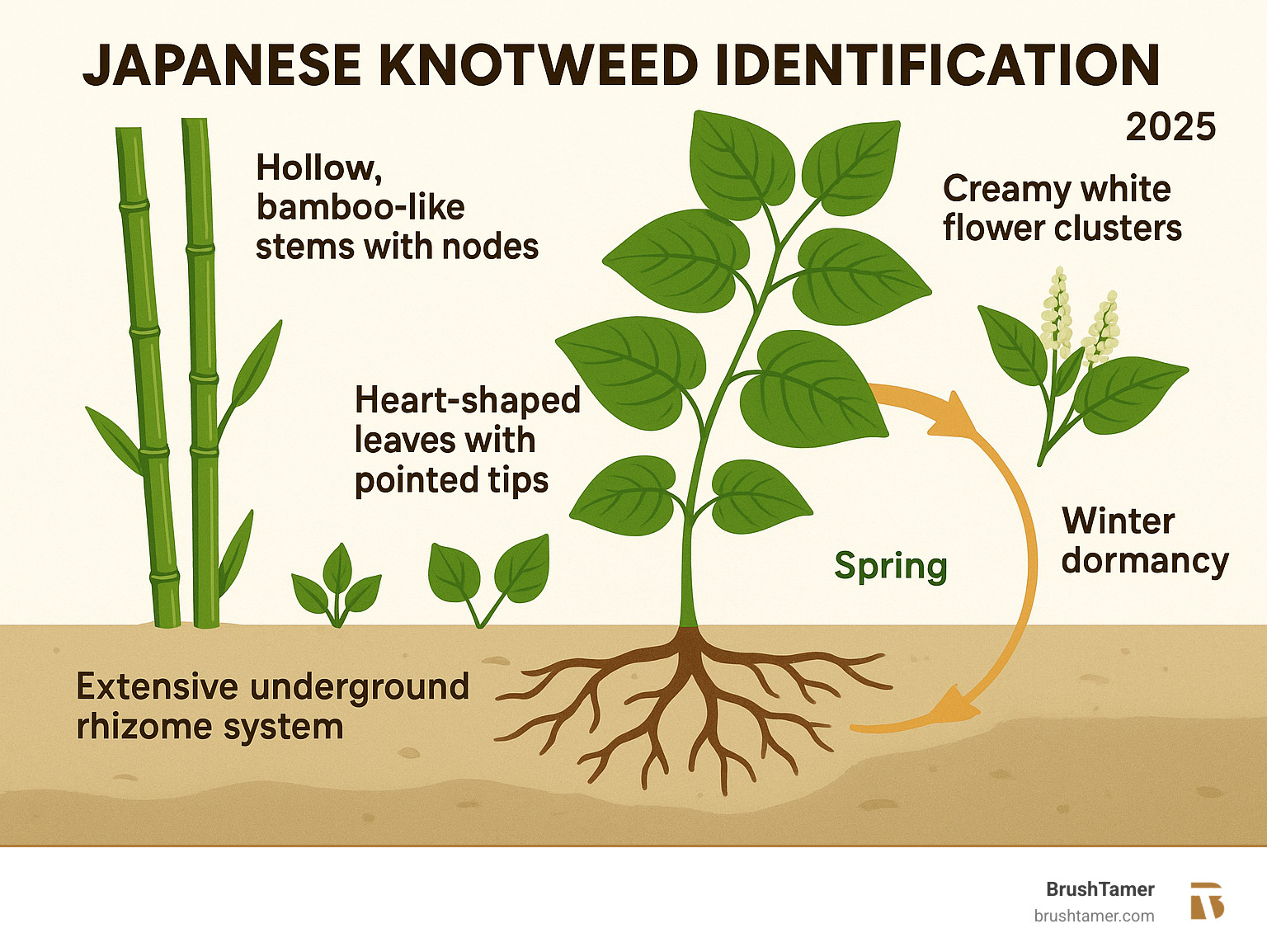
The plant’s identification features are distinctive once you know what to look for. In spring, bright red or purple shoots emerge from the ground, resembling asparagus spears. These quickly develop into hollow, bamboo-like stems with prominent nodes that can reach heights of 6-12 feet. The leaves are broad and spade-shaped, typically 3-6 inches long with a distinctive pointed tip and flat base. During late summer, clusters of small creamy-white flowers appear, creating an almost attractive display that belies the plant’s destructive nature.
But it’s what happens underground that makes Japanese knotweed truly problematic. The rhizome system – the plant’s underground stem network – can extend up to 7 meters horizontally and burrow down 3 meters deep. These rhizomes are incredibly durable and can remain dormant in soil for up to 20 years. Even a fragment as small as 0.2 grams can give rise to a new plant in just 10 days under the right conditions.
The economic impact is staggering. In the UK, Japanese knotweed routinely cracks pavement and damages building foundations. Some mortgage companies refuse to lend on properties affected by the plant, and house values can drop by up to 50% when surveys identify infestations. The plant forms dense thickets that exclude native vegetation, leading to decreased biodiversity and increased soil erosion along waterways.
Here in the Midwest, we’re seeing similar patterns emerge. The plant colonizes along streams and spreads during routine roadside maintenance when equipment moves contaminated soil. Once established, it can quickly dominate an area, creating monocultures that provide poor habitat for native wildlife and fail to stabilize soil as effectively as native plants.
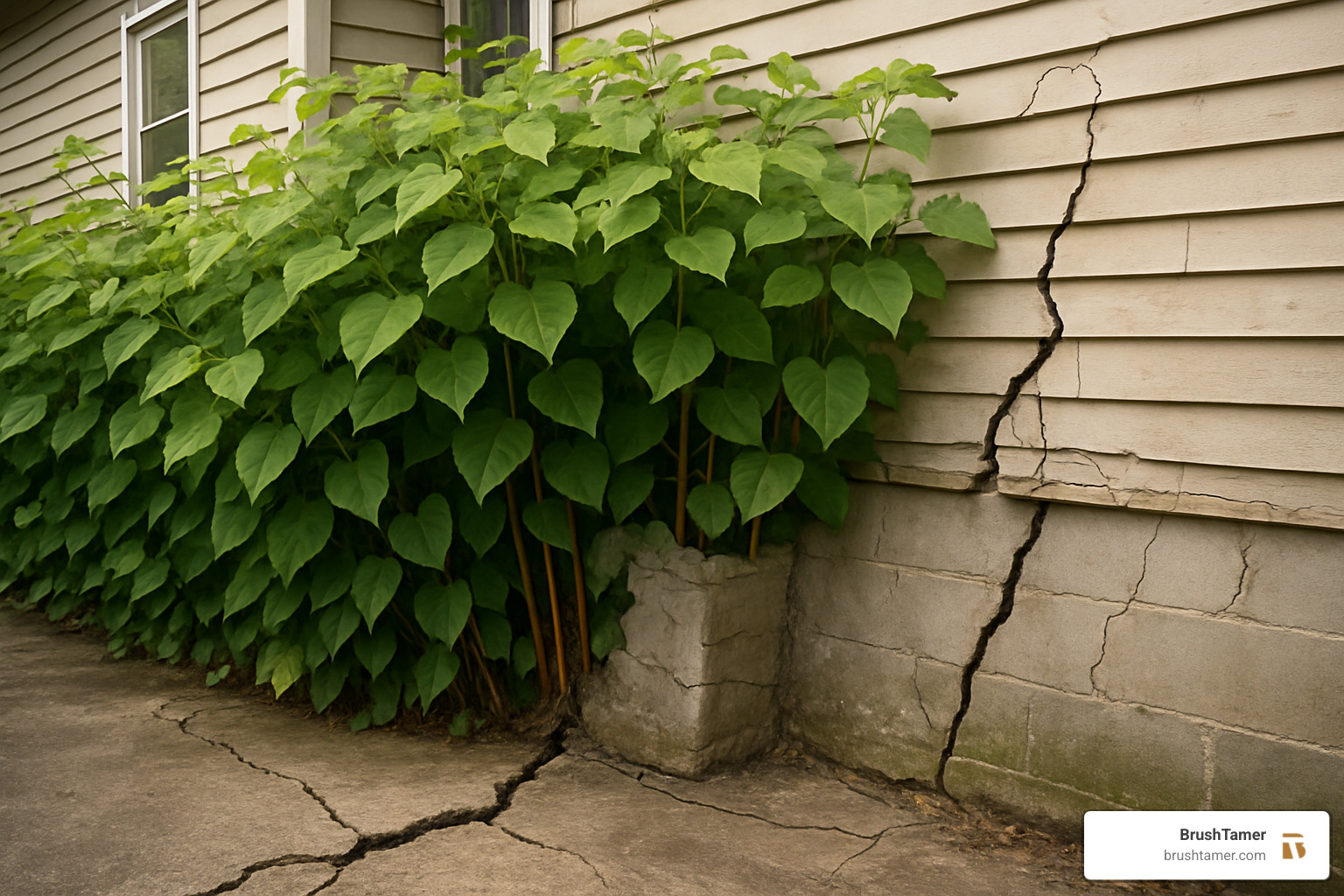
For property owners, the implications go beyond ecological concerns. Japanese knotweed can cause serious structural damage by exploiting existing cracks in foundations, driveways, and retaining walls. As the rhizomes expand, they gradually widen these cracks, potentially compromising the integrity of buildings and hardscaping.
A Step-by-Step Guide to Japanese Knotweed Treatment
Fighting Japanese knotweed is never a one-and-done job. Because the plant stores huge reserves of energy in its rhizomes, every control tactic must chip away at those reserves over several seasons. Below is a streamlined plan that hits the critical points without the fluff.
Chemical Control Methods: Herbicides and Application
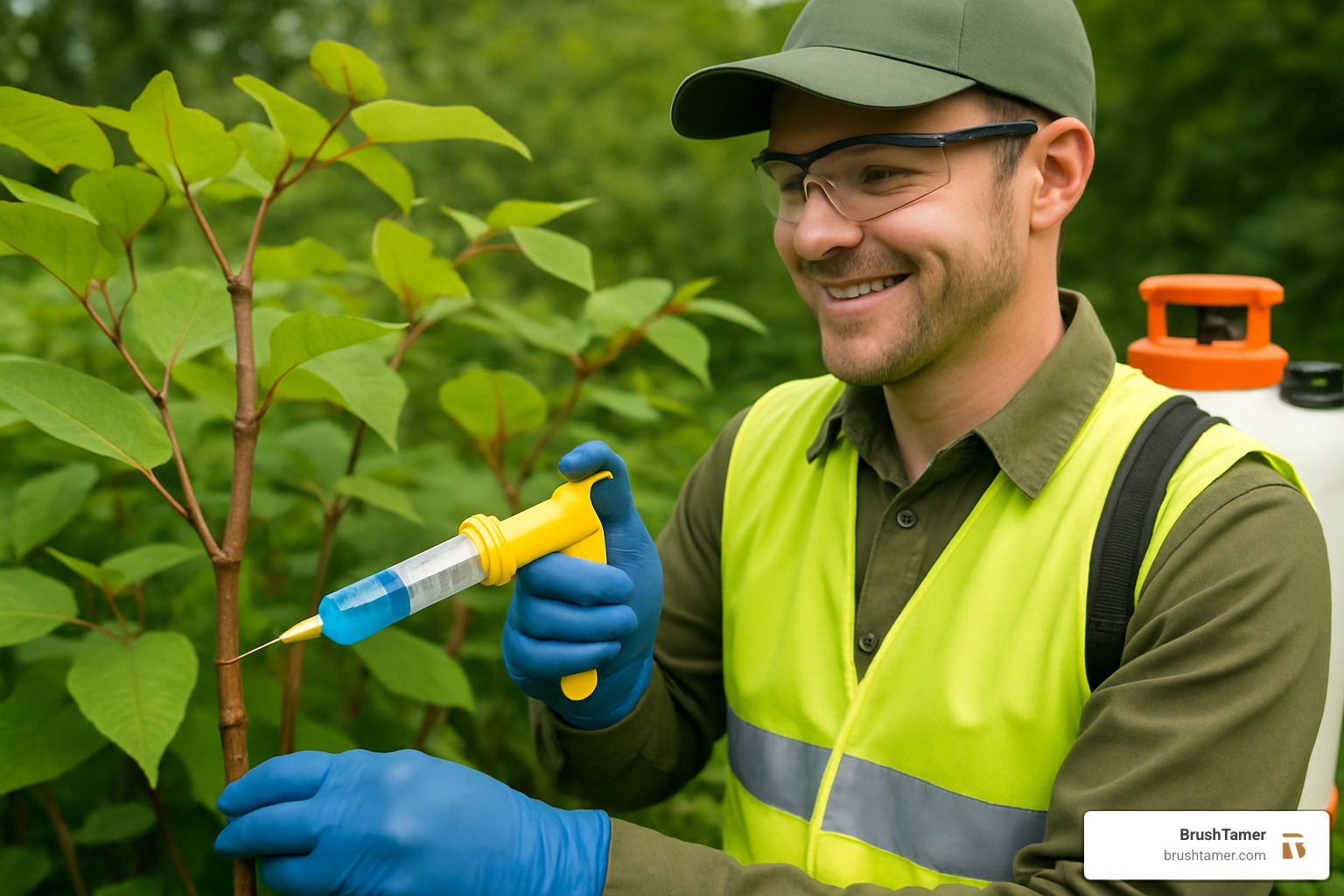
- Glyphosate (5 % solution) remains the industry standard because it moves from leaves to roots, starving the rhizome.
- Stem-injection delivers concentrate directly into hollow stems—ideal when you must protect desirable plants nearby.
- Triclopyr is a good alternative on turf because it spares most grasses.
Best practices: treat after flowering (late Aug.–Sept.), add a surfactant for uptake, avoid windy or wet weather, and wear full PPE. Always follow your local COSHH guidelines and keep written application records.
Physical and Mechanical Control Methods
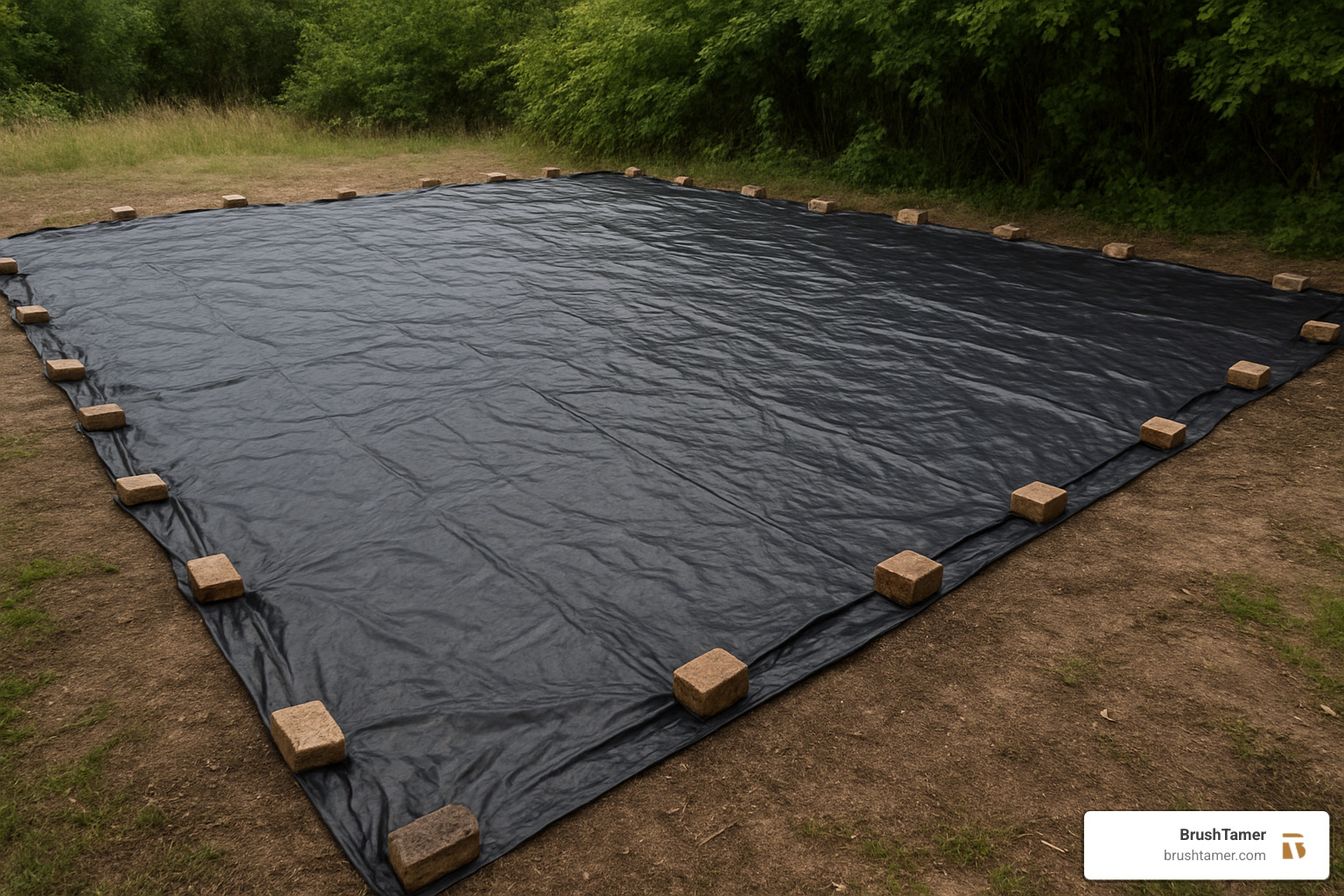
- Smothering: Cover the stand with 7 mil plastic or geotextile for 5 years; extend the sheet at least 5 ft past the visible edge and patch any tears promptly.
- Excavation: Remove all rhizome-bearing soil to 3 m deep. This is fast but generates controlled waste that must be hauled by licensed carriers.
- MeshTech: Lay ½-inch wire mesh over cut stems; expanding regrowth girdles itself and weakens the root system over several seasons.
Essential gear: heavy-duty plastic, shovels or an excavator, wire mesh, and the Land Clearing Services that can supply them.
When to Treat: The Importance of Seasonal Timing
Late summer/early fall is the “sweet spot” because the plant naturally shuttles carbohydrates (and therefore herbicide) down to the rhizomes. Spring treatments are mostly cosmetic; if you cut stems for access, wait eight weeks so there is enough regrowth to absorb herbicide.
Proper Disposal: Preventing Re-infestation

Japanese knotweed is classified as controlled waste. Never compost or chip it. Bag material on site, de-soil tools and machinery, and use a registered hauler to an approved landfill or incinerator. More details are in the Environment Agency guide: https://www.gov.uk/guidance/prevent-japanese-knotweed-from-spreading.
A good rule of thumb: if a fragment can hitchhike, it can re-grow—so keep every scrap contained.
DIY vs. Professional Removal: Making the Right Choice
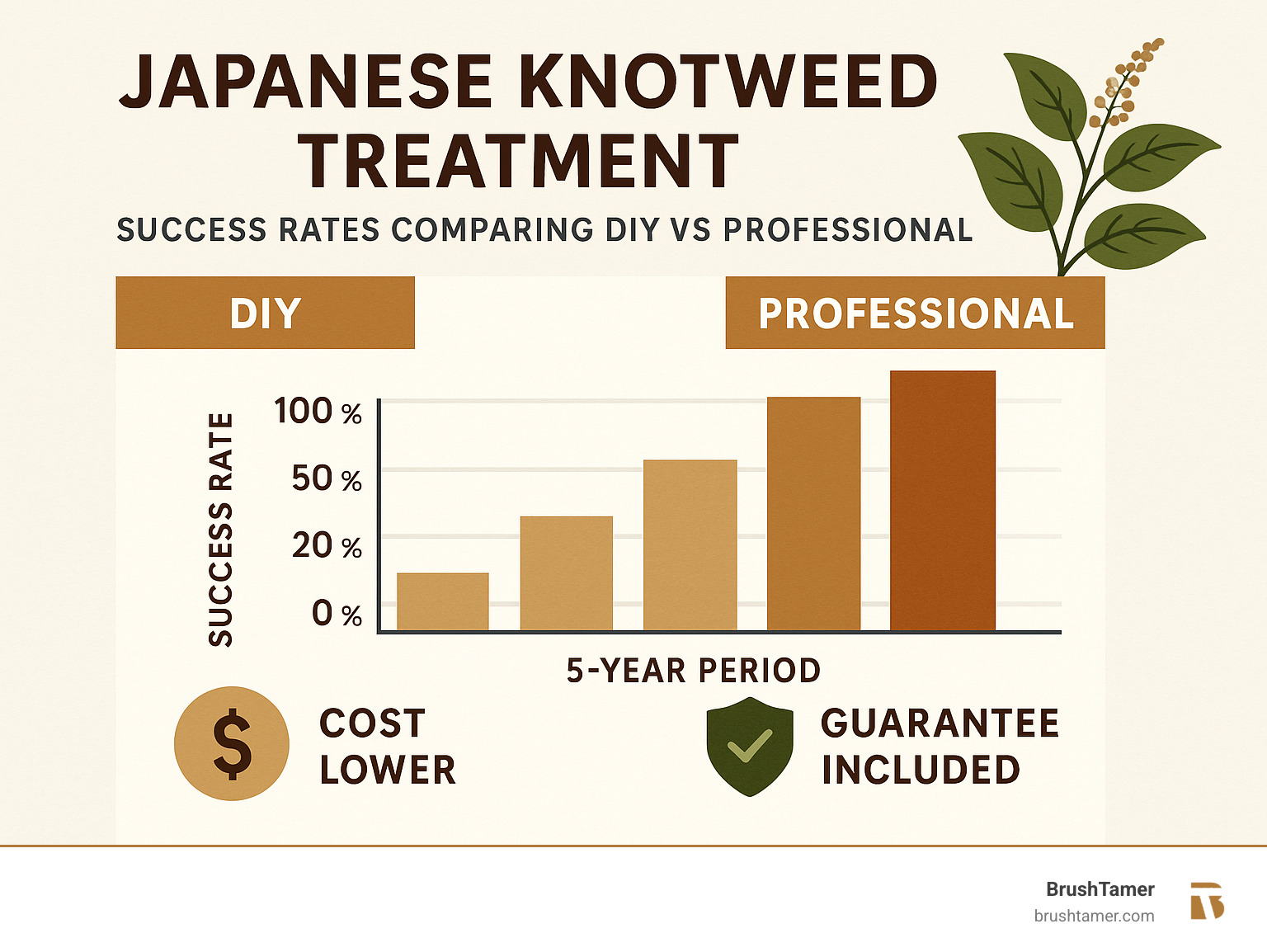
Tackling knotweed on your own can look tempting, but the underground reality is a 7 m-wide, 3 m-deep root network that easily outlasts most weekend projects.
The Limits of DIY
Home-use herbicides are weaker than commercial products, and a single mistimed spray often drives the plant into dormancy rather than killing it. If fragments spread during cutting or disposal, you can create new colonies and legal liability in one afternoon.
Why Pros Come Out Ahead
- Access to stronger, targeted herbicides and specialized equipment.
- Treatments timed to the plant’s growth cycle for maximum impact.
- Insurance-backed guarantees—important for lenders, buyers, and peace of mind.
- Documented disposal that protects you from “spreading” claims.
Up-front costs are higher, but failed DIY attempts usually mean longer—and pricier—professional programs later.
How Long Does Eradication Take?
Professional herbicide programs average 3–5 years. Older, larger patches or those disturbed by failed DIY work can take up to seven. Victory is declared only after two full seasons with zero regrowth.
Can Japanese Knotweed Grow Through Concrete?
It can’t drill through solid, well-laid concrete, but rhizomes eagerly exploit existing cracks, joints and utility gaps, then enlarge them over time. Keeping hardscapes in good repair and treating knotweed within 7 m of any structure is the best insurance.
Choosing between DIY and professional help boils down to risk tolerance. For anything beyond a tiny, isolated patch, calling in specialists like BrushTamer is the surest path to permanent control.
Take Control of Your Property with Expert Help
Japanese knotweed might seem like an impossible challenge, but here’s the truth: it can be defeated. The key lies in understanding that this isn’t a weekend project or a quick fix situation. Success requires a strategic, persistent approach that targets the plant’s extensive underground network over multiple growing seasons.
After years of helping Midwest property owners tackle invasive species, I’ve learned that the most successful outcomes come from treating Japanese knotweed with the respect it deserves as a formidable opponent. The plant’s biology – those deep rhizomes, the ability to regrow from tiny fragments, the incredible persistence – demands a response that’s equally thorough and determined.
Why Professional Treatment Makes Sense
While DIY methods might seem appealing at first glance, the reality is that incomplete eradication often makes the problem worse. When homeowners attempt treatment without fully understanding the plant’s seasonal cycles or proper herbicide application techniques, they frequently end up with a temporarily suppressed infestation that rebounds stronger than before.
Professional Japanese knotweed treatment programs consistently achieve higher success rates because they combine the right tools, timing, and expertise. Licensed applicators have access to more effective herbicides and understand the critical importance of application timing. Perhaps most importantly, they provide the insurance-backed guarantees that protect your property value and give you legal protection.
The Real Cost of Waiting
Here’s something many property owners don’t realize: Japanese knotweed problems don’t improve with time. Every growing season allows the rhizome system to expand further, potentially reaching toward foundations, driveways, and neighboring properties. What starts as a manageable problem can quickly become a major structural and legal liability.
The potential impact on property values alone often exceeds treatment costs. In some markets, mortgage lenders won’t approve loans for properties with untreated infestations. Even when financing is available, buyers typically demand significant price reductions to account for treatment costs and potential damage.
Our Approach at BrushTamer
At BrushTamer, we’ve developed our approach to invasive species management through years of experience with Midwest growing conditions and property challenges. We understand that every infestation is unique, requiring customized treatment plans that consider factors like proximity to structures, environmental sensitivity, and your long-term land use goals.
Our environmentally responsible methods focus on achieving complete eradication while protecting native plants and wildlife. We stay current with the latest research and treatment innovations, ensuring that our clients receive the most effective approaches available. Whether you’re dealing with a small residential problem or managing a large commercial property, we provide comprehensive solutions custom to your specific situation.
Taking the First Step
The sooner treatment begins, the more manageable Japanese knotweed becomes. Early intervention not only reduces total treatment time but also minimizes the risk of structural damage and spread to neighboring areas. Even well-established infestations can be successfully eradicated with the right approach and professional expertise.
Don’t let Japanese knotweed continue threatening your property’s value and structural integrity. Contact us today to learn more about our Brush Management Services and take the first step toward reclaiming your land from this persistent invasive species.
Beyond Just Removal
Successful Japanese knotweed eradication represents more than just solving a plant problem. It’s about protecting your investment, preserving the native ecosystems that make our Midwest landscapes special, and ensuring that future generations inherit healthy, diverse environments rather than degraded monocultures.
With the right professional support and a commitment to seeing the process through, even the most challenging infestations can be overcome. The path to success is clear – it just requires the patience and expertise to follow it properly.