
Introduction to Taming Your Overgrown Land
Heavy brush removal transforms unusable, overgrown land into valuable, accessible property through professional clearing techniques and specialized equipment, making BrushTamer your trusted land clearing contractor across Northern Indiana and Michigan.
Heavy Brush Removal Methods
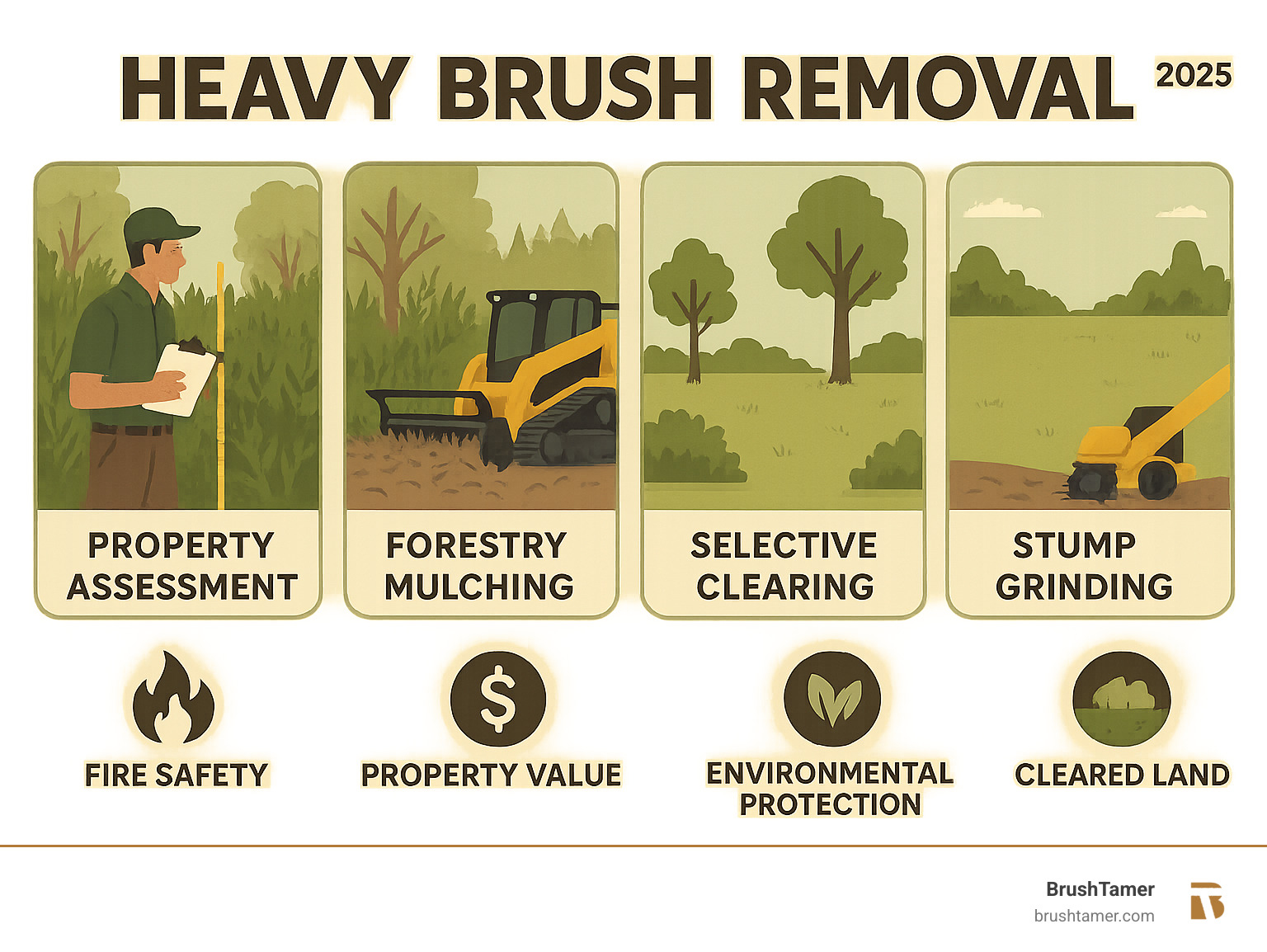
- Forestry Mulching – Cuts and mulches vegetation in place using specialized equipment
- Mechanical Clearing – Uses brush mowers and cutters for dense areas
- Selective Clearing – Targets specific vegetation while preserving valuable plants
- Stump Grinding – Removes remaining stumps and root systems
- Professional Assessment – Evaluates terrain, species, and environmental factors
If you’re staring at acres of tangled brush, invasive plants, and overgrown vegetation, you’re not alone. Many property owners find themselves overwhelmed when dense thickets take over their land, creating fire hazards and making their property unusable.
The good news? Professional heavy brush removal can reclaim your land efficiently and safely. Unlike simple lawn mowing, heavy brush clearing requires specialized equipment like forestry mulchers that can handle saplings up to 4 inches thick and dense vegetation that would destroy regular mowers.
Professional services eliminate the guesswork and safety risks, delivering the peace of mind you deserve. Because we value service, a thorough assessment of your property’s unique challenges—including hidden stumps, utility lines, steep terrain, and invasive species—is part of our commitment to delivering a complete solution. The result is cleared land that’s ready for your next project, whether that’s pasture restoration, construction preparation, or simply creating a safer, more beautiful property.
Modern brush clearing techniques also benefit the environment. Forestry mulching leaves nutrients in the soil, prevents erosion, and can actually improve ecosystem health by removing invasive species and allowing native plants to thrive.
I’m Leon Miller, owner of BrushTamer, and I’ve spent years helping property owners across Indiana reclaim their overgrown land through safe, efficient heavy brush removal techniques. My hands-on experience with everything from forestry mulching to stump grinding has shown me that the right professional approach transforms properties while protecting the environment.
Why Professional Heavy Brush Removal is Essential
When you’re dealing with acres of tangled brush and overgrown vegetation, you’re facing much more than an eyesore. Heavy brush removal is a critical service for protecting your property, your family, and your investment. The difference between a DIY attempt with inadequate tools and hiring a professional crew can mean the difference between a successful land transformation and a costly, dangerous disaster.
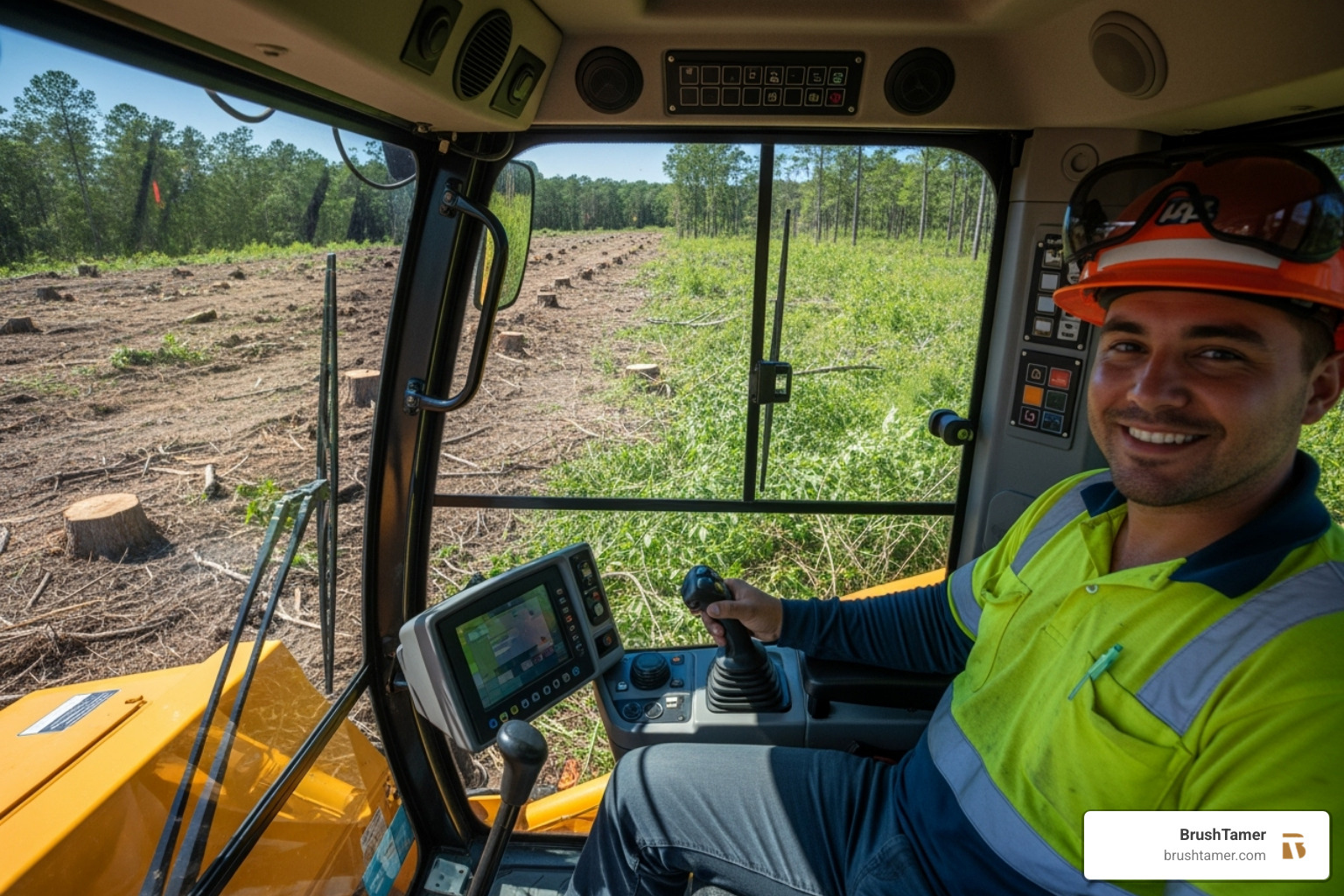
Fire risk reduction stands as the most urgent reason to clear overgrown brush, especially during dry seasons. Dense, dry vegetation acts as a highly flammable fuel, creating a direct path for wildfires to travel rapidly across your property and toward your home and other structures. Professional clearing establishes crucial defensible space, a concept fire scientists use to describe the managed area around a building that reduces fire danger. This is typically done in zones:
- Zone 0 (0-5 feet): The area immediately adjacent to your home, which should be completely free of flammable materials.
- Zone 1 (5-30 feet): The “lean, clean, and green” zone, where vegetation is kept short, well-irrigated, and spaced out to prevent fire from reaching the structure.
- Zone 2 (30-100+ feet): The fuel reduction zone, where we thin out trees, remove lower branches to eliminate “ladder fuels,” and clear dense underbrush to slow a fire’s spread and reduce its intensity. We’ve seen countless properties where well-maintained defensible space was the single factor that saved a home from a spreading wildfire.
Overgrown areas also become pest and rodent magnets. Those thick, unmanaged tangles provide the perfect dark, damp, and protected habitat for ticks, venomous snakes, rats, mice, and other unwanted visitors. Clearing the brush eliminates their home base. This is more than a matter of comfort; it’s a health issue. Ticks in the Midwest can carry serious illnesses like Lyme disease and ehrlichiosis, while rodent infestations can introduce threats like Hantavirus. By removing their habitat, you make your property safer for your family and pets to enjoy.
The improved property value from professional clearing often surprises property owners. What once looked like a worthless, inaccessible jungle suddenly becomes valuable, usable space with tangible market appeal. Cleared land is a blank canvas that potential buyers can easily envision their dreams on. This could mean transforming an impassable thicket into a lush pasture for horses, creating a network of ATV trails for family recreation, or clearing a sun-filled area perfect for a large vegetable garden or a small orchard. Whether you’re planning to sell or simply want to maximize your investment, cleared, accessible land consistently appraises higher than brush-covered acres.
Professional services also focus on preventing regrowth through proper technique. We don’t just cut—we use methods that address the entire plant, including the root system, to create conditions that naturally suppress unwanted vegetation. Simply cutting the top of many woody plants removes the “apical dominance,” signaling the root system to send up multiple new, vigorous shoots, resulting in a thicker, more aggressive thicket than before. Our approach includes soil preservation and erosion prevention, which protects your land’s health for the long term. For properties with significant erosion concerns, we incorporate specialized erosion prevention techniques as part of our core forestry mulching process.
The Hidden Risks of Overgrown Land
Every overgrown property holds surprises—and most of them aren’t pleasant. After years of clearing brush across the Midwest, I can tell you that hidden obstacles are the rule, not the exception. We regularly uncover forgotten barbed wire fences hidden at ankle height, chunks of old concrete foundations that can destroy equipment, abandoned well heads, and large rocks completely obscured by vegetation. These hazards can cause serious injury or lead to thousands of dollars in equipment repairs.
Utility lines present another major, invisible hazard. Power, gas, water, and critical fiber optic lines often run through overgrown areas, completely hidden from view. A single wrong cut can lead to expensive repairs, prolonged service outages for you and your neighbors, or a life-threatening situation like a gas leak or electrical shock. Professional operators are trained to use the “Call 811” service and know how to identify signs of buried utilities, working with precision to avoid these dangers.
Uneven terrain becomes treacherous when covered by a thick blanket of brush. What appears to be level ground can hide dangerous ditches, deep holes, or steep drop-offs that can cause heavy machinery to tip over or become stuck. Our operators are skilled at reading the land and using equipment with low ground pressure that can safely navigate these challenges.
The physical strain of clearing heavy brush manually is enormous and often underestimated. Dense thickets fight back, tangled vines can jam equipment, and thorny vegetation like multiflora rose can shred clothing and skin. Many well-intentioned property owners start a clearing project only to find they are physically overmatched and exhausted by the sheer effort required.
Poisonous plants like poison ivy, poison oak, and poison sumac thrive in the undisturbed, shady conditions of overgrown areas. A DIY clearing attempt can easily result in a severe, debilitating rash that requires medical attention. Our professional crews wear appropriate personal protective equipment (PPE) and are trained to identify and safely remove these hazardous plants without spreading their toxic oils.
Perhaps most frustrating are the inadequate results from amateur clearing attempts. Using the wrong equipment or techniques often makes the problem worse. As mentioned, improper cutting can stimulate aggressive regrowth, and without addressing the root cause, you may find yourself fighting the same battle, only harder, the following year. Professional clearing is designed to provide a lasting solution, not a temporary fix.
Professional Methods for Heavy Brush Removal
When it comes to tackling serious overgrowth, our professional methods for heavy brush removal are designed for maximum efficiency, safety, and environmental responsibility. We don’t just hack away at brush; we employ a strategic, multi-phase approach using highly specialized equipment and trained operators to achieve superior, long-lasting results that align with your vision for the property.
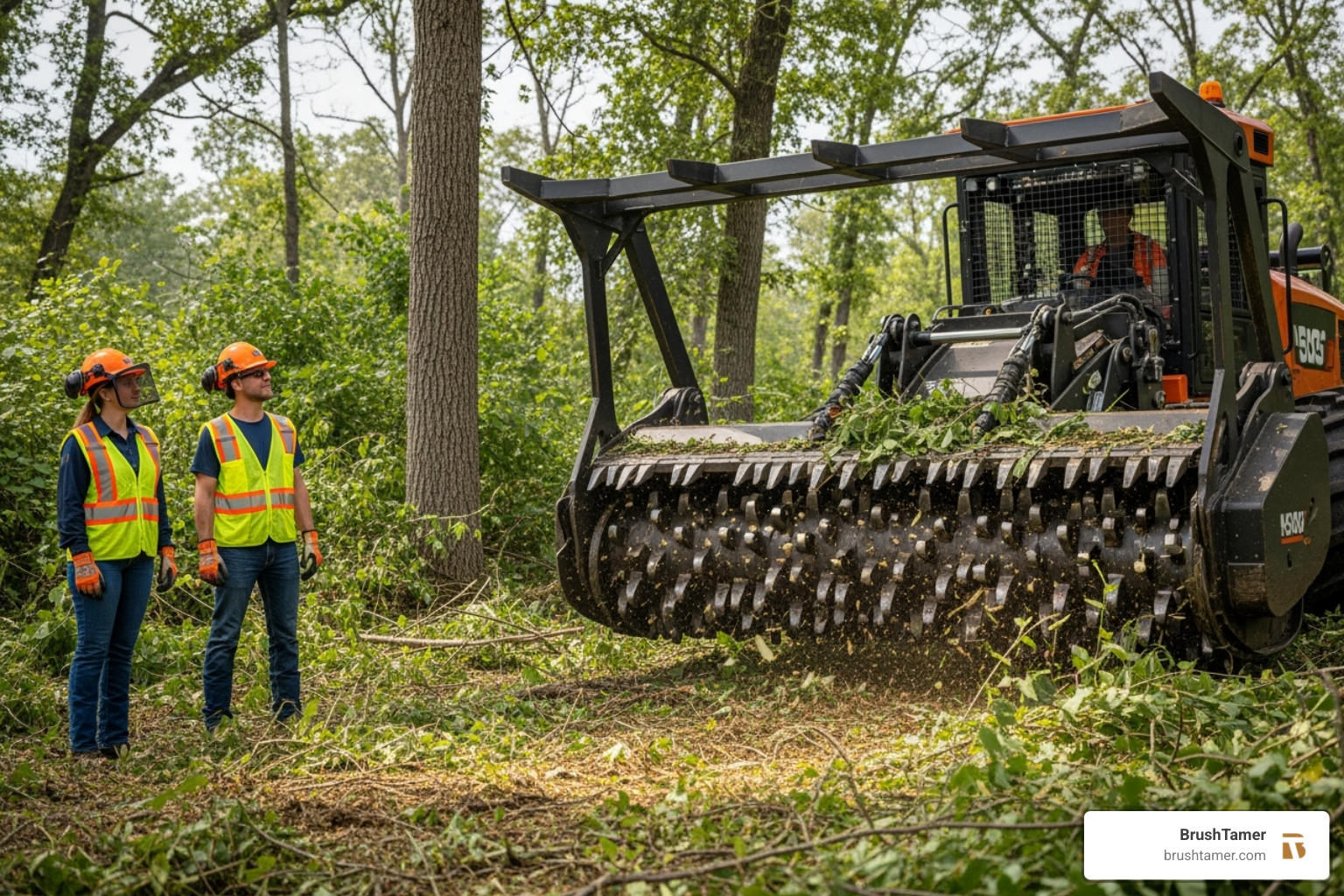
Every project begins with a thorough site assessment. This is a critical first step where we walk the property with you to understand your goals. We evaluate the type, size, and density of the vegetation, analyze the terrain for slopes and potential hazards, identify sensitive areas like waterways or valuable trees to be preserved, and determine the best access points for our equipment. This detailed evaluation allows us to select the most effective techniques and machinery for your unique property, ensuring a predictable and successful outcome. Our goal is to manage all debris effectively on-site, primarily by mulching it in place, which returns valuable nutrients to the soil and eliminates the cost and environmental impact of hauling and disposal.
Mechanical Clearing with Specialized Equipment
Mechanical clearing is the backbone of effective heavy brush removal, utilizing powerful machinery designed to handle the toughest vegetation. At the forefront of our operations is forestry mulching. A forestry mulcher, typically mounted on a high-flow skid-steer or a dedicated track loader, uses a rotating drum or disc equipped with hardened steel or carbide teeth to shred standing trees, brush, and undergrowth on contact. This single-step process is exceptionally efficient and eco-friendly, transforming dense thickets into a nutrient-rich layer of mulch that is left directly on the soil surface.
This method is a stark contrast to older, more disruptive techniques like bulldozing, which scrapes away the vital topsoil, causes severe soil compaction, and leaves behind massive piles of debris to be burned or hauled away. Forestry mulching eliminates the need for hauling or burning, prevents soil erosion, helps retain moisture, and enriches the soil as the mulch decomposes. It’s the ideal solution for densely overgrown areas, capable of handling saplings and trees up to 5 inches in diameter with ease. You can learn more about our dedicated Forestry Mulching services.
For areas with slightly less dense but still heavy brush, brush mowing with powerful skid-steer attachments like brush hogs or brushcats is invaluable. These rugged mowers can turn small trees, saplings, and thick brush into mulch, clearing wide swaths of land quickly and efficiently. Our equipment features impressive cutting capacities, capable of leveling brush up to 6 feet tall and cutting saplings up to 3 inches thick, all while minimizing soil disturbance.
The Right Technique for Every Type of Vegetation
Different types of brush require different tactics. We understand that a one-size-fits-all approach simply doesn’t work for effective heavy brush removal. Our expertise lies in matching the right technique to the specific vegetation on your property.
- Thorny Bushes and Brambles: For aggressive, thorny vegetation like blackberry, raspberry, or multiflora rose thickets, we use specialized mulching heads that can quickly shred the dense, entangled growth. This turns a painful, impenetrable barrier into a layer of nutrient-rich ground cover, making it highly effective for reclaiming areas overrun by these prickly invaders.
- Invasive Shrubs (Honeysuckle, Autumn Olive): These common Midwest invaders form dense monocultures that choke out all other life. Forestry mulching is the premier method for their removal. It effectively shreds the plants down to ground level, opening the canopy to sunlight and allowing native species to return. The resulting mulch layer also helps suppress immediate regrowth of seedlings.
- Entangled Vines: Grapevines, poison ivy, and other aggressive vines can be particularly challenging, as they often climb and damage desirable trees. Our skilled operators can use the precision of our equipment to carefully cut and mulch these vines without harming the host trees, severing their connection to the ground and preventing them from causing further damage.
- Dense Thickets and Undergrowth: For areas with a high density of mixed brush and small trees, forestry mulching is our go-to solution. It efficiently processes the entire thicket in a single pass, leaving a clean, mulched surface that is immediately usable. This is ideal for reclaiming pastures, creating firebreaks, or preparing land for new uses.
- Small Trees and Saplings: Our powerful machinery can shear off small trees and saplings, typically up to 3-5 inches in diameter, right at ground level. This technique is much faster, safer, and less disruptive than traditional hand-felling, especially for large expanses of invasive trees like Bradford pears or Siberian elms.
Crucially, our techniques are designed to manage regrowth. While mulching cuts vegetation at the surface, the resulting ground cover can suppress new seedlings. When complete eradication is the goal, we can discuss follow-up strategies or employ methods that address the root systems more directly, ensuring long-term control of unwanted vegetation.
Finishing the Job: Stump and Root System Management
After the heavy brush is cleared, managing the remaining stumps and root systems is a critical final step in achieving a truly finished and usable landscape. We offer comprehensive solutions to ensure your land is completely ready for its next purpose.
Stump grinding is the most common, cost-effective, and least disruptive method for eliminating stumps. Our specialized grinders use a high-speed cutting wheel to reduce stumps to a pile of wood chips, grinding them down several inches below the soil surface. This removes the visible hazard and prevents regrowth from the stump itself. The resulting wood chips can be used as natural mulch in other areas of your property or raked back into the hole to decompose.
For projects requiring a completely clear subsurface, we offer complete stump extraction and root raking. While stump grinding is ideal for aesthetic purposes or preparing for a lawn, it leaves the bulk of the root system in the ground. For projects like new construction foundations, septic field installation, or agricultural planting, complete removal is necessary. This involves using heavy machinery to pull the entire stump and its primary root ball from the ground. Afterward, we can perform site grading to smooth out the terrain, leaving your property level, clean, and ready for the next phase of your project. Explore our Stump Grinding & Removal services for more details.
How to Prepare Your Property for Professional Clearing
Getting your property ready for professional heavy brush removal doesn’t have to be complicated. Think of it as setting the stage for success – a little preparation upfront makes everything run smoother and safer.
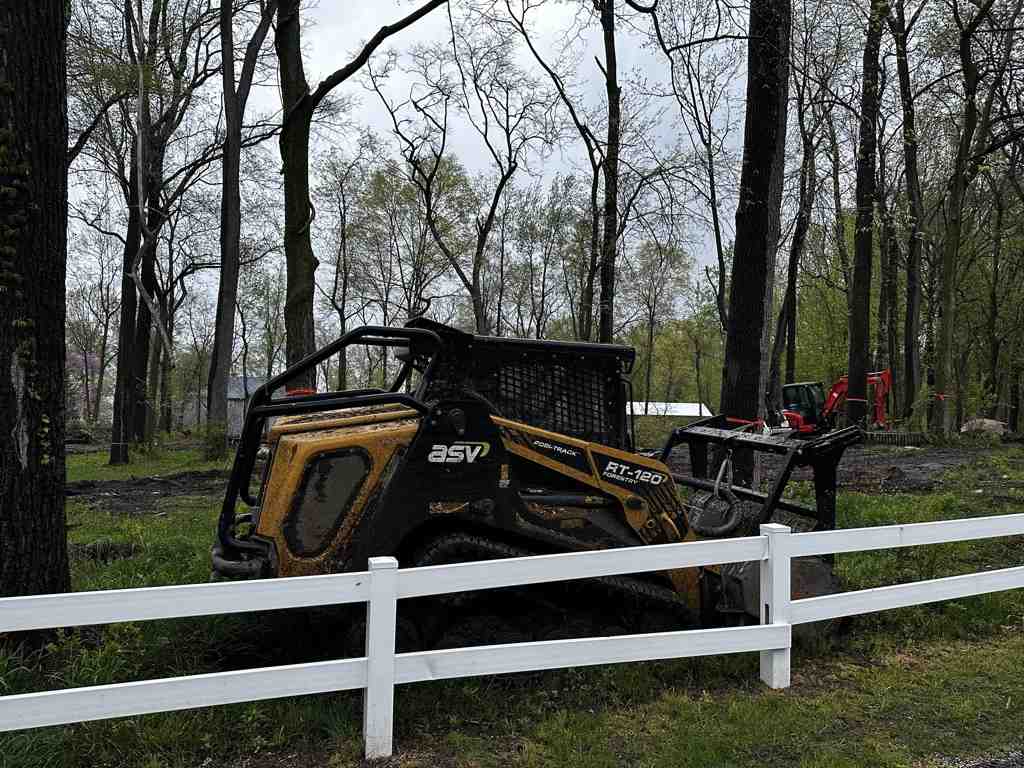
Start with your property boundaries. This might sound obvious, but you’d be surprised how often property lines aren’t as clear as they seem. Having a clear understanding of where your property begins and ends helps us focus our efforts exactly where they need to be. If you have a property survey or plat map, that’s gold – it saves time and prevents any awkward conversations with neighbors later.
Marking underground utilities is absolutely critical. Before any heavy machinery touches your land, we need to know where water lines, gas pipes, electrical cables, and septic systems are hiding. Your local “Call Before You Dig” service (usually 811) will come out and mark these for free. It’s not just smart – it’s the law in most places, and it keeps everyone safe.
While you’re thinking about what’s underground, take a walk around and identify any other hazards we should know about. Old concrete foundations, large rocks, abandoned well heads, or even that rusty farm equipment that’s been sitting there for decades – all of these things matter when we’re bringing in heavy equipment.
Defining your clearing goals helps us deliver exactly what you envision. Maybe you want a clean slate for construction, or perhaps you’d prefer to keep certain mature trees while clearing everything else. Some clients want us to create specific access routes or leave natural buffers near waterways. The clearer you are about your goals, the better we can tailor our approach.
Access routes for our equipment deserve some thought too. Our machines are tough and can handle rough terrain, but knowing the best way to get them on and off your property helps us work more efficiently. We’ll need to consider things like gate widths, overhead clearance, and ground conditions.
For larger development projects that need comprehensive site preparation, our Construction Site Clearance services handle all these preparatory details and more, ensuring your project starts on solid ground.
Environmental Best Practices for Responsible Clearing
At BrushTamer, we believe that heavy brush removal and environmental stewardship are not mutually exclusive—in fact, when done correctly, they go hand in hand. After years of working across the diverse ecosystems of the Midwest, I’ve learned that the most successful land clearing projects are those that leave the property healthier and more resilient than we found it. Our commitment to responsible clearing is built on a foundation of proven environmental best practices.
Soil preservation forms the core of our operational philosophy. The soil is a living ecosystem, and our primary goal is to protect it. When we use forestry mulching, we’re not just cutting down brush; we’re creating a natural, protective blanket for your soil. This layer of organic material protects the delicate soil microbiome from the sun’s harsh UV rays and extreme temperature fluctuations. Unlike heavy-handed methods like bulldozing, which scrape away precious topsoil and severely compact the earth, forestry mulching leaves the soil structure intact. This allows the vital community of worms, beneficial fungi, and bacteria—the soil food web—to thrive, which is essential for long-term land health.
This approach directly contributes to superior erosion prevention. Bare soil is vulnerable soil. A single heavy rainstorm can wash away tons of topsoil from a conventionally cleared property. The fresh mulch layer we create acts like a sponge, dramatically reducing surface runoff and sediment loss, which is key for excellent site preparation for future uses like farming or construction. This dramatically reduces the velocity and volume of surface runoff, preventing the formation of erosional rills and gullies that can scar your landscape and carry sediment and pollutants into nearby waterways.
Managing invasive plants is where we can make a profound positive impact on the local environment. Aggressive, non-native species like bush honeysuckle, autumn olive, and multiflora rose create dense, shaded monocultures that offer little value to native wildlife. They outcompete native plants for resources and can even release chemicals into the soil (a process called allelopathy) that inhibit the growth of other species. When we strategically remove these invaders, it’s like opening a window for nature to heal itself. Sunlight reaches the forest floor for the first time in years, allowing the dormant seed bank of native wildflowers, grasses, and tree saplings the chance they need to germinate and flourish. The USDA guidance on managing invasive plants provides excellent insights into why this is so critical for restoring local ecosystems.
We are always mindful of wildlife habitat during our clearing operations. Our goal is not to sterilize the land, but to enhance its value for wildlife. Through selective clearing, we can transform a low-value thicket of invasives into a diverse “habitat mosaic”—a healthy mix of open areas, dense protective cover, and valuable food sources. This means preserving the mature oak trees that provide acorns for deer and turkey, keeping the berry-producing shrubs that feed songbirds, and maintaining natural travel corridors that wildlife use to move safely across the landscape. This structural diversity supports a much wider and healthier range of wildlife.
Waterway protection is a non-negotiable aspect of our operations. We work carefully to establish and respect “riparian buffers,” which are critical zones of vegetation along streams, ponds, and wetlands. These buffers are nature’s filtration system; they trap sediment, absorb excess nutrients, stabilize banks against erosion, and provide essential shade to keep water temperatures cool for fish and other aquatic life. Our operations strictly adhere to all local, state, and federal guidelines, such as those related to the Clean Water Act, to ensure these vital ecosystems are protected.
The on-site mulching benefits continue to work for your property long after we’ve finished the job. As that organic mulch layer slowly breaks down, it releases a steady supply of nutrients back into the soil, acting as a natural, slow-release fertilizer. It improves soil structure, increases water retention, and fosters a healthy environment for new, desirable growth. This sustainable approach is central to our Environmentally Friendly Land Clearing philosophy. We prove that you don’t have to choose between reclaiming your land and being a good steward of the environment—our methods deliver both.
When to Call the Experts for Your Land Clearing Project
Sometimes you look at your overgrown property and wonder if you should tackle it yourself. The honest answer? Heavy brush removal is one of those jobs where calling in the professionals isn’t just smart—it’s essential for your safety and your wallet.
Large acreage is the first clear sign you need expert help. If you’re dealing with several acres or more, the sheer scale quickly becomes overwhelming. What might take you months with smaller equipment, our specialized crews can accomplish in days. We’ve seen too many property owners burn out halfway through massive clearing projects, leaving them with half-cleared land that looks worse than when they started.
When you’re facing extremely dense vegetation—those impenetrable thickets where you can’t even see three feet ahead—that’s our specialty. Dense brush with saplings over 2-3 inches in diameter will destroy regular equipment and leave you frustrated. Our forestry mulchers are built specifically to turn these challenging areas into manageable, mulched surfaces.
Steep or difficult terrain presents serious safety risks that most property owners aren’t equipped to handle. Slopes, uneven ground, wet areas, and rocky terrain require specialized machinery with low ground pressure and experienced operators who know how to work safely in these conditions. One wrong move on challenging terrain can result in injury or expensive equipment damage.
Time pressure makes professional help even more critical. Projects with tight deadlines—like preparing a construction site or creating firebreaks before fire season—demand the speed and reliability that only professional services provide. We understand that delays cost money, and we’re equipped to meet your schedule.
Proximity to structures or utility lines requires precision that comes with experience. When brush clearing needs to happen near buildings, fences, or underground utilities, our controlled methods ensure only the target vegetation gets removed. We’ve helped countless property owners clear brush right up to their property lines without damaging valuable assets.
Environmental regulations can be tricky to steer alone. Different areas have varying requirements for vegetation removal, especially near waterways or in environmentally sensitive areas. We stay current on regulations across the Midwest, including Indiana, Michigan, Illinois, Ohio, and Wisconsin, ensuring your project stays compliant from start to finish.
The bottom line? If your clearing project feels overwhelming, involves challenging conditions, or has important deadlines, that’s when you call us. Our Lot Clearing Guide can help you understand everything involved in professional land clearing and why the expert approach saves you time, money, and headaches in the long run.
Reclaim Your Land with Confidence
When you look at that overgrown corner of your property, it’s easy to feel overwhelmed. But here’s the truth: changing that tangled mess into beautiful, usable land is absolutely achievable with the right professional help.
Heavy brush removal doesn’t have to be a source of stress or uncertainty. At BrushTamer, we’ve spent years perfecting our craft, turning challenging landscapes into spaces that property owners actually want to spend time in. Our approach puts safety first every single time, because we know that cutting corners on safety leads to problems nobody wants to deal with.
What sets us apart is our commitment to delivering superior results that last. We don’t just hack away at vegetation and call it good. Instead, we take the time to understand your property’s unique challenges and your specific goals. Whether you’re dealing with fire-prone brush in Illinois or dense thickets overtaking your Indiana pasture, we know exactly how to handle it.
Professional expertise makes all the difference when you’re facing acres of overgrown land. Our team understands the unique terrain and vegetation challenges across the Midwest. We’ve cleared everything from steep wooded slopes in Ohio to flat agricultural areas in Wisconsin, and we bring that experience to every project.
But we’re not just about clearing brush and moving on. We’re your partners in long-term land management. Maybe you want to increase your property value for a future sale. Perhaps you’re concerned about fire risks during dry seasons. Or you might be preparing land for construction or agricultural use. Whatever your goals, we help you achieve them while protecting the environmental health of your property.
The difference between a cleared property and a properly managed property is significant. When we finish a project, you’re not just looking at empty land – you’re seeing the foundation for whatever comes next. Clean sight lines, improved access, reduced fire hazards, and soil that’s ready for new growth.
Ready to see what your property can become? Don’t let heavy brush continue limiting your land’s potential. Call BrushTamer today for a free consultation on forestry mulching, brush management, or complete site preparation services, and let us deliver the exceptional results you need to bring your land back to earth.