
What Is an Overgrown Trail — and How Do You Find One Again?
An overgrown trail is a corridor of land previously cleared for passage that has been reclaimed by dense vegetation, invasive species, and natural forest succession. Brush Tamer utilizes professional scouting and forestry mulching to identify and restore these lost routes across Northern Indiana and Lower Michigan, ensuring your property remains accessible and functional.
In the fertile landscapes of the Midwest, an overgrown trail is defined as any corridor where grasses, shrubs, and invasive species have reclaimed the path until the original route is obscured. Without professional intervention, these corridors are swallowed by aggressive growth cycles. Many property owners don’t realize they are losing land until it’s too late. A trail that was once wide enough for a tractor can shrink to a footpath in two seasons, and by the third, it’s a wall of thorns. When an overgrown trail disappears, you lose practical access to parts of the property—reducing how usable that acreage feels day to day. Reclaiming these routes isn’t just about aesthetics; it’s about restoring the boundaries and accessibility of your investment.
Here are 10 professional methods BrushTamer uses to find and reclaim an overgrown trail:
- Professional analysis of vegetation density and sunlight
- Identification of invasive indicators like buckthorn
- Observation of animal traffic patterns
- Evaluation of soil compaction and hard surfaces
- Tracking the rapid overgrowth timeline
- Implementation of professional scouting and mapping
- Analysis of historical land use records
- Inspection of firebreak effectiveness
- Assessment of erosion and drainage failures
- Professional navigation with specialized gear
If you own property in the Midwest, you’ve likely walked into the woods expecting a trail and found a wall of brush instead. Trails do not stay open on their own. Without regular professional maintenance, vegetation moves back in with incredible speed. Experienced land managers describe sections as short as 50 feet feeling completely impassable, especially in late spring and summer when growth peaks. When the perimeter of a woodlot becomes impassable, the interior becomes a “black box” where invasive species can spread unchecked, and drainage issues can worsen without notice.
A disused trail will vanish without frequent use and professional clearing. This is the reality of regional forest ecology, where aggressive species outcompete native vegetation to fill every available gap. Whether you’re reclaiming an old property trail or restoring a path through your land, Brush Tamer provides the expertise needed to take your land back.
I’m Leon Miller, owner of Brush Tamer. Since founding this company in 2021, I’ve spent years helping property owners across Northern Indiana and Lower Michigan identify and reclaim overgrown trails using professional forestry mulching and land management techniques. Our team uses the exact methods detailed in this guide to restore value and utility to your acreage.
Identifying the Signs of an Overgrown Trail
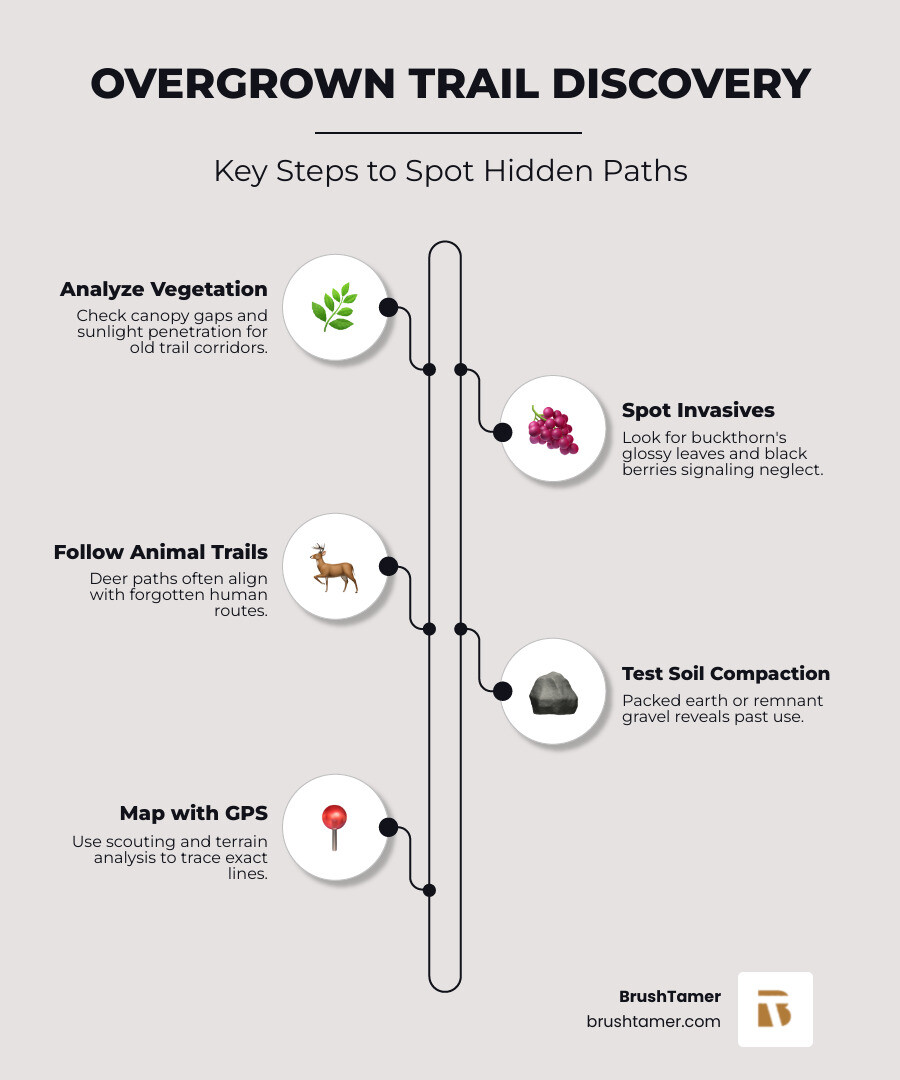
To locate an overgrown trail, look for straight-line ‘anomalies’—canopy gaps, edge growth patterns, and invasive understory that follows an old corridor. Brush Tamer’s expert team uses these indicators to locate the “ghost” of a path even when it is completely obscured by brush. In the dense forests of Northern Indiana and Lower Michigan, the clues are often hidden in how the sunlight hits the ground and how the understory responds to past human intervention.
When we evaluate a property for Sustainable Trail Design, we look for structural anomalies in the forest. A trail is essentially a corridor. Even if that corridor is filled with weeds, the trees on either side are often older and spaced differently than the growth in the middle. Our Heavy Brush Removal Ultimate Guide highlights that identifying these structural lines is the first step toward professional reclamation.
Way 1: Analyze Vegetation Density and Sunlight
To find a hidden trail, Brush Tamer experts look up before looking down. An overgrown trail often leaves a ‘linear gap’ in the canopy—edge branches grow into the corridor even after the tread fills in. Even years after a trail is abandoned, the trees on the edges have often grown limbs horizontally into that open space. This creates a specific pattern of sunlight penetration that our team is trained to recognize.
During the peak of summer, an overgrown trail might be carpeted in thick, light-hungry weeds like stinging nettles or jewelweed because more sunlight reaches the forest floor there than in the deep, undisturbed woods. Even when vegetation hides the tread, a corridor often reveals itself through light patterns and edge structure (see USDA FS trail guidance).
Way 2: Identify Invasive Indicators like Buckthorn
In Northern Indiana and parts of Lower Michigan, common buckthorn is one of the most frequent invasive shrubs that helps an overgrown trail disappear. It is a highly aggressive, invasive shrub that thrives in the disturbed soil and extra light of a trail edge.
On an overgrown trail, buckthorn is often identifiable by glossy oval leaves and dark berries later in the season. It can grow up to 25 feet tall, effectively creating a tunnel that swallows a path. Because buckthorn outcompetes native plants, a solid wall of it often indicates where a trail or “edge” used to be. Brush Tamer uses forestry mulching services to grind these stems, even when they’ve become substantial, directly into a restorative mulch layer that helps suppress future regrowth.
Way 3: Observe Animal Traffic Patterns
Nature hates a vacuum, and wildlife frequently utilizes the easiest routes available. When humans stop using a trail, deer and other wildlife often take it over. These “social trails” keep the old human path from disappearing entirely.
On an overgrown trail, deer traffic can keep a faint line open by packing soil and knocking back soft growth. Brush Tamer looks for areas where the ground is slightly lower than the surrounding forest floor—a sign of long-term compaction. In some areas, plant chemistry can reduce nearby growth, leaving a subtle line that hints at where an overgrown trail once ran. You can see how these natural lines persist in photos like Overgrown Trail #345, where the path remains visible despite the encroaching brush.
Environmental Factors and Natural Barriers
Environmental factors like soil compaction and seasonal growth cycles are the primary drivers of trail visibility and degradation in the Midwest. Brush Tamer evaluates these factors to determine the most sustainable reclamation strategy for private and public land. Understanding why a trail remains visible—or why it disappears—requires looking at the environmental “bones” of the land in Northern Indiana and Lower Michigan.
Way 4: Evaluate Soil Compaction and Hard Surfaces
To confirm an overgrown trail, check the tread for compacted soil—often firmer under leaf litter than the surrounding forest floor. Human trails, especially those used by horses or old logging equipment, feature highly compacted soil that resists root penetration from larger woody plants.
In areas like Bristol Woods County Park, you might find remnant gravel or hard-packed clay beneath the leaf litter. Even if the surface is covered in organic matter, the lack of large trees growing directly in the center of the “line” is a dead giveaway. We help clients with Sustainable Private Land Trails by identifying these stable foundations, which are much more efficient to reclaim than starting a new trail from scratch on soft, uncompacted ground.
Way 5: The Rapid Timeline of an Overgrown Trail
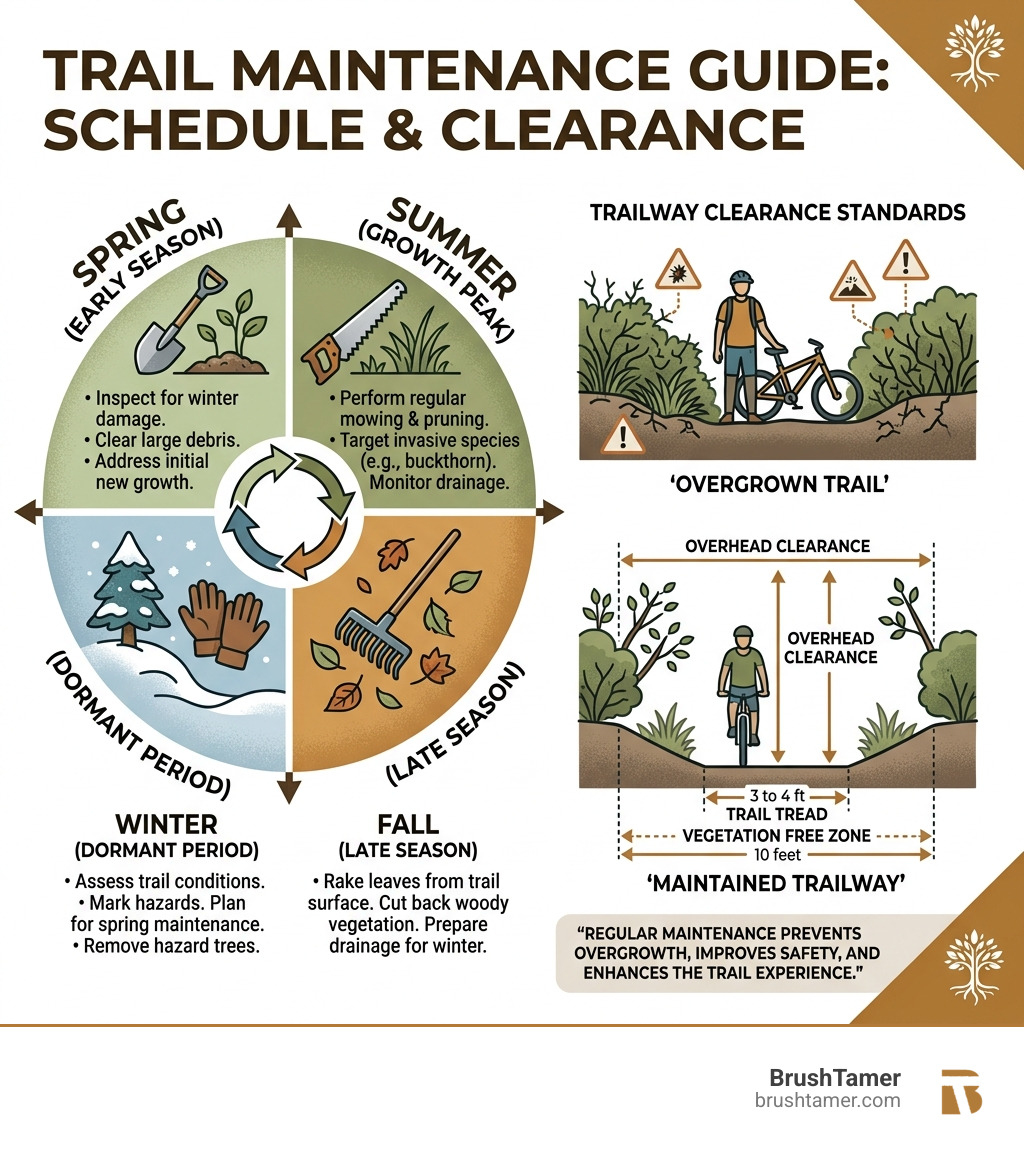
How fast does an overgrown trail form? In Midwest growing conditions, visibility can drop dramatically within a single growing season without consistent maintenance.
| Season | Growth Impact | Visibility |
|---|---|---|
| Spring | Rapid burst of grasses and soft-stemmed weeds | High (early), Low (late) |
| Summer | Woody stems and invasive vines (brambles) thicken | Very Low |
| Fall | Leaf drop hides the soil path | Low |
| Winter | Best time for professional scouting; structure is visible | High |
As noted in reports where this stretch of singletrack shows signs of overgrowth, vegetation can begin creeping back in immediately after a cutback. In our climate, a trail should be professionally inspected and plan routine inspections throughout the growing season so small regrowth doesn’t become a major overgrown trail clearing project. Brush Tamer provides scheduled maintenance to prevent this rapid degradation.
Regional Vegetation Challenges
In towns like Warsaw, Indiana, and Battle Creek, Michigan, the combination of high humidity and rich soil creates a “perfect storm” for overgrowth. Species such as Multiflora Rose and Autumn Olive can grow several feet in a single season, creating thorny barriers that require industrial-grade mulching equipment to clear. Brush Tamer’s machinery is specifically designed to handle these Midwest-specific challenges, turning dense thickets into walkable paths in a fraction of the time it would take using manual methods.
Professional Assessment and Reclamation Strategies
Reclaiming an overgrown trail reliably often requires mapping the corridor and clearing it with equipment designed for dense understory. Brush Tamer provides these comprehensive services to ensure trails are not only found but also permanently cleared and stabilized. When a trail has been lost for years, manual scouting is rarely sufficient for a long-term solution.
Way 6: Use Professional Scouting and Mapping
At Brush Tamer, we utilize GPS tracking and terrain analysis to map out the most sustainable route. Often, an overgrown trail was originally placed in a poor location that led to drainage issues or erosion.
When Fixing Overgrown Land, we assess the slope and soil type. If the old trail is too far gone, we use our mapping data to design a new path that follows the natural contours of the land, ensuring it stays clear longer with less maintenance. This professional approach is essential for properties in hilly areas like Valparaiso, Indiana, or the rolling terrain near Paw Paw, Michigan.
Way 7: Check Historical Land Use Records
If you’ve recently purchased property in Granger or Ligonier, the “lost” trails on your land might be documented in old deeds or property maps. Historically, many trails in Northern Indiana were old logging roads or farm access paths.
Historical maps, deeds, and aerial imagery can help confirm where an overgrown trail corridor originally ran. Brush Tamer analyzes these records to reveal the original intent of the paths on your property, allowing for a more authentic restoration.
Way 8: Inspect Firebreak Effectiveness
A professionally maintained trail serves a dual purpose: recreation and safety. For an overgrown trail you want to keep open, plan a corridor wide enough for safe passage and future maintenance access. However, for maximum effectiveness against both overgrowth and fire risk, Brush Tamer recommends clearing 5 feet on either side of the trail.
A wider cleared corridor around an overgrown trail can slow edge encroachment and reduce maintenance pressure—especially where invasives dominate. When we clear back to this width using our forestry mulchers, it significantly slows the rate at which the forest “closes in,” giving you a much longer window between maintenance cycles. This is particularly important for large wooded estates in areas like Angola, Indiana, and Marshall, Michigan.

Regional Navigation and Maintenance Standards
Regional maintenance standards for trails in Northern Indiana and Lower Michigan focus on managing high-moisture drainage issues and mitigating the rapid growth of invasive woody perennials. Brush Tamer implements these standards to ensure long-term trail viability and user safety. Maintaining a trail in the Midwest requires specific knowledge of our local flora and weather patterns.
Way 9: Assess Erosion and Drainage Failures
A trail that is constantly wet will grow over faster because water-loving weeds thrive in the mud. When Brush Tamer performs Trail Building and Maintenance, we look for signs of siltation and pooling that indicate drainage failure.
If you see areas where the trail has “sloughed” or where water is injecting into small cracks at the edge, the trail’s foundation is at risk. In areas like the Trails Of Middlebury, proper drainage is the difference between a permanent path and a seasonal swamp. We use professional brush management services to ensure that vegetation isn’t trapping water on the trail surface, which is a common issue in the low-lying areas of Portage and Three Rivers, Michigan.
Way 10: Navigating an Overgrown Trail Safely
If you are currently dealing with an overgrown trail, professional scouting is the only safe way to proceed. Overgrowth often hides “hat pegs” (dead branches), “reach-arounds” (briar walls), and hidden drop-offs.
As reported in various ride reports like “Overgrown!,” unchecked thorns and weeds can hide obstacles that lead to injury. Before Brush Tamer brings in heavy machinery, our team scouts for:
- Tensioned branches — Especially dangerous after Midwest storms.
- Ground-nesting insects — Common in the undisturbed brush of La Porte and Plymouth.
- Hidden stumps or rocks — Which can damage standard equipment but are easily handled by our industrial mulchers.
- Invasive briars — Such as Raspberry and Multiflora Rose, that can snag clothing and skin.
The Brush Tamer Advantage
By hiring Brush Tamer, you avoid the physical strain and safety risks associated with manual clearing. For an overgrown trail, forestry mulching can convert dense brush into a walkable corridor while leaving protective mulch on the surface. This method is not only faster but also more environmentally friendly, as it returns nutrients to the soil and prevents the erosion often caused by traditional bulldozing.
Frequently Asked Questions about Trail Overgrowth
Trail overgrowth is managed by understanding the specific biological and environmental pressures of the Midwest. Brush Tamer addresses these issues through scheduled maintenance and specialized clearing techniques designed for Northern Indiana and Lower Michigan.
How quickly do trails become impassable in the Midwest?
In Northern Indiana and Lower Michigan, a trail can go from “clear” to “difficult” in a single summer. Without professional maintenance, a path can become completely impassable within two to three years as woody perennials like buckthorn and honeysuckle take root. Overgrowth is driven by high rainfall and rich soils. We recommend quarterly inspections to catch issues early, as mulching annual growth is easier than clearing woody stems.
What role does buckthorn play in trail overgrowth?
Buckthorn is the most aggressive driver of overgrowth in our region. It creates dense, dark thickets that block out all other light, killing off native ground cover and leaving only bare, erodible soil beneath its canopy. Because it grows so fast and produces so many seeds, it can swallow a trail corridor faster than almost any other species. Buckthorn is also allelopathic, releasing chemicals that prevent other plants from growing. Our forestry mulchers grind these stands to the stump, preventing regrowth and allowing native species to return.
When should I hire a professional for trail clearing?
You should hire Brush Tamer when the overgrowth includes woody stems larger than an inch in diameter, or when the trail has disappeared over a large area (more than 100 feet). If you are dealing with invasive species, steep slopes, or drainage issues, professional intervention is necessary to ensure the trail is reclaimed sustainably without damaging the surrounding ecosystem. Clearing large areas manually often leads to exhaustion without long-term results. Our team serves clients from Niles, Michigan, to Fort Wayne, Indiana, providing expert solutions for all trail types.
Why is forestry mulching better than traditional clearing?
Forestry mulching is superior because it is a single-step process that clears vegetation and creates a protective ground cover simultaneously. Unlike traditional methods that might involve hauling away debris, burning, or using a bulldozer that disturbs the topsoil and invites more weeds, Brush Tamer’s mulching process leaves a nutrient-rich layer. This mulch acts as a natural barrier, suppressing the germination of weed seeds while preventing the soil erosion often caused by heavy rains in the Midwest. It is the most cost-effective and eco-friendly way to maintain trails on large properties, as it eliminates the need for multiple machines and labor-intensive cleanup.
Reclaim Your Land with Brush Tamer
Reclaiming land with Brush Tamer involves utilizing specialized equipment and local expertise to restore lost corridors and enhance property value. We serve property owners across Northern Indiana and Lower Michigan, providing professional land clearing that restores utility to your acreage. An overgrown trail is more than just a nuisance; it’s a lost opportunity to enjoy your property.
We serve a wide range of locations, including:
- Northern Indiana: Elkhart, Goshen, South Bend, Mishawaka, Granger, Fort Wayne, Warsaw, Valparaiso, La Porte, Angola, and Plymouth.
- Lower Michigan: Benton Harbor, St. Joseph, Niles, Kalamazoo, Grand Rapids, Three Rivers, Paw Paw, Portage, Battle Creek, Marshall, and Edwardsburg.
- Chicagoland: Joliet, Naperville, and the surrounding suburbs.
Don’t let your trails disappear into the woods. Let Brush Tamer help you take your land back. We provide reliable, high-quality results with an environmentally responsible approach that respects the health of your forest while maximizing your enjoyment of it. Reach out to us today to schedule a professional assessment of your property’s trails and experience the difference that professional land management can make.