
Why Your Soil’s Hidden Problems Are Costing You Productivity
If you’ve ever wondered what is subsoiling is, and whether it’s actually worth doing on land in Northern Indiana or Lower Michigan, here’s the simple truth:
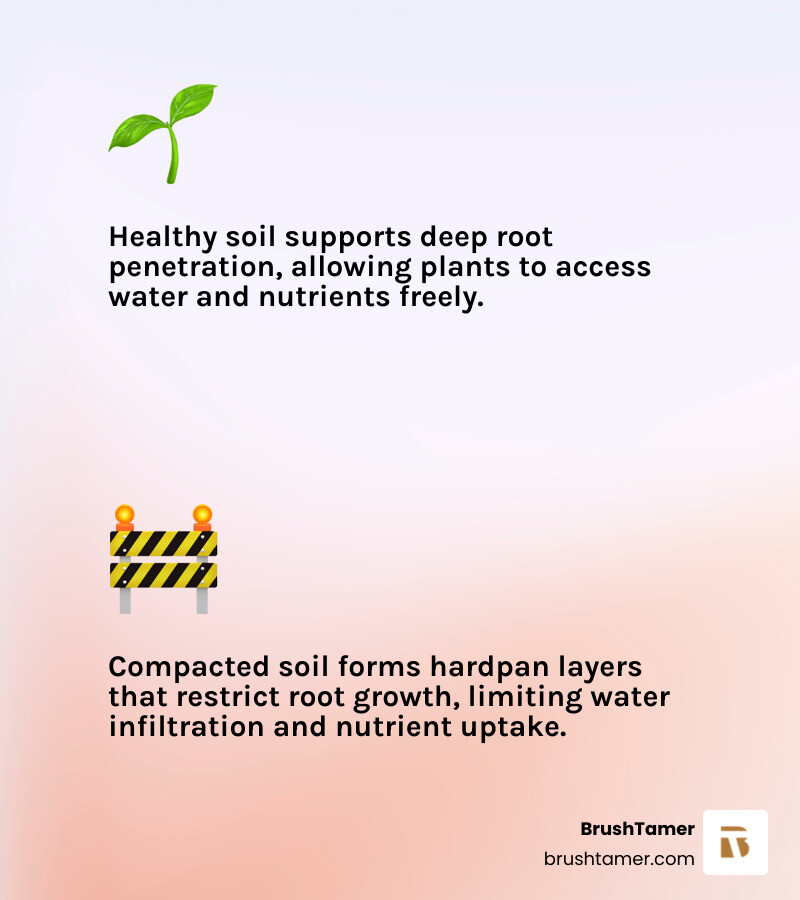
Most “soil problems” don’t start on the surface. They start below it, where compaction forms a tight, resistant layer that roots can’t push through and water can’t soak past.
And yes, 16 inches in-ground is absolutely subsoiling. In fact, for most real-world land improvement projects (food plots, pasture renovation, drainage improvement, restoration after equipment traffic), breaking compaction in the top 12–16 inches is exactly where the biggest payoff is.
At BrushTamer, our subsoiling setup runs up to 16 inches, which puts it in the “serious, professional-grade” category—because the goal isn’t to chase extreme depth for the sake of a number. The goal is to break the compaction layer that’s actually present on your site.
The good news is that professional subsoiling can break through these compacted layers, restoring your soil’s natural ability to support vigorous plant growth and significantly boosting your land’s productivity. As Leon Miller, owner of BrushTamer, I’ve seen how addressing soil compaction transforms underperforming land across Lower Michigan and Northern Indiana. Understanding the principles of subsoiling is the first step toward maximizing your property’s potential.
What is Subsoiling?
Subsoiling is a deep-tillage method that uses a heavy-duty shank (or shanks) to fracture compacted soil below the surface without flipping the soil profile over like a plow would.
Think of it like this:
- A disc mainly stirs and slices the top layer
- A tiller pulverizes and mixes the surface layer into a seedbed
- A subsoiler cracks and opens the soil deeper to restore drainage and root access
When land has been driven on, logged, repeatedly mowed, grazed hard, or worked with equipment, compaction is common. That compaction can show up as:
- standing water after rain
- thin, stressed vegetation
- shallow root systems
- “hardpan” or a tight layer you can feel when probing the soil
- poor establishment in food plots or reseeding projects
The Big Fix: You Don’t Need “30 Inches” to Get Real Results
Some articles make subsoiling sound like it only “counts” if you’re ripping 24–30 inches down.
Reality: Most properties don’t have compaction that deep, and machines that truly run beyond 16–18 inches are far less common (and often unnecessary for the typical landowner use-case).
BrushTamer’s 16-inch capability is exactly the range where most actionable compaction lives, especially for:
- food plots and habitat improvement
- pasture renovation and overseeding prep
- drainage improvement on compacted ground
- property restoration after equipment traffic
- sites that need better infiltration, not soil inversion
Regular Disc vs. Forestry Mulcher vs. Tiller vs. Subsoiler
Here’s the comparison that landowners actually need, based on what each tool does to the soil and what problem it solves:
| Tool | What it’s best for | Typical working depth | What it does | What it does NOT do |
|---|---|---|---|---|
| Regular Disc (Disc Harrow) | Smoothing, light seedbed prep, mixing residue | \~2–6 inches | Cuts and stirs the topsoil; helps level and blend | Won’t break compaction below the disc depth |
| Forestry Mulcher | Clearing brush/trees, creating a mulch layer | Surface | Mulches vegetation into ground cover; reduces regrowth; improves access | Does not loosen soil compaction (can even increase compaction if conditions are wet/heavy traffic) |
| Tiller (Rotary Tiller) | Garden-style seedbed, fine surface prep | \~3–8 inches | Pulverizes and mixes soil for planting | Often creates a “tillage pan” below the worked depth over time |
| Subsoiler (BrushTamer) | Fixing compaction, improving infiltration and rooting | Up to 16 inches | Fractures tight soil below the surface to open pathways for water/roots | Not meant to pulverize/finish a seedbed like a tiller |
Bottom line:
If your problem is compaction and drainage, a disc and tiller mostly “make the top look nice.” A subsoiler actually changes what’s happening underneath.
Why 16-Inch Subsoiling Is a High-End Solution (When Done Right)
A subsoiler’s value isn’t only the number of inches—it’s the combination of:
- true penetration (not bouncing/skimming)
- fracturing action (breaking the layer, not just slicing)
- right conditions (soil moisture matters)
- correct depth setting (deep enough to break compaction, not deeper than needed)
On most properties we evaluate in Northern Indiana and Lower Michigan, compaction is often concentrated in that critical zone below the surface where roots stall and water starts pooling.
Breaking that zone can lead to:
- faster infiltration (less standing water)
- stronger vegetation and better establishment
- deeper root growth and improved drought tolerance
- better performance of seeding projects, food plots, and restoration work
When a Disc or Tiller Is the Right Call (and When It Isn’t)
A lot of frustration happens when landowners use the wrong tool for the job:
Use a disc when you need:
- light mixing and leveling
- quick prep before broadcasting seed (depending on soil and goals)
- residue management at the surface
Use a tiller when you need:
- a fine, mixed seedbed (small areas, specific planting needs)
Use a subsoiler when you’re dealing with:
- repeated water pooling
- soil that “seals” after rain
- shallow rooting and weak stands
- areas driven on repeatedly (access lanes, staging areas, edges, logging zones)
- food plots/pasture that won’t perform even after reseeding
And when there’s heavy vegetation in the way? That’s where BrushTamer shines, because we can pair the right steps (often mulching first, then soil correction).
What to Expect From BrushTamer Subsoiling
We don’t show up and randomly “rip deep.”
We focus on:
- what the land is doing (drainage, growth, history of traffic)
- where compaction likely sits
- the right depth (up to 16″) to actually break that layer
- timing it so the soil fractures instead of smearing
That approach is what makes subsoiling feel like a premium service, because the results come from doing the right work, at the right depth, under the right conditions.
If Your Ground Is Tight, Subsoiling Is the Reset Button
If your property is underperforming, whether it’s a food plot that won’t establish, a pasture that stays soggy, or a piece of land that never seems to “take” seed, there’s a good chance compaction is the real issue.
And yes: 16-inch subsoiling is legitimate subsoiling, and it’s often the most effective depth range for real properties across Northern Indiana and Lower Michigan.
If you want clarity on whether subsoiling is right for your site and whether you should pair it with a disc pass, tillage, seeding, or mulching, BrushTamer can help.
This is not a DIY task. Effective subsoiling requires specialized, high-horsepower equipment and the expert knowledge to assess soil conditions, determine the correct depth and timing, and integrate the practice into a sustainable land management strategy. Without this expertise, the effort can be inefficient or even counterproductive.
Since 2021, BrushTamer has been dedicated to providing comprehensive land solutions, utilizing our specialized equipment and experienced team to restore land health and productivity across Lower Michigan and Northern Indiana. We understand the unique challenges of our region’s soils and are committed to delivering reliable, high-quality results with an environmentally responsible approach.
Want clarity on what subsoiling entails for your specific soil conditions, and whether it’s good for the environment on your site? Contact BrushTamer to request an assessment and next-step plan