
Why Pruning Blueberry Bushes Is Critical for Your Harvest
Pruning blueberry bushes is one of the most important professional services for maintaining a productive, healthy planting. Across Lower Michigan and Northern Indiana, from backyard gardens in South Bend and Kalamazoo to commercial plantings near St. Joseph and Benton Harbor, expert pruning from a dedicated vegetation management company is essential for maximizing fruit yield and long-term plant health.
Without regular, expert pruning, blueberry bushes become dense tangles of old, unproductive wood. They produce a high volume of small, poor-quality berries as their vigor declines. This overgrowth also chokes out new canes, increases disease risk, and ultimately shortens the plant’s productive life.
Professionally planned and executed pruning, as performed by the specialists at BrushTamer, reverses this decline. Our approach encourages the growth of strong new canes, concentrates the plant’s energy into producing larger and more flavorful fruit, and opens the bush’s structure to improve air circulation and sunlight exposure. The result is a healthier, longer-lived planting that delivers consistently high yields in climates as varied as Portage, MI, and Fort Wayne, IN.
Michigan and Northern Indiana provide a prime climate for these hardy plants. However, to truly capitalize on that potential, a professional pruning strategy is essential. I am Leon Miller, and at BrushTamer, our team has seen how strategic, science-based pruning blueberry bushes transforms underperforming plantings in towns like Niles, Mishawaka, and Valparaiso into thriving, highly productive landscapes. Understanding the science behind this service is the first step toward a better harvest, and partnering with a professional crew ensures that science is applied correctly, safely, and at the right time every year.
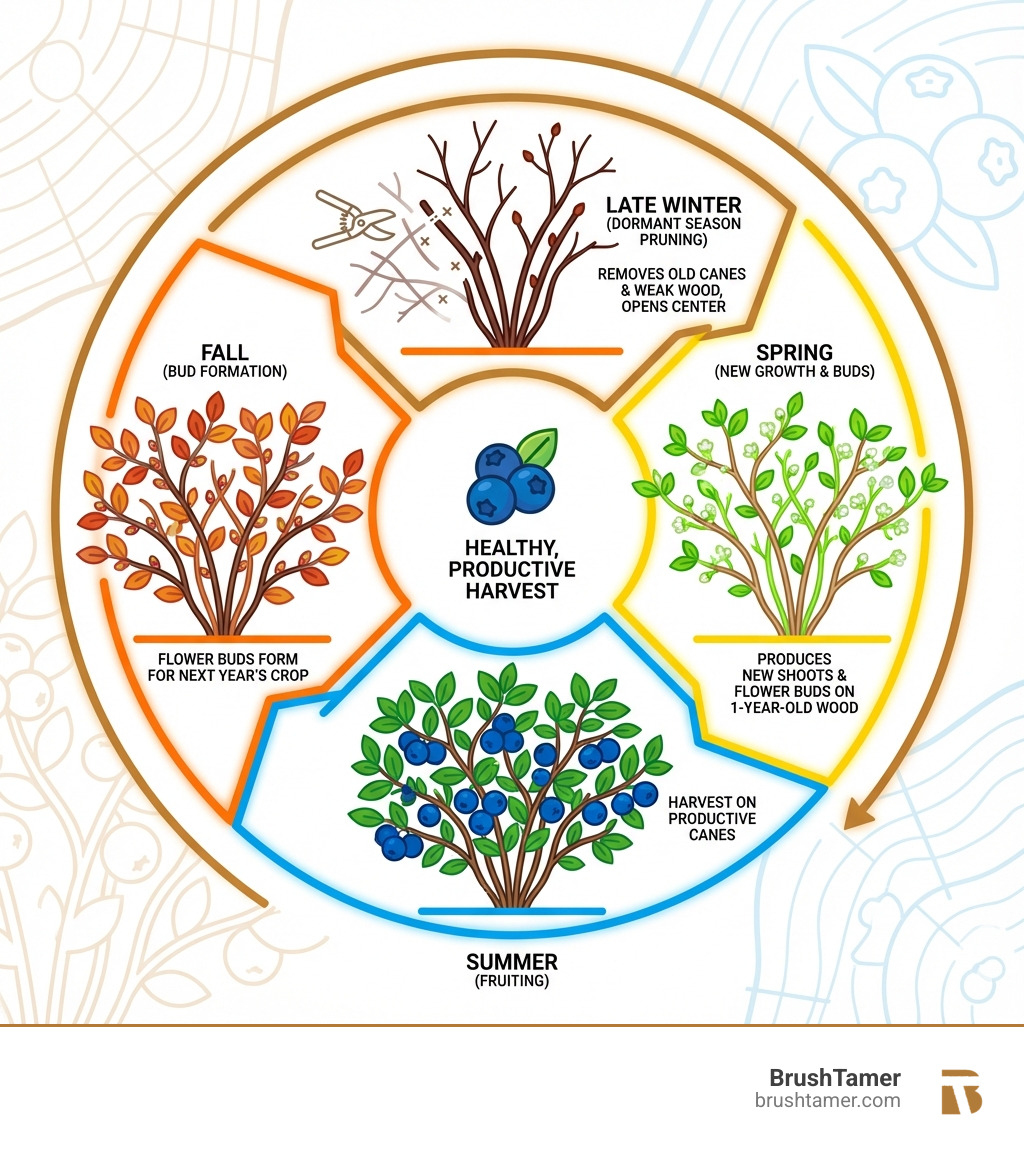
The Science Behind Pruning: Why It’s Essential for Plant Health and Fruit Production
At BrushTamer, our team understands that pruning blueberry bushes is a vital horticultural practice rooted in plant science, directly impacting a plant’s long-term health and fruit production. When our crews arrive at a blueberry patch in Mishawaka, a homestead planting outside Goshen, or a commercial field near Buchanan, our goal is to optimize the plant’s natural growth cycle for maximum yield and quality through our expert Vegetation Management Solutions.
The philosophy behind effective, professional pruning is one of managed renewal based on the plant’s biology. By strategically removing old, less productive wood, our technicians manipulate the plant’s hormonal responses. Removing older canes stimulates the production of cytokinins in the plant’s crown and root system, which in turn promotes the growth of vigorous new basal shoots. This constant renewal is the key to sustaining a productive planting for decades.
How Pruning Manages Specific Diseases and Pests
In the humid climates of Lower Michigan and Northern Indiana, disease and pest management are critical components of responsible land care. Professional pruning blueberry bushes is the most effective cultural practice for preventing common diseases, reducing the need for chemical interventions.
Our process involves the targeted removal of dead, diseased, or damaged wood, which are primary entry points for pathogens. More importantly, by thinning the canopy to create an open, airy structure, we alter the microclimate within the bush. This improved air circulation and sunlight penetration allows foliage and fruit to dry quickly after rain or morning dew, creating an environment less hospitable to fungal diseases that thrive in damp, stagnant conditions. Key diseases managed through our pruning include:
- Mummy Berry (Monilinia vaccinii-corymbosi): Pruning removes infected twigs where the fungus can overwinter. An open canopy also makes it easier to clean up mummified fruit from the ground, disrupting the fungal life cycle.
- Phomopsis Twig Blight: This fungus often infects canes through winter-injured wood. Our crews are trained to identify and remove this damaged wood, eliminating the primary infection sites.
- Botrytis Blight and Fruit Rot: Common in damp, cool conditions, this fungus attacks blossoms and fruit. By improving air circulation, we reduce the duration of wetness on these tissues, significantly lowering infection rates.
A well-pruned bush is a healthier bush, better equipped to resist pressure from diseases and pests. Because these outcomes depend on precise cuts, correct cane selection, and regionally appropriate timing, BrushTamer delivers this work with trained crews and professional oversight, ensuring blueberry plantings in communities from South Bend to Grand Rapids remain vigorous and productive year after year.
Optimal Timing and Tools for Professional Blueberry Pruning
The success of pruning blueberry bushes hinges significantly on precise timing and the use of professional-grade tools. At BrushTamer, we emphasize expertise in both areas to deliver exceptional results for our clients across Lower Michigan and Northern Indiana, from Fort Wayne and Warsaw to Paw Paw and Berrien Springs.
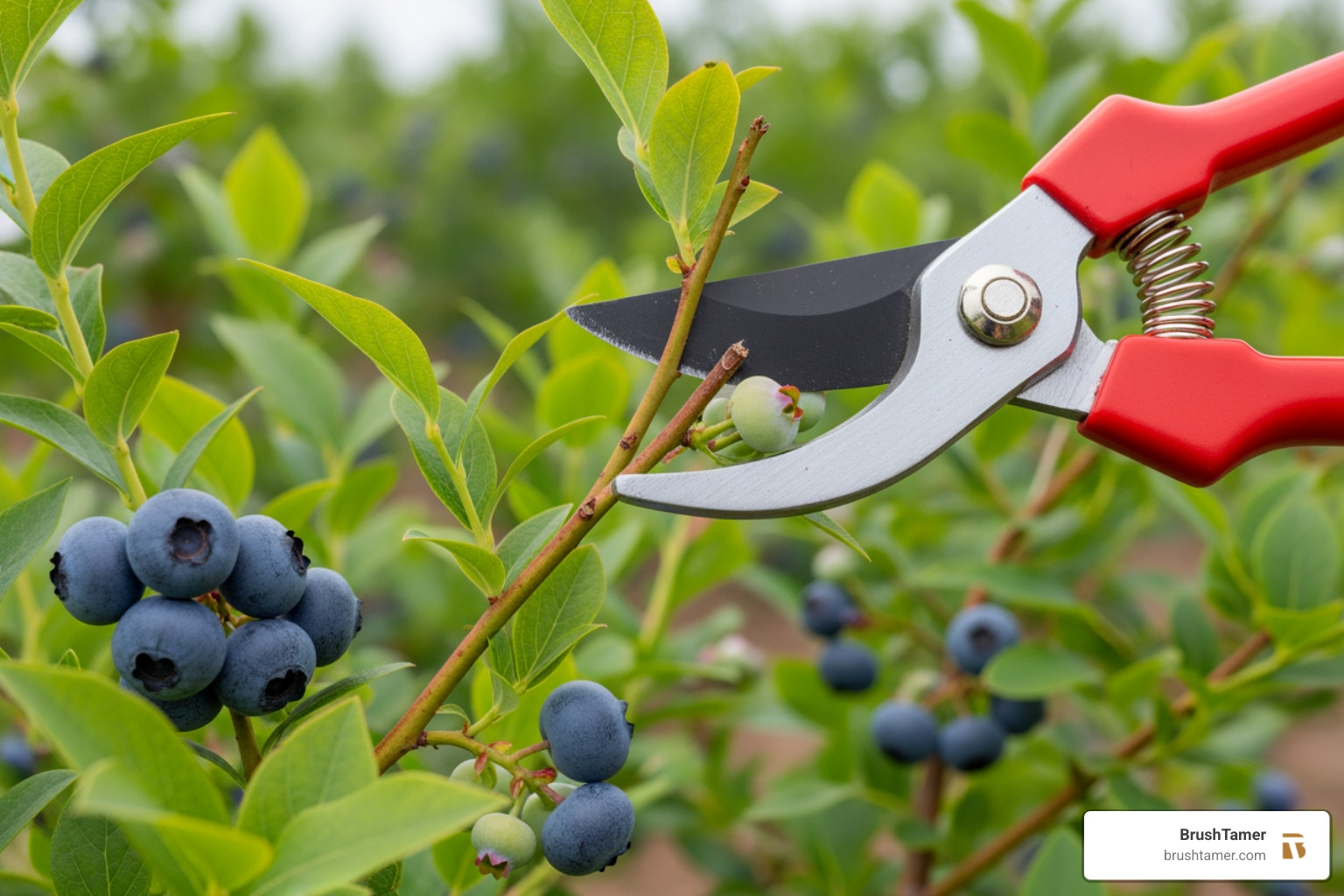
The optimal time for professional pruning is during the plant’s dormant season, typically from late February to early March in our region. Pruning too early in the winter can expose fresh cuts to severe cold and desiccation, potentially causing dieback. Pruning too late, after buds have swollen, means the plant has already invested energy in branches that are about to be removed, reducing the efficiency of the process. Working in the late-dormant window allows our technicians to easily see the plant’s structure, identify winter injury, and distinguish between plump flower buds and smaller leaf buds, all while minimizing stress on the plant.
The Right Tools for a Clean Cut
Our services rely on high-quality, sharp, and meticulously maintained tools operated by trained crews. The quality of the cut is paramount, as a clean cut heals faster and reduces the risk of disease. Our standard toolkit includes:
- Bypass Hand Pruners: Used for cuts up to ¾ inch in diameter. We exclusively use bypass pruners, which have two curved blades that pass each other like scissors, to make a clean, precise cut without crushing plant tissue.
- Bypass Loppers: These long-handled tools provide the leverage needed to cut through canes between ¾ inch and 1.5 inches in diameter, allowing our crews to remove larger branches cleanly from the base.
- Pruning Saws: For the thickest, oldest canes over 1.5 inches in diameter, a specialized pruning saw with a curved blade and sharp teeth is essential. It allows for the removal of large wood without damaging the plant’s crown.
When to Prune in Lower Michigan and Northern Indiana
The distinct seasons and potential for late frosts in our region make late February to early March the prime window for pruning blueberry bushes. This timing allows BrushTamer’s experts to assess and remove any stems that have suffered winter injury before the plant directs energy to them. During dormancy, the plump, round flower buds are easily distinguishable from smaller, pointed leaf buds, enabling our crews to strategically manage the future crop load by selectively removing or retaining fruit-bearing wood.
Because weather patterns vary between locations like South Bend, Grand Rapids, and Michigan City, BrushTamer adjusts schedules by microclimate. By waiting until the most severe cold has typically passed, while still staying firmly within dormancy, we ensure plants are ready for a productive spring. Our deep understanding of local conditions across communities such as Mishawaka, Hammond, and Kalamazoo allows us to fine-tune pruning schedules for optimal results. Property owners and orchard managers who want to understand the research behind these decisions can learn more about pruning principles from university research, then rely on BrushTamer to apply those principles precisely and safely in the field.
The Expert’s Guide to Pruning Blueberry Bushes
Effective pruning blueberry bushes requires a trained eye, specialized tools, and a systematic approach. BrushTamer professionals follow a detailed, multi-step process to ensure every bush receives the precise care it needs, whether it is a small patch in Granger, a rural property outside Columbia City, or a sprawling orchard near St. Joseph. This expertise is a core component of our comprehensive Professional Land Management services.
Our process is a deliberate sequence designed to build a strong, productive, and open-structured plant. Here is the step-by-step method our crews employ:
Step 1: Assess the Plant’s Overall Structure
Before a single cut is made, our technicians assess the entire bush. We identify the oldest canes, look for imbalances in growth, and visualize the desired final form—an upright, open vase shape with a good distribution of cane ages.
Step 2: Remove the “Three D’s”
The first cuts always target the removal of any wood that is Dead, Damaged, or Diseased. These branches are unproductive, harbor pests and pathogens, and detract from the plant’s overall vigor. This initial cleanup immediately improves plant health.
Step 3: Eliminate Problematic Structural Wood
Next, our crews focus on the bush’s architecture. We remove any low-hanging branches that would allow fruit to touch the ground, where it can rot or be contaminated. We also cut out any crossing or rubbing canes that create wounds and block airflow, as well as any weak, spindly shoots that will never become productive canes.
Step 4: Perform Renewal Pruning
This is the most critical step for long-term productivity. Our technicians identify the one to three oldest, thickest, and least productive canes—typically gray, with peeling bark and weak side shoots. These are removed completely, cut flush with the ground or crown. This is a thinning cut, which encourages the growth of strong new replacement canes from the base of the plant.
Step 5: Thin the Remaining Canes and Tipping
Finally, we thin out the remaining canes to achieve the ideal open structure. If too many new shoots have emerged, we select the strongest 2-3 and remove the rest. We also look for excessive twiggy growth on otherwise healthy canes and thin those out to direct energy to larger fruit. In some cases, a heading cut (snipping the tip of a cane) may be used on very vigorous, tall new shoots to encourage lateral branching and stiffen the cane, but this is used sparingly as it can reduce the primary fruit crop on that stem.
Identifying Canes for Removal vs. Retention
Distinguishing between canes to remove and those to retain is a cornerstone of professional pruning blueberry bushes. BrushTamer technicians are trained to recognize these key differences:
- Old, Unproductive Canes (To Remove): These are typically the thickest canes in the bush. They appear grayish, with rough, peeling, or scaly bark, and may be covered in lichens. Their lateral branches are short, weak, and “twiggy,” and they produce small, poor-quality berries.
- Young, Productive Canes (To Retain): These canes are smooth, pliable, and have a distinct reddish-brown or bright green color. They exhibit strong, upright growth and are tipped with plump, round flower buds. These are the canes that will produce the largest, highest-quality fruit.
By entrusting this detailed work to BrushTamer, property owners and growers in Lower Michigan and Northern Indiana—from Dowagiac and Plymouth to Greenwood—receive meticulous pruning that protects their investment and supports more abundant, higher-quality harvests.
Custom Pruning Strategies: From Young Plants to Mature Orchards
Just as a child’s needs differ from an adult’s, the pruning blueberry bushes strategies BrushTamer employs vary significantly depending on the plant’s age and condition. Our team tailors its approach to ensure optimal development for young plants and sustained productivity for mature orchards across our service areas, from Michigan City and New Buffalo along the lakeshore to Kokomo, Lafayette, and Anderson further south.
| Plant Age | Goal of Pruning | Key Techniques |
|---|---|---|
| Young (Years 1-3) | Establish strong framework, promote vegetative growth, delay fruit production for robust plant development. | BrushTamer removes all flower buds in year 1. In years 2-3, our crews remove low-lying and weak shoots, crossing branches, and select 2-3 strongest new canes annually. |
| Mature (Year 4+) | Maintain peak fruit production, renew older canes, ensure plant vigor, control size and shape. | Annual renewal pruning carried out by our technicians: remove 20% of oldest, least productive canes. Maintain 10-15 canes of varying ages. Thin center for light and air. |
Pruning Young Blueberry Bushes for Future Success
The first three years are critical for establishing a strong, productive framework. When caring for young plants in areas like Rochester, IN, and Three Rivers, MI, BrushTamer’s primary focus is on building the plant’s “factory”—its root system and cane structure. For newly planted bushes, our crews remove all flower buds. This prevents the plant from spending its limited energy on fruit, redirecting it into developing a robust root system and strong shoots. In years two and three, pruning is still light and structural, removing only weak or crossing shoots and retaining the best two to three new canes each year. This professionally guided development builds a well-structured bush prepared for decades of bountiful harvests.
Maintaining Mature Bushes for Peak Productivity
Once bushes mature (year four and beyond), our pruning blueberry bushes strategy shifts to annual renewal pruning, a key part of our Brush Management Services. The goal is to maintain a balance of cane ages for a continuous supply of productive one-year-old wood. Each year, our crews remove about 20% of the wood, targeting the one or two oldest, least productive canes and cutting them to the ground. This stimulates new canes to grow from the base, ensuring the bush always has a mix of productive canes of different ages. Our objective is a mature bush with 10 to 15 canes of varying ages, ensuring consistent high yields in gardens and orchards from Warsaw to Berrien Springs.
Specialized Techniques for Different Blueberry Varieties
BrushTamer experts adapt pruning techniques for different blueberry varieties to maximize their potential. For common Northern Highbush varieties like the upright ‘Duke’, we focus on thinning the top to manage height and prevent shading. For more spreading varieties like ‘Bluecrop’ and ‘Jersey’, we focus on removing low-hanging branches and thinning the center. For Rabbiteye varieties, which can be grown in the warmer, southern parts of our service area like Indianapolis and Carmel, our pruning is often more aggressive to manage their vigorous, tall growth, involving shortening long canes to create a more compact, manageable bush.
Revitalizing Overgrown and Neglected Bushes
BrushTamer frequently encounters bushes that have been neglected for years. These overgrown plants can often be saved through a multi-year rejuvenation pruning program, planned and executed by our professionals.
- Year 1: The Hard Reset. Our crews perform a drastic pruning. We first remove all dead and diseased wood. Then, we cut one-third to one-half of the oldest, thickest canes completely to the ground. This is a shocking cut that sacrifices most of that year’s crop but floods the plant’s base with light and stimulates a flush of new, vigorous shoots.
- Year 2: Shaping the New Growth. The following winter, we assess the new growth. We select the 6-8 strongest, best-placed new shoots to become the new framework of the bush. We then remove another third of the remaining old, weak canes. This continues the renewal process while allowing the new canes to develop.
- Year 3: Establishing the New Framework. By this year, the bush has a solid set of one- and two-year-old canes. We remove all of the remaining old canes. The bush is now fully renewed, and we can transition it into an annual maintenance pruning schedule.
For severely declined orchards in areas like Elkhart or Monticello, a professional assessment is crucial. Sometimes, the most cost-effective long-term strategy is removal. For these situations, BrushTamer provides Blueberry Orchard Removal Services to efficiently clear failing plantings and prepare the land for its next productive use.
Conclusion: Ensuring a Bountiful Harvest in Michigan and Indiana
As demonstrated across orchards and homesteads from Fort Wayne to the Lake Michigan shoreline, pruning blueberry bushes is a critical investment in the long-term health and productivity of your plants. From establishing a strong framework in young bushes to maintaining peak performance in mature orchards, this complex task ensures larger berries, higher yields, and robust plants capable of thriving in our Midwest climate.
Effective pruning is not a casual trim. It requires:
- A detailed understanding of cane age and productivity
- Precision tools and safe work practices
- Regionally specific timing that accounts for local frost patterns
- Experience with different blueberry varieties and planting layouts
For property owners and orchard managers across Lower Michigan and Northern Indiana—from Mishawaka, Goshen, and La Porte to Benton Harbor, Bridgman, and Paw Paw—professional expertise is indispensable. Contact Brush Tamer today to confidently approach pruning your blueberry bushes this year. Relying on a specialized vegetation management company like BrushTamer ensures that each bush is evaluated accurately, each cut supports long-term goals, and each pruning session fits within a broader plan for soil health, disease prevention, and overall land productivity.
Whether you are looking to refresh a neglected patch in Granger, optimize a commercial orchard near Kalamazoo, or integrate an existing planting into a broader land-clearing project in Lafayette or Indianapolis, BrushTamer has the equipment, staffing, and knowledge to manage the work efficiently and responsibly.
For orchards where rejuvenation is not the best path forward, a full overhaul may be the answer. In those situations, our team can safely remove aging blueberry blocks, manage stumps and brush, and prepare your ground for its next use. If you are considering a fresh start, learn more about our Blueberry Orchard Removal services and how we can help you restore the productivity and health of your land across Lower Michigan and Northern Indiana.