
Why Sustainable Trail Design Matters Now More Than Ever
Sustainable trail design is the professional practice of planning, constructing, and maintaining trail systems that manage water on the landscape, minimize environmental disturbance, and deliver long service life at a reasonable total cost of ownership. It is not a shortcut or a set of ad hoc techniques; it is a disciplined methodology that integrates geomorphology, hydrology, soil science, ecology, and user-risk management into a cohesive project approach.
Recreation use has grown significantly across the Midwest and beyond, and many legacy trails were never engineered for the volumes and diversity of today’s users, which now include high-torque e-bikes, adaptive mountain bikes, and a greater number of year-round visitors. Trails cut straight up fall lines or sited in drainage swales simply cannot withstand modern loads or changing climate patterns that are bringing more frequent high-intensity storm events, prolonged wet seasons, and more aggressive freeze-thaw cycles. The consequences are predictable: incision and rutting, widening as users attempt to circumvent damage, sediment delivery to streams, and ballooning maintenance liabilities that drain public and private resources.
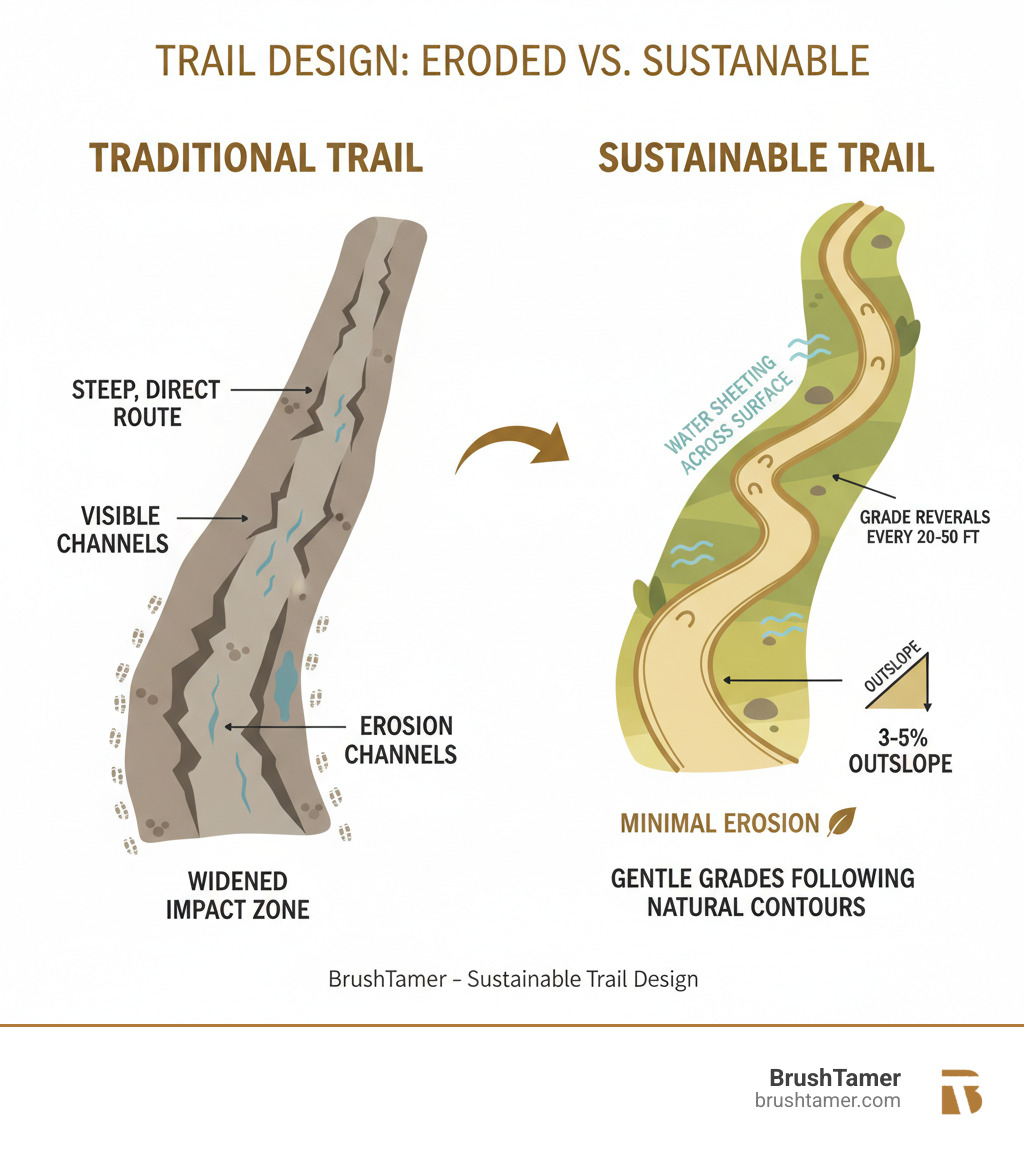
Sustainably designed trails are fundamentally different. They are aligned to live with the land rather than fight it, with geometry that sheds water across the tread instead of down it, and with grades that respect both the slope of the hillsides and the needs of the intended users. The result is a durable corridor that blends into the setting, protects watershed function, supports wildlife habitat, and provides safer, more enjoyable access for hikers, bikers, runners, equestrians, and adaptive users.
This standard is now the expectation for responsible public and private land stewards. Granting agencies, resource managers, insurers, and communities increasingly require engineered alignments, environmental compliance, and life-cycle maintenance planning. Sustainable design delivers these outcomes without trading away the immersive experiences people seek in natural places.
BrushTamer provides the professional site preparation and vegetation management that set sustainable trail projects up for success. From the first field walk to final corridor clearing, BrushTamer prepares the right footprint—precise, environmentally responsible, and ready for construction—to ensure the design performs as intended. That level of preparation is the difference between a corridor that functions on day one and one that fails at the first heavy rain.
A modern trail system is community infrastructure. It supports public health, local economies, outdoor education, and climate resilience while concentrating recreation impacts on a designed, durable corridor. The premise is straightforward: invest in alignment, drainage, and materials at the outset, and the trail will reliably serve users and protect natural resources for decades with a measured maintenance budget. BrushTamer’s role is to make that investment work by delivering the professional preparation every build requires—cleared to spec, staged for efficient construction, and executed with environmental safeguards in place.
The Core Principles of Sustainable Trail Design

The governing principle of sustainable trail design is water management. Every design choice—from micro-alignment to surfacing—functions to keep water off the tread and disperse it onto stable ground where it can infiltrate. When water is allowed to run down a trail, the tread becomes a channel; when water is guided across the tread and back to the hillslope, the corridor remains intact.
That principle translates into a series of deliberate professional decisions:
- Site suitability: Trails belong on durable terrain. Slopes with stable soils, good canopy cover, and established root matrices provide natural reinforcement and shade that preserves moisture balance in the tread.
- Alignment on contour: Routing along the land’s contour produces a tread that gently meanders, avoiding the energy of concentrated flow. This creates the foundation for stable grades, sound drainage, and an intuitive user experience.
- Predictable control points: Scenic overlooks, water crossings, and property boundaries anchor the route, while culturally sensitive sites and wetlands are avoided. Control points are identified during analysis and used to lock in decisions that protect resources and manage risk.
Sustainable trail design is not a single specification; it is a balanced framework that integrates environmental stewardship, user safety, and long-term economics:
- Environmental: Concentrate use on a resilient corridor, keep sediment out of waterways, and avoid fragmenting habitat. Shade retention, root preservation, and carefully placed drainage features are critical to watershed health.
- Social: Provide consistent surfaces, clear sightlines, and predictable grades. Reduce conflict potential on multi-use alignments by designing for speed control, passing zones, and intuitive wayfinding.
- Economic: Reduce maintenance exposure through geometry and materials that endure seasonal cycles and heavy use. Budget predictably and allocate resources to proactive care rather than emergency repairs.
BrushTamer operationalizes these principles from the first day on site. The team maps constraints and opportunities, verifies soils and vegetation conditions, and clears corridors with a level of precision that protects desirable trees and understory while creating the exact footprint needed for construction crews to implement the design. Clients gain a dependable partner who aligns field execution with the intent of the design team.
More on our environmentally-friendly approach
Read the Sustainable Trail Development Guidelines
Key Technical Elements for Building a Lasting Trail
Building a durable trail demands disciplined fieldwork, clear specifications, and coordinated execution. BrushTamer supports this process with expert site preparation, erosion control, and vegetation management that pave the way for efficient construction and long-term performance.
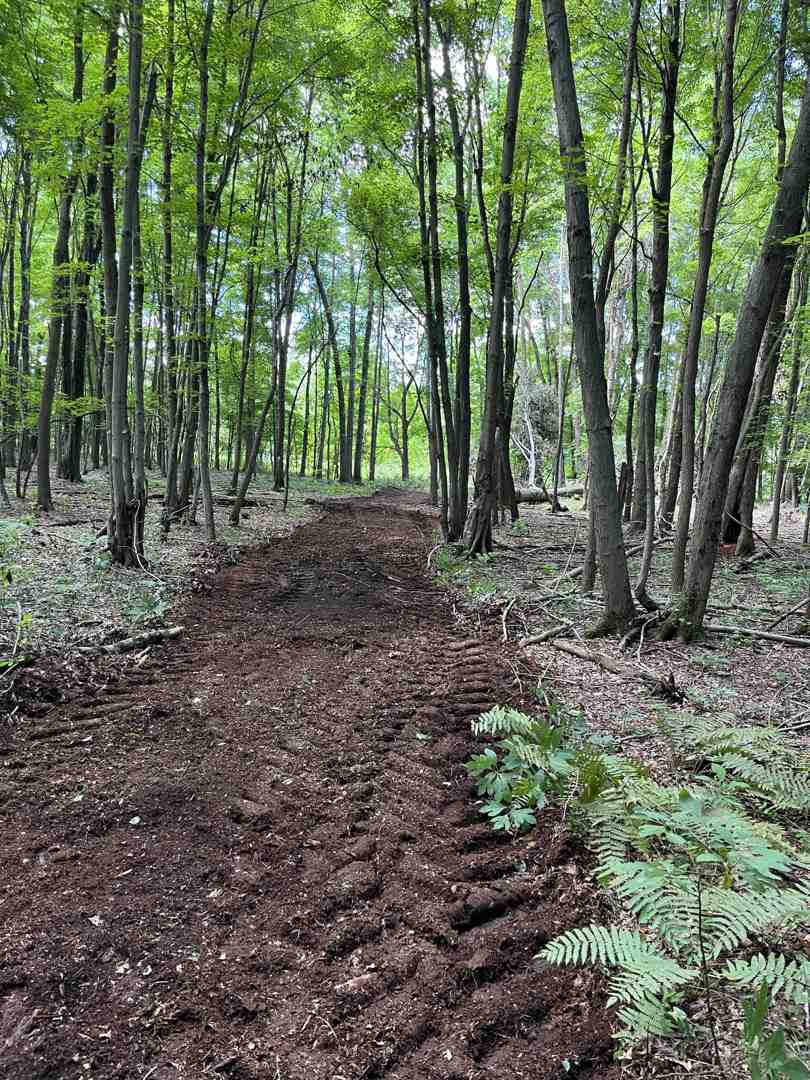
Technical fundamentals professionals employ include:
Site and soil analysis
- Soil texture and structure: A blend of angular mineral soil and fractured rock creates a compactable tread with interlocking particles. Excessive clay retains water; excessive sand lacks cohesion. The target is a well-graded aggregate of native materials wherever feasible.
- Drainage patterns: Field-verified micro-drainages, seep zones, and perched water must be mapped so alignments avoid becoming flow paths. Seasonal hydrology checks confirm assumptions beyond desktop models.
- Vegetation and root zones: Protecting established root networks and canopy shade improves tread longevity by moderating moisture and temperature swings.
Geometric design
- The Half Rule: The trail grade should remain less than half the grade of the sideslope. This fundamental ratio ensures that gravity will pull water across the trail tread rather than allowing it to gain momentum by flowing down the trail’s length.
- Average grade: A 10% average or less supports tread stability and a broad range of users, with short, steeper pitches (often called ‘pitching grade’) reserved only where the terrain and soil allow and drainage can be verified.
- Outslope and surface crown: A 3–5% cross-slope, or outslope, is the primary mechanism for moving water off the tread uniformly in a process called ‘sheet flow.’ In select contexts, a gentle crown is used on wider multi-use routes to shed water to both sides.
- Grade reversals: Often called rolling grade dips or ‘knicks,’ these are subtle undulations placed at appropriate intervals to create repeating high and low points that interrupt potential flow and force water off the trail. Spacing is defined by terrain, soil, and design speed, but they are essential for creating a ‘rolling contour’ trail that actively manages water.
Tread and structure selection
- Bench construction: Full bench cutting into native hillslope soils provides the most stable platform, avoiding placed fill that may settle or slough over time. Where full bench is not feasible, engineered solutions and strict compaction standards are required to build up a durable tread base.
- Surfacing: Crushed stone, compacted mineral soils, and native rock are selected based on traffic loads, soil types, and moisture regimes. The ideal surfacing material, often a crushed aggregate mix, provides both structural support and permeability. Geotextiles or geocells may be specified where soils warrant added separation or confinement, preventing the surfacing material from mixing with unstable subsoils.
- Crossings: Appropriately sized culverts, armored for inlet and outlet protection, and rock-armored fords are selected based on drainage area and recurrence interval. Boardwalks, causeways, and bridges are used to protect sensitive wetlands and riparian areas, completely spanning the resource to avoid impact.
- Retaining and armoring: Dry-laid rock walls, stone pitching, and cribbing stabilize edges and steep approaches, particularly in wet or highly trafficked segments.
Construction sequencing and protection
- Access and staging: Defined access routes and staging pads minimize disturbance, reduce compaction in undesired areas, and streamline material handling.
- Erosion and sediment controls: Silt fences, construction entrances, check structures, and prompt stabilization protect adjacent resources during active work.
- Revegetation: Native seed and mulch, live staking in riparian areas, and strategic woody debris placement accelerate recovery of disturbed soils.
BrushTamer’s preparation work ensures these specifications are achievable in the field. The team clears the corridor to the precise design width, protects retained vegetation, manages slash to support stabilization, installs temporary erosion controls, and coordinates with trail builders so construction proceeds efficiently with minimal environmental risk.
Learn about responsible land management
From Concept to Reality: Implementing and Maintaining Your Trail System
Bringing a sustainable trail from vision to reality requires coordinated expertise at every stage—planning, environmental review, corridor preparation, construction, and long-term care. BrushTamer provides the professional site work that allows each phase to proceed on schedule and in compliance.

Our comprehensive vegetation management solutions
Professional delivery roadmap
- Feasibility and planning: Define desired user groups, experience goals, and management capacity. Establish success criteria for durability, maintenance levels, and environmental outcomes.
- Site assessment: Field-verify terrain, soils, hydrology, vegetation, property boundaries, and constraints. Identify control points and sensitive resources to guide alignment.
- Concept alignment and flagging: Translate planning goals into an on-the-ground route, carefully flagged to represent centerline, corridor width, and structure locations.
- Environmental review and permitting: Complete required resource surveys, erosion and sediment control plans, and authorizations. Compliance protects resources and reduces liability.
- Corridor preparation: BrushTamer clears to the specified width, retains desired canopy, manages slash for stabilization, and sets up access and staging areas to minimize disturbance.
- Construction and QA/QC: Builders shape the tread, install drainage features and structures, place surfacing, and stabilize margins. Quality checks confirm specifications are met.
- Commissioning: Final walkthrough, punch list completion, and documentation of as-built conditions form the baseline for maintenance.
Operational maintenance
- Inspections: Scheduled inspections following storm events and season transitions identify minor issues early and keep performance on track.
- Drainage upkeep: Clearing outlets, refreshing dips, and addressing isolated depressions prevent small concerns from escalating.
- Vegetation management: Targeted pruning and selective removals maintain sightlines and clearance while preserving canopy health and shade.
- Surface management: In high-use areas, periodic touch-ups and spot hardening maintain consistency and prolong service life.
Common challenges and BrushTamer’s solutions
- Difficult terrain: Steep or wet landscapes call for precise clearing, staging, and access solutions. BrushTamer configures corridors and work pads to facilitate safe, efficient installation of armoring, retaining, and elevated structures.
- Multi-user design: Managing design speed and sightlines reduces conflict. BrushTamer’s preparation supports properly scaled tread widths, passing zones, and wayfinding installations.
- Legacy trail rehabilitation: Reroutes and decommissioning of erosive alignments require careful planning and restoration. BrushTamer prepares new corridors to modern standards and assists with stabilization of retired segments to accelerate recovery.
- Budget stewardship: Phased delivery is often strategic. BrushTamer executes corridor preparation in stages that align with funding tranches, ensuring each completed segment functions independently while supporting future connections.
Conclusion
Sustainable trail design is the modern standard for responsible recreation infrastructure. When the alignment, geometry, and materials are engineered to work with the land—and the corridor is professionally prepared—the result is a durable asset that protects natural resources, elevates user experience, and reduces long-term costs.
BrushTamer delivers the preparation that makes sustainable design perform: precise corridor clearing, environmentally responsible vegetation management, and erosion control that safeguards resources and construction schedules. Landowners and agencies gain a dependable partner from early field assessments through final stabilization and long-term vegetation care.
Engage a team that treats your trail system like the essential community infrastructure it is. BrushTamer is ready to prepare your land the right way so your trail performs from day one and for decades to come.
Contact us to prepare your land for a sustainable trail system today!